



IAP
IAP (Inhibitor of apoptosis) proteins, a family of anti-apoptotic proteins, have an important role in evasion of apoptosis, as they can both block apoptosis-signaling pathways and promote survival. Eight members of this family have been described in humans (BIRC1/NAIP, BIRC2/cIAP1, BIRC3/cIAP2, BIRC4/XIAP, BIRC5/Survivin, BIRC6/Apollon, BIRC7/ML-IAP and BIRC8/ILP2).
IAP genes encode proteins that directly bind and inhibit caspases, and thus play a critical role in deciding cell fate. The IAPs are in turn regulated by endogenous proteins (second mitochondrial activator of caspases and Omi) that are released from the mitochondria during apoptosis. IAP protein family members are frequently overexpressed in cancer and contribute to tumor cell survival, chemo-resistance, disease progression, and poor prognosis. Targeting critical apoptosis regulators, like IAPs, is an attractive therapeutic way undertaken for the development of new classes of therapies for cancer.
Although best known for their ability to regulate caspases, IAPs also influence ubiquitin (Ub)-dependent pathways that modulate innate immune signaling via activation of NF-κB. Several members of the IAP family regulate innate and adaptive immunity through modulation of signal transduction pathways, cytokine production, and cell survival. The regulation of immunity by the IAPs is primarily mediated through the ubiquitin ligase function of cIAP1, cIAP2, and XIAP, the targets of which impact NF-κB and MAPK signalling pathways.
IAP Isoform Specific Products
All Product Categories
-
IAP Inhibitors
(46)
View all products
-
IAP Antagonists
(29)
View all products
-
IAP Activators
(3)
View all products
-
IAP Modulator
(1)
View all products
-
IAP Inducer
(1)
View all products
-
IAP Degraders
(12)
View all products
-
IAP Control
(1)
View all products
-
IAP Ligands
(10)
View all products
-
X-Linked Inhibitor Of Apoptosis (XIAP) Proteins
(3)
View all products
-
IAP Related Products (109)
Related Products (109)

-
Recombinant Proteins (3)
-
Antibodies (2)
-
IAP Isoform Comparison
-
Sanggenon G
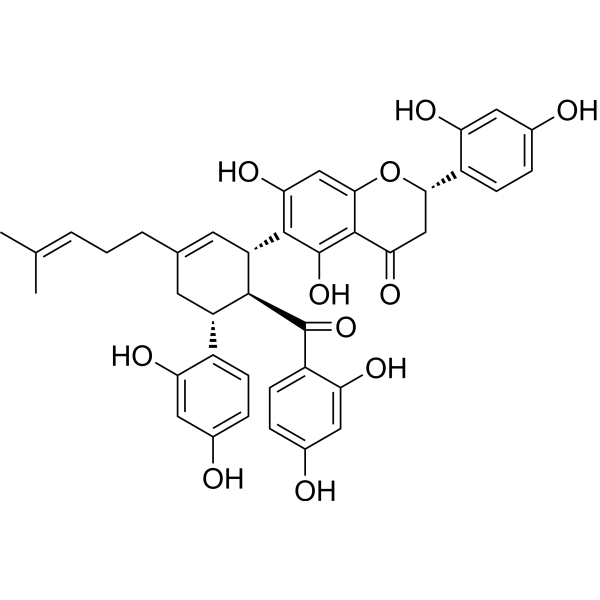 0 ImagesCat. No.: HY-12372CAS No.: 85698-31-3Sanggenon G is a cell-permeable and potent inhibitor of X-linked inhibitor of apoptosis protein (XIAP). Sanggenon G binds specifically to the BIR3 domain of XIAP with a binding affinity of 34.26 μM. Sanggenon G enhances caspase activation.
-
SM-433 hydrochloride
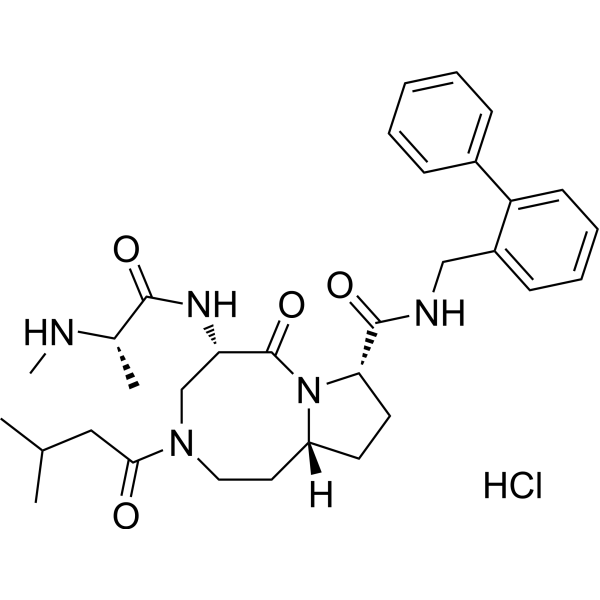 0 ImagesCat. No.: HY-138059APurity: 98.55%
-
Anticancer agent 294
 0 ImagesCat. No.: HY-160601CAS No.: 1258392-56-1Anticancer agent 294 (Example 2) is an anticancer agent that has inhibitory activity against apoptosis inhibitor protein 1 (cIAP1) with an IC50 of 15 nM.
-
Anticancer agent 128
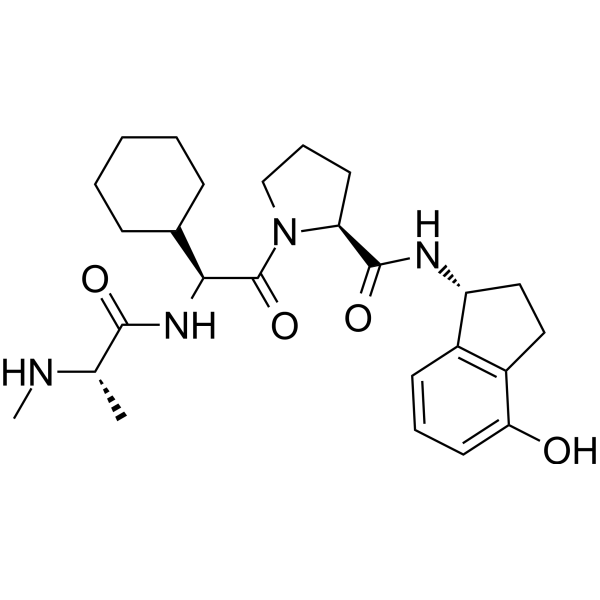 0 ImagesCat. No.: HY-155019CAS No.: 2941243-62-3Anticancer agent 128 (compound 1) is an IAP inhibitor that covalently targets the BIR3 domains of XIAP, cIAP1, and cIAP2. Anticancer agent 128 targets the BIR3 domains of XIAP, cIAP1, and cIAP2 with IC50s of 24.9 nM, 19.3 nM, and 10.3 nM, respectively.
-
CDK9-IN-45
 0 ImagesCat. No.: HY-179023CDK9-IN-45 (Compound B11) is a highly selective CDK9 inhibitor with IC50 values for CDK9 and CDK1 of 7.13 and 489.5 nM respectively. CDK9-IN-45 exhibits a potent inhibitory effect on colorectal cancer cells. CDK9-IN-45 induces cell apoptosis and leads to significant accumulation of ROS. CDK9-IN-45 activates Caspase-3, downregulates Mcl-1, XIAP, and c-Myc. CDK9-IN-45 can be used for research on colorectal cancer.

-
HM90822
 0 ImagesCat. No.: HY-12440CAS No.: 1363145-46-3HM90822 is an orally active IAP antagonist. HM90822 induces ubiquitination and proteasome-dependent degradation of XIAP, cIAP1 and cIAP2 in sensitive pancreatic cancer cells. HM90822 induces Apoptotic cell death. HM90822 inhibits tumor growth in Panc-1 pancreatic cancer xenograft and orthotopic mouse models. HM90822 can be used for the research of pancreatic cancer.
-
ZLMT-72
 0 ImagesCat. No.: HY-179633ZLMT-72 is an orally active dual CDK2 and CDK9 inhibitor with IC50s of 0.741 nM and 1.03 nM, respectively. ZLMT-72 shows good selectivity in kinase profiling andcholinesterase inhibition activity. ZLMT-72 has strong antiproliferative effects in the colorectal cancer (CRC) cell line HCT116 (GI50 < 0.1 nM). ZLMT-72 induces apoptosis by inhibiting thephosphorylation of retinoblastoma and RNA polymerase II, resulting in downregulation of antiapoptotic proteins (Mcl-1 and XIAP). ZLMT-72 can be used for the study of colorectal cancer (CRC).
-
BP-198
 0 ImagesCat. No.: HY-176440BP-198 is a inhibitor and a SNIPER-class degrader targeting to SARS-CoV-2 main protease (Mpro) , with antiviral activity. BP-198 recruits the IAP ubiquitin ligase complex to degrade target proteins via the ubiquitin-proteasome system. BP-198 also degrades protease mutants resistant to Nirmatrelvir (HY-138687). BP-198 can be used in studies related to COVID-19.

-
Anticancer agent 127
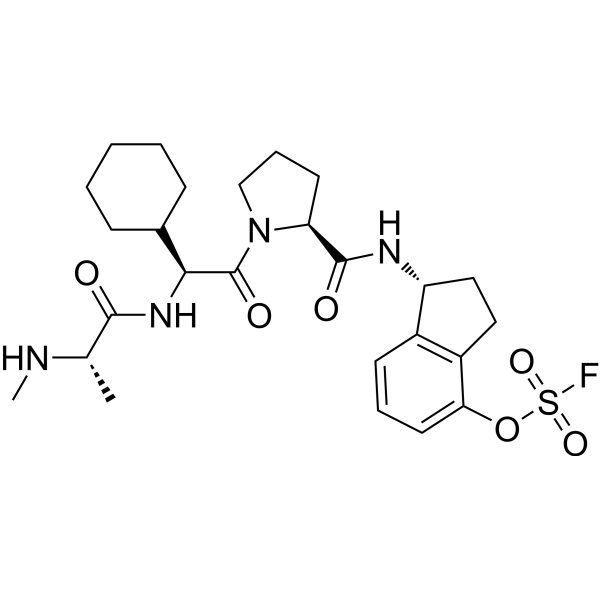 0 ImagesCat. No.: HY-155018CAS No.: 2410953-19-2Anticancer agent 127 (142D6) is an IAP inhibitor that covalently targets the BIR3 domains of XIAP, cIAP1, and cIAP2. Anticancer agent 127 targets the BIR3 domains of XIAP, cIAP1, and cIAP2 with IC50s of 12 nM, 14 nM, and 9 nM, respectively. Anticancer agent 127 has anticancer effects.
-
PROTAC TEAD1/IAP degrader-1
 0 ImagesCat. No.: HY-181534PROTAC TEAD1/IAP degrader-1 (Compound A232) is a selective TEAD1 and cIAP1 PROTAC degrader, with DC50 values of 14 nM and 270 nM, respectively. PROTAC TEAD1/IAP degrader-1 promotes the ubiquitination and degradation of TEAD1 and cIAP1. PROTAC TEAD1/IAP degrader-1 downregulates the expression of the TEAD-dependent gene CTGF. PROTAC TEAD1/IAP degrader-1 exhibits anticancer activity against mesothelioma.

-
Topo I/DDX5-IN-1
 0 ImagesCat. No.: HY-181018CAS No.: 3040940-61-9Topo I/DDX5-IN-1 (Compound A10) is a Topo I and DDX5 inhibitor. Topo I/DDX5-IN-1 inhibits Topo I activity, binds to DDX5, and suppresses DDX5 function. Topo I/DDX5-IN-1 increases expression of γ-H2AX and p21, suppresses the expression of antiapoptotic proteins (Bcl-2 and XIAP), stimulates ROS generation, and triggers Apoptosis. Topo I/DDX5-IN-1 exhibits anticancer activity against pancreatic cancer, non-small cell lung cancer, skin cancer, and colorectal cancer.

-
GNE-5472
 0 ImagesCat. No.: HY-175445CAS No.: 2417369-99-2GNE-5472 is a potent bifunctional ERα PRRTAC degrader, with its E3 ligand being a pan-IAP antagonist. GNE-5472 antagonizes cIAP1/2, activating the non-classical NF-κB pathway, resulting in a significant upregulation of TNFα expression. GNE-5472 inhibits the proliferation of breast cancer cells and induces cell apoptosis. GNE-5472 can be used for the study of breast cancer.
-
MX107
 0 ImagesCat. No.: HY-123870CAS No.: 2170102-50-6MX107 is a selective and potent survivin inhibitor that suppresses triple-negative breast cancer (TNBC) cell proliferation. MX107 induces degradation of survivin and inhibitor-of-apoptosis proteins (IAPs), which inhibits nuclear factor κB (NF-κB) activation induced by DNA damage. MX107 enhances tumoricidal efficacy of genotoxic treatments synergized with chemotherapeutic drugs.
-
LBW242
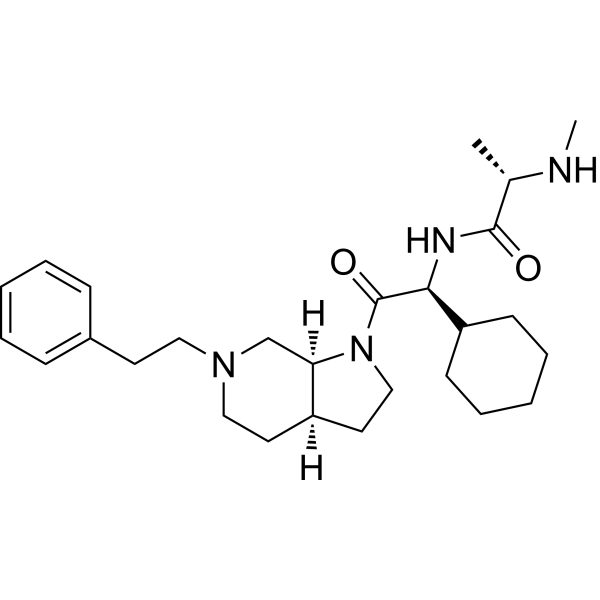 0 ImagesCat. No.: HY-15519CAS No.: 867324-12-7LBW242, a 3-mer and Smac mimetic, is a potent and orally active proapoptotic IAP inhibitor. LBW242 shows effects on mutant FLT3-expressing cells. LBW242 has activity against multiple myeloma, and potentiates TRAIL- and anticancer agent-mediated cell death of ovarian cancer cells.

-
N4Py
 0 ImagesCat. No.: HY-120420CAS No.: 167695-87-6N4Py is a bleomycin-mimetic pentadentate ligand that targets intracellular FeII and reversibly chelates a variety of transition metals. N4Py chelates induce apoptosis through two pathways: DNA cleavage via ROS generation and XIAP downregulation via ZnII chelation, with only FeII/FeIII-N4Py exhibiting potent DNA cleavage activity. The folate conjugate of N4Py targets folate receptors, can be intracellularly cleaved, and selectively kills FR-positive cancer cells. N4Py can be used in research on various cancers including nasopharyngeal epidermoid carcinoma, ovarian cancer, and mammary adenocarcinoma.




