



IAP
IAP (Inhibitor of apoptosis) proteins, a family of anti-apoptotic proteins, have an important role in evasion of apoptosis, as they can both block apoptosis-signaling pathways and promote survival. Eight members of this family have been described in humans (BIRC1/NAIP, BIRC2/cIAP1, BIRC3/cIAP2, BIRC4/XIAP, BIRC5/Survivin, BIRC6/Apollon, BIRC7/ML-IAP and BIRC8/ILP2).
IAP genes encode proteins that directly bind and inhibit caspases, and thus play a critical role in deciding cell fate. The IAPs are in turn regulated by endogenous proteins (second mitochondrial activator of caspases and Omi) that are released from the mitochondria during apoptosis. IAP protein family members are frequently overexpressed in cancer and contribute to tumor cell survival, chemo-resistance, disease progression, and poor prognosis. Targeting critical apoptosis regulators, like IAPs, is an attractive therapeutic way undertaken for the development of new classes of therapies for cancer.
Although best known for their ability to regulate caspases, IAPs also influence ubiquitin (Ub)-dependent pathways that modulate innate immune signaling via activation of NF-κB. Several members of the IAP family regulate innate and adaptive immunity through modulation of signal transduction pathways, cytokine production, and cell survival. The regulation of immunity by the IAPs is primarily mediated through the ubiquitin ligase function of cIAP1, cIAP2, and XIAP, the targets of which impact NF-κB and MAPK signalling pathways.
IAP Isoform Specific Products
All Product Categories
-
IAP Inhibitors
(46)
View all products
-
IAP Antagonists
(29)
View all products
-
IAP Activators
(3)
View all products
-
IAP Modulator
(1)
View all products
-
IAP Inducer
(1)
View all products
-
IAP Degraders
(12)
View all products
-
IAP Control
(1)
View all products
-
IAP Ligands
(10)
View all products
-
X-Linked Inhibitor Of Apoptosis (XIAP) Proteins
(3)
View all products
-
IAP Related Products (109)
Related Products (109)

-
Recombinant Proteins (3)
-
Antibodies (2)
-
IAP Isoform Comparison

-
MRS2693
 0 ImagesCat. No.: HY-117356CAS No.: 93906-48-0MRS2693 is a selective P2Y6 receptor agonist. MRS2693 exerts biological effects by activating the Gq-coupled P2Y6 receptor, the ERK1/2 pathway, and the P2RY6-PLCB3-CAMKK2-PRKAA1-ULK1 signaling cascade. MRS2693 attenuates TNFα-induced NF-κB activation, stabilizes XIAP via AKT-mediated phosphorylation, induces autophagy, and reactivates PRKAA1. MRS2693 can be used in research on diseases including skeletal muscle ischemia/reperfusion injury, TNFα-induced skeletal muscle apoptosis, chronic myelomonocytic leukemia, colorectal cancer, and dry eye disease.
-
Apoptosis inducer 61
 0 ImagesCat. No.: HY-182002Apoptosis inducer 61 (Compound 4E) is an Apoptosis inducer. Apoptosis inducer 61 significantly downregulates the expression of BIRC3 and activates Apoptosis. Anticancer agent 313 exhibits anticancer activity against ER+ breast cancer cells, triple-negative breast cancer cells, and gastric cancer cells.
-
XIAP antagonist 1
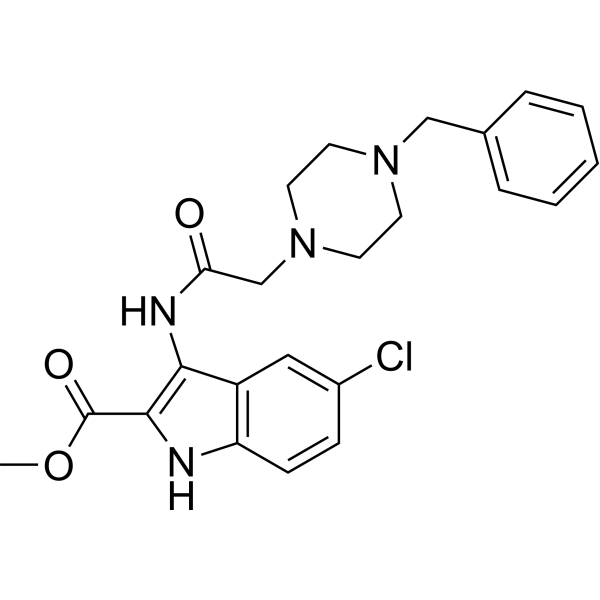 0 ImagesCat. No.: HY-157230CAS No.: 375835-04-4XIAP antagonist 1 degrades rather than inhibits XIAP, catalyzing rapid degradation of XIAP through the ubiquitin-proteasome pathway[2].
-
CSLP43
 0 ImagesCat. No.: HY-123925CAS No.: 2244988-80-3CSLP43 is a selective RIPK2 and XIAP inhibitor with an IC50 of 19.9 nM against human RIPK2. CSLP43 binds to the ATP-binding pocket of RIPK2 and disrupts the interaction between RIPK2 and the BIR2 domain of XIAP or cIAP1. CSLP43 inhibits RIPK2 ubiquitination, NOD1-dependent inflammatory signaling pathways, NOD2-dependent inflammatory signaling pathways, as well as NF-κB activation associated with NOD agonists. CSLP43 is selective for the NOD1/NOD2 signaling pathway and does not inhibit the kinase activity of RIPK1 or RIPK3. CSLP43 is applicable to research related to Crohn's disease, Blau syndrome, early-onset sarcoidosis and early-onset inflammatory bowel disease.
-
(2''S)-2'',3''-Dihydrodelicaflavone
 0 ImagesCat. No.: HY-N18315CAS No.: 3035699-17-0(2''S)-2'',3''-Dihydrodelicaflavone is a biflavonoid compound present in the whole herb of Selaginella doederleinii, which exhibits antiproliferative and apoptosis-inducing activities against non-small cell lung cancer cells. (2''S)-2'',3''-Dihydrodelicaflavone can be used in the research of non-small cell lung cancer.
-
FL113
 0 ImagesCat. No.: HY-187844CAS No.: 104155-89-7
-
IAP ligand 9
 0 ImagesCat. No.: HY-181533IAP ligand 9 is an ASX-series, non-peptidic SMAC mimetic and IAP binder with high cell permeability. IAP ligand 9 selectively targets cIAP1-BIR3, XIAP-BIR3, exhibits extremely weak binding affinity for XIAP-BIR2, with a KD of 100 nM for cIAP1-BIR3 and 10 nM for XIAP-BIR2. IAP ligand 9 can be used to synthesize IAP-recruiting protein degraders (IPD), and can calibrate the cell permeability and cellular-level target binding assays of the IPD molecule SNIPER (TEAD)-1 (HY-181607). IAP ligand 9 and its series of degraders can be used in the research of solid tumors such as malignant pleural mesothelioma associated with abnormal activation of the Hippo pathway.
-
PROTAC GPX4 degrader-2
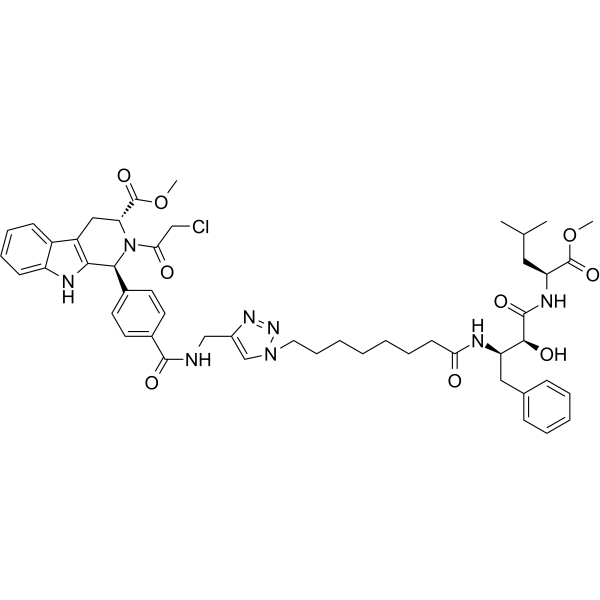 0 ImagesCat. No.: HY-162106CAS No.: 3035509-76-0PROTAC GPX4 degrader-2 is a cIAP-recruiting GPX4 PROTAC degrader with a DC50 of 1.68 μM. PROTAC GPX4 degrader-2 forms a ternary complex with GPX4 and cIAP, and induces GPX4 degradation via the ubiquitin-proteasome system pathway. PROTAC GPX4 degrader-2 induces Mitochondrial depolarization and Ferroptosis. PROTAC GPX4 degrader-2 exhibits antiproliferative effects in cancer cells. PROTAC GPX4 degrader-2 can be used for the research of fibrosarcoma.

-
XIAP ligand 5
 0 ImagesCat. No.: HY-175449XIAP ligand 5 is a XIAP antagonist. XIAP ligand 5 is an E3 ligase ligand. XIAP ligand 5 can be used for synthesis of PROTAC GNE-1567 (HY-175448).
-
IAP ligand 8
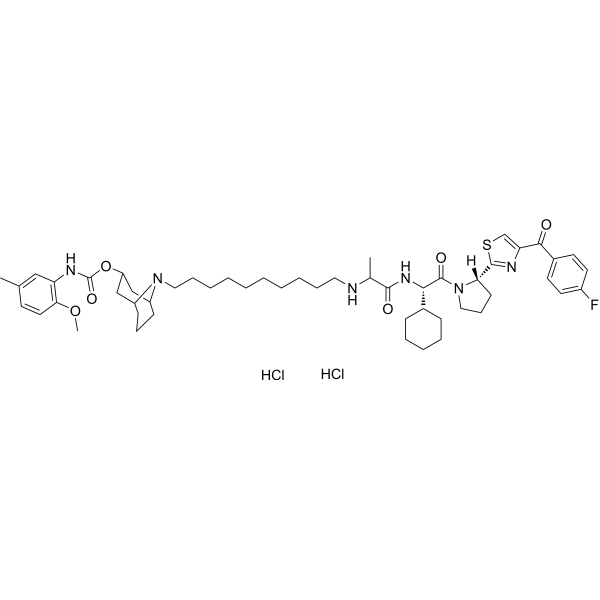
 0 ImagesCat. No.: HY-181532IAP ligand 8 is an ASX-series, non-peptidic SMAC mimetic and IAP binder with high cell permeability. IAP ligand 8 selectively targets cIAP1-BIR3, XIAP-BIR2 (with a KD of 15.8 nM for both). IAP ligand 8 serves as an IAP ligand moiety to synthesize IAP-recruiting protein degrader (IPD) (HY-181590). This IPD simultaneously forms two ternary complexes, cIAP1-A538-TEAD1 and XIAP-A538-TEAD1, and efficiently degrades TEAD1 via a dual E3 recruitment mechanism, while inducing the autodegradation of cIAP1. IAP ligand 8 and its series of degraders are applicable to targeted research on Hippo pathway-dysregulated cancers such as NF2-mutant mesothelioma.
-
GNE-1567
 0 ImagesCat. No.: HY-175448GNE-1567 is a potent ERα PROTAC degrader and a XIAP antagonist with a Kd of 0.03 μM. GNE-1567 induces ubiquitination and degradation of ERα by recruiting the E3 ubiquitin ligase XIAP, thereby achieving the dual effects of ERα protein elimination and abrogation of XIAP-mediated apoptosis inhibition simultaneously. GNE-1567 can be used in studies related to ERα-dependent breast cancer.
-
Anisomelic acid
 0 ImagesCat. No.: HY-N20712CAS No.: 59632-76-7Anisomelic acid is a human papillomavirus HPV16 E6 and HPV E7 depletor. Anisomelic acid directly interacts with HPV16 E6, promotes its ubiquitination and proteasomal degradation by recruiting E3 ubiquitin ligase, downregulates E6 and facilitates E7 degradation. Anisomelic acid induces endogenous mitochondrial apoptosis, activates caspase-3, causes cleavage of PARP, and triggers p53-independent endogenous apoptosis by depleting cIAP2. Anisomelic acid can be used in research related to HPV-positive cancers and cervical cancer.
-
T-3256336
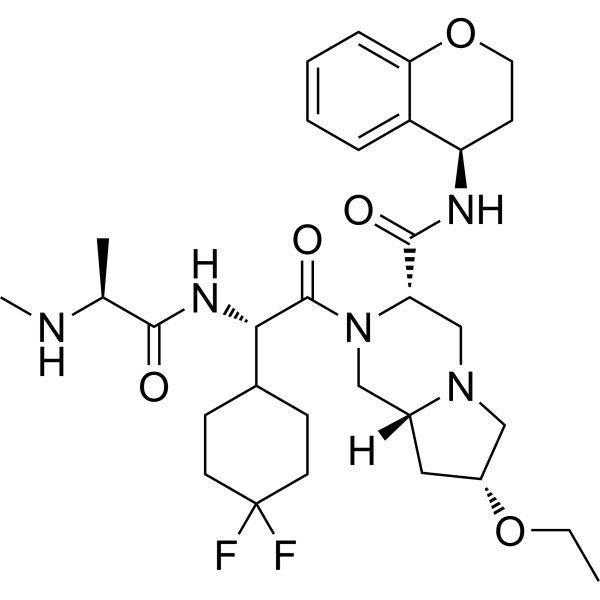 0 ImagesCat. No.: HY-100682CAS No.: 1266227-69-3
-
Jolkinolide B (Standard)
 0 ImagesCat. No.: HY-N0732RCAS No.: 37905-08-1Jolkinolide B (Standard) is the analytical standard of Jolkinolide B (HY-N0732). This product is intended for research and analytical applications. Jolkinolide B is a bioactive diterpene isolated from the roots of Euphorbia fischeriana Steud with oral activity. Jolkinolide B downregulates XIAP, cIAP1, cIAP2, and phosphorylated Akt, upregulates Smac, activates caspase-3 and caspase-9, and inhibits NF-κB, TGFβ/smad3 and JAK/STAT3 pathways. Jolkinolide B exerts comprehensive biological effects including inducing cancer cell apoptosis, suppressing inflammatory responses, improving lung function, alleviating hepatic steatosis and eliminating intracellular Mycobacterium tuberculosis. Jolkinolide B can be used for the research of leukemia, histiocytic lymphoma, asthma, metabolic dysfunction-associated steatotic liver disease and tuberculosis.

-
AEG40826
 0 ImagesCat. No.: HY-120434CAS No.: 949963-04-6Synonyms: HGS1029
-
PROTAC TEAD1/IAP degrader-2
 0 ImagesCat. No.: HY-181537PROTAC TEAD1/IAP degrader-2 is an IAP-harnessing TEAD1 PROTAC degrader, with a DC50 of 170 nM against TEAD1 in NCI-H2052 cells. PROTAC TEAD1/IAP degrader-2 exhibits moderate antiproliferative activity in Hippo pathway-dependent mesothelioma cells. PROTAC TEAD1/IAP degrader-2 inhibits the expression of CTGF, but with a weaker effect than the TEAD inhibitor VT-107 (HY-134957). PROTAC TEAD1/IAP degrader-2 can be used in mesothelioma-related research.




