



Ras
Ras is the name given to a family of related proteins which is ubiquitously expressed in all cell lineages and organs. All Ras protein family members belong to a class of protein called small GTPase, and are involved in transmitting signals within cells. Ras is the prototypical member of the Ras superfamily of proteins, which are all related in 3D structure and regulate diverse cell behaviours. When Ras is 'switched on' by incoming signals, it subsequently switches on other proteins, which ultimately turn on genes involved in cell growth, differentiation and survival. As a result, mutations in ras genes can lead to the production of permanently activated Ras proteins. This can cause unintended and overactive signalling inside the cell, even in the absence of incoming signals. Because these signals result in cell growth and division, overactive Ras signaling can ultimately lead to cancer. The 3 Ras genes in humans (HRAS,KRAS, and NRAS) are the most common oncogenes in human cancer; Ras inhibitors are being studied as a treatment for cancer, and other diseases with Ras overexpression.
Ras Isoform Specific Products
All Product Categories
-
Ras Related Products (753)
Related Products (753)

-
Antibodies (36)
-
Ras Isoform Comparison
-
Zoldonrasib (Standard)
 0 ImagesCat. No.: HY-156819RCAS No.: 3034802-05-3Synonyms: RMC-9805 (Standard); KRAS G12D inhibitor 18 (Standard)Zoldonrasib (Standard) is the analytical standard of Zoldonrasib (HY-156819). This product is intended for research and analytical applications. Zoldonrasib (RMC-9805) is a potent and orally active KRAS G12D inhibitor.Zoldonrasib induces apoptosis in KRAS G12D mutant cancer cells. Zoldonrasib has the potential for the research of KRAS G12D mutant cancer.
-
8-CPT-cAMP-AM
 0 ImagesCat. No.: HY-134299CAS No.: 663941-66-0Synonyms: 8-(4-Chlorophenylthio)-cAMP-AM8-CPT-cAMP-AM (8-(4-Chlorophenylthio)-cAMP-AM) is an Epac/PKA activator. 8-CPT-cAMP-AM potentiates glucose-dependent first- and second-phase insulin secretion, induces β-cell depolarization, modulates intracellular calcium via influx and ryanodine-sensitive store mobilization, and facilitates calcium-induced calcium release resistant to PKA inhibition. 8-CPT-cAMP-AM can be used for the research of cardiac hypertrophy, diabetic cardiomyopathy, and melanoma.
-
ML141 (Standard)
 0 ImagesCat. No.: HY-12755RCAS No.: 71203-35-5ML141 (Standard) is the analytical standard of ML141 (HY-12755). This product is intended for research and analytical applications. ML141 (CID-2950007) is a potent, allosteric, selective and reversible non-competitive inhibitor of Cdc42 GTPase. ML141 inhibits Cdc42 wild type and Cdc42 Q61L mutant with EC50s of 2.1 and 2.6 μM, respectively. ML141 shows low micromolar potency and selectivity against other members of the Rho family of GTPases (Rac1, Rab2, Rab7). ML141 do not show cytotoxicity in multiple cell lines.
-
8-pHPT-2'-O-Me-cAMP
 0 ImagesCat. No.: HY-134348CAS No.: 612513-15-2Synonyms: 8-(4-Hydroxyphenylthio)-2'-O-Me-cAMP8-pHPT-2'-O-Me-cAMP is a cAMP analog and an Epac agonist. 8-pHPT-2'-O-Me-cAMP can be used in cardiac research.
-
CCG-203971 (Standard)
 0 ImagesCat. No.: HY-108361RCAS No.: 1443437-74-8CCG-203971 (Standard) is the analytical standard of CCG-203971 (HY-108361). This product is intended for research and analytical applications. CCG-203971 is a second-generation Rho/MRTF/SRF pathway inhibitor. CCG-203971 potently targets RhoA/C-activated SRE-luciferase (IC50 =6.4 μM). CCG-203971 inhibits PC-3 cell migration with an IC50 of 4.2 μM. Potential anti-metastasis Agent.
-
Neoantimycin
 0 ImagesCat. No.: HY-121459CAS No.: 22862-63-1Neoantimycin is a GRP78/BiP and K-Ras regulator with anticancer activity. Its biosynthesis is catalyzed by a hybrid nonribosomal peptide synthetase/polyketide synthase (NRPS/PKS) system.
-
SJ-C1044
 0 ImagesSJ-C1044 is an orally available pan-RAF inhibitor with immunomodulatory and anti-tumor activities. SJ-C1044 inhibits wild-type BRAF, wild-type CRAF, and BRAF (V600E) with IC50 values ??of 331, 257, and 187 nM, respectively. SJ-C1044 inhibits tumor cell proliferation by inhibiting kras activation and MEK-ERK phosphorylation. In addition, SJ-C1044 also has a certain inhibitory effect on VEGFR2, TIE2, and CSF1R, with IC50 values ??of 100, 23, and 235 nM, respectively. SJ-C1044 improves the tumor immune microenvironment by inhibiting angiogenesis and regulating macrophage function. SJ-C1044 can be used in the study of colorectal cancer.
-
BI-2865 (Standard)
 0 ImagesCat. No.: HY-153724RCAS No.: 2937327-93-8BI-2865 (Standard) is the analytical standard of BI-2865 (HY-153724). This product is intended for research and analytical applications. BI-2865 is a none-covalent pan-KRAS Inhibitor. BI-2865 binds to WT, G12C, G12D, G12V and G13D mutant KRAS with KDs of 6.9, 4.5, 32, 26, 4.3 nM respectively. BI-2865 inhibits the proliferation of G12C, G12D or G12V mutant KRAS expressing BaF3 cells (mean IC50: roughly 140 nM).
-
NSC 23766 trihydrochloride (Standard)
 0 ImagesNSC 23766 (trihydrochloride) (Standard) is the analytical standard of NSC 23766 (trihydrochloride). This product is intended for research and analytical applications. NSC 23766 trihydrochloride is an inhibitor of Rac1 activation.

-
DCAI hydrochloride
 0 ImagesCat. No.: HY-118692ACAS No.: 1049742-84-8DCAI hydrochloride is a KRas inhibitor with a Kd value of 1.1 mM. DCAI hydrochloride directly binds to the Ras protein and competitively inhibits SOS-mediated nucleotide release (IC50 = 155 μM) and exchange reaction (IC50 = 342 μM). DCAI hydrochloride binds to the pocket at the Ras-SOS interface and blocks the formation of the Ras-SOS complex intermediate by impeding salt bridge formation through steric hindrance and the induction of Ras conformational changes. DCAI hydrochloride is used in the study of wild-type and mutant Ras tumors.
-
2C07
 0 ImagesCat. No.: HY-114894CAS No.: 2230185-95-02C07 is a mutant Ras (K-RasM72C, H-RasM72C) inhibitor. 2C07 blocks the activation of PI3K through allosteric Ras modification. 2C07 binds to the modified switch II pocket (S-IIG) of Ras in both GDP- and GTP-bound states, stabilizes the GDP-bound state, disrupts the polar interactions of the canonical GTP-bound state, and inhibits SOS binding and nucleotide exchange. 2C07 can be used in cancer-related research.
-
EPAC 5376753 (Standard)
 0 ImagesCat. No.: HY-111446RCAS No.: 302826-61-5EPAC 5376753 (Standard) is the analytical standard of EPAC 5376753 (HY-111446). This product is intended for research and analytical applications. EPAC 5376753, a 2-Thiobarbituric acid (HY-77962) derivative, is a selective and allosteric Epac inhibitor. EPAC 5376753 inhibits Epac1 with an IC50 of 4 µM in Swiss 3T3 cells. EPAC 5376753 does not inhibit PKA and adenylyl cyclases.
-
GGTI-297
 0 ImagesCat. No.: HY-120271CAS No.: 181045-83-0GGTI-297 is a geranylgeranyl transferase I (GGTase-1) inhibitor with IC50 values of 56 nM and 203 nM for GGTase-1 and fanesyl transferase (FTase), respectively. GGTI-297 inhibits the processing of the geranylgeranylated protein Rap1A without affecting the farnesylated protein H-Ras.

-
KRAS G12C inhibitor 62
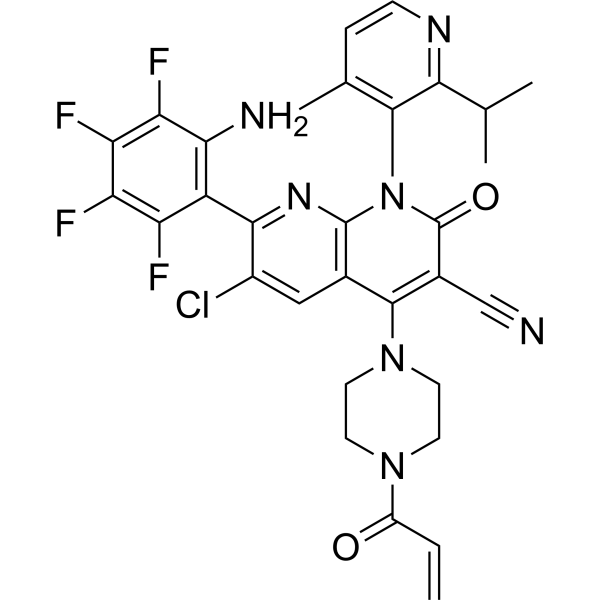 0 ImagesCat. No.: HY-157067CAS No.: 2658588-10-2KRAS G12C inhibitor 62 is a KRAS G12C inhibitor. KRAS G12C inhibitor 62 has the potential for the research of KRAS G12C-mediated cancer (extracted from patent WO2021121367A1).
-
VUBI1 (Standard)
 0 ImagesCat. No.: HY-111671RCAS No.: 2245237-53-8Synonyms: SOS1 activator 1 (Standard)VUBI1 (Standard) is the analytical standard of VUBI1 (HY-111671). This product is intended for research and analytical applications. VUBI1 (SOS1 activator 1) is a benzimidazole derivative and SOS1 activator with a Kd of 44 nM. VUBI1 can significantly activate RAS-GTP and regulate the phosphorylation of ERK. VUBI1 also can serve as a target ligand for synthesizing PROTACs, such as PROTAC SOS1 degrader-1 (HY-145737), to induce SOS1 degradation. VUBI1 can be used in the study of cancer.
-
RasGRP3 ligand 1
 0 ImagesCat. No.: HY-123977CAS No.: 2229068-13-5
-
l-Naproxen (Standard)
 0 ImagesCat. No.: HY-15031RCAS No.: 23979-41-1Synonyms: (R)-Naproxen (Standard)l-Naproxen (Standard) is the analytical standard of l-Naproxen. This product is intended for research and analytical applications.
-
Bragsin2 (Standard)
 0 ImagesCat. No.: HY-111550RCAS No.: 342795-08-8Bragsin2 (Standard) is the analytical standard of Bragsin2 (HY-111550). This product is intended for research and analytical applications. Bragsin2 is a potent, selective and noncompetitive nucleotide exchange factor BRAG2 inhibitor, with an IC50 of 3 μM. Bragsin2 binds at the interface between the PH domain of BRAG2 and the lipid bilayer, leads BRAG2 unable to activate lipidated Arf GTPase. Bragsin2 affects breast cancer stem cells.




