



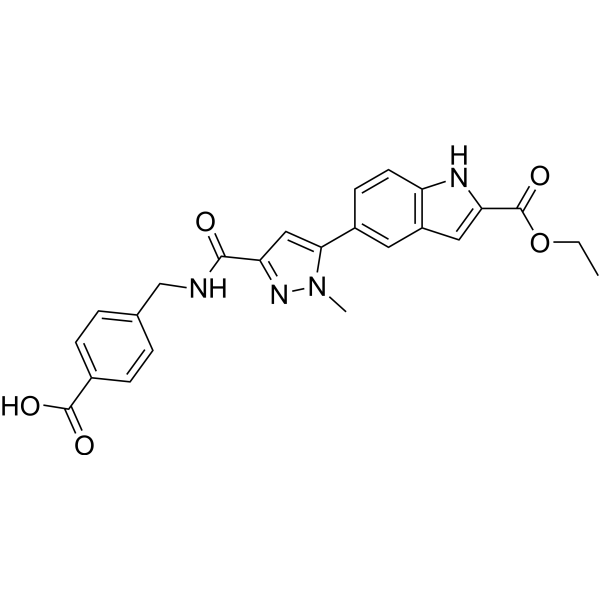
BI-4394

Based on 1 Customer Validation
BI-4394 (MMP13-IN-3), a chemical probe, is a potent, selective, and orally active MMP-13 inhibitor (IC50=1 nM) for the potential treatment of osteoarthritis. BI-4394 is >1000 selective over other MMPs.
Nos produits utilisent uniquement pour la recherche. Nous ne vendons pas aux patients.
The BI-4394 was designed by Boehringer Ingelheim and could be obtained free of charge through the Boehringer Ingelheim open innovation portal opnMe.com, associated with its negative control.
- Pureté : 99.09%
- CAS No.: 1222173-37-6
- Formule: C24H22N4O5
- Masse moléculaire:446.46
-
Stockage:Powder -20°C, 3 years , 4°C, 2 years ; In solvent -80°C, 6 months , -20°C, 1 month

To place orders, for customer services and technical support, please contact: MedChemExpress USA
Tel: 609-228-6898 E-mail: [email protected] [email protected]


-
 Activité biologique
-
Chemical Information
-
Solvant et solubilité
- Protocole
- Pureté et documentation
- Références
-
 Help & FAQs




Activité biologique
Description
IC50 & Target
[1]|
MMP-13 1 nM (IC50) |
MMP-14 8.3 μM (IC50) |
MMP-9 8.9 μM (IC50) |
MMP-10 16 μM (IC50) |
MMP-2 18 μM (IC50) |
In Vitro
BI-4394 (Compound 15) is potent in a full-length MMP-13 collagen degradation assay (11 nM) and is able to inhibit degradation of bovine nasal cartilage with an IC50 of 31 nM. BI-4394 inhibits MMP-2, MMP-9, MMP-10 and MMP-14 with IC50s of 18, 8.9, 16 and 8.3 μM, respectively[1].
MedChemExpress (MCE) has not independently confirmed the accuracy of these methods. They are for reference only. Further protocols information, click here.
In Vivo
MedChemExpress (MCE) has not independently confirmed the accuracy of these methods. They are for reference only.
-
Animal Model:Srapgue Dally Rats[1]
-
Dosage:10 mg/kg (oral gavage); 1 mg/kg (i.v.)
-
Administration:Dosed orally (10 mg/kg); i.v. (1 mg/kg)(Pharmacokinetic Analysis)
-
Result:T1/2=0.47 h for rat (1 mg/kg, i.v.) and rat (10 mg/kg, orally) , respectively.


Chemical Information
-
CAS No. 1222173-37-6
-
Appearance Solid
-
Masse moléculaire 446.46
-
Formule C24H22N4O5
-
Color White to off-white
-
SMILES
O=C(C(N1)=CC2=C1C=CC(C3=CC(C(NCC4=CC=C(C(O)=O)C=C4)=O)=NN3C)=C2)OCC
-
Synonyms
MMP13-IN-3
-
Livraison
Room temperature in continental US; may vary elsewhere.
-
Stockage
Powder -20°C 3 years 4°C 2 years In solvent -80°C 6 months -20°C 1 month


Solvant et solubilité
In Vitro:
DMSO : 100 mg/mL (223.98 mM; ultrasonic and warming and heat to 60°C; Hygroscopic DMSO has a significant impact on the solubility of product, please use newly opened DMSO)
Please refer to the solubility information to select the appropriate solvent. Once prepared, please aliquot and store the solution to prevent product inactivation from repeated freeze-thaw cycles.
Storage method and period of stock solution: -80°C, 6 months; -20°C, 1 month. When stored at -80°C, please use it within 6 months. When stored at -20°C, please use it within 1 month.
Please refer to the solubility information to select the appropriate solvent. Once prepared, please aliquot and store the solution to prevent product inactivation from repeated freeze-thaw cycles.
Storage method and period of stock solution: -80°C, 6 months; -20°C, 1 month. When stored at -80°C, please use it within 6 months. When stored at -20°C, please use it within 1 month.
Concentration (start) × Volume (start) = Concentration (final) × Volume (final)

Protocole
-
Mitochondrial membrane-potential fluorescent assay
Mitochondrial membrane potential fluorescent assays estimate ΔΨm in living cells using lipophilic cationic dyes such as TMRM, TMRE, rhodamine 123, and JC-1, which accumulate in mitochondria according to membrane polarization; loss of signal after FCCP or CCCP treatment is interpreted as mitochondrial depolarization. TMRM/TMRE and rhodamine 123 are commonly used for semi-quantitative live-cell microscopy or flow cytometry, while JC-1 can report a shift from red aggregate fluorescence to green monomer fluorescence during depolarization; interpretation requires controls because dye concentration, quenching mode, cell type, dye efflux, and mitochondrial mass can affect fluorescence independently of ΔΨm.
-
Cell Cytotoxicity Assay
Cytotoxicity assays are usually based on the assessment of cell membrane damage, which can also be indirectly detected by measuring cell viability. Detection methods include MTT assay, CKK-8 assay, LDH assay and ATP assay, etc.
-
Mitochondrial membrane-potential and mitochondrial mass staining
Mitochondrial membrane potential staining measures the electrochemical polarization across the mitochondrial inner membrane in live cells using lipophilic cationic fluorescent probes; early rhodamine-based work showed that selective mitochondrial dye accumulation is lost when the mitochondrial transmembrane potential is dissipated. JC-1 reports mitochondrial polarization by shifting from green monomer fluorescence to red J-aggregate fluorescence as dye concentration increases within energized mitochondria; therefore, the red/green fluorescence ratio is used as a relative readout of mitochondrial membrane potential. TMRE or TMRM staining provides a single-channel relative readout because these cationic rhodamine esters accumulate in polarized mitochondria, and lower fluorescence indicates reduced mitochondrial polarization when acquisition and dye-loading conditions are controlled. Mitochondrial mass staining is commonly performed with MitoTracker Green FM or related MitoTracker dyes as


Pureté et documentation
-
Fiche technique (273 KB)
-
SDS (251 KB)
- English - EN (251 KB)
- Français - FR (251 KB)
- Deutsch - DE (251 KB)
- Norwegian - NO (251 KB)
- Español - ES (251 KB)
- Swedish - SV (251 KB)
- Italian - IT (251 KB)
- Korean - KR (251 KB)
- Portuguese - PT (251 KB)
-
Instruction de manipulation (2659 KB)
Références
[1]. Taylor SJ, et al. Fragment-based discovery of indole inhibitors of matrix metalloproteinase-13. J Med Chem. 2011 Dec 8;54(23):8174-87. [Content Brief]
[2]. Ruminski PG, et al. Discovery of N-(4-Fluoro-3-methoxybenzyl)-6-(2-(((2S,5R)-5-(hydroxymethyl)-1,4-dioxan-2-yl)methyl)-2H-tetrazol-5-yl)-2-methylpyrimidine-4-carboxamide. A Highly Selective and Orally Bioavailable Matrix Metalloproteinase-13 Inhibitor for the Potential Treatment of Osteoarthritis. J Med Chem. 2016 Jan 14;59(1):313-27. [Content Brief]


Complete Stock Solution Preparation Table
Please refer to the solubility information to select the appropriate solvent. Once prepared, please aliquot and store the solution to prevent product inactivation from repeated freeze-thaw cycles.
Storage method and period of stock solution: -80°C, 6 months; -20°C, 1 month. When stored at -80°C, please use it within 6 months. When stored at -20°C, please use it within 1 month.
| Optional Solvent | Concentration Solvent Mass | 1 mg | 5 mg | 10 mg | 25 mg |
|---|---|---|---|---|---|
| DMSO | 1 mM | 2.2398 mL | 11.1992 mL | 22.3984 mL | 55.9961 mL |
| 5 mM | 0.4480 mL | 2.2398 mL | 4.4797 mL | 11.1992 mL | |
| 10 mM | 0.2240 mL | 1.1199 mL | 2.2398 mL | 5.5996 mL | |
| 15 mM | 0.1493 mL | 0.7466 mL | 1.4932 mL | 3.7331 mL | |
| 20 mM | 0.1120 mL | 0.5600 mL | 1.1199 mL | 2.7998 mL | |
| 25 mM | 0.0896 mL | 0.4480 mL | 0.8959 mL | 2.2398 mL | |
| 30 mM | 0.0747 mL | 0.3733 mL | 0.7466 mL | 1.8665 mL | |
| 40 mM | 0.0560 mL | 0.2800 mL | 0.5600 mL | 1.3999 mL | |
| 50 mM | 0.0448 mL | 0.2240 mL | 0.4480 mL | 1.1199 mL | |
| 60 mM | 0.0373 mL | 0.1867 mL | 0.3733 mL | 0.9333 mL | |
| 80 mM | 0.0280 mL | 0.1400 mL | 0.2800 mL | 0.7000 mL | |
| 100 mM | 0.0224 mL | 0.1120 mL | 0.2240 mL | 0.5600 mL |


BI-4394 Related Classifications
HY-124029 Related Classifications
 Powered by Bioz