



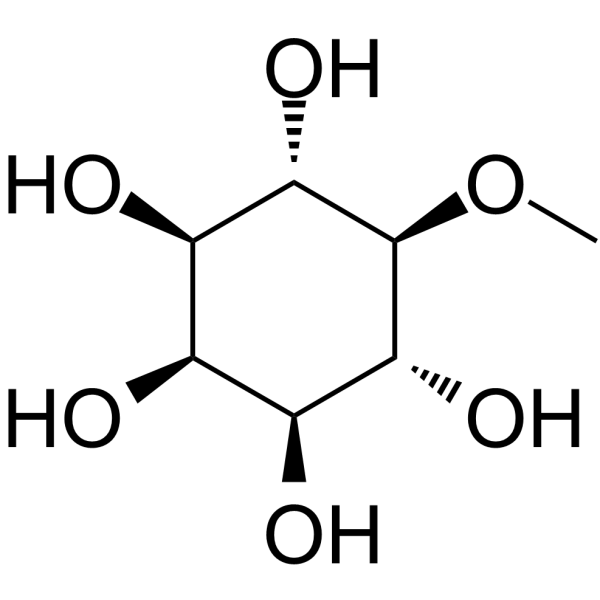
Sequoyitol
Based on 1 publication(s) in Google Scholar
Sequoyitol (5-O-Methyl-myo-inositol) is an orally active hypoglycemic agent and antioxidant. Sequoyitol can be isolated from herbaceous plants. Sequoyitol downregulates the expression of NF-κB and TGF-β1, reduces ROS production and malondialdehyde levels, and enhances total antioxidant capacity. Sequoyitol activates the insulin signaling pathway, including the phosphorylation of IR, IRS1 and Akt. Sequoyitol increases serum insulin levels, inhibits hepatic glucose production, and promotes cellular glucose uptake. Sequoyitol antagonizes TNFα-induced inhibition of the insulin signaling pathway, and decreases blood urea nitrogen and serum creatinine levels. Sequoyitol elicits potential peaks in the chemosensors of adult and larval Atrophaneura alcinous, and acts as an oviposition stimulant for female Atrophaneura alcinous. Sequoyitol can be used in research related to type 2 diabetes, insulin resistance, hyperglycemia, impaired glucose tolerance and diabetic nephropathy.
For research use only. We do not sell to patients.
- Purity : 98.0%
- CAS No.: 523-92-2
- Formula: C7H14O6
- Molecular Weight:194.18
-
Storage:
4°C, protect from light
* In solvent : -80°C, 6 months; -20°C, 1 month (protect from light)

To place orders, for customer services and technical support, please contact: MedChemExpress USA
Tel: 609-228-6898 E-mail: [email protected] [email protected]


-
 Biological Activity
-
Chemical Information
-
Solvent & Solubility
- Protocols
- Purity & Documentation
- References
-
 Help & FAQs


Publications Citing Use of MedChemExpress (MCE) Sequoyitol
MoreAll Parasite Isoforms
More

Biological Activity
Description
In Vitro
Sequoyitol (1-10 μmol·L−1; added 1 hour prior to the addition of high-glucose medium) protects rat mesangial cells from high-glucose-induced loss of viability, with the 10 μmol·L−1 dose exerting a stronger protective effect[1].
Sequoyitol (1-10 μmol·L−1; added 1 hour prior to the addition of high-glucose medium) reduces excessive ROS production induced by high glucose in rat mesangial cells, with the 10 μmol·L−1 dose exerting a more significant inhibitory effect on ROS levels[1].
Sequoyitol (1-10 μmol·L−1) reduces the level of high glucose-induced lipid peroxidation in rat mesangial cells, as evidenced by decreased MDA levels, with the inhibitory effect being stronger at the dose of 10 μmol·L−1[1].
Sequoyitol (1-10 μmol·L−1) enhances the cellular antioxidant capacity of rat mesangial cells exposed to high glucose, with the 10 μmol·L−1 dose exerting a more significant enhancing effect[1].
Sequoyitol (100 μM; 12 h) directly enhances the insulin signaling pathway in HepG2 cells, including the phosphorylation of IRS1 and Akt, and reverses TNF-α-induced insulin resistance[2].
Sequoyitol (100 μM; 16 h) directly suppresses DB-cAMP-stimulated gluconeogenesis in primary mouse hepatocytes in vitro in an insulin-independent manner, and exerts additive or synergistic effects to inhibit gluconeogenesis when combined with insulin[2].
Sequoyitol (100 μM; 12 h) directly enhances the insulin signaling pathway in 3T3-L1 adipocytes, including the phosphorylation of IR, IRS1 and Akt, and reverses TNF-α-induced insulin resistance[2].
Sequoyitol (5-10 mg/mL; 3-6 h) dose-dependently protects INS-1 pancreatic β-cells against STZ (HY-13753)- and H2O2-induced damage, and enhances the insulin signaling pathway in these cells[2].
Sequoyitol (15 mM) induces single-amplitude action potentials in the lateral styloconic sensilla of fifth-instar Atrophaneura alcinous larvae, elicits a small number of small action potentials in the epipharyngeal sensilla, but causes no evoked responses in the medial styloconic sensilla[3].
MedChemExpress (MCE) has not independently confirmed the accuracy of these methods. They are for reference only.
-
Cell Line:human hepatoblastoma HepG2 cells
-
Concentration:100 μM
-
Incubation Time:12 h (pretreatment before 5 min insulin stimulation); 12 h (pretreatment with TNF-α before 5 min insulin stimulation)
-
Result:Increased insulin-stimulated phosphorylation of IRS1 by 114% and Akt (pSer473) by 54% compared to control.
Increased insulin-stimulated phosphorylation of IR by 46%, IRS1 by 48%, and Akt (pSer473) by 61% in TNF-α-treated cells compared to TNF-α-only control.
-
Cell Line:3T3-L1 mouse adipocytes
-
Concentration:100 μM
-
Incubation Time:12 h (pretreatment before 5 min insulin stimulation); 12 h (pretreatment with TNF-α before 5 min insulin stimulation)
-
Result:Increased insulin-stimulated phosphorylation of IR by 31% and IRS1 by 73% compared to control.
Increased insulin-stimulated phosphorylation of IR by 53%, IRS1 by 69%, and Akt by 74% in TNF-α-treated cells compared to TNF-α-only control.
In Vivo
Sequoyitol (0.5 nmol/h; s.c.; continuous; 23 days) improves hyperglycemia, hyperinsulinemia, insulin resistance, and glucose intolerance in ob/ob mice by enhancing insulin signaling, including increasing Akt phosphorylation and reducing IRS1 Ser307 phosphorylation[2].
Sequoyitol (40 mg/kg; p.o.; twice daily; up to 31 days) improves hyperglycemia and glucose intolerance in ob/ob mice of both sexes by enhancing insulin sensitivity without altering body weight or plasma insulin levels[2].
Sequoyitol (70-100 mg·kg-1·day-1; p.o.; continuous; 31 days) reduces hyperglycemia, improves glucose intolerance, and increases plasma insulin levels in STZ-induced insulin-deficient C57BL/6 mice[2].
MedChemExpress (MCE) has not independently confirmed the accuracy of these methods. They are for reference only.
-
Animal Model:Sprague-Dawley (male, 6-8 weeks old, 180-220 g, induced by 4-week high-fat diet + intraperitoneal streptozotocin injection)[1]
-
Dosage:12.5 mg/kg; 25.0 mg/kg; 50.0 mg/kg
-
Administration:p.o.; daily; 6 weeks
-
Result:Significantly decreased fasting blood glucose levels compared to the diabetic model group, with 25.0 mg/kg and 50.0 mg/kg doses showing statistically significant reductions (# P < 0.05, ## P < 0.01).
Significantly increased plasma insulin levels compared to the diabetic model group, with 25.0 mg/kg and 50.0 mg/kg doses showing statistically significant elevations (# P < 0.05, ## P < 0.01).
Significantly decreased serum creatinine (SCr) and blood urea nitrogen (BUN) levels compared to the diabetic model group, with 50.0 mg/kg dose producing statistically significant reduction in SCr (## P < 0.01) and all doses producing statistically significant reductions in BUN (# P < 0.05, ## P < 0.01).
Improved renal histopathology, reducing glomerular hypertrophy, mesangial cell proliferation, and extracellular matrix accumulation compared to the diabetic model group.
Significantly decreased renal collagen IV mRNA and protein expression compared to the diabetic model group, with 50.0 mg/kg dose producing statistically significant reductions (## P < 0.01).
Significantly decreased renal p22phox and p47phox mRNA and protein expression compared to the diabetic model group, with 25.0 mg/kg and 50.0 mg/kg doses producing statistically significant reductions (## P < 0.01).
Significantly decreased renal malondialdehyde (MDA) levels and increased total antioxidative capacity (T-AOC) compared to the diabetic model group, with 50.0 mg/kg dose producing statistically significant changes (## P < 0.01).
Significantly decreased renal NF-κB mRNA and protein expression compared to the diabetic model group, with 50.0 mg/kg dose producing statistically significant reductions (## P < 0.01).
Significantly decreased renal TGF-β1 mRNA and protein expression compared to the diabetic model group, with 25.0 mg/kg and 50.0 mg/kg doses producing statistically significant reductions (## P < 0.01).
-
Animal Model:ob/ob (male and female, 8-9 wk old, genetic obesity/insulin resistance model)[2]
-
Dosage:40 mg/kg
-
Administration:p.o.; twice daily; up to 31 days
-
Result:Did not alter body weight in males or females.
Reduced fasting blood glucose significantly in males (P=0.014) and reduced in females (P=0.08) compared to controls.
Lowered blood glucose levels significantly at multiple time points post-glucose injection during GTT in both sexes.
Maintained plasma insulin levels similar to control groups.
Lowered blood glucose levels significantly at 15, 30, and 60 minutes post-insulin injection during ITT in both males and females.
-
Animal Model:C57BL/6 (male, 9 wk old, insulin deficiency model induced by streptozotocin injection)[2]
-
Dosage:70-100 mg·kg-1·day-1
-
Administration:p.o.
-
Result:Did not alter body weight.
Reduced random-fed blood glucose significantly at days 22 and 31 post-treatment, with a 26% reduction at day 31 compared to controls.
Increased plasma insulin levels by 155% compared to controls.
Lowered blood glucose levels significantly at 60 and 120 minutes post-glucose injection during GTT.
Reduced AUC during GTT significantly.
- Kinase activity and phosphorylation assays
- RNA extraction experimental
- Western Blot
- Nephrotoxicity Study
- ROS/oxidative-stress fluorescent staining
- Research Protocol for Endocrine Diseases
- Research Protocol for Inflammation-related Diseases
- Protocol for Kinase activity and phosphorylation assays
- Research Protocol for Metabolic Diseases


Chemical Information
-
CAS No. 523-92-2
-
Appearance Solid
-
Molecular Weight 194.18
-
Formula C7H14O6
-
Color White to off-white
-
SMILES
CO[C@@H]1[C@H]([C@@H]([C@H](O)[C@H](O)[C@H]1O)O)O
-
Synonyms
5-O-Methyl-myo-inositol
-
Structure Classification
-
Initial Source
-
Shipping
Room temperature in continental US; may vary elsewhere.
-
Storage
4°C, protect from light
* In solvent : -80°C, 6 months; -20°C, 1 month (protect from light)


Publications (1)
-
Journal Impact Factor
-
Most Recent


Solvent & Solubility
In Vitro:
H2O : 100 mg/mL (514.99 mM; Need ultrasonic)
Please refer to the solubility information to select the appropriate solvent. Once prepared, please aliquot and store the solution to prevent product inactivation from repeated freeze-thaw cycles.
Storage method and period of stock solution: -80°C, 6 months; -20°C, 1 month (protect from light). When stored at -80°C, please use it within 6 months. When stored at -20°C, please use it within 1 month.
* Note: If you choose water as the stock solution, please dilute it to the working solution, then filter and sterilize it with a 0.22 μm filter before use.
Please refer to the solubility information to select the appropriate solvent. Once prepared, please aliquot and store the solution to prevent product inactivation from repeated freeze-thaw cycles.
Storage method and period of stock solution: -80°C, 6 months; -20°C, 1 month (protect from light). When stored at -80°C, please use it within 6 months. When stored at -20°C, please use it within 1 month.
* Note: If you choose water as the stock solution, please dilute it to the working solution, then filter and sterilize it with a 0.22 μm filter before use.
Concentration (start) × Volume (start) = Concentration (final) × Volume (final)
In Vivo:
For the following dissolution methods, please prepare the working solution directly:
It is recommended to prepare fresh solutions and use them promptly within a short period of time.
The percentages shown for the solvents indicate their volumetric ratio in the final prepared solution. If precipitation or phase separation occurs during preparation, heat and/or sonication can be used to aid dissolution.
Add each solvent one by one: PBS
Solubility: 100 mg/mL (514.99 mM); Clear solution; Need ultrasonic


Purity & Documentation
-
Data Sheet (291 KB)
-
SDS (252 KB)
- English - EN (252 KB)
- Français - FR (252 KB)
- Deutsch - DE (252 KB)
- Norwegian - NO (252 KB)
- Español - ES (252 KB)
- Swedish - SV (252 KB)
- Italian - IT (252 KB)
- Korean - KR (252 KB)
- Portuguese - PT (252 KB)
-
Handling Instructions (2659 KB)
References
[1]. Li XW, et al. Sequoyitol ameliorates diabetic nephropathy in diabetic rats induced with a high-fat diet and a low dose of streptozotocin. Can J Physiol Pharmacol. 2014;92(5):405-417. [Content Brief]
[2]. Shen H, et al. Herbal constituent sequoyitol improves hyperglycemia and glucose intolerance by targeting hepatocytes, adipocytes, and β-cells. Am J Physiol Endocrinol Metab. 2012;302(8):E932-E940. [Content Brief]
[3]. Tsuchihara K, et al. Electrophysiological and Morphological Characterization of Contact Chemosensilla in Adults and Larvae of the Butterfly, Atrophaneura alcinous. Insects. 2022 Sep 2;13(9):802. [Content Brief]


Complete Stock Solution Preparation Table
Please refer to the solubility information to select the appropriate solvent. Once prepared, please aliquot and store the solution to prevent product inactivation from repeated freeze-thaw cycles.
Storage method and period of stock solution: -80°C, 6 months; -20°C, 1 month (protect from light). When stored at -80°C, please use it within 6 months. When stored at -20°C, please use it within 1 month.
| Optional Solvent | Concentration Solvent Mass | 1 mg | 5 mg | 10 mg | 25 mg |
|---|---|---|---|---|---|
| H2O | 1 mM | 5.1499 mL | 25.7493 mL | 51.4986 mL | 128.7465 mL |
| 5 mM | 1.0300 mL | 5.1499 mL | 10.2997 mL | 25.7493 mL | |
| 10 mM | 0.5150 mL | 2.5749 mL | 5.1499 mL | 12.8747 mL | |
| 15 mM | 0.3433 mL | 1.7166 mL | 3.4332 mL | 8.5831 mL | |
| 20 mM | 0.2575 mL | 1.2875 mL | 2.5749 mL | 6.4373 mL | |
| 25 mM | 0.2060 mL | 1.0300 mL | 2.0599 mL | 5.1499 mL | |
| 30 mM | 0.1717 mL | 0.8583 mL | 1.7166 mL | 4.2916 mL | |
| 40 mM | 0.1287 mL | 0.6437 mL | 1.2875 mL | 3.2187 mL | |
| 50 mM | 0.1030 mL | 0.5150 mL | 1.0300 mL | 2.5749 mL | |
| 60 mM | 0.0858 mL | 0.4292 mL | 0.8583 mL | 2.1458 mL | |
| 80 mM | 0.0644 mL | 0.3219 mL | 0.6437 mL | 1.6093 mL | |
| 100 mM | 0.0515 mL | 0.2575 mL | 0.5150 mL | 1.2875 mL |
* Note: If you choose water as the stock solution, please dilute it to the working solution, then filter and sterilize it with a 0.22 μm filter before use.


Sequoyitol Related Classifications
HY-N2421 Related Classifications
 Powered by Bioz