



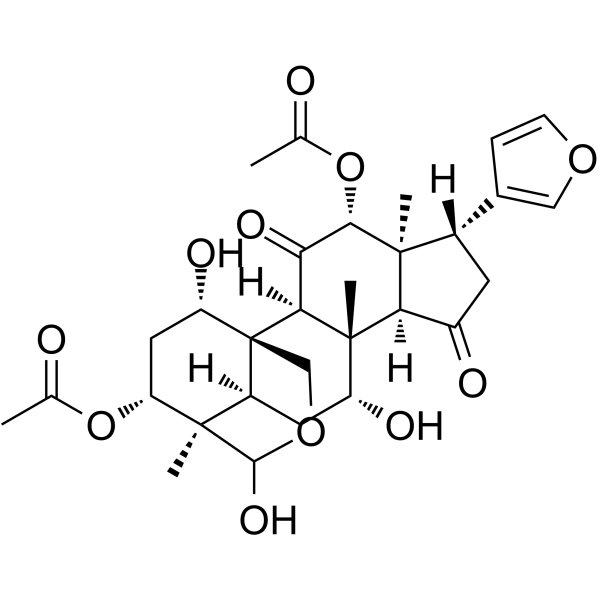
Isotoosendanin
Based on 1 publication(s) in Google Scholar
Isotoosendanin is an orally active TGFβR1 inhibitor and abrogating its kinase activity (IC50 = 6732 nM). Isotoosendanin inhibits the JAK/STAT3 signaling pathway by directly targeting SHP-2, enhancing its stability, and reducing its ubiquitination. Isotoosendanin inhibits TGF-β-induced reduces the migration, invasion, and metastasis in triple-negative breast cancer (TNBC) cells. Isotoosendanin exhibits anti-tumor efficacy in TNBC xenograft models and A549 xenograft tumors. Isotoosendanin exhibits significant anti-inflammatory effects in acetic acid-induced vascular permeability and λ-carrageenan-induced hind paw edema tests. Isotoosendanin can be used for the study of non-small cell lung cancer (NSCLC), TNBC and inflammation.
Para uso exclusivo en investigación. No vendemos a pacientes.
- Pureza : 99.51%
- No. CAS: 97871-44-8
- Fòrmula: C30H38O11
- Peso molecular:574.62
-
Almacenamiento:
-20°C, protect from light
* In solvent : -80°C, 6 months; -20°C, 1 month (protect from light)

To place orders, for customer services and technical support, please contact: MedChemExpress USA
Tel: 609-228-6898 E-mail: [email protected] [email protected]


-
 Actividad biológica
-
Chemical Information
-
Solvente y solubilidad
- Protocolo
- Pureza y Documentación
- Referencias
-
 Help & FAQs


Publications Citing Use of MedChemExpress (MCE) Isotoosendanin
More

Actividad biológica
Descripciòn
In Vitro
Isotoosendanin (10-1000 nM, 24 h) reduces wound closure, invasion, invadopodia formation and migration of MDA-MB-231, BT549, and 4T1 TNBC cells in a concentration-dependent manner[1].
Isotoosendanin (300-1000 nM, 24 h) reverses TGF-β-induced EMT in MDA-MB-231, BT549, and 4T1 TNBC cells by decreasing Vimentin, α-SMA, FSP1, Snail, ZEB1 expression and increasing E-cadherin expression, while reducing Smad2/3 phosphorylation[1].
Isotoosendanin (10-1000 nM) directly interacts with TGFbR1, abrogates its kinase activity (IC50 = 6732 nM), and reduces its binding with Smad2/3 in MDA-MB-231, BT549, and 4T1 TNBC cells[1].
Isotoosendanin (0-90 μM, 48-72 h) reduces the viability of NSCLC cells such as A549, HCC827, and H838 in a dose- and time-dependent manner, with IC50 values ranging from 1.691 to 18.20 µM[2].
Isotoosendanin (1-6 μM, 72 h) significantly inhibits colony formation and proliferation (EdU assay) of A549, HCC827, and H838 cells[2].
Isotoosendanin (1-6 μM, 24-72 h) induces G0/G1 phase arrest in A549, HCC827, and H838 cells, reduces the expression of CDK2 and Cyclin D1/A2; promotes cell apoptosis, increases the expression of Bax and Cleaved Caspase-3, and decreases the expression of Survivin and inactive Caspase-3[2].
Isotoosendanin (1-6 μM , 72 h) reduces the phosphorylation level of STAT3 (Tyr705) in A549, HCC827, and H838 cells in a dose-dependent manner, inhibits STAT3 nuclear translocation, and suppresses IL-6/EGF-induced STAT3 phosphorylation as well as JAK2/3 and TYK2 phosphorylation[2].
MedChemExpress (MCE) has not independently confirmed the accuracy of these methods. They are for reference only.
-
Cell Line:TGF-β-induced MDA-MB-231, BT549, and 4T1 TNBC cells
-
Concentration:300, 1000 nM
-
Incubation Time:24 h
-
Result:Decreased Vimentin, α-SMA, FSP1, Snail, ZEB1 expression.
Increased E-cadherin expression.
Reduced Smad2/3 phosphorylation.
-
Cell Line:A549, HCC827, and H838 cells
-
Concentration:1, 2, 4, 6 μM
-
Incubation Time:72 h
-
Result:Induced G0/G1 phase arrest in A549, HCC827, and H838 cells.
-
Cell Line:A549, HCC827, and H838 cells
-
Concentration:1, 2, 4, 6 μM
-
Incubation Time:24 h
-
Result:Promoted cell apoptosis.
Increased the expression of Bax and Cleaved Caspase-3.
Decreased the expression of Survivin and inactive Caspase-3.
-
Cell Line:A549, HCC827, and H838 cells
-
Concentration:1, 2, 4, 6 μM
-
Incubation Time:72 h
-
Result:Reduced the phosphorylation level of STAT3 (Tyr705).
Inhibited STAT3 nuclear translocation.
Suppressed IL-6/EGF-induced STAT3 phosphorylation as well as JAK2/3 and TYK2 phosphorylation.
In Vivo
Isotoosendanin (1 mg/kg, i.g., daily, 2 months) shows no additional anti-metastatic effect in TGFbR1-knockdown MDA-MB-231 xenograft model compared to the knockdown alone, as both reduce metastasis and reverse EMT[1]. Isotoosendanin (1 mg/kg, i.g., daily, 2 months) fails to inhibit metastasis and reverse EMT in TGFbR1-overexpressed MDA-MB-231 xenograft model[1].
Isotoosendanin (0.1-1 mg/kg, i.g., daily, 1 month) reduces TNBC metastasis in 4T1-luc-GFP xenograft model when used alone or combined with anti-PD-L1[1].
Isotoosendanin (10-20 mg/kg, i.p., once every two days, 7 times) significantly reduces the growth of A549 xenograft tumors[2].
MedChemExpress (MCE) has not independently confirmed the accuracy of these methods. They are for reference only.
-
Animal Model:MDA-MB-231-luc-GFP, BT549-luc-GFP or 4T1 cells (1×10⁶ per mouse) were subcutaneously injected into the fourth right mammary fat pad at the base of the nipple of 4-week-old female BALB/c nude mice[1]
-
Dosage:0.1, 1 mg/kg
-
Administration:i.g. daily for 2 months
-
Result:Reduced bioluminescence signal of metastases.
Decreased number of metastatic foci in liver and lung.
Reversed EMT in tumor tissues, with decreased Vimentin, α-SMA, FSP1 expression and increased E-cadherin expression.
-
Animal Model:MDA-MB-231-luc-GFP-shTGFbR1 cells (1×10⁶ per mouse) were subcutaneously injected into the fourth right mammary fat pad at the base of the nipple of 4-week-old female BALB/c nude mice[1]
-
Dosage:1 mg/kg
-
Administration:i.g. daily for 1 or 2 months
-
Result:Showed no additional reduction in bioluminescence signal of metastases compared to TGFbR1 knockdown alone at 1 mg/kg/day.
Showed no additional decrease in number of metastatic foci in liver and lung compared to TGFbR1 knockdown alone.
Showed no additional reversal of EMT in tumor tissues compared to TGFbR1 knockdown alone.
-
Animal Model:MDA-MB-231-luc-GFP-TGFbR1 cells (1×10⁶ per mouse) were subcutaneously injected into the fourth right mammary fat pad at the base of the nipple of 4-week-old female BALB/c nude mice[1]
-
Dosage:1 mg/kg
-
Administration:i.g. daily for 2 months
-
Result:Failed to reduce bioluminescence signal of metastases at 1 mg/kg/day (p.o., 2 months).
Failed to decrease number of metastatic foci in liver and lung.
Lost the ability to reverse EMT in tumor tissues.
-
Animal Model:4T1 cells (1×10⁶ per mouse) were subcutaneously injected into the fourth right mammary fat pad at the base of the nipple of 4-week-old female BALB/c nude mice[1]
-
Dosage:0.1, 1 mg/kg
-
Administration:i.g. daily for 1 months
-
Result:Enhanced inhibition of tumor growth when combined with anti-PD-L1 at 1 mg/kg/day.
Prolonged survival time of mice compared to monotherapy.
Reduced collagen deposition in tumor microenvironment.
Promoted infiltration of TILs, DCs, and cytotoxic T cells (CD3+, Granzyme B+, CD107a+, CD8+ T cells) in tumor microenvironment.
Reversed EMT in tumor tissues more effectively than monotherapy.
-
Animal Model:A549 cells were subcutaneously injected into BALB/c nude mice (female, 4-5 weeks old, 18-20 g) to establish a xenograft model[2].
-
Dosage:10, 20 mg/kg
-
Administration:i.p. once every two days for 7 times
-
Result:Reduced tumor volume and weight in A549 xenograft models.
Showed no significant change in mice body weight.
Increased expression of SHP-2, p-SHP-2 (Tyr542) and p-SHP-2 (Tyr580) in tumor tissues.
Decreased expression of p-STAT3 (Tyr705) and PCNA in tumor tissues.
Reduced expression of Cyclin D1, CDK2 and Survivin in tumor tissues.
Increased expression of Bax in tumor tissues.
- Cell migration
- Research Protocol for Inflammation-related Diseases
- Breast Cancer Modeling
- Kinase activity and phosphorylation assays
- Carrageenan-Induced Paw Edema
- Patient-Derived Xenograft (PDX)
- Transepithelial/transendothelial electrical resistance assay
- Cell invasion
- Splenic/Portal-Vein Liver Metastasis Xenograft
- Protocol for Kinase activity and phosphorylation assays
- Subcutaneous Cell-Line-Derived Xenograft
- Orthotopic Cell-Line Xenograft
- Intraperitoneal/Peritoneal Dissemination Xenograft


Chemical Information
-
No. CAS 97871-44-8
-
Appearance Solid
-
Peso molecular 574.62
-
Fòrmula C30H38O11
-
Color White to off-white
-
SMILES
O[C@@H](C[C@H]1OC(C)=O)[C@]([C@](C[C@H]2O)([H])[C@@]31C)(COC3O)[C@](C([C@@H]4OC(C)=O)=O)([H])[C@@]2([C@@](C5=O)([H])[C@@]4([C@@](C6=COC=C6)([H])C5)C)C
-
Structure Classification
-
Initial Source
-
Envío
Room temperature in continental US; may vary elsewhere.
-
Almacenamiento
-20°C, protect from light
* In solvent : -80°C, 6 months; -20°C, 1 month (protect from light)


Publications (1)
-
Journal Impact Factor
-
Most Recent
-
Ecotoxicol Environ Saf
Multi-level bioinformatics combined with in vitro and in vivo experiments reveal the nephrotoxicity risk of isotoosendanin. [Abstract]2025 Nov 1:306:119288. PMID: 41161241


Solvente y solubilidad
In Vitro:
DMSO : 25 mg/mL (43.51 mM; ultrasonic and warming and heat to 60°C; Hygroscopic DMSO has a significant impact on the solubility of product, please use newly opened DMSO)
Please refer to the solubility information to select the appropriate solvent. Once prepared, please aliquot and store the solution to prevent product inactivation from repeated freeze-thaw cycles.
Storage method and period of stock solution: -80°C, 6 months; -20°C, 1 month (protect from light). When stored at -80°C, please use it within 6 months. When stored at -20°C, please use it within 1 month.
Please refer to the solubility information to select the appropriate solvent. Once prepared, please aliquot and store the solution to prevent product inactivation from repeated freeze-thaw cycles.
Storage method and period of stock solution: -80°C, 6 months; -20°C, 1 month (protect from light). When stored at -80°C, please use it within 6 months. When stored at -20°C, please use it within 1 month.
Concentration (start) × Volume (start) = Concentration (final) × Volume (final)
In Vivo:
Select the appropriate dissolution method based on your experimental animal and administration route.
- For the following dissolution methods, please ensure to first prepare a clear stock solution using an In Vitro approach and then sequentially add co-solvents:
- To ensure reliable experimental results, the clarified stock solution can be appropriately stored based on storage conditions. As for the working solution for In Vivo experiments, it is recommended to prepare freshly and use it on the same day.
- The percentages shown for the solvents indicate their volumetric ratio in the final prepared solution. If precipitation or phase separation occurs during preparation, heat and/or sonication can be used to aid dissolution.
Add each solvent one by one: 10% DMSO 40% PEG300 5% Tween-80 45% Saline
Solubility: ≥ 2.5 mg/mL (4.35 mM); Clear solution
This protocol yields a clear solution of ≥ 2.5 mg/mL (saturation unknown).
Taking 1 mL working solution as an example, add 100 μL DMSO stock solution (25.0 mg/mL) to 400 μL PEG300, and mix evenly; then add 50 μL Tween-80 and mix evenly; then add 450 μL Saline to adjust the volume to 1 mL.
Preparation of Saline: Dissolve 0.9 g sodium chloride in ddH₂O and dilute to 100 mL to obtain a clear Saline solution.
Add each solvent one by one: 10% DMSO 90% (20% SBE-β-CD in Saline)
Solubility: ≥ 2.5 mg/mL (4.35 mM); Clear solution
This protocol yields a clear solution of ≥ 2.5 mg/mL (saturation unknown).
Taking 1 mL working solution as an example, add 100 μL DMSO stock solution (25.0 mg/mL) to 900 μL 20% SBE-β-CD in Saline, and mix evenly.
Preparation of 20% SBE-β-CD in Saline (4°C, storage for one week): 2 g SBE-β-CD powder is dissolved in 10 mL Saline, completely dissolve until clear.
In Vivo Dissolution Calculator
Please enter the basic information of animal experiments:
-
-
-
-
Recommended: Prepare an additional quantity of animals to account for potential losses during experiments.
Please enter your animal formula composition:
-
%DMSO +
Recommended: Keep the proportion of DMSO in working solution below 2% if your animal is weak.
-
%+
-
+%Tween-80 + +
-
%Saline +
The co-solvents required include: DMSO, . All of co-solvents are available by MedChemExpress (MCE). , Tween 80. All of co-solvents are available by MedChemExpress (MCE).
Working solution concentration: 0.22 mg/mL
Method for preparing stock solution: mg drug dissolved in μL DMSO. Stock solution concentration: mg/mL. * In solvent : -80°C, 6 months; -20°C, 1 month (protect from light)
1. Take μL DMSO stock solution;
2. Add μL .
μL , mix evenly;
3. Then add μL Tween 80, mix evenly;
4. Then add μL
Please ensure that the stock solution in the first step is dissolved to a clear state, and add co-solvents in sequence. You can use ultrasonic heating (ultrasonic cleaner, recommended frequency 20-40 kHz), vortexing, etc. to assist dissolution.


Pureza y Documentación
-
Ficha de datos (294 KB)
-
SDS (252 KB)
- English - EN (252 KB)
- Français - FR (252 KB)
- Deutsch - DE (252 KB)
- Norwegian - NO (252 KB)
- Español - ES (252 KB)
- Swedish - SV (252 KB)
- Italian - IT (252 KB)
- Korean - KR (252 KB)
- Portuguese - PT (252 KB)
-
Instrucciones de manejo (2659 KB)
Referencias
[1]. Zhang J, et al. Isotoosendanin exerts inhibition on triple-negative breast cancer through abrogating TGF-β-induced epithelial-mesenchymal transition via directly targeting TGFβR1. Acta Pharm Sin B. 2023 Jul;13(7):2990-3007. [Content Brief]
[2]. Shu C, et al. Isotoosendanin exerts anti-tumor effects in NSCLC by enhancing the stability of SHP-2 and inhibiting the JAK/STAT3 pathway. Phytomedicine. 2024 Sep;132:155832. [Content Brief]
[3]. Xie F, et al. Anti-inflammatory and analgesic activities of ethanolic extract and two limonoids from Melia toosendan fruit. J Ethnopharmacol. 2008 May 22;117(3):463-6. [Content Brief]


Complete Stock Solution Preparation Table
Please refer to the solubility information to select the appropriate solvent. Once prepared, please aliquot and store the solution to prevent product inactivation from repeated freeze-thaw cycles.
Storage method and period of stock solution: -80°C, 6 months; -20°C, 1 month (protect from light). When stored at -80°C, please use it within 6 months. When stored at -20°C, please use it within 1 month.
| Optional Solvent | Concentration Solvent Mass | 1 mg | 5 mg | 10 mg | 25 mg |
|---|---|---|---|---|---|
| DMSO | 1 mM | 1.7403 mL | 8.7014 mL | 17.4028 mL | 43.5070 mL |
| 5 mM | 0.3481 mL | 1.7403 mL | 3.4806 mL | 8.7014 mL | |
| 10 mM | 0.1740 mL | 0.8701 mL | 1.7403 mL | 4.3507 mL | |
| 15 mM | 0.1160 mL | 0.5801 mL | 1.1602 mL | 2.9005 mL | |
| 20 mM | 0.0870 mL | 0.4351 mL | 0.8701 mL | 2.1754 mL | |
| 25 mM | 0.0696 mL | 0.3481 mL | 0.6961 mL | 1.7403 mL | |
| 30 mM | 0.0580 mL | 0.2900 mL | 0.5801 mL | 1.4502 mL | |
| 40 mM | 0.0435 mL | 0.2175 mL | 0.4351 mL | 1.0877 mL |


Isotoosendanin Related Classifications
HY-N7694 Related Classifications
 Powered by Bioz