



CDK-IN-9
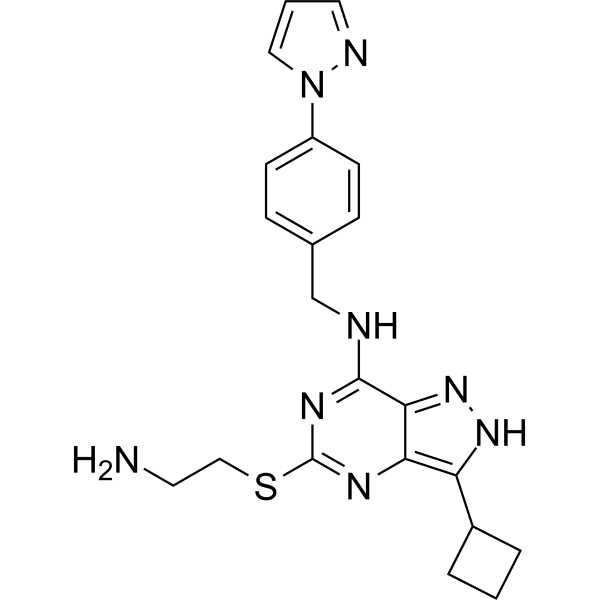
CDK-IN-9 (compound 24) is a potent CDK inhibitor, also as a molecular glue inducing an interaction between CDK12 and DDB1, with an IC50 values of 4 nM for CDK2/E. CDK-IN-9 leads to polyubiquitination of cyclin K and its subsequent degradation. CDK-IN-9 induce apoptosis through dephosphorylation of retinoblastoma protein and RNA polymerase II.
商品は「研究用試薬」です。人や動物の医療用・臨床診断用・食品用の製品ではありません。
研究用途以外に使用した場合、当社は一切の責任を負いかねます。
- CAS 番号: 3031561-92-6
- 分子式: C21H24N8S
- 分子量:420.53
-
保管条件:
Please store the product under the recommended conditions in the Certificate of Analysis.

To place orders, for customer services and technical support, please contact: MedChemExpress USA
Tel: 609-228-6898 E-mail: [email protected] [email protected]


-
 生物活性
生物活性
-
化学情報
- プロトコル
- 純度とドキュメンテーション
- 参考文献
-
 Help & FAQs


DNA/RNA Synthesis アイソフォーム固有の製品をすべて表示
More

生物活性
製品説明
IC50 & Target
[1]|
RNA Polymerase |
CDK2/E 4 nM (IC50) |
Cdk5/p25 39 nM (IC50) |
CDK9/T1 20 nM (IC50) |
CDK12/K 64 nM (IC50) |
CDK13/K 22 nM (IC50) |
Cellular Effect
|
Cell Line

|
Type | Value | Description | References |
|---|---|---|---|---|
| DB | GI50 |
0.02 μM
Compound: 24
|
Antiproliferative activity against human DB cells assessed as cell growth inhibition measured after 72 hrs by resazurin dye based microplate reader analysis
Antiproliferative activity against human DB cells assessed as cell growth inhibition measured after 72 hrs by resazurin dye based microplate reader analysis
|
[PMID: 35749742] |
| NU-DUL-1 | GI50 |
0.015 μM
Compound: 24
|
Antiproliferative activity against human NU-DUL-1 cells assessed as cell growth inhibition measured after 72 hrs by resazurin dye based microplate reader analysis
Antiproliferative activity against human NU-DUL-1 cells assessed as cell growth inhibition measured after 72 hrs by resazurin dye based microplate reader analysis
|
[PMID: 35749742] |
| OCI-LY19 | GI50 |
0.465 μM
Compound: 24
|
Antiproliferative activity against human OCILY19 cells assessed as cell growth inhibition measured after 72 hrs by resazurin dye based microplate reader analysis
Antiproliferative activity against human OCILY19 cells assessed as cell growth inhibition measured after 72 hrs by resazurin dye based microplate reader analysis
|
[PMID: 35749742] |
| SUD4 | GI50 |
0.028 μM
Compound: 24
|
Antiproliferative activity against human SU-DHL-4 cells assessed as cell growth inhibition measured after 72 hrs by resazurin dye based microplate reader analysis
Antiproliferative activity against human SU-DHL-4 cells assessed as cell growth inhibition measured after 72 hrs by resazurin dye based microplate reader analysis
|
[PMID: 35749742] |
| U2932 | GI50 |
0.055 μM
Compound: 24
|
Antiproliferative activity against human U2932 cells assessed as cell growth inhibition measured after 72 hrs by resazurin dye based microplate reader analysis
Antiproliferative activity against human U2932 cells assessed as cell growth inhibition measured after 72 hrs by resazurin dye based microplate reader analysis
|
[PMID: 35749742] |
体外実験
CDK-IN-9 (compound 24) (0.005, 0.05, 0.5, or 5 μM; 2 h) potently decreases the level of cyclin K in MINO cells at 5 nM, and makes cyclin K disappear completely at 50 nM[1].
CDK-IN-9 makes siRNA silencing of DDB1 effectively stabilizes cyclin K at the protein level in treated MINO cells[1].
CDK-IN-9 (2.5-40 nM; 24 h) activates caspases 3/7/9 and decreases anti-apoptotic proteins Mcl-1 and XIAP in MINO cells[1].
MedChemExpress (MCE) has not independently confirmed the accuracy of these methods. They are for reference only.
体内実験
MedChemExpress (MCE) has not independently confirmed the accuracy of these methods. They are for reference only.


化学情報
-
CAS 番号 3031561-92-6
-
分子量 420.53
-
分子式 C21H24N8S
-
SMILES
NCCSC1=NC2=C(NN=C2C(NCC3=CC=C(C=C3)N4C=CC=N4)=N1)C5CCC5
-
輸送条件
Room temperature in continental US; may vary elsewhere.
-
保管条件
Please store the product under the recommended conditions in the Certificate of Analysis.


純度とドキュメンテーション
参考文献

Calculators
濃度 (開始) × 体積 (開始) = 濃度 (終了) × 体積 (終了)


CDK-IN-9 関連分類
HY-150641 関連分類
 Powered by Bioz