



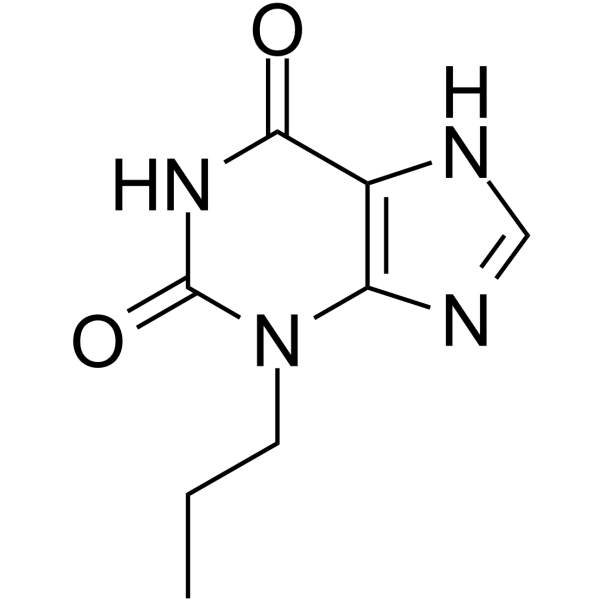
Enprofylline

Based on 1 Customer Validation
Enprofylline acts as a selective and competitive A2B receptor antagonist with the Ki of 7 μM. Enprofylline also acts as a phosphodiesterase inhibitor. Enprofylline can be used for the research of asthma, chronic obstructive pulmonary disease.
For research use only. We do not sell to patients.
- Purity : 98.71%
- CAS No.: 41078-02-8
- Formula: C8H10N4O2
- Molecular Weight:194.19
-
Storage:
4°C, protect from light
* In solvent : -80°C, 6 months; -20°C, 1 month (protect from light)

To place orders, for customer services and technical support, please contact: MedChemExpress USA
Tel: 609-228-6898 E-mail: [email protected] [email protected]


-
 Biological Activity
-
Chemical Information
-
Solvent & Solubility
- Purity & Documentation
- References
-
 Help & FAQs


-
HY-15025S
Sildenafil-d3Deuterium Labeled Sildenafil -
HY-103173
5'-N-EthylcarboxamidoadenosineAdenosine Receptor Agonist -
HY-139362
Enpp-1-IN-2ENPP1 Inhibitor -
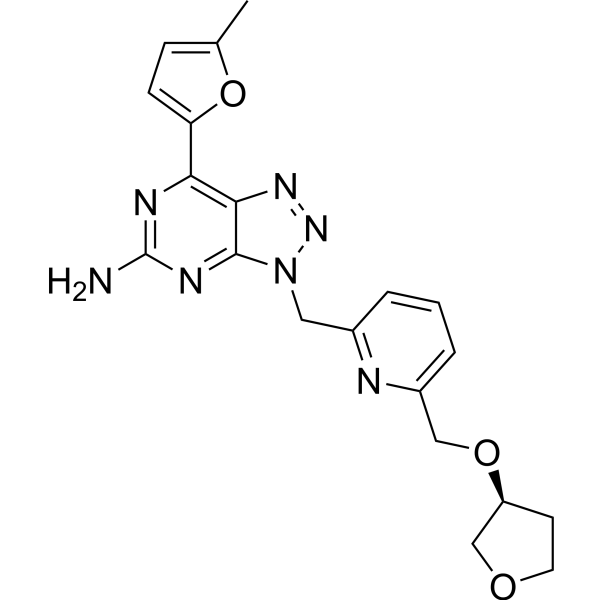
HY-101978
CiforadenantA2AR Antagonist -
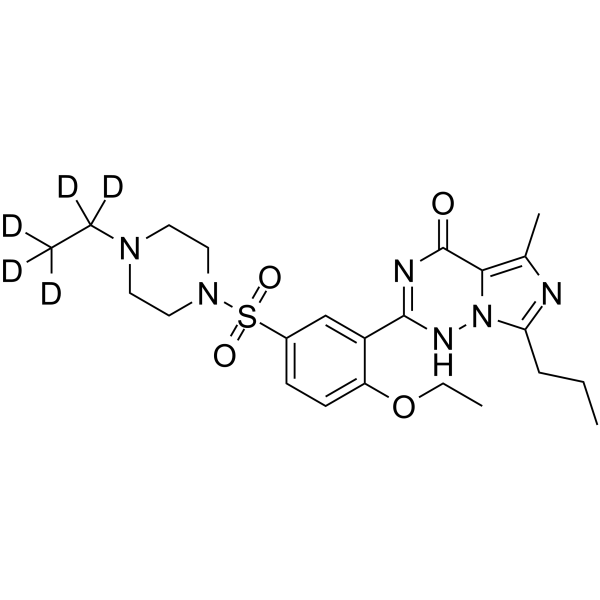
HY-B0442S
Vardenafil-d5Stable Isotope -

HY-103173R
5'-N-Ethylcarboxamidoadenosine (Standard)Adenosine Receptor Agonist -

HY-101978R
Ciforadenant (Standard)Reference Standard
All Adenosine Receptor Isoforms
More

Biological Activity
Description
IC50 & Target
[1]|
A2B receptor 7 μM (Ki) |
In Vitro
Enprofylline (300 μM) completely blocks the release of IL-8 by N-ethylcarboxamidoadenosine (NECA)[1].
Enprofylline (10 μM) inhibits NECA (10 μM) induced proliferation in a concentration-dependent manner[2].
MedChemExpress (MCE) has not independently confirmed the accuracy of these methods. They are for reference only.
-
Cell Line:Human retinal endothelial cells (HRECs)
-
Concentration:10 μM
-
Incubation Time:24, 48, 72 hours
-
Result:NECA (10 μM) induced a time-dependent increase in HREC proliferation as measured by cell counts, achieving approximately 80% of the density of cells exposed to normal growth medium for 3 days.
Enprofylline (10 μM) completely blocked the proliferative effect of NECA when added concurrently with the analogue.
In Vivo
A high dose of Enprofylline (30 mg/kg) also decreases temperature compared with saline injection in female (but not in males) WT mice, but a low dose (7.5 mg/kg) has little effect on mouse temperature[3].
MedChemExpress (MCE) has not independently confirmed the accuracy of these methods. They are for reference only.
-
Animal Model:A1RKO mice (were cross-bred to C57BL/6 mice for six generations) and A2ARKO mice (were backcrossed to C57BL/6 mice for more than 10 generations)[3]
-
Dosage:30 mg/kg
-
Administration:Intraperitoneally injected (bolus) at 2-h intervals
-
Result:Increased HR in male WT mouse from 529±23 to 590±20 and 562±20 after the low (7.5 mg/kg) and high dose (30 mg/kg), respectively.


Chemical Information
-
CAS No. 41078-02-8
-
Appearance Solid
-
Molecular Weight 194.19
-
Formula C8H10N4O2
-
Color White to light yellow
-
SMILES
O=C1NC(N(CCC)C2=C1NC=N2)=O
-
Shipping
Room temperature in continental US; may vary elsewhere.
-
Storage
4°C, protect from light
* In solvent : -80°C, 6 months; -20°C, 1 month (protect from light)


Solvent & Solubility
In Vitro:
DMSO : 62.5 mg/mL (321.85 mM; Need ultrasonic; Hygroscopic DMSO has a significant impact on the solubility of product, please use newly opened DMSO)
Please refer to the solubility information to select the appropriate solvent. Once prepared, please aliquot and store the solution to prevent product inactivation from repeated freeze-thaw cycles.
Storage method and period of stock solution: -80°C, 6 months; -20°C, 1 month (protect from light). When stored at -80°C, please use it within 6 months. When stored at -20°C, please use it within 1 month.
Please refer to the solubility information to select the appropriate solvent. Once prepared, please aliquot and store the solution to prevent product inactivation from repeated freeze-thaw cycles.
Storage method and period of stock solution: -80°C, 6 months; -20°C, 1 month (protect from light). When stored at -80°C, please use it within 6 months. When stored at -20°C, please use it within 1 month.
Concentration (start) × Volume (start) = Concentration (final) × Volume (final)
In Vivo:
Select the appropriate dissolution method based on your experimental animal and administration route.
- For the following dissolution methods, please ensure to first prepare a clear stock solution using an In Vitro approach and then sequentially add co-solvents:
- To ensure reliable experimental results, the clarified stock solution can be appropriately stored based on storage conditions. As for the working solution for In Vivo experiments, it is recommended to prepare freshly and use it on the same day.
- The percentages shown for the solvents indicate their volumetric ratio in the final prepared solution. If precipitation or phase separation occurs during preparation, heat and/or sonication can be used to aid dissolution.
Add each solvent one by one: 10% DMSO 90% (20% SBE-β-CD in Saline)
Solubility: ≥ 2.08 mg/mL (10.71 mM); Clear solution
This protocol yields a clear solution of ≥ 2.08 mg/mL (saturation unknown).
Taking 1 mL working solution as an example, add 100 μL DMSO stock solution (20.8 mg/mL) to 900 μL 20% SBE-β-CD in Saline, and mix evenly.
Preparation of 20% SBE-β-CD in Saline (4°C, storage for one week): 2 g SBE-β-CD powder is dissolved in 10 mL Saline, completely dissolve until clear.
In Vivo Dissolution Calculator
Please enter the basic information of animal experiments:
-
-
-
-
Recommended: Prepare an additional quantity of animals to account for potential losses during experiments.
Please enter your animal formula composition:
-
%DMSO +
Recommended: Keep the proportion of DMSO in working solution below 2% if your animal is weak.
-
%+
-
+%Tween-80 + +
-
%Saline +
The co-solvents required include: DMSO, . All of co-solvents are available by MedChemExpress (MCE). , Tween 80. All of co-solvents are available by MedChemExpress (MCE).
Working solution concentration: 0.22 mg/mL
Method for preparing stock solution: mg drug dissolved in μL DMSO. Stock solution concentration: mg/mL. * In solvent : -80°C, 6 months; -20°C, 1 month (protect from light)
1. Take μL DMSO stock solution;
2. Add μL .
μL , mix evenly;
3. Then add μL Tween 80, mix evenly;
4. Then add μL
Please ensure that the stock solution in the first step is dissolved to a clear state, and add co-solvents in sequence. You can use ultrasonic heating (ultrasonic cleaner, recommended frequency 20-40 kHz), vortexing, etc. to assist dissolution.


Purity & Documentation
-
Data Sheet (276 KB)
-
SDS (393 KB)
- English - EN (393 KB)
- Français - FR (393 KB)
- Deutsch - DE (393 KB)
- Norwegian - NO (393 KB)
- Español - ES (393 KB)
- Swedish - SV (393 KB)
- Italian - IT (393 KB)
- Korean - KR (393 KB)
- Portuguese - PT (393 KB)
-
Handling Instructions (2659 KB)
References
[1]. I Feoktistov, et al. Adenosine A2b receptors evoke interleukin-8 secretion in human mast cells. An enprofylline-sensitive mechanism with implications for asthma. J Clin Invest. 1995 Oct;96(4):1979-86. [Content Brief]
[2]. M B Grant, et al. Proliferation, migration, and ERK activation in human retinal endothelial cells through A(2B) adenosine receptor stimulation. Invest Ophthalmol Vis Sci. 2001 Aug;42(9):2068-73. [Content Brief]
[3]. Jiang-Ning Yang, et al. Physiological roles of A1 and A2A adenosine receptors in regulating heart rate, body temperature, and locomotion as revealed using knockout mice and caffeine. Am J Physiol Heart Circ Physiol. 2009 Apr;296(4):H1141-9. [Content Brief]


Complete Stock Solution Preparation Table
Please refer to the solubility information to select the appropriate solvent. Once prepared, please aliquot and store the solution to prevent product inactivation from repeated freeze-thaw cycles.
Storage method and period of stock solution: -80°C, 6 months; -20°C, 1 month (protect from light). When stored at -80°C, please use it within 6 months. When stored at -20°C, please use it within 1 month.
| Optional Solvent | Concentration Solvent Mass | 1 mg | 5 mg | 10 mg | 25 mg |
|---|---|---|---|---|---|
| DMSO | 1 mM | 5.1496 mL | 25.7480 mL | 51.4960 mL | 128.7399 mL |
| 5 mM | 1.0299 mL | 5.1496 mL | 10.2992 mL | 25.7480 mL | |
| 10 mM | 0.5150 mL | 2.5748 mL | 5.1496 mL | 12.8740 mL | |
| 15 mM | 0.3433 mL | 1.7165 mL | 3.4331 mL | 8.5827 mL | |
| 20 mM | 0.2575 mL | 1.2874 mL | 2.5748 mL | 6.4370 mL | |
| 25 mM | 0.2060 mL | 1.0299 mL | 2.0598 mL | 5.1496 mL | |
| 30 mM | 0.1717 mL | 0.8583 mL | 1.7165 mL | 4.2913 mL | |
| 40 mM | 0.1287 mL | 0.6437 mL | 1.2874 mL | 3.2185 mL | |
| 50 mM | 0.1030 mL | 0.5150 mL | 1.0299 mL | 2.5748 mL | |
| 60 mM | 0.0858 mL | 0.4291 mL | 0.8583 mL | 2.1457 mL | |
| 80 mM | 0.0644 mL | 0.3218 mL | 0.6437 mL | 1.6092 mL | |
| 100 mM | 0.0515 mL | 0.2575 mL | 0.5150 mL | 1.2874 mL |


Enprofylline Related Classifications
HY-14117 Related Classifications
 Powered by Bioz