



Theophylline L-lysine
Based on 12 publication(s) in Google Scholar
Theophylline L-lysine (Lysine theophyllinate) is a soluble derivative of Theophylline (HY-B0809). Theophylline L-lysine is a potent phosphodiesterase (PDE) inhibitor, adenosine receptor antagonist, and histone deacetylase (HDAC) activator. Theophylline L-lysine inhibits PDE3 activity to relax airway smooth muscle. Theophylline L-lysine has anti-inflammatory activity by increasing IL-10 and inhibiting NF-κB into the nucleus. Theophylline L-lysine induces apoptosis. Theophylline L-lysine can be used for asthma and chronic obstructive pulmonary disease (COPD) research.
For research use only. We do not sell to patients.
- CAS No.: 83920-54-1
- Formula: C13H22N6O4
- Molecular Weight:326.35
-
Storage:
Please store the product under the recommended conditions in the Certificate of Analysis.


To place orders, for customer services and technical support, please contact: MedChemExpress USA
Tel: 609-228-6898 E-mail: [email protected] [email protected]


-
 Biological Activity
-
Chemical Information
- Purity & Documentation
- References
-
 Help & FAQs


Publications Citing Use of MedChemExpress (MCE) Theophylline L-lysine
More- Nucleic Acids Res. 2026 Jun 8;54(11):gkag592. [Abstract]
- Cell Rep Med. 2023 Jun 20;4(6):101061. [Abstract]
- Cell Chem Biol. 2025 Sep 18;32(9):1140-1149.e3. [Abstract]
- Cell Rep Methods. 2023 Oct 23;3(10):100599. [Abstract]
- Int J Mol Sci. 2025 Nov 10;26(22):10883. [Abstract]
- Int J Mol Sci. 2024 Mar 3;25(5):2947. [Abstract]
- Int J Mol Sci. 2023 Jan 5;24(2):1019. [Abstract]
- Drug Metab Dispos. 2026 Jul 14;54(8):100365.
- Pharmacol Res Perspect. 2020 Apr;8(2):e00575. [Abstract]
- Eur J Drug Metab Pharmacokinet. 2022 Sep;47(5):639-652. [Abstract]
- Exp Brain Res. 2024 Aug;242(8):1983-1998. [Abstract]
- Research Square Preprint. 2020 Oct.
 Customer Validation & Images

-
Flow Cytometry
-
Cell Proliferation/Viability Assay
-
WB
-
IF
-
Cell Imaging/Staining
All Adenosine Receptor Isoforms
More

Biological Activity
Description
IC50 & Target
[1]|
IL-10 |
IL-6 |
PDE3 |
In Vitro
Theophylline L-lysine (1-1000 μM) inhibits cAMP hydrolysis by PDE in homogenates of bronchial tissue to relax human bronchus and pulmonary arteries[1].
Theophylline L-lysine (10 μg/mL; 24 h; eosinophils) induces apoptosis through a reduction in the antiapoptotic protein Bcl-2[2].
Theophylline L-lysine (0-500 μM; 2 h; A549 cells) inhibits NF-κB activation, I kappa B alpha (I-κBα) degradation and decreases the level of IL-6 in a concentration-dependent manner[3].
Theophylline L-lysine (0-1000 μM; 30 min; A549 cells) induces histone deacetylase activity to decrease inflammatory gene expression[4].
MedChemExpress (MCE) has not independently confirmed the accuracy of these methods. They are for reference only.
-
Cell Line:A549 cells
-
Concentration:0, 20, 100 and 500 µM
-
Incubation Time:2 hours
-
Result:Decreased the expression of NF-κB p65 and I-κBα degradation in a concentration-dependent manner.
-
Cell Line:Eosinophils
-
Concentration:10 µg/mL
-
Incubation Time:24 hours
-
Result:Decreased the expression of Bcl-2.
In Vivo
MedChemExpress (MCE) has not independently confirmed the accuracy of these methods. They are for reference only.
-
Animal Model:Male Swiss mice[1]
-
Dosage:100 mg/kg
-
Administration:Intraperitoneal injection; daily, for 9 days
-
Result:Increased IL-6 and IL-10 levels and inhibited TNF-α and NO.


Chemical Information
-
CAS No. 83920-54-1
-
Molecular Weight 326.35
-
Formula C13H22N6O4
-
SMILES
N[C@@H](CCCCN)C(O)=O.O=C(N1C)N(C)C2=C(N=CN2)C1=O
-
Synonyms
Lysine theophyllinate
-
Shipping
Room temperature in continental US; may vary elsewhere.
-
Storage
Please store the product under the recommended conditions in the Certificate of Analysis.


Publications (12)
-
Journal Impact Factor
-
Most Recent
-
Nucleic Acids Res
Enhancing small-molecule-mediated translational control through multivalent RNA aptamers. [Abstract]2026 Jun 8;54(11):gkag592. PMID: 42273917 -
Cell Rep Med
2023 Jun 20;4(6):101061. PMID: 37267943 -
Cell Chem Biol
Structural basis of adenosine 2A receptor-balanced signaling activation relies on allosterically mediated structural dynamics. [Abstract]2025 Sep 18;32(9):1140-1149.e3. PMID: 40925370 -
Cell Rep Methods
RECOVER identifies synergistic drug combinations in vitro through sequential model optimization. [Abstract]2023 Oct 23;3(10):100599. PMID: 37797618 -
Int J Mol Sci
Elucidating Circular Ribonucleic Acid Mechanisms Associated with Splicing Factor 3 Inhibition in Cervical Cancer. [Abstract]2025 Nov 10;26(22):10883. PMID: 41303368
Theophylline L-lysine purchased from MedChemExpress. Usage Cited in: Int J Mol Sci. 2025 Nov 10;26(22):10883. [Abstract]
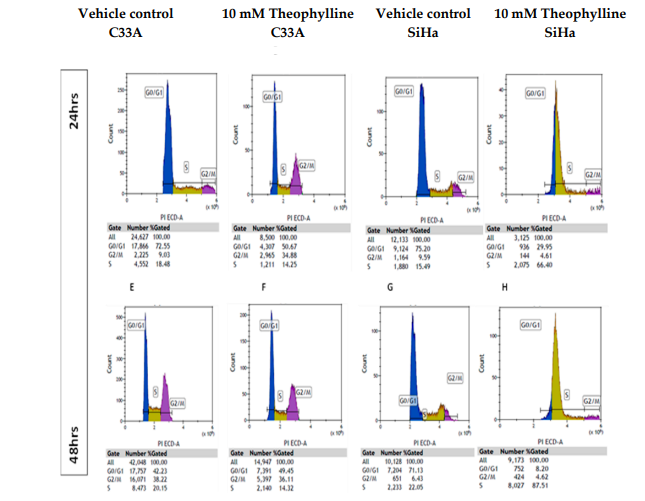
Flow cytometry analysis of cell cycle distribution in CCa cell lines C33A and SiHa following treatment with vehicle control or 10 mM Theophylline for 24 and 48 h.
Theophylline L-lysine purchased from MedChemExpress. Usage Cited in: Int J Mol Sci. 2025 Nov 10;26(22):10883. [Abstract]
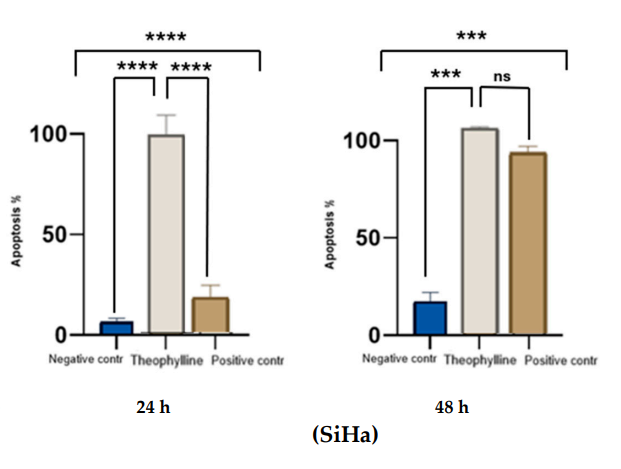
Bar graphs showing the apoptotic effects of 10 mM Theophylline on SiHa cells at 24 and 48 h.
-
Int J Mol Sci
Proanthocyanidins Ameliorate LPS-Inhibited Osteogenesis of PDLSCs by Restoring Lysine Lactylation. [Abstract]2024 Mar 3;25(5):2947. PMID: 38474198
Theophylline L-lysine purchased from MedChemExpress. Usage Cited in: Int J Mol Sci. 2024 Mar 3;25(5):2947. [Abstract]
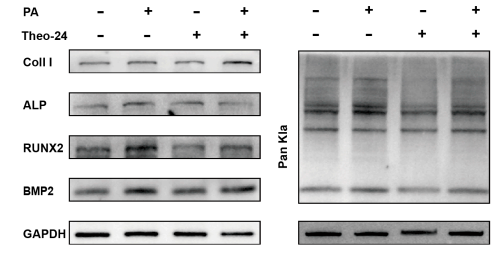
Theophylline (Theo-24). Western blotting shows the protein levels of COL-1, ALP, RUNX2, and BMP2 in PDLSCs after treatment with the indicated conditions.
Theophylline L-lysine purchased from MedChemExpress. Usage Cited in: Int J Mol Sci. 2024 Mar 3;25(5):2947. [Abstract]
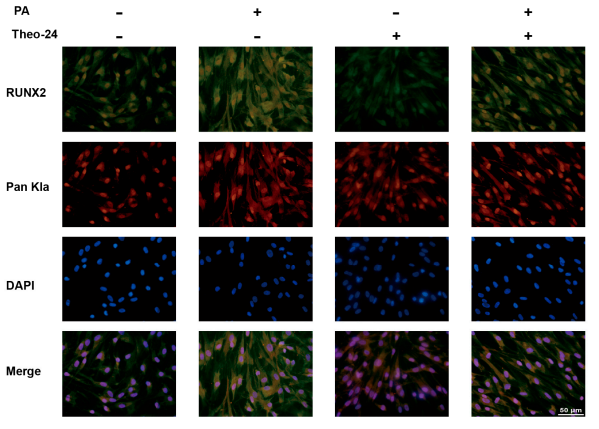
Theophylline (Theo-24). Immunofluorescence staining images showing the expression levels of RUNX2 (green) and Pan Kla (red) in PDLSCs treated with the conditions as shown. Cell nuclei were stained with DAPI (blue).
Theophylline L-lysine purchased from MedChemExpress. Usage Cited in: Int J Mol Sci. 2024 Mar 3;25(5):2947. [Abstract]
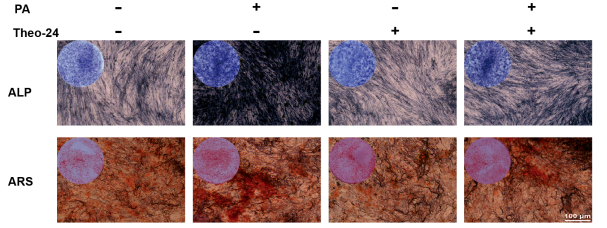
Theophylline (Theo-24). ALP staining at 7 days and ARS staining at 21 days of osteogenic induction in PDLSCs.
-
Int J Mol Sci
Theophylline Attenuates BLM-Induced Pulmonary Fibrosis by Inhibiting Th17 Differentiation. [Abstract]2023 Jan 5;24(2):1019. PMID: 36674533 -
-
Pharmacol Res Perspect
Applicability of free drug hypothesis to drugs with good membrane permeability that are not efflux transporter substrates: A microdialysis study in rats. [Abstract]2020 Apr;8(2):e00575. PMID: 32266794 -
Eur J Drug Metab Pharmacokinet
Evaluation of an Ussing Chamber System Equipped with Rat Intestinal Tissues to Predict Intestinal Absorption and Metabolism in Humans. [Abstract]2022 Sep;47(5):639-652. PMID: 35733077 -
Exp Brain Res
HDAC6 modulates the cognitive behavioral function and hippocampal tissue pathological changes of APP/PS1 transgenic mice through HSP90-HSF1 pathway. [Abstract]2024 Aug;242(8):1983-1998. PMID: 38935089 -


Purity & Documentation
References
[1]. Rabe KF, et, al. Theophylline and selective PDE inhibitors as bronchodilators and smooth muscle relaxants. Eur Respir J. 1995 Apr;8(4):637-42. [Content Brief]
[2]. Németh ZH, et, al. Amrinone and theophylline differentially regulate cytokine and nitric oxide production in endotoxemic mice. Shock. 1997 May;7(5):371-5. [Content Brief]
[3]. Ichiyama T, et, al. Theophylline inhibits NF-kappa B activation and I kappa B alpha degradation in human pulmonary epithelial cells. Naunyn Schmiedebergs Arch Pharmacol. 2001 Dec;364(6):558-61. [Content Brief]
[4]. Ito K, et, al, Adcock IM, Barnes PJ. A molecular mechanism of action of theophylline: Induction of histone deacetylase activity to decrease inflammatory gene expression. Proc Natl Acad Sci U S A. 2002 Jun 25;99(13):8921-6. [Content Brief]
[5]. Barnes PJ. Theophylline. Am J Respir Crit Care Med. 2013 Oct 15;188(8):901-6. [Content Brief]

Calculators
Concentration (start) × Volume (start) = Concentration (final) × Volume (final)


Theophylline L-lysine Related Classifications
HY-130054 Related Classifications
 Powered by Bioz