



Vitexin-4''-O-glucoside

Based on 1 Customer Validation
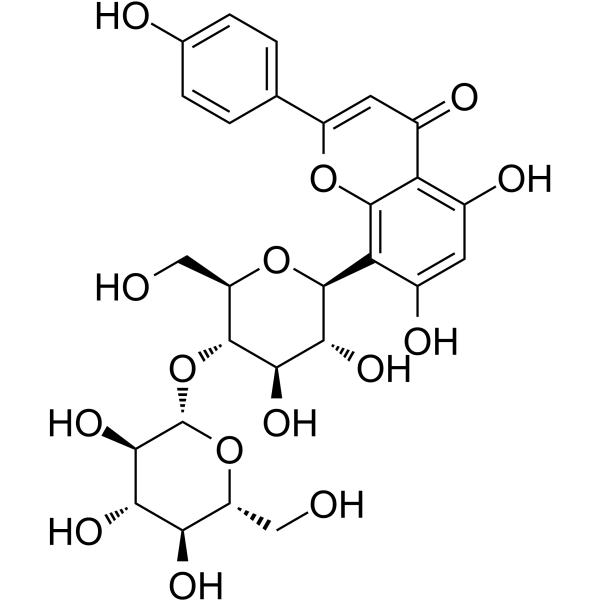
Vitexin-4''-O-glucoside (4''-O-Glucosylvitexin) is an orally active natural flavonoid component with multiple pharmacological effects including antioxidation, anti-inflammation, cytoprotection and anti-apoptosis. Vitexin-4''-O-glucoside regulates the MAPK signaling pathway by downregulating the phosphorylation levels of JNK and p38, thereby blocking endoplasmic reticulum stress responses. Vitexin-4''-O-glucoside alleviates oxidative stress by reducing MDA content and upregulating the activities of SOD and CAT, attenuates inflammation by downregulating the expressions of inflammatory factors TNF-α, IL-1β and IL-6, and also reduces LDH release and inhibits caspase-3 activation. Vitexin-4''-O-glucoside effectively improves drug-induced acute liver injury and exerts significant protective effects against myocardial hypoxia/reoxygenation injury. Vitexin-4''-O-glucoside can be used in studies on acute liver injury, cardiovascular diseases and myocardial hypoxia-reoxygenation injury.
For research use only. We do not sell to patients.
- Purity : 99.81%
- CAS No.: 178468-00-3
- Formula: C27H30O15
- Molecular Weight:594.52
-
Storage:
4°C, sealed storage, away from moisture and light
* In solvent : -80°C, 6 months; -20°C, 1 month (sealed storage, away from moisture and light)

To place orders, for customer services and technical support, please contact: MedChemExpress USA
Tel: 609-228-6898 E-mail: [email protected] [email protected]


-
 Biological Activity
-
Chemical Information
-
Solvent & Solubility
- Purity & Documentation
- References
-
 Help & FAQs






All Caspase Isoforms
More

Biological Activity
Description
|
JNK |
p38 |
IL-6 |
IL-1β |
TNF-α |
Caspase 3 |
In Vitro
Vitexin-4''-O-glucoside (VOG) (1.25-40 μg/mL) alleviates Tunicamycin (HY-A0098) -induced endoplasmic reticulum stress and cell damage in AML-12 mouse hepatocytes, with significant protective effects observed at concentrations of 5.00 μg/mL and higher[1].
Vitexin-4''-O-glucoside (120 μM; 24 h pretreatment) prevents hydrogen peroxide-induced apoptotic nuclear morphological changes in human adipose-derived stem cells[2].
Vitexin-4''-O-glucoside (30-480 μM; 24-72 h) is non-cytotoxic to human adipose-derived stem cells at concentrations up to 480 μM over 72 h[2].
MedChemExpress (MCE) has not independently confirmed the accuracy of these methods. They are for reference only.
-
Cell Line:human adipose-derived stem cells (hADSCs)
-
Concentration:30 μM; 60 μM; 120 μM; 240 μM; 480 μM
-
Incubation Time:24 h; 48 h; 72 h
-
Result:Showed no cytotoxic effect on hADSCs at concentrations up to 480 μM across all incubation times.
Promoted hADSC viability.
Significantly increased hADSC viability.
-
Cell Line:human adipose-derived stem cells (hADSCs)
-
Concentration:120 μM
-
Incubation Time:24 h (pretreatment)
-
Result:Reduced hydrogen peroxide-induced percentage of hADSCs in early apoptosis and late apoptosis/necrosis .
Parmacokinetics
| Species | Dose | Route | T1/2 (Distribution) | T1/2β | AUC0-t | AUC0-∞ | MRT0-t | MRT0-∞ | CL | Vd | Cmax |
|---|---|---|---|---|---|---|---|---|---|---|---|
| Rat[4] | 1.73 mg/kg | i.v. | 0.11 h | 0.87 h | 15,602.08 μg·h/mL | 15,626.16 μg·h/mL | 1.17 h | 1.19 h | 0.002 L/h/kg | 0.003 L/kg | 17,706.47 μg/L |
In Vivo
Vitexin-4''-O-glucoside (VGL) (1.73 mg/kg; i.v.; single dose) exhibits a three-compartment pharmacokinetic profile in healthy male Sprague-Dawley rats[4].
MedChemExpress (MCE) has not independently confirmed the accuracy of these methods. They are for reference only.
-
Animal Model:C57BL/6 (8-week-old male, 20 g, acetaminophen-induced acute liver injury)[1]
-
Dosage:30 mg/kg; 60 mg/kg
-
Administration:p.o.; single dose; 2 hours prior to acetaminophen injection
-
Result:Lowered plasma ALT and AST levels in a dose-dependent manner, with 60 mg/kg showing stronger effects than 30 mg/kg.
Alleviated hepatocyte vacuolation and inflammatory infiltration, and achieved better morphological improvement at 60 mg/kg.
Decreased hepatic MDA content and elevated SOD and CAT activities, with more notable antioxidant effects at the higher dose.
Suppressed hepatic IL-1β, IL-6 and TNF-α expression, and 60 mg/kg produced a more potent anti-inflammatory effect.
Inhibited phosphorylation of JNK and p38 in a dose-dependent fashion.
Downregulated the expression of IRE-1α, GRP78 and XBP1s, and 60 mg/kg exerted superior regulatory effects on IRE-1α and GRP78.


Chemical Information
-
CAS No. 178468-00-3
-
Appearance Solid
-
Molecular Weight 594.52
-
Formula C27H30O15
-
Color Light yellow to yellow
-
SMILES
O=C1C=C(C2=CC=C(O)C=C2)OC3=C([C@H]4[C@@H]([C@H]([C@@H]([C@@H](CO)O4)O[C@H]5[C@@H]([C@H]([C@@H]([C@@H](CO)O5)O)O)O)O)O)C(O)=CC(O)=C13
-
Synonyms
4''-O-Glucosylvitexin
-
Structure Classification
-
Initial Source
-
Shipping
Room temperature in continental US; may vary elsewhere.
-
Storage
4°C, sealed storage, away from moisture and light
* In solvent : -80°C, 6 months; -20°C, 1 month (sealed storage, away from moisture and light)


Solvent & Solubility
In Vitro:
DMSO : 100 mg/mL (168.20 mM; Need ultrasonic; Hygroscopic DMSO has a significant impact on the solubility of product, please use newly opened DMSO)
Please refer to the solubility information to select the appropriate solvent. Once prepared, please aliquot and store the solution to prevent product inactivation from repeated freeze-thaw cycles.
Storage method and period of stock solution: -80°C, 6 months; -20°C, 1 month (sealed storage, away from moisture and light). When stored at -80°C, please use it within 6 months. When stored at -20°C, please use it within 1 month.
Please refer to the solubility information to select the appropriate solvent. Once prepared, please aliquot and store the solution to prevent product inactivation from repeated freeze-thaw cycles.
Storage method and period of stock solution: -80°C, 6 months; -20°C, 1 month (sealed storage, away from moisture and light). When stored at -80°C, please use it within 6 months. When stored at -20°C, please use it within 1 month.
Concentration (start) × Volume (start) = Concentration (final) × Volume (final)
In Vivo:
Select the appropriate dissolution method based on your experimental animal and administration route.
- For the following dissolution methods, please ensure to first prepare a clear stock solution using an In Vitro approach and then sequentially add co-solvents:
- To ensure reliable experimental results, the clarified stock solution can be appropriately stored based on storage conditions. As for the working solution for In Vivo experiments, it is recommended to prepare freshly and use it on the same day.
- The percentages shown for the solvents indicate their volumetric ratio in the final prepared solution. If precipitation or phase separation occurs during preparation, heat and/or sonication can be used to aid dissolution.
Add each solvent one by one: 10% DMSO 40% PEG300 5% Tween-80 45% Saline
Solubility: ≥ 2.5 mg/mL (4.21 mM); Clear solution
This protocol yields a clear solution of ≥ 2.5 mg/mL (saturation unknown).
Taking 1 mL working solution as an example, add 100 μL DMSO stock solution (25.0 mg/mL) to 400 μL PEG300, and mix evenly; then add 50 μL Tween-80 and mix evenly; then add 450 μL Saline to adjust the volume to 1 mL.
Preparation of Saline: Dissolve 0.9 g sodium chloride in ddH₂O and dilute to 100 mL to obtain a clear Saline solution.
Add each solvent one by one: 10% DMSO 90% (20% SBE-β-CD in Saline)
Solubility: ≥ 2.5 mg/mL (4.21 mM); Clear solution
This protocol yields a clear solution of ≥ 2.5 mg/mL (saturation unknown).
Taking 1 mL working solution as an example, add 100 μL DMSO stock solution (25.0 mg/mL) to 900 μL 20% SBE-β-CD in Saline, and mix evenly.
Preparation of 20% SBE-β-CD in Saline (4°C, storage for one week): 2 g SBE-β-CD powder is dissolved in 10 mL Saline, completely dissolve until clear.
In Vivo Dissolution Calculator
Please enter the basic information of animal experiments:
-
-
-
-
Recommended: Prepare an additional quantity of animals to account for potential losses during experiments.
Please enter your animal formula composition:
-
%DMSO +
Recommended: Keep the proportion of DMSO in working solution below 2% if your animal is weak.
-
%+
-
+%Tween-80 + +
-
%Saline +
The co-solvents required include: DMSO, . All of co-solvents are available by MedChemExpress (MCE). , Tween 80. All of co-solvents are available by MedChemExpress (MCE).
Working solution concentration: 0.22 mg/mL
Method for preparing stock solution: mg drug dissolved in μL DMSO. Stock solution concentration: mg/mL. * In solvent : -80°C, 6 months; -20°C, 1 month (sealed storage, away from moisture and light)
1. Take μL DMSO stock solution;
2. Add μL .
μL , mix evenly;
3. Then add μL Tween 80, mix evenly;
4. Then add μL
Please ensure that the stock solution in the first step is dissolved to a clear state, and add co-solvents in sequence. You can use ultrasonic heating (ultrasonic cleaner, recommended frequency 20-40 kHz), vortexing, etc. to assist dissolution.


Purity & Documentation
-
Data Sheet (288 KB)
-
SDS (394 KB)
- English - EN (394 KB)
- Français - FR (394 KB)
- Deutsch - DE (394 KB)
- Norwegian - NO (394 KB)
- Español - ES (394 KB)
- Swedish - SV (394 KB)
- Italian - IT (394 KB)
- Korean - KR (394 KB)
- Portuguese - PT (394 KB)
-
Handling Instructions (2659 KB)
References
[1]. Dong F, et al. Zhejiang Da Xue Xue Bao Yi Xue Ban. 2025;54(3):307-317. [Content Brief]
[2]. Wei W, et al. Effects of vitexin-2"-O-rhamnoside and vitexin-4"-O-glucoside on growth and oxidative stress-induced cell apoptosis of human adipose-derived stem cells. J Pharm Pharmacol. 2014;66(7):988-997. [Content Brief]
[3]. Ying XX, et al. Pharmacokinetics of vitexin-4″-O-glucoside in rats after intravenous application. Eur J Drug Metab Pharmacokinet. 2012;37(2):109-115. [Content Brief]
[4]. Zhang W, et al. Simultaneous determination of vitexin-4''-O-glucoside, vitexin-2''-O-rhamnoside, rutin and vitexin from hawthorn leaves flavonoids in rat plasma by UPLC-ESI-MS/MS. J Chromatogr B Analyt Technol Biomed Life Sci. 2010;878(21):1837-1844. [Content Brief]


Complete Stock Solution Preparation Table
Please refer to the solubility information to select the appropriate solvent. Once prepared, please aliquot and store the solution to prevent product inactivation from repeated freeze-thaw cycles.
Storage method and period of stock solution: -80°C, 6 months; -20°C, 1 month (sealed storage, away from moisture and light). When stored at -80°C, please use it within 6 months. When stored at -20°C, please use it within 1 month.
| Optional Solvent | Concentration Solvent Mass | 1 mg | 5 mg | 10 mg | 25 mg |
|---|---|---|---|---|---|
| DMSO | 1 mM | 1.6820 mL | 8.4101 mL | 16.8203 mL | 42.0507 mL |
| 5 mM | 0.3364 mL | 1.6820 mL | 3.3641 mL | 8.4101 mL | |
| 10 mM | 0.1682 mL | 0.8410 mL | 1.6820 mL | 4.2051 mL | |
| 15 mM | 0.1121 mL | 0.5607 mL | 1.1214 mL | 2.8034 mL | |
| 20 mM | 0.0841 mL | 0.4205 mL | 0.8410 mL | 2.1025 mL | |
| 25 mM | 0.0673 mL | 0.3364 mL | 0.6728 mL | 1.6820 mL | |
| 30 mM | 0.0561 mL | 0.2803 mL | 0.5607 mL | 1.4017 mL | |
| 40 mM | 0.0421 mL | 0.2103 mL | 0.4205 mL | 1.0513 mL | |
| 50 mM | 0.0336 mL | 0.1682 mL | 0.3364 mL | 0.8410 mL | |
| 60 mM | 0.0280 mL | 0.1402 mL | 0.2803 mL | 0.7008 mL | |
| 80 mM | 0.0210 mL | 0.1051 mL | 0.2103 mL | 0.5256 mL | |
| 100 mM | 0.0168 mL | 0.0841 mL | 0.1682 mL | 0.4205 mL |


Vitexin-4''-O-glucoside Related Classifications
HY-N5073 Related Classifications
 Powered by Bioz
Keywords
- Vitexin-4''-O-glucoside
- 178468-00-3
- 4''-O-Glucosylvitexin
- JNK
- p38 MAPK
- Interleukin Related
- TNF Receptor
- Caspase
- Lactate Dehydrogenase
- Apoptosis
- AML-12 mouse hepatocytes
- Sprague-Dawley rats
- p38 mitogen-activated protein kinase
- X-box binding protein 1s
- glucose-regulated protein 78
- endoplasmic reticulum stress
- human adipose-derived stem cells
- c-Jun N-terminal kinase
- MAPK signaling pathway
- inositol-requiring enzyme 1 alpha
- Inhibitor
- inhibitor
- inhibit