



Apoptosis
Apoptosis
Apoptosis is a distinctive form of cell death exhibiting specific morphological and biochemical characteristics, including cell membrane blebbing, chromatin condensation, genomic DNA fragmentation, and exposure of specific phagocytosis signaling molecules on the cell surface. Cells undergoing apoptosis differ from those dying through necrosis. Necrotic cells are usually recognized by the immune system as a danger signal and, thus, resulting in inflammation; in contrast, apoptotic death is quiet and orderly.
There are two major pathways of apoptotic cell death induction: The intrinsic pathway, also called the Bcl-2-regulated or mitochondrial pathway, is activated by various developmental cues or cytotoxic insults, such as viral infection, DNA damage and growth-factor deprivation, and is strictly controlled by the BCL-2 family of proteins. The extrinsic or death-receptor pathway is triggered by ligation of death receptors (members of the tumor necrosis factor (TNF) receptor family, such as Fas or TNF receptor-1 (TNFR1)) that contain an intracellular death domain, which can recruit and activate caspase-8 through the adaptor protein Fas-associated death domain (FADD; also known as MORT1) at the cell surface. This recruitment causes subsequent activation of downstream (effector) caspases, such as caspase-3, -6 or -7, without any involvement of the BCL-2 family.
Studies suggest that alterations in cell survival contribute to the pathogenesis of a number of human diseases, including cancer, viral infections, autoimmune diseases, neurodegenerative disorders, and AIDS (acquired immunodeficiency syndrome). Treatments designed to specifically alter the apoptotic threshold may have the potential to change the natural progression of some of these diseases.
All Product Categories
-
Apoptosis Inhibitors
(904)
View all products
-
Apoptosis Agonists
(7)
View all products
-
Apoptosis Antagonists
(9)
View all products
-
Apoptosis Activators
(363)
View all products
-
Apoptosis Modulators
(60)
View all products
-
Apoptosis Inducers
(7944)
View all products
-
Apoptosis Degrader
(1)
View all products
-
Apoptosis Controls
(33)
View all products
-
Apoptosis Related Products (9888)
Related Products (9888)

-
Antibodies (120)
-
Fasentin (Standard)
 0 ImagesCat. No.: HY-101849RCAS No.: 392721-37-8Fasentin (Standard) is the analytical standard of Fasentin. This product is intended for research and analytical applications. Fasentin, a potent glucose uptake inhibitor, inhibits GLUT-1/GLUT-4 transporters. Fasentin preferentially inhibits GLUT4 (IC50=68 μM) over GLUT1. Fasentin is a death receptor stimuli (FAS) sensitizer and sensitizes cells to FAS-induced cell death. Fasentin is also a tumor necrosis factor (TNF) apoptosis-inducing ligand sensitizer. Fasentin blocks glucose uptake in cancer cell lines and has anti-angiogenic activity.
-
7,8-Dihydroxyflavone (Standard)
 0 Images7,8-Dihydroxyflavone is a potent and selective TrkB agonist that mimics the physiological actions of Brain-derived neurotrophic factor (BDNF). Displays therapeutic efficacy toward various neurological diseases.
-
Metoprolol Hydrochloride
 0 ImagesCat. No.: HY-17503DCAS No.: 56392-18-8Metoprolol Hydrochloride is an orally active and selective β1-adrenoceptor antagonist. Metoprolol Hydrochloride exhibits anti-inflammatory, antitumor, and anti-angiogenic properties.
-
β-Tocotrienol (Standard)
 0 ImagesCat. No.: HY-108693RCAS No.: 490-23-3β-Tocotrienol (Standard) is the analytical standard of β-Tocotrienol. This product is intended for research and analytical applications. β-Tocotrienol is an isomer of vitamin E. β-Tocotrienol is a less potent antioxidant than α-tocotrienol. β-Tocotrienol can be found in the tocotrienol-rich fraction (TRF) of palm oil, which possesses anti-carcinogenic effects in vitro on human colon carcinoma and prostate cancer cells. β-Tocotrienol inhibits the growth of A549 (GI50 = 1.38 μM) and U87MG (GI50 = 2.53 μM) cells. β-Tocotrienol also induces apoptosis in cancer cells. β-Tocotrienol can inhibit PD-L1 expression and mitigates PD-L1-mediated immune suppression in vitro and in vivo.
-
PF-4878691 (Standard)
 0 ImagesSynonyms: 3M-852A (Standard)PF-4878691 (Standard) is the analytical standard of PF-4878691. This product is intended for research and analytical applications. PF-4878691 (3M-852A) is an orally active TLR7 agonist. PF-4878691 has the innate immune response activity, antiviral efficacy against HCV, and can be used for the research of cancer.
-
Kuwanon G (Standard)
 0 ImagesCat. No.: HY-N4247RCAS No.: 75629-19-5Kuwanon G (Standard) is the analytical standard of Kuwanon G (HY-N4247). This product is intended for research and analytical applications. Kuwanon G is a flavonoid compound and an antagonist of the bombesin receptor. Kuwanon G has multiple activities such as bactericidal, anti-tumor, anti-inflammatory, antioxidant, anti-atherosclerotic, and neuroprotective effects. Kuwanon G exhibits strong antibacterial activity against oral pathogens, especially cariogenic bacteria and periodontal pathogens. Kuwanon G can induce apoptosis and inhibit proliferation, migration, and invasion of tumor cells. Kuwanon G can be used in the research of diseases such as gastric cancer and atherosclerosis.
-
Amiloride-15N3
 0 ImagesCat. No.: HY-B0285SCAS No.: 1217169-93-1Synonyms: MK-870-15N3Amiloride-15N3 (MK-870-15N3) is 15N labeled Amiloride. Amiloride (MK-870) is an inhibitor of both epithelial sodium channel (ENaC) and urokinase-type plasminogen activator receptor (uTPA). Amiloride is a blocker of polycystin-2 (PC2; TRPP2) channel.
-
Mitoxantrone (Standard)
 0 ImagesSynonyms: Mitozantrone (Standard); NSC 301739 (Standard)Mitoxantrone (Standard) is the analytical standard of Mitoxantrone. This product is intended for research and analytical applications. Mitoxantrone is a potent topoisomerase II inhibitor. Mitoxantrone also inhibits protein kinase C (PKC) activity with an IC50 of 8.5 μM. Mitoxantrone induces apoptosis of B-CLL (B-chronic lymphocytic leukaemia) cells. Mitoxantrone shows antitumor activity. Mitoxantrone also has anti-orthopoxvirus activity with EC50s of 0.25 μM and and 0.8 μM for cowpox and monkeypox, respectively.
-
NSC114792
 0 ImagesCat. No.: HY-122101CAS No.: 17392-79-9
-
COTI-2 hydrochloride
 0 ImagesCat. No.: HY-19896ACAS No.: 1204956-74-0COTI-2 hydrochloride is an orally active thiosemicarbazone anticancer agent and p53 mutant activator. COTI-2 hydrochloride induces Apoptosis. COTI-2 hydrochloride triggers the activation of AMPK and the inhibition of the mTOR pathway. COTI-2 hydrochloride induces DNA damage and replication stress responses. COTI-2 hydrochloride binds to misfolded mutant p53 proteins, thereby inducing conformational changes that restore p53 to its normal state and reactivate its function. COTI-2 hydrochloride acts on a variety of cancer cell lines and xenografts. COTI-2 hydrochloride can be used in research related to colorectal cancer, small cell lung cancer, glioblastoma, breast cancer, and ovarian cancer.
-
Ethylene dimethanesulfonate (Standard)
 0 ImagesCat. No.: HY-129524RCAS No.: 4672-49-5Ethylene dimethanesulfonate (Standard) is the analytical standard of Ethylene dimethanesulfonate. This product is intended for research and analytical applications. Ethylene dimethane sulfonate is a mild alkylating, non-volatile methanesulfonic diester of ethylene glycol. Ethylene dimethanesulfonate has selective pro-apoptotic effects on LCs.
-
Vandetanib trifluoroacetate
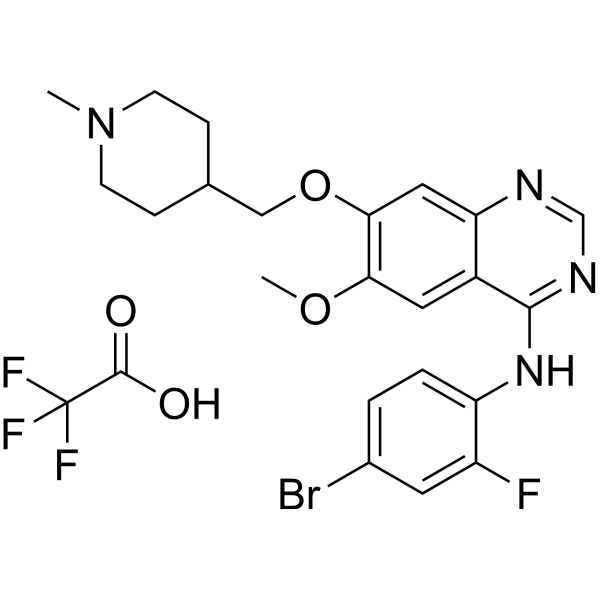 0 ImagesCat. No.: HY-10260ACAS No.: 338992-53-3Synonyms: ZD6474 trifluoroacetateVandetanib trifluoroacetate (D6474 trifluoroacetate) is a potent, orally active inhibitor of VEGFR2/KDR tyrosine kinase activity (IC50=40 nM). Vandetanib trifluoroacetate also has activity versus the tyrosine kinase activity of VEGFR3/FLT4 (IC50=110 nM) and EGFR/HER1 (IC50=500 nM).
-
AG1024 (Standard)
 0 ImagesCat. No.: HY-10253RCAS No.: 65678-07-1Synonyms: Tyrphostin AG 1024 (Standard)AG1024 (Standard) is the analytical standard of AG1024 (HY-10253). This product is intended for research and analytical applications. AG1024 (Tyrphostin AG 1024) is a reversible, competitive and selective IGF-1R inhibitor with an IC50 of 7 μM. AG1024 inhibits phosphorylation of IR (IC50=57 μM). AG1024 induces apoptosis and has anti-cancer activity.
-
nor-NOHA
 0 ImagesCat. No.: HY-112885CAS No.: 189302-40-7Synonyms: Nω-Hydroxy-nor-L-argininenor-NOHA is a selective and reversible arginase inhibitor. nor-NOHA induces apoptosis in ARG2-expressing cells under hypoxia. nor-NOHA has anti-leukemic activity. nor-NOHA can used in study of endothelial dysfunction, immunosuppression and metabolism.
-
MRS 2578 (Standard)
 0 ImagesCat. No.: HY-13104RCAS No.: 711019-86-2MRS 2578 (Standard) is the analytical standard of MRS 2578. This product is intended for research and analytical applications. MRS 2578 is a selective and potent P2Y6 receptor antagonist with IC50s of 37 nM (human) and 98 nM (rat). MRS 2578 exhibits insignificant activity at P2Y1, P2Y2, P2Y4, and P2Y11 receptors.
-
VJ115
 0 ImagesCat. No.: HY-111089CAS No.: 929256-79-1VJ115 is a potent ENOX1 inhibitor with an EC50 of 50 μM. By inhibiting ENOX1, VJ115 elevates NADH, which in turn downregulates the phosphorylation of p70S6K1/S6, alters the expression of c-Jun and cytoskeletal proteins, induces endothelial cells to lose polarization and migration ability, and increases caspase-3-dependent apoptosis under radiation. VJ115 can be used in studies related to solid tumors.
-
Olprinone (Standard)
 0 ImagesCat. No.: HY-14254ARCAS No.: 106730-54-5Synonyms: Loprinone (Standard)Olprinone (Loprinone) Standard is the analytical standard of Olprinone (HY-14254A). This product is intended for research and analytical applications. Olprinone (Loprinone) is a potent and selective phosphodiesterase 3 (PDE3) inhibitor, with IC50 values of 150, 100, 0.35, and 14 μM against PDE1, PDE2, PDE3, and PDE4, respectively. Olprinone exerts comprehensive protective effects including anti-inflammatory, antioxidant, and anti-apoptotic activities by elevating intracellular cAMP levels and inhibiting the NF-κB and MAPK signaling pathways. Olprinone can be used in studies related to lung injury, spinal cord injury, heart failure, myocardial ischemia-reperfusion injury, and cerebral ischemic injury.
-
HX531 (Standard)
 0 ImagesCat. No.: HY-108521RCAS No.: 188844-34-0HX531 (Standard) is the analytical standard of HX531 (HY-108521). This product is intended for research and analytical applications. HX531 is an orally active RXR antagonist with an IC50 of 18 nM. HX531 upregulates the p53-p21Cip1 pathway. HX531 abrogates the anti-apoptotic effect of t-RA. HX531 exerts anti-obesity, anti-diabetic and anti-melanoma activities.
-
Evofosfamide (Standard)
 0 ImagesCat. No.: HY-10535RCAS No.: 918633-87-1Synonyms: TH-302 (Standard)Evofosfamide (Standard) is the analytical standard of Evofosfamide (HY-10535). This product is intended for research and analytical applications. Evofosfamide (TH-302) is a hypoxia-activated proagent with IC50 of 10 μM and 1000 μM in hypoxia (N2) and normoxia (21% O2), respectively.
-
Monogalactosyldiacylglycerol
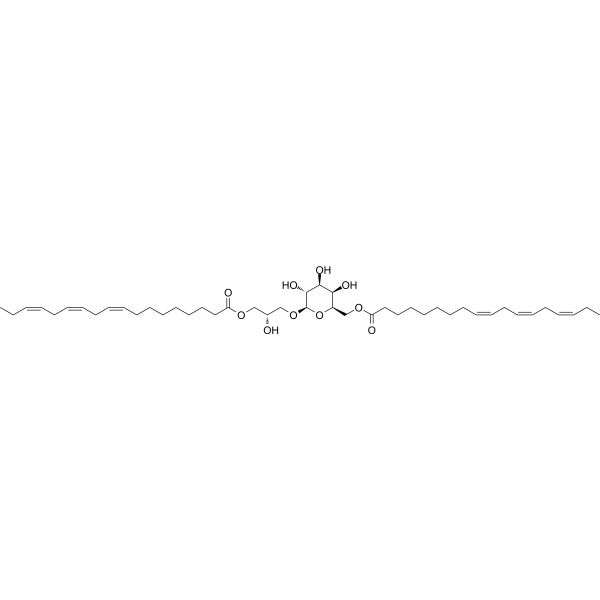 0 ImagesCat. No.: HY-N12540CAS No.: 1932659-76-1Synonyms: MGDGMonogalactosyldiacylglycerol (MGDG) is a galactolipid with anti-inflammatory and anticancer activities, which is found in photosynthetic organisms. Monogalactosyldiacylglycerol is a potent DNA polymerase inhibitor with pro-apoptotic activity. Monogalactosyldiacylglycerol inhibits the synthesis of LPS (HY-D1056)-induced inflammation-related proteins (Ex-FABP, Avidin, Serum Amyloid A). Monogalactosyldiacylglycerol exerts an anti-proliferative effect on chicken articular chondrocytes. Monogalactosyldiacylglycerol can be used in research related to osteoarthritis, cancer and inflammatory diseases.




