



CDK9
CDK9 (cyclin-dependent kinase 9) is a transcription-associated serine/threonine kinase that functions as the catalytic subunit of positive transcription elongation factor b (P-TEFb) and regulates productive RNA polymerase II (RNAPII) elongation through phosphorylation of the RNAPII C-terminal domain and elongation factors.[1][2] Mechanistically, CDK9-cyclin T complexes promote release of promoter-proximally paused RNAPII into gene bodies, thereby controlling transcriptional programs required for cellular responses to developmental and environmental signals.[1][2] Beyond transcriptional elongation, CDK9 contributes to transcription initiation, termination, and maintenance of appropriate transcriptional output, highlighting its central role in gene expression regulation.[1] Dysregulated CDK9 activity has been linked to multiple pathological conditions, particularly cancer, where aberrant transcriptional dependencies create vulnerability to pharmacological CDK9 inhibition.[1][3] In cancer models, activation of P-TEFb-dependent transcription supports oncogenic pathways including MYC, NF-κB, and stress-response signaling, and selective suppression of CDK9 can induce apoptotic programs and impair tumor cell proliferation.[4] Compared with related transcriptional cyclin-dependent kinases such as CDK12 and CDK13, which primarily regulate distinct transcriptional and RNA-processing programs through cyclin K-containing complexes, CDK9 acts as the principal P-TEFb kinase controlling promoter-proximal pause release and rapid transcriptional activation.[1][5] For experimental applications, small-molecule CDK9 inhibitors including flavopiridol have been widely used to suppress RNAPII-dependent transcription, investigate transcriptional addiction, and evaluate therapeutic vulnerabilities associated with transcriptional dysregulation.[1][6]
References:
- [1]. Egloff S. CDK9 keeps RNA polymerase II on track. Cell Mol Life Sci. 2021 Jul;78(14):5543-5567. [Content Brief]
- [2]. Anshabo AT, et al. CDK9: A Comprehensive Review of Its Biology, and Its Role as a Potential Target for Anti-Cancer Agents. Front Oncol. 2021 May 10;11:678559. [Content Brief]
- [3]. Constantin TA, et al. Transcription associated cyclin-dependent kinases as therapeutic targets for prostate cancer. Oncogene. 2022 Jun;41(24):3303-3315. [Content Brief]
- [4]. Yuan B, et al. Engineering of cytosine base editors with DNA damage minimization and editing scope diversification. Nucleic Acids Res. 2023 Nov 10;51(20):e105. [Content Brief]
- [5]. Fan Z, et al. CDK13 cooperates with CDK12 to control global RNA polymerase II processivity. Sci Adv. 2020 Apr 29;6(18):eaaz5041. [Content Brief]
- [6]. Phiel CJ, et al. Histone deacetylase is a direct target of valproic acid, a potent anticonvulsant, mood stabilizer, and teratogen. J Biol Chem. 2001 Sep 28;276(39):36734-41. [Content Brief]
-
CDK9 Related Products (205)
Related Products (205)

-
Antibodies (1)
-
CDK9-IN-51
 0 ImagesCat. No.: HY-183698CAS No.: 2853500-43-1CDK9-IN-51 is a CDK9 inhibitor. CDK9-IN-51 binds stably to purified CDK9 protein via interactions with key active-site residues Cys106, Asp109, and Phe103. CDK9-IN-51 exhibits antiproliferative activity against multiple cancer cells. CDK9-IN-51 can be used for the research of cancer, such as lung carcinoma, cervical carcinoma and breast carcinoma.
-
CDK2-IN-12
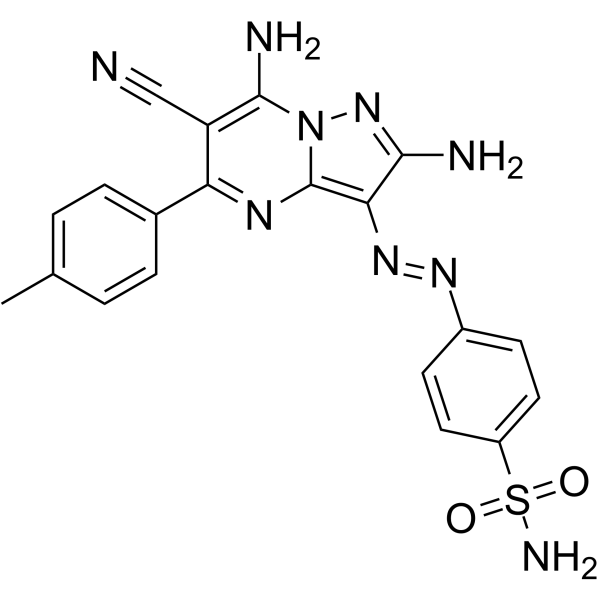 0 ImagesCat. No.: HY-150573CAS No.: 2410402-88-7CDK2-IN-12 (compound 10b) is a potent CDK2 inhibitor, with an IC50 of 11.6 μM. CDK2-IN-12 inhibits hCA (carbonic anhydrase) isoforms I, II, IX and XII, with KI values of 3534, 638.4, 44.3, and 48.8 nM. CDK2-IN-12 shows anticancer activity.
-
CDK9-IN-45
 0 ImagesCat. No.: HY-179023CDK9-IN-45 (Compound B11) is a highly selective CDK9 inhibitor with IC50 values for CDK9 and CDK1 of 7.13 and 489.5 nM respectively. CDK9-IN-45 exhibits a potent inhibitory effect on colorectal cancer cells. CDK9-IN-45 induces cell apoptosis and leads to significant accumulation of ROS. CDK9-IN-45 activates Caspase-3, downregulates Mcl-1, XIAP, and c-Myc. CDK9-IN-45 can be used for research on colorectal cancer.
-
ZLMT-72
 0 ImagesCat. No.: HY-179633ZLMT-72 is an orally active dual CDK2 and CDK9 inhibitor with IC50s of 0.741 nM and 1.03 nM, respectively. ZLMT-72 shows good selectivity in kinase profiling andcholinesterase inhibition activity. ZLMT-72 has strong antiproliferative effects in the colorectal cancer (CRC) cell line HCT116 (GI50 < 0.1 nM). ZLMT-72 induces apoptosis by inhibiting thephosphorylation of retinoblastoma and RNA polymerase II, resulting in downregulation of antiapoptotic proteins (Mcl-1 and XIAP). ZLMT-72 can be used for the study of colorectal cancer (CRC).
-
CDKI-83
 0 ImagesCat. No.: HY-123034CAS No.: 1189558-88-0CDKI-83 is a potent CDK9 and CDK1 inhibitor with Ki values of 21 nM and 72 nM for CDK9/T1 and CDK1/B, respectively. CDKI-83 demonstrates effective anti-proliferative activity in human tumour cell lines with a GI50<1 μM. CDKI-83 effectively induces apoptosis in A2780 human ovarian cancer cells. CDKI-83 reduces phosphorylation at Ser-2 of RNA polymerase II (RNAPII) by inhibiting cellular CDK9 activity, and down-regulates Mcl-1 and Bcl-2. CDKI-83 has the potential for anti-cancer research.
-
CDK9 degrader-2
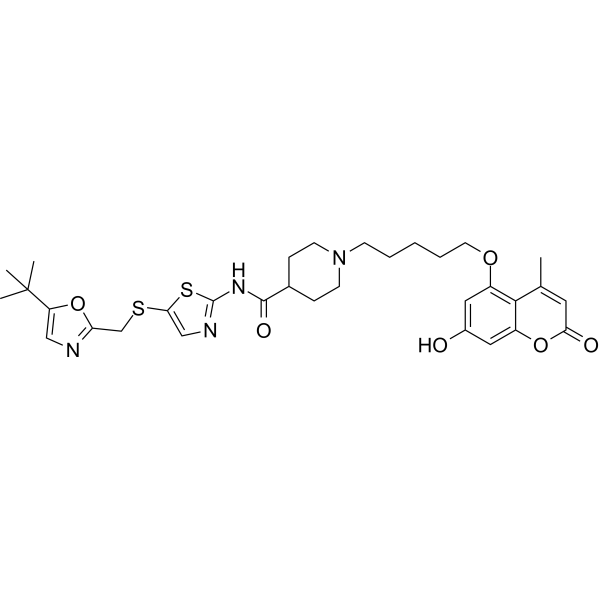 0 ImagesCat. No.: HY-156083CAS No.: 3020773-81-0CDK9 degrader-2 is a bifunctional degrader of ATTEC (Autophagy-Tethering Compound) that degrades the CDK9/cyclin T1 complex. CDK9 degrader-2 forms a ternary complex with CDK9 and LC3B, and achieves degradation through the autophagy-lysosome pathway, a process independent of the ubiquitin-proteasome system. CDK9 degrader-2 downregulates the expression of Mcl-1 and c-Myc proteins, induces apoptosis, and exhibits antitumor activity in in vivo MV4-11 xenograft models. CDK9 degrader-2 can be used for leukemia research.
-
LCI133
 0 ImagesCat. No.: HY-179375CAS No.: 3065284-87-6LCI133 is afirst-in-class,nanomolar-potent, selective multikinase inhibitor targeting CDK4/6/9 and AURKA/B (IC50 = 4.7/10.2/4.1 nM and 2.8/10.6 nM). LCI133 induces S/G2 cell-cycle arrest and robust apoptosis in MYCN-amplified neuroblastoma BE(2)-C cells. LCI133 demonstrates significant antitumor efficacy in a BE(2)-C neuroblastoma xenograft model.
-
CDK9-IN-49
 0 ImagesCat. No.: HY-185340CAS No.: 2987897-39-0CDK9-IN-49 is a CDK9 inhibitor with an IC50 of 7.32 nM. CDK9-IN-49 inhibits the proliferation of various cancer cells. CDK9-IN-49 can be used in the research of cancers such as acute myeloid leukemia and prostate cancer.
-
CP-07
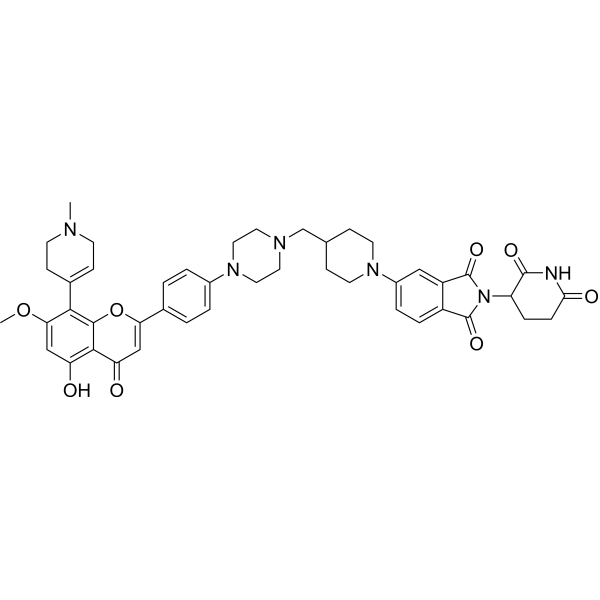 0 ImagesCat. No.: HY-149495CP-07 is a selective flavonoid-based PROTAC degrader that targets and degrades CDK9. CP-07 exhibits an IC50 of 3.3 nM against CDK9/cyclin T1, and induces CDK9 degradation in a concentration-dependent manner in 22RV1 cells with a DC50 of 43 nM. CP-07 rapidly triggers ligand-dependent and proteasome-dependent degradation of CDK9. CP-07 can be applied in prostate cancer-related research.
-
PROTAC CDK9 degrader-11
 0 ImagesCat. No.: HY-170978CAS No.: 3039540-19-4PROTAC CDK9 degrader-11 is an orally active, selective CDK9 PROTAC degrader with a DC50 of 1.09 nM. PROTAC CDK9 degrader-11 recruits CRBN to form a ternary complex and degrades CDK9 via the ubiquitin-proteasome pathway, thereby inhibiting RNA polymerase II phosphorylation and downregulating the expression of anti-apoptotic and pro-oncogenic genes, ultimately inducing apoptosis. PROTAC CDK9 degrader-11 is suitable for research on small-cell lung cancer (SCLC).
-
CDK9-IN-37
 0 ImagesCat. No.: HY-173481CDK9-IN-37 (Compound 24) is a CDK9 inhibitor (EC50: 5.5 nM) with weak inhibition on other CDK isoforms, showing high selectivity. CDK9-IN-37 has significant antiproliferative activity against acute myeloid leukemia MOLM-13 cells (IC50: 0.034 μM). CDK9-IN-37 inhibits the CDK9 signaling pathway, reduces the phosphorylation level of RNAP II CTD (Ser2), downregulates the anti-apoptotic protein McI-1, induces cell apoptosis, and arrests the cell cycle at the G2/M phase. CDK9-IN-37 can be used in the study of acute myeloid leukemia (AML).
-
CDK5-IN-4
 0 ImagesCat. No.: HY-161595CAS No.: 1212711-91-5
-
CDK9 degrader-1
 0 ImagesCat. No.: HY-176451CDK9 degrader-1 is a HyT-type CDK9 degrader that selectively induces protein degradation by recruiting ATG101 (with a DC50 of 0.4073 μM in HCT116 cells). CDK9 degrader-1 recruits ATG101 to initiate the autophagy-lysosome pathway, forming LC3-containing autophagosomes that fuse with lysosomes to degrade CDK9. CDK9 degrader-1 mediates the degradation of Cyclin T1 via the same autophagy-lysosome pathway. CDK9 degrader-1 induces downstream phenotypic effects associated with CDK9 degradation. CDK9 degrader-1 can be used in the research of colorectal cancer (Blue: hydrophobic group; Pnk: CDK9 ligand (HY-50940); Black: linker (HY-N0420)).
-
CDK9 ligand 1
 0 ImagesCat. No.: HY-150889CAS No.: 2118356-94-6CDK9 ligand 1 is a CDK9-targeting ligand. CDK9 ligand 1 can be used for PROTAC synthesis, and serves as the target protein ligand for PROTAC CDK9 Degrader-1 (HY-103628).
-
CDK9-IN-24
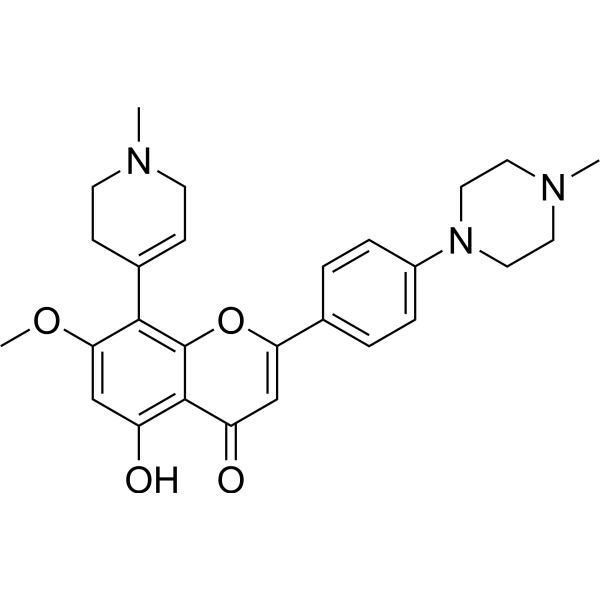 0 ImagesCat. No.: HY-155153CAS No.: 3052935-72-2CDK9-IN-24 (compound 21a) is a highly selective CDK9 inhibitor with significant inhibitory effect on tumor growth. CDK9-IN-24 effectively blocks cell proliferation and induces apoptosis by downregulating Mcl-1 and c-Myc, and can be used in acute myeloid leukemia research.
-
BAY-1112054 hydrochloride
 0 ImagesCat. No.: HY-121081ACAS No.: 1424871-27-1Synonyms: BAY-958 hydrochlorideBAY-1112054 (BAY-958) hydrochloride is a potent PTEFb/CDK9 inhibitor with high selectivity demonstrated, particularly within the CDK family. BAY-1112054 hydrochloride shows strong antiproliferative activity against cancer cell lines such as HeLa and MOLM-13. BAY-1112054 hydrochloride exhibits good metabolic stability. BAY-1112054 hydrochloride effectively inhibits tumor growth in mouse xenograft models without significant toxicity.
-
Rohitukine
 0 ImagesCat. No.: HY-119831CAS No.: 71294-60-5Rohitukine is an orally active CDK9/T1 inhibitor with an IC50 of 0.3 μM. Rohitukine blocks ATP binding sites of CDK2/A and CDK9/T1, suppresses PPARγ, AKT, mTOR, C/EBPα, SREBP-2, and NF-κB signaling, and increases hepatic LXRα expression. Rohitukine induces S-phase cell cycle arrest, ROS generation, apoptosis, and exhibits anti-inflammatory activity. Rohitukine can be used for the research of leukemia, pancreatic cancer, prostate cancer, breast cancer, CNS cancer, ovarian cancer, lung cancer, dyslipidemia, inflammatory diseases, inflammatory bowel disease, and arthritis.
-
SLM6
 0 ImagesCat. No.: HY-136841CAS No.: 22242-91-7SLM6 is a sangivamycin-like molecule. SLM6 is a CDK9 inhibitor. SLM6 inhibits CDK9/cyclin K and CDK9/cyclin T1 kinase activity with IC50s of 280 nM and 133 nM, respectively. SLM6 also inhibits CDK1/cyclin B and CDK2/ cyclin A with IC50s of less than 300 nM. SLM6 induces apoptosis in multiple myeloma (MM) cells.
-
CDK9-IN-34
 0 ImagesCat. No.: HY-164619CAS No.: 252725-86-3
-
CDK9-IN-33
 0 ImagesCat. No.: HY-162619CDK9-IN-33 (compound C35) is a potent, selective and orally active CDK9 inhibitor with IC50 values of 17.44, 160, 316.30, 1771.00, >10000 nM for CDK9, CDK7, CDK2, CDK4, CDK6 respectively. CDK9-IN-33 induces apoptosis. CDK9-IN-33 decreases the protein expression of RPB1 CTD Ser2, RPB1, MCL1. CDK9-IN-33 shows anti-tumor activity.




