MMP
Matrix metalloproteinases
MMP Isoform Specific Products
-
MMP-1
(64)
View all products
-
MMP-2
(147)
View all products
-
MMP-3
(56)
View all products
-
MMP-8
(31)
View all products
-
MMP-9
(186)
View all products
-
MMP-13
(54)
View all products
-
MMP-14
(23)
View all products
-
MMP-17
(3)
View all products
-
ADAM10
(9)
View all products
-
ADAM17
(10)
View all products
-
MMP-7
(23)
View all products
-
MMP-12
(19)
View all products
-
MMP-10
(8)
View all products
-
MMP
(438)
View all products
-
ADAM8
(1)
View all products
-
MMP-19
(1)
View all products
All Product Categories
-
MMP Inhibitors
(597)
View all products
-
MMP Agonists
(2)
View all products
-
MMP Antagonist
(1)
View all products
-
MMP Activators
(35)
View all products
-
MMP Modulators
(3)
View all products
-
MMP Chemicals
(2)
View all products
-
MMP Inducers
(13)
View all products
-
MMP Degrader
(1)
View all products
-
MMP Controls
(5)
View all products
-
MMP Substrates
(14)
View all products
-
MMP Ligands
(3)
View all products
-
Matrix Metalloproteinases Proteins
(41)
View all products
-
MMP-1 Proteins
(2)
View all products
-
MMP-2 Proteins
(7)
View all products
-
MMP-3 Proteins
(2)
View all products
-
MMP-7 Proteins
(2)
View all products
-
MMP-10 Proteins
(1)
View all products
-
MMP-12 Proteins
(2)
View all products
-
MMP-8 Proteins
(7)
View all products
-
MMP-9 Proteins
(11)
View all products
-
MMP-13 Proteins
(1)
View all products
-
MMP-14 Proteins
(1)
View all products
-
ADAM8 Proteins
(4)
View all products
-
ADAM10 Proteins
(1)
View all products
-
ADAM17/TACE Proteins
(3)
View all products
-
MMP Related Products (795)
Related Products (795)

-
Recombinant Proteins (49)
-
Antibodies (15)
-
MMP Isoform Comparison
-
Auraptene (Standard)
 0 ImagesAuraptene (Standard) is the analytical standard of Auraptene. This product is intended for research and analytical applications. Auraptene is an orally active geranyloxycoumarin that can be isolated from plants in the Brassicaceae family, antibacterial, anti-pathogen, antioxidant, anti-tumor, and neuroprotective effects. Auraptene plays an important role in the treatment of various chronic diseases such as hypertension and cystic fibrosis.
-
SC-44463
 0 ImagesCat. No.: HY-114786CAS No.: 104408-38-0SC-44463 is a synthetic collagenase inhibitor. SC-44463 can inhibit tumor cells invasion. SC-44463 can block ovulation, inhibit action of ovarian interstitial collagenase, and inhibit action of the small metalloproteinase of the rat uterus. SC-44463 can be used for the researches of cancer and endocrinology.
-
CPA 926
 0 ImagesCat. No.: HY-105140CAS No.: 169673-60-3CPA 926 is a prodrug of Esculetin (HY-N0284) and is orally active. CPA 926 can inhibit the production of MMP in cartilage explants. CPA 926 can be used for the research of inflammation, such as experimental osteoarthritis.
-
RJF02215
 0 ImagesCat. No.: HY-169062CAS No.: 883028-78-2RJF02215 is an MMP-9 inhibitor. RJF02215 has growth-inhibitory activity on the ovarian cancer SKOV3 cell line. RJF02215 can be used for tumor research.
-
Ageladine A dihydrochloride
 0 ImagesCat. No.: HY-113621BCAS No.: 2757574-06-2Ageladine A dihydrochloride is an inhibitor of matrix metalloproteinase (MMP) isolated from the marine sponge Agelas nakamurai, possessing anti-angiogenic activity. Ageladine A dihydrochloride not only inhibits MMP-2 but also MMP-1, MMP-8, MMP-9, MMP-12, and MMP-13, with IC50 values of 4.65 μM, 2.79 μM, 907.12 nM, 1.83 μM, 767.57 nM, and 1.09 μM, respectively. Additionally, Ageladine A dihydrochloride is a pH-sensitive membrane-permeable dye that emits fluorescence in the blue-green range upon UV excitation, featuring a maximum absorption peak at 370 nm. Furthermore, Ageladine A dihydrochloride serves as a reliable and stable fluorescent pH sensor for detecting changes in intracellular pH values.
-
SDH-IN-25
 0 ImagesCat. No.: HY-172777CAS No.: 3052432-15-9SDH-IN-25 is a succinate dehydrogenase (SDH) inhibitor (IC50 = 4.82 mg/L). SDH-IN-25 exhibited broad-spectrum and potent antifungal activity. SDH-IN-25 mimics the interaction pattern of commercial fungicide Fluxapyroxad (HY-135549) through binding to SDH amino acid residues (TRP173, TYR58, and ARG43). SDH-IN-25 can induce hyphal morphology, interfere with respiratory metabolism by binding to complex II, generate reactive oxygen species (ROS), and affect mitochondrial membrane potential (MMP) in mycelia. SDH-IN-25 can be studied in research for agricultural disease control.
-
α-Solanine (Standard)
 0 ImagesCat. No.: HY-N6602RCAS No.: 20562-02-1α-Solanine (Standard) is the analytical standard of α-Solanine. This product is intended for research and analytical applications. α-solanine, a bioactive component and one of the major steroidal glycoalkaloids in Solanum nigrum, has been observed to inhibit growth and induce apoptosis in cancer cells.
-
Doxycycline monohydrate (Standard)
 0 ImagesCat. No.: HY-W008923RCAS No.: 17086-28-1Doxycycline monohydrate (Standard) is the analytical standard of Doxycycline monohydrate (HY-W008923). Doxycycline monohydrate is an orally active highly lipophilic, tissue-permeable MMP inhibitor with broad-spectrum antibacterial activity. Doxycycline monohydrate is also a semi-synthetic antibiotic with chelating properties, which blocks bacterial protein synthesis and inhibits extracellular matrix degradation through interactions with zinc and calcium atoms. Doxycycline monohydrate also inhibits mitochondrial biogenesis, translation, and the expression of respiratory chain proteins. Doxycycline monohydrate induces apoptosis, inhibits autophagy and EMT, downregulates stem cell markers, and activates the PI3K-AKT pathway, thereby effectively inhibiting the viability and proliferation of cancer cells such as breast cancer cells. Doxycycline monohydrate also promotes the survival and self-renewal of embryonic stem cells and neural stem cells, and reduces the frequency of medium changes in culture. Doxycycline monohydrate has been applied in studies related to breast cancer, prostate cancer, bladder cancer, and other cancers.
-
Antitumor agent-173
 0 ImagesCat. No.: HY-161821Antitumor agent-173 (Compound 4b) is a prodrug of Cycloicaritin (HY-N1940). Antitumor agent-173 is a substrate for OATP2B1. Antitumor agent-173 selectively inhibits the growth of tumor Antitumor agent-173 significantly increases the oral bioavailability of Cycloicaritin and exerts good antitumor activity and safety.
-
Matrix metalloproteinase 3
 0 ImagesCat. No.: HY-P3202CAS No.: 79955-99-0Synonyms: MMP-3; Stromelysin-1Matrix metalloproteinase 3 (MMP-3) is a member of the class of zinc-dependent proteases that can degrade the extracellular matrix (ECM). Matrix metalloproteinase 3 palys an important role in the neuronal apoptotic process as well as in neuroinflammation. Matrix metalloproteinase 3 can be used in the study of neurodegenerative diseases including Alzheimer’s disease (AD) and Parkinson’s disease (PD).
-
Berkeleyamide C
 0 ImagesCat. No.: HY-N16409CAS No.: 1019854-23-9Berkeleyamide C is a selective matrix metalloproteinase-3 (MMP-3) and caspase-1 inhibitor. Berkeleyamide C blocks MMP-3-mediated tumor cell invasion and metastasis, as well as the abnormal activation of inflammation and apoptosis related to caspase-1. Berkeleyamide C is promising for research of cancers and inflammation-related diseases.

-
Mmp8 Rat Pre-designed siRNA Set A
 0 ImagesCat. No.: HY-RS08556
Mmp8 Rat Pre-designed siRNA Set A contains three designed siRNAs for Mmp8 gene (Rat), as well as a negative control, a positive control, and a FAM-labeled negative control.
-
C-telopeptide acetate
 0 ImagesCat. No.: HY-P0284BPurity: 98.03%C-telopeptide acetate is a cross-linked peptide of type I collagen that is released during bone resorption and correlates with bone mineral density (BMD). C-telopeptide acetate can be used in studies related to postmenopausal osteoporosis.
-
ADAM17-IN-1
 0 ImagesCat. No.: HY-175876CAS No.: 1802395-34-1ADAM17-IN-1 is a selective inhibitor of ADAM17. ADAM17-IN-1 inhibits ADAM17 activity to reduce metabolic activity of dendritic cells (DCs), impair DC antigen-presenting function, suppress allergen-specific Th2 cell polarization, and reduce Th2 cytokine (IL-4, IL-5, IL-13) secretion. ADAM17-IN-1 demonstrates protective efficacy against house dust mite (HDM)-induced type 2/eosinophilic airway inflammation in mice. ADAM17-IN-1 can be used for the study of type 2-high allergic asthma.
-
MAHS-3
 0 ImagesCat. No.: HY-187513MAHS-3 is a thymidylate synthase (TS) and dihydrofolate reductase (DHFR) inhibitor, with IC50 values of 5.279 μM and 52.60 μM against human targets, respectively. MAHS-3 exhibits broad-spectrum antiproliferative activity against cancer cells, induces cell cycle arrest, activates endogenous caspase-dependent apoptosis, reduces MMP levels, inhibits cell migration, increases intracellular NO levels, and promotes autophagy activity. MAHS-3 can be used in cancer-related research.
-
Anti-inflammatory agent 121
 0 ImagesCat. No.: HY-137839CAS No.: 927827-98-3Anti-inflammatory agent 121 is a protease inhibitor, with IC50 values against different targets as follows: 1.3 μM (Staphylococcus aureus type I staphylokinase), 2.2 μM (Staphylococcus aureus type II staphylokinase), 2.3 μM (human MMP-1), 2.7 μM (human MMP-2), 1.4 μM (human MMP-8), 4.6 μM (human MMP-9), and 79 μM (human ADAM17). Anti-inflammatory agent 121 inhibits the activities of staphylococcal serine protease glutamyl endopeptidase (V8 protease) and cysteine protease staphylococcal protease B in Staphylococcus aureus cultures. Anti-inflammatory agent 121 inhibits protease activity in skin wash samples, metalloprotease (staphylokinase) activity in Staphylococcus aureus culture supernatants, and staphylokinase-mediated activation of pro-urokinase-type plasminogen activator (pro-uPA). Anti-inflammatory agent 121 can be used in the research of atopic dermatitis.
-
Viridicatol (Standard)
 0 ImagesCat. No.: HY-116474RCAS No.: 14484-44-7Viridicatol (Standard) is the analytical standard of Viridicatol (HY-116474). This product is intended for research and analytical applications. Viridicatol is a quinolone alkaloid with anti-inflammatory, antibacterial, antifungal, osteogenic and chondrogenic activities. Viridicatol reduces the phosphorylation levels of ERK, JNK, p38 and STAT6; inhibits MMP-2, MMP-9, NF-κB signaling pathway and PTP1B; downregulates genes related to mast cell activation; and binds to SHN3 to activate the Wnt/SHN3 signaling pathway. Viridicatol inhibits the expression of pro-inflammatory mediators and cytokines, and promotes osteogenic/chondrogenic differentiation. Viridicatol can be used in studies related to fibrosarcoma, allergy, bacterial infection, fungal infection and osteoporosis.
-
Dnp-PLGLWAr-NH2
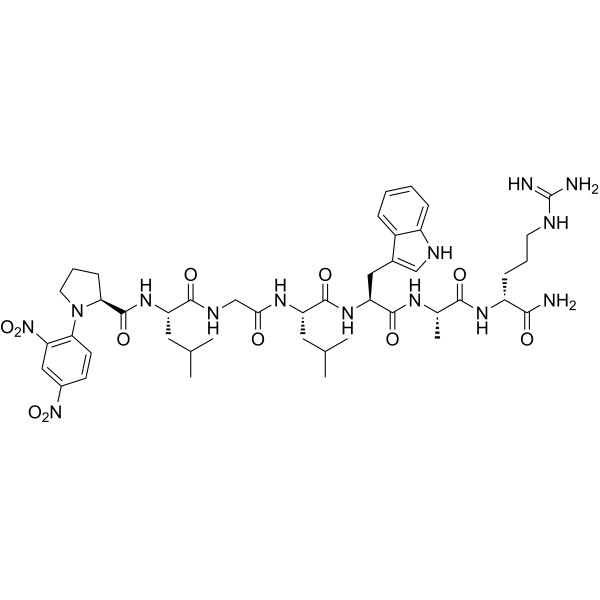 0 ImagesCat. No.: HY-P10139CAS No.: 121282-17-5Dnp-PLGLWAr-NH2 is a synthetic collagenase/gelatinase substrate. Dnp-PLGLWAR-NH2 can be used to quantify total MMP activity in APMA-activated conditioned medium samples.