



Microtubule/Tubulin
Microtubules are a component of the cytoskeleton, found throughout the cytoplasm. These tubular polymers of tubulin can grow as long as 50 micrometres, with an average length of 25 µm, and are highly dynamic. The outer diameter of a microtubule is about 24 nm while the inner diameter is about 12 nm. Microtubules are found in eukaryotic cells and are formed by the polymerization of a dimer of two globular proteins, alpha and beta tubulin. Tubulin is one of several members of a small family of globular proteins. The tubulin superfamily includes five distinct families, the alpha-, beta-, gamma-, delta-, and epsilon-tubulins and a sixth family which is present only in kinetoplastid protozoa. The most common members of the tubulin family are α-tubulin and β-tubulin, the proteins that make up microtubules. Microtubules are very important in a number of cellular processes. They are involved in maintaining the structure of the cell.
All Product Categories
-
Microtubule/Tubulin Inhibitors
(812)
View all products
-
Microtubule/Tubulin Agonists
(2)
View all products
-
Microtubule/Tubulin Antagonist
(1)
View all products
-
Microtubule/Tubulin Activators
(21)
View all products
-
Microtubule/Tubulin Modulators
(20)
View all products
-
Microtubule/Tubulin Inducers
(5)
View all products
-
Microtubule/Tubulin Degraders
(3)
View all products
-
Microtubule/Tubulin Controls
(19)
View all products
-
Microtubule/Tubulin Ligands
(5)
View all products
-
Microtubule/Tubulin Related Products (1003)
Related Products (1003)

-
Antibodies (69)
-
Podofilox (Standard)
 0 ImagesPodofilox (Standard) is the analytical standard of Podofilox. This product is intended for research and analytical applications. Podofilox (Podophyllotoxin) is a potent inhibitor of microtubule assembly and DNA topoisomerase II.
-
(R)-Colchicine
 0 ImagesCat. No.: HY-W741136CAS No.: 75520-89-7(R)-Colchicine is the R-isomer of Colchicine (HY-16569). Colchicine, an orally active alkaloid, is a potent tubulin inhibitor and a microtubule disrupting agent. Colchicine inhibits microtubule polymerization with an IC50 of 3 nM. Colchicine is also a competitive antagonist of the α3 glycine receptors (GlyRs). Colchicine prevents non-steroidal anti-inflammatory drug (NSAID)-induced small intestinal injury by inhibiting activation of the NLRP3 inflammasome. Colchicine has extensive anti-inflammatory, immunosuppressive and strong anti-fibrosis effects and has the potential for gouty arthritis research.
-
(±)-Evodiamine (Standard)
 0 Images(±)-Evodiamine Standard is the analytical standard of (±)-Evodiamine (HY-N0114A). This product is intended for research and analytical applications. (±)-Evodiamine is an orally active indoloquinazoline alkaloid composed of equal amounts of enantiomers, with (+)-Evodiamine exerting the primary biological functions. (±)-Evodiamine is a Top1 inhibitor and a TRPV1 receptor agonist. (±)-Evodiamine induces cell cycle arrest and apoptosis by inhibiting Top1 and disrupting Tubulin polymerization, suppresses oncogenic signaling pathways such as NF-κB and Akt, and specifically agonizes TRPV1 receptors to regulate neuropeptide release and energy metabolism. (±)-Evodiamine is used in research on traumatic brain injury, obesity, cancer, neuropathy, dry eye disease, and colitis.
-
Monomethyl auristatin E intermediate-13
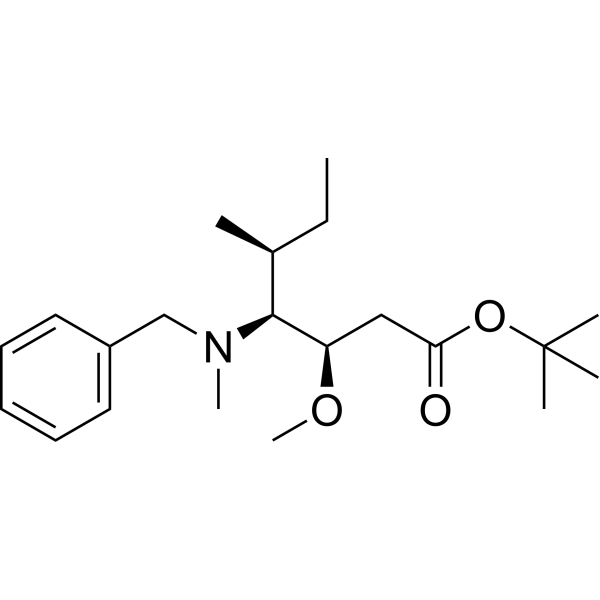 0 ImagesCat. No.: HY-78911CAS No.: 870640-64-5Monomethyl auristatin E intermediate-13 is an intermediate reagent in the synthesis of Monomethyl auristatin E (HY-15162). Monomethyl auristatin E (MMAE) is a microtubule/tubulin inhibitor with anticancer activity. MMAE is widely used as the cytotoxic component (ADC Cytotoxin) of antibody-drug conjugates (ADCs).
-
5HPP-33
 0 ImagesCat. No.: HY-114545CAS No.: 105624-86-05HPP-33 is an inhibitor for tubulin polymerization with IC50 of 8.1 μM. 5HPP-33 inhibits the proliferation of leukemia cell and multiple myeloma cells with IC50 of 1-10 μM, arrests the cell cycle at G2/M phase, and induces apoptosis.
-
Cemadotin
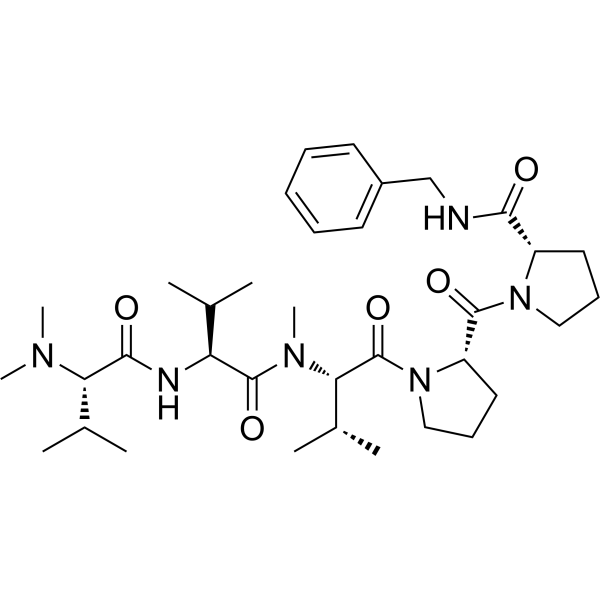 0 ImagesCat. No.: HY-13589CAS No.: 159776-69-9Synonyms: LU103793 free baseCemadotin (LU103793) is a water-soluble synthetic analogue of Dolastatin 15 (HY-P1126) that inhibits cell proliferation in vitro and the growth of tumor xenografts in mice. Cemadotin blocks cells at mitosis, and exhibits Ki value of 1 μM for inhibiting tubulin. Cemadotin can be used to research anticancer.
-
MPT0B392 (Standard)
 0 ImagesCat. No.: HY-101287RCAS No.: 1346169-92-3MPT0B392 (Standard) is the analytical standard of MPT0B392 (HY-101287). This product is intended for research and analytical applications. MPT0B392, an orally active quinoline derivative, induces c-Jun N-terminal kinase (JNK) activation, leading to apoptosis. MPT0B392 inhibits tubulin polymerization and triggers induction of the mitotic arrest, followed by mitochondrial membrane potential loss and caspases cleavage by activation of JNK and ultimately leads to apoptosis. MPT0B392 is demonstrated to be a novel microtubule-depolymerizing agent and enhances the cytotoxicity of sirolimus in sirolimus-resistant acute leukemic cells and the multidrug resistant cell line.
-
Verubulin hydrochloride (Standard)
 0 ImagesCat. No.: HY-12098RCAS No.: 917369-31-4Synonyms: MPC-6827 hydrochloride (Standard)Verubulin (hydrochloride) (Standard) is the analytical standard of Verubulin (hydrochloride). This product is intended for research and analytical applications. Verubulin hydrochloride (MPC-6827 hydrochloride) is a blood brain barrier permeable microtubule-disrupting agent, with potent and broad-spectrum in vitro and in vivo cytotoxic activities. Verubulin hydrochloride (MPC-6827 hydrochloride) exhibits potent anticancer activity in human MX-1 breast and other mouse xenograft cancer models. Verubulin hydrochloride (MPC 6827 hydrochloride) is a promising candidate for the treatment of multiple cancer types.
-
EHT-6706 free base
 0 ImagesCat. No.: HY-117587CAS No.: 1351592-10-3EHT-6706 free base is a tubulin inhibitor with an IC50 value of 1 μM against porcine tubulin. EHT-6706 free base binds to the colchicine-binding site on tubulin to inhibit tubulin polymerization and disrupt the cellular microtubule network. EHT-6706 free base acts as an antiproliferative, vascular-disrupting, permeability-modulating, migration-inhibiting and antiangiogenic agent. EHT-6706 free base exhibits inhibitory activity against human tumor cells. EHT-6706 free base can be used in cancer and angiogenesis research.

-
Combretastatin A-1 (Standard)
 0 ImagesCat. No.: HY-121993RCAS No.: 109971-63-3Combretastatin A-1 (Standard) is the analytical standard of Combretastatin A-1. This product is intended for research and analytical applications. Combretastatin A-1 is a microtubule polymerization inhibitor that binds to the colchicine-binding site of tubulin. Combretastatin A-1 inhibits the Wnt/β-catenin pathway through tubulin depolymerization mediated AKT deactivation. Combretastatin A-1 exhibits anti-tumor and anti-vascular effects.
-
ADC Control Human IgG1-vcMMAE (DAR8)
 0 ImagesCat. No.: HY-185830ADC Control Human IgG1-vcMMAE (DAR8) is an antibody-drug conjugate (ADCs), serving as an isotype control for ADC human IgG1-vcMMAE, and inhibits tubulin polymerization. The antibody moiety of ADC Control Human IgG1-vcMMAE (DAR8) is Human IgG1 kappa, Isotype Control (HY-P99001), while the cytotoxic payload and linker moiety are VcMMAE (HY-15575). ADC Control Human IgG1-vcMMAE can be used in cancer-related research.
-
MAP4343 (Standard)
 0 ImagesCat. No.: HY-107116RCAS No.: 511-26-2MAP4343 (Standard) is the analytical standard of MAP4343 (HY-107116). This product is intended for research and analytical applications. MAP4343 is the 3-methylether derivative of Pregnenolone. MAP4343 binds in vitro to microtubule-associated protein 2 (MAP2), stimulates the polymerization of tubulin, enhances the extension of neurites and protects neurons against neurotoxic agents.
-
DM1-SMe (Standard)
 0 ImagesCat. No.: HY-100128RCAS No.: 138148-68-2
-
Tubulozole hydrochloride
 0 ImagesCat. No.: HY-119169ACAS No.: 83086-73-1Synonyms: R 46846 hydrochlorideTubulozole hydrochloride (R 46846 hydrochloride) is an orally active inhibitor of tubulin polymerization with an ID50 of 0.34 μM. Tubulozole hydrochloride induces activation of the Chk1 kinase and phosphorylation of ERK1/2, which is required for microtubule formation. Tubulozole hydrochloride arrests Mitosis at the metaphase stage. Tubulozole hydrochloride causes cells to accumulate in the radiosensitive mitotic phase of the cell cycle. Tubulozole hydrochloride exerts anticancer activity against colon cancer. Tubulozole hydrochloride produces a radiosensitizing effect in mouse tumor models and enhances the tumor growth delay effect when combined with γ-ray irradiation. Tubulozole hydrochloride is used in studies related to colon cancer, fascioliasis, MO4 fibrosarcoma, and Lewis lung carcinoma.
-
Monomethyl auristatin E intermediate-16
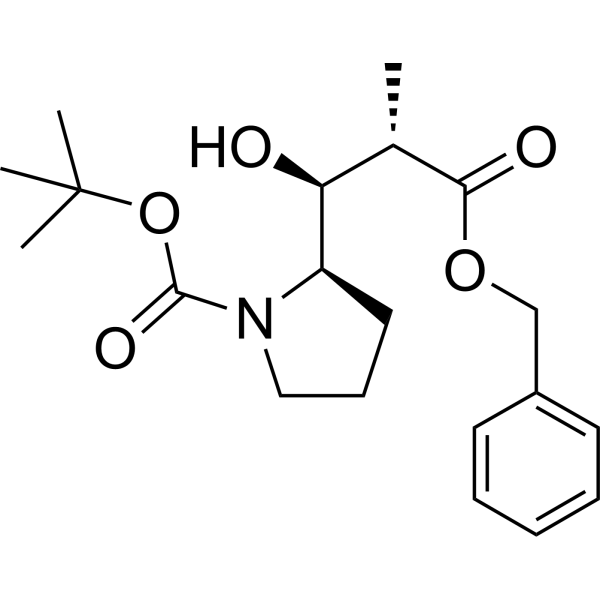 0 ImagesCat. No.: HY-79198CAS No.: 2380991-16-0Monomethyl auristatin E intermediate-16 is an intermediate reagent in the synthesis of Monomethyl auristatin E (HY-15162). Monomethyl auristatin E (MMAE) is a microtubule/tubulin inhibitor with anticancer activity. MMAE is widely used as the cytotoxic component (ADC Cytotoxin) of antibody-drug conjugates (ADCs).
-
ABT-751 (Standard)
 0 ImagesSynonyms: E7010 (Standard)ABT-751 (Standard) is the analytical standard of ABT-751. This product is intended for research and analytical applications. ABT-751 (E7010) is a novel, highly orally bioavailable sulfonamides antimitotic compound and tubulin binder. It prevents tubulin aggregation by binding to the colchicine site on β-tubulin, leading to cell cycle arrest in G2/M phase and inducing apoptosis, thus effectively preventing cell division. ABT-751 induces autophagy by inhibiting the AKT/MTOR signaling pathway. ABT-751 showed significant inhibition against various types of cancer cells, including lung, gastric, colon, and breast cancer.
-
Combretastatin A4 (Standard)
 0 ImagesSynonyms: CRC 87-09 (Standard)Combretastatin A4 is a microtubule-targeting agent that binds β-tubulin with Kd of 0.4 μM.
-
Cytochalasin J
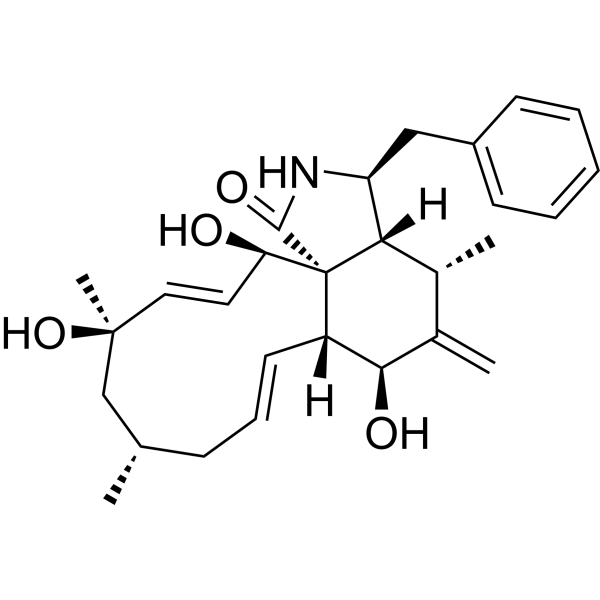 0 ImagesCat. No.: HY-126556CAS No.: 53760-20-6Cytochalasin J is a cytochalasin detivative. Cytochalasin J affects mitotic spindel microtubule organization and kinetochore structure, and exhibits cytotoxicity in human leukemia K562 cell with IC50 of 1.5 μM.




