



NF-κB
Nuclear factor-κB; Nuclear factor-kappaB
NF-κB (Nuclear factor kappa-light-chain-enhancer of activated B cells) is a protein complex that controls transcription of DNA. NF-κB is found in almost all animal cell types and is involved in cellular responses to stimuli such as stress, cytokines, free radicals, ultraviolet irradiation, oxidized LDL, and bacterial or viral antigens. NF-κB plays a key role in regulating the immune response to infection. Incorrect regulation of NF-κB has been linked to cancer, inflammatory, and autoimmune diseases, septic shock, viral infection, and improper immune development. NF-κB has also been implicated in processes of synaptic plasticity and memory. There are five proteins in the mammalian NF-κB family: NF-κB1, NF-κB2, RelA, RelB, c-Rel.
NF-κB Isoform Specific Products
All Product Categories
-
NF-κB Inhibitors
(1610)
View all products
-
NF-κB Agonists
(6)
View all products
-
NF-κB Antagonist
(1)
View all products
-
NF-κB Activators
(142)
View all products
-
NF-κB Modulators
(34)
View all products
-
NF-κB Inducers
(3)
View all products
-
NF-κB Degraders
(4)
View all products
-
NF-κB Controls
(7)
View all products
-
NF-κB Ligands
(2)
View all products
-
NF-κB Related Products (1943)
Related Products (1943)

-
Antibodies (32)
-
NF-κB Signaling Pathway
-
NF-κB Isoform Comparison
-
NF-κB-IN-13
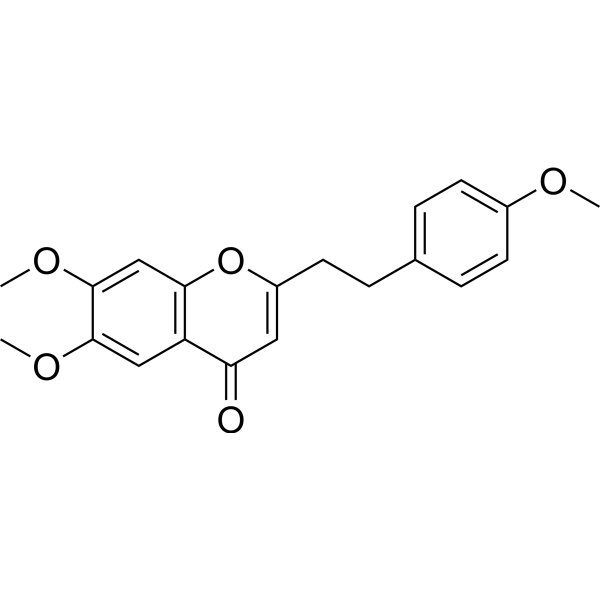 0 ImagesCat. No.: HY-N12283CAS No.: 117596-92-6NF-κB-IN-13 (compound 12) can significantly inhibit LPS-induced NF-κB activation and NO production in RAW264.7 macrophages. NF-κB-IN-13 has anti-inflammatory effects.
-
Dihydrodaidzein (Standard)
 0 ImagesCat. No.: HY-N1461RCAS No.: 17238-05-0Synonyms: (±)-Dihydrodaidzein (Standard)Dihydrodaidzein (Standard) ((±)-Dihydrodaidzein (Standard)) is the analytical standard of Dihydrodaidzein (HY-N1461). This product is intended for research and analytical applications. Dihydrodaidzein is a dietary phytoestrogen. Dihydrodaidzein possesses functions including antioxidation, inhibition of DNA oxidative damage, regulation of lipid metabolism and maintenance of intestinal flora stability. Dihydrodaidzein induces apoptosis, regulates immune responses, modulates tumor-related factors, activates the Bmp-2 signaling pathway, inhibits NF-κB and MAPK, and exhibits anti-inflammatory activity. Dihydrodaidzein can be used in research related to cancer, cardiovascular diseases, osteoporosis and inflammatory diseases.
-
QNZ (Standard)
 0 ImagesSynonyms: EVP4593 (Standard)QNZ (Standard) is the analytical standard of QNZ. This product is intended for research and analytical applications. QNZ (EVP4593) shows strong inhibitory effects on NF-κB transcriptional activation and TNF-α production with IC50s of 11 and 7 nM, respectively. QNZ (EVP4593) is a neuroprotective inhibitor of SOC channel.
-
Neoandrographolide (Standard)
 0 ImagesCat. No.: HY-N0721RCAS No.: 27215-14-1Synonyms: Neoandrographiside (Standard)Neoandrographolide (Standard) is the analytical standard of Neoandrographolide. This product is intended for research and analytical applications. Neoandrographolide is a diterpenoid compound isolated from Andrographis paniculata. Neoandrographolide inhibits osteoclasts differentiation and bone resorption through inhibition of MAPK/NF-κB/PI3K/AKT/GSK3β/PPAR/CAMK signaling pathway. Neoandrographolide inhibits apoptosis in rat embryonic ventricular cardiomyocytes. Neoandrographolide inhibits iNOS and the generation of ROS, activates eNOS, exhibiting anti-inflammatory and hypolipidemic activity.
-
Tofacitinib-d3
 0 ImagesCat. No.: HY-40354S5Synonyms: Tasocitinib-d3; CP-690550-d3Tofacitinib-d3 (Tasocitinib-d3; CP-690550-d3) is the deuterated-labeled Tofacitinib (HY-40354). Tofacitinib (Tasocitinib) is an orally active, blood-brain barrier permeable selective inhibitor of JAK1/JAK3. Tofacitinib blocks the JAK-STAT/NF-κB signaling pathway, inhibits cytokine signal transduction, phosphorylation of STAT1/STAT5, and suppresses innate and adaptive immune responses. Tofacitinib can be used in research related to major depressive disorder, rheumatoid arthritis, pulmonary diseases, systemic lupus erythematosus, and immune-mediated liver injury.
-
Emavusertib tosylate
 0 ImagesCat. No.: HY-135317CCAS No.: 2376399-41-4Synonyms: CA-4948 tosylateEmavusertib tosylate (CA-4948 tosylate) is the tosylate salt form of Emavusertib (HY-135317). Emavusertib tosylate is an orally active inhibitor for IRAK4 (IC50=57 nM) and FLT3. Emavusertib tosylate inhibits NF-κB and MyD88 signaling pathways, reduces the generation of pro-inflammatory cytokines like IL-6 and IL-10, thereby exhibiting anti-inflammatory and anti-proliferative activities against cancer cells, leading to cell apoptosis. Emavusertib tosylate exhibits antitumor activity in mouse model.
-
Olprinone hydrochloride solution
 0 ImagesCat. No.: HY-FL14254BCAS No.: 2072803-95-1Synonyms: Loprinone hydrochloride hydrate solutionOlprinone hydrochloride solution is mainly composed of Olprinone hydrochloride hydrate (HY-14254B). Olprinone hydrochloride hydrate is a potent phosphodiesterase (PDE) 3 inhibitor, with IC50s of 150, 100, 0.35 and 14 μM for PDE1, PDE2, PDE3 and PDE4, respectively. Olprinone hydrochloride hydrate has anti-inflammatory activity, and is used for the research of heart failure due to its positive inotropic and vasodilative effects. Anti-inflammatory activity
-
Nimbolide (Standard)
 0 ImagesCat. No.: HY-116035RCAS No.: 25990-37-8Nimbolide (Standard) is the analytical standard of Nimbolide. This product is intended for research and analytical applications. Nimbolide is a triterpene compound that can be isolated from neem (Azadirachta indica), possesses anticancer and antiproliferative activity. Nimbolide induces tumor cell apoptosis by inhibiting NF-κB and CDK4/CDK6 kinase. Nimbolide suppresses the Wnt, PI3K-Akt, MAPK and JAK-STAT signaling pathways.
-
Bengamide B
 0 ImagesCat. No.: HY-110151CAS No.: 104947-69-5Bengamide B is an alkaloid with anti-tumor and anti-inflammatory activities. Bengamide B reduces the phosphorylation level of IκBα, thereby blocking the activation of NF-κB. Bengamide B inhibits the proliferation of tumor cells. Bengamide B can be used in research related to inflammatory diseases and cancers.
-
BSF2
 0 ImagesCat. No.: HY-183008CAS No.: 179118-06-0BSF2 is a anti-Leishmania agent. BSF2 modulates gene expression linked to ubiquitination, chromatin remodeling, and peroxisomal membrane transport pathways in Leishmania braziliensis. BSF2 downregulates TNF, IL-17, NF-κB, and Toll-like receptor pathways in Leishmania-infected macrophages. BSF2 exerts leishmanicidal activity against intracellular Leishmania braziliensis amastigotes. BSF2 can be used for the research of american tegumentary leishmaniasis.
-
Perindopril-d5
 0 ImagesCat. No.: HY-B0130S1Synonyms: S-9490-d5Perindopril-d5 (S-9490-d5) is deuterium labeled Perindopril. Perindopril (S-9490) is an orally available, long-acting angiotensin-converting enzyme (ACE) inhibitor. Perindopril inhibits inflammatory cell influx and intimal thickening, preserving elastin on the inside of the aorta. Perindopril effectively inhibits experimental abdominal aortic aneurysm (AAA) formation in a rat model and reduces pulmonary vasoconstriction in rats with pulmonary hypertension.
-
Quercetagitrin (Standard)
 0 ImagesQuercetagitrin (Standard) is the analytical standard of Quercetagitrin. This product is intended for research and analytical applications. Quercetagitrin (Quercetagetin-7-O-glucoside) is a natural product that can be isolated from the African marigold (Tagetes erecta). Quercetagitrin has anti-inflammatory activity. Quercetagitrin inhibits Tau accumulation. Quercetagitrin can reverse neuroinflammation and cognitive deficits in P301S-Tau transgenic mouse model through inhibiting NF-κB activation. Quercetagitrin is a dual-target inhibitor of PTPN6 (IC50 = 1 μM) and PTPN9 (IC50 = 1.7 μM). Quercetagitrin enhances glucose uptake by mature C2C12 myoblasts. Quercetagitrin can be studied in research for Alzheimer’s disease and type 2 diabetes.
-
5-Aminosalicylic acid-d3 disodium
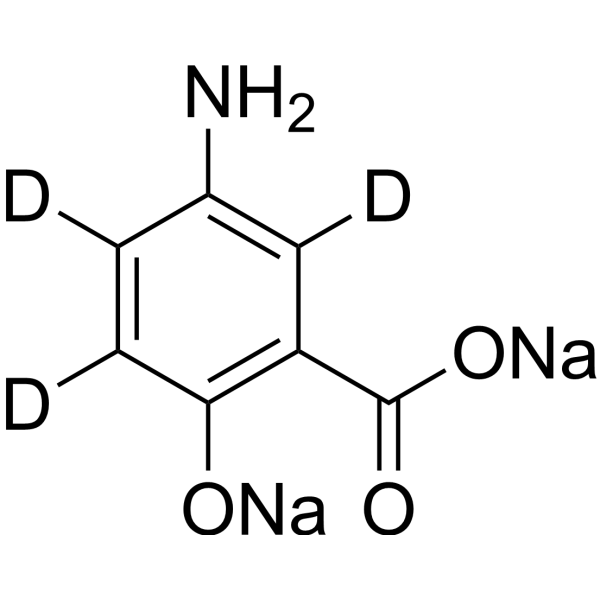 0 ImagesCat. No.: HY-15027S3Synonyms: Mesalamine-d3 disodium; 5-ASA-d3 disodium; Mesalazine-d3 disodium5-Aminosalicylic acid-d3 disodium is deuterated labeled 5-Aminosalicylic Acid (HY-15027). 5-Aminosalicylic acid (Mesalamine) acts as a specific PPARγ agonist and also inhibits p21-activated kinase 1 (PAK1) and NF-κB.5-Aminosalicylic acid can inhibit the activity of osteopontin (OPN).
-
LASSBio-1829 hydrochloride
 0 ImagesCat. No.: HY-118973CAS No.: 1807810-16-7LASSBio-1829 hydrochloride is an orally active IKK2 inhibitor with an IC50 of 3.8 μM against the human target (Sf21 cells). LASSBio-1829 hydrochloride blocks signal transduction of the inflammation-associated NF-κB activation pathway. LASSBio-1829 hydrochloride reduces leukocyte migration, TNF-α biosynthesis, ROS production and NO production. LASSBio-1829 hydrochloride exhibits anti-inflammatory activity in a carrageenan-induced subcutaneous air pouch mouse model. LASSBio-1829 hydrochloride alleviates licking behavior during the inflammatory phase of the mouse formalin test. LASSBio-1829 hydrochloride can be used in inflammation-related research.
-
11-Keto-beta-boswellic acid (Standard)
 0 ImagesCat. No.: HY-N2056RCAS No.: 17019-92-0Synonyms: 11-Keto-β-boswellic acid (Standard)11-Keto-beta-boswellic acid (Standard) is the analytical standard of 11-?Keto-?beta-?boswellic acid. This product is intended for research and analytical applications. 11-Keto-beta-boswellic acid (11-Keto-β-boswellic acid) is a pentacyclic triterpenic acid of the oleogum resin from the bark of the Boswellia serrate tree, popularly known as Indian Frankincense. 11-Keto-beta-boswellic acid has the anti-inflammatory activity is primarily due to inhibit 5-lipoxygenase (5-LOX) and subsequent leukotriene and nuclear factor-kappa B (NF-κB) activation and tumor necrosis factor alpha generation production.
-
CGP-43182
 0 ImagesCat. No.: HY-116192CAS No.: 150379-37-6CGP-43182 is a secretory phospholipase A2 group II (sPLA2) inhibitor with an IC50 of 2.8 μM. CGP-43182 binds to the active site of the enzyme, blocks IL1β-stimulated gene expression and NFκB activation, and inhibits the production of prostaglandin and nitric oxide (NO). CGP-43182 exhibits anti-inflammatory activity in multiple inflammatory models and can be used for studies on adjuvant arthritis, carrageenan-induced edema, pertussis pleurisy, and glomerular inflammatory responses.
-
GO-Y078
 0 ImagesCat. No.: HY-137059CAS No.: 1217503-60-0GO-Y078 is a curcumin (HY-N0005) analog. GO-Y078 activates p38/JNK1/2. GO-Y078 activates the MAPK pathway, Caspase 3/8/9, PARP, AP-1, DR5, and TP53, while inhibiting cIAP-1, XIAP, and NF-κB. GO-Y078 induces sub-G1/G2/M phase arrest and Apoptosis. GO-Y078 impairs angiogenesis. GO-Y078 can be used in research related to osteosarcoma, cervical cancer, oral squamous cell carcinoma, and peritoneal metastasis of gastric cancer.
-
Anti-osteoporosis agent-11
 0 ImagesCat. No.: HY-168090CAS No.: 2869099-50-1Anti-osteoporosis agent-11 (compound 3k) is an anti-osteoporosis compound targeting osteoclasts. Anti-osteoporosis agent-11 has the most significant inhibitory effect on osteoclast differentiation, with an IC50 value of 0.36 μM. In addition, Anti-osteoporosis agent-11 inhibits osteoclast formation, bone resorption, and the expression of osteoclast-specific genes by blocking rankl-induced mitogen-activated protein kinase (MAPK) and NF-κB signaling pathways.
-
Lambertellin
 0 ImagesCat. No.: HY-124508CAS No.: 28980-51-0Lambertellin is an effective antibiotic that can be used as a bactericide and as a fungicide. Lambertellin exerts its anti-inflammatory effect in LPS (HY-D1056)-stimulated RAW 264.7 macrophage cells by modulating the activation of the MAPK and NF-κB signaling pathways.
-
Sipeimine (Standard)
 0 ImagesCat. No.: HY-N0696RCAS No.: 61825-98-7Synonyms: Imperialine (Standard)Sipeimine (Standard) is the analytical standard of Sipeimine (HY-N0696R). Sipeimine (Imperialine) is an inhibitor targeting the PI3K/AKT/NF-κB pathway and NLRP3 inflammasome, which can competitively bind to PI3K and p65. Sipeimine inhibits PI3K/AKT phosphorylation, blocks NF-κB nuclear translocation and NLRP3 inflammasome activation. Sipeimine exerts anti-inflammatory activities, inhibits pyroptosis and ferroptosis, and protects the extracellular matrix. Sipeimine can reduce cartilage degradation and synovial inflammation in osteoarthritis and improve PM2.5-induced lung injury. Sipeimine is mainly used in the study of anti-inflammatory and degenerative diseases.




