



PARP
poly ADP ribose polymerase
PARP is a family of proteins involved in a number of cellular processes involving mainly DNA repair and programmed cell death. The PARP family comprises 17 members. They have all very different structures and functions in the cell. PARP1, PARP2, VPARP (PARP4), Tankyrase-1 and -2 (PARP-5a or TNKS, and PARP-5b or TNKS2) have a confirmed PARP activity. Others include PARP3, PARP6, TIPARP (or PARP7), PARP8, PARP9, PARP10, PARP11, PARP12, PARP14, PARP15, and PARP16. PARP is found in the cell’s nucleus. The main role is to detect and signal single-strand DNA breaks (SSB) to the enzymatic machinery involved in the SSB repair.
PARP Isoform Specific Products
-
PARP
(307)
View all products
-
PARP1
(212)
View all products
-
PARP2
(84)
View all products
-
PARP3
(23)
View all products
-
PARP4
(11)
View all products
-
TNKS1/
PARP5A (41)View all products
-
TNKS2/
PARP5B (38)View all products
-
PARP7
(25)
View all products
-
PARP10
(20)
View all products
-
PARP14
(17)
View all products
-
PARP15
(14)
View all products
-
PARP12
(4)
View all products
-
PARP16
(3)
View all products
All Product Categories
-
PARP Inhibitors
(464)
View all products
-
PARP Agonists
(4)
View all products
-
PARP Activators
(111)
View all products
-
PARP Modulators
(13)
View all products
-
PARP Inducers
(20)
View all products
-
PARP Degraders
(25)
View all products
-
PARP Substrate
(1)
View all products
-
PARP Ligands
(4)
View all products
-
PARP Related Products (702)
Related Products (702)

-
Antibodies (11)
-
PARP Isoform Comparison
-
Calactin
 0 ImagesCat. No.: HY-167237CAS No.: 20304-47-6Calactin is a glycoside that can be isolated from Asclepias curassavica L.. Calactin activates caspase-3, caspase-8, caspase-9, and phosphorylates ERK. Calactin induces DNA damage, apoptosis, PARP cleavage, G2/M phase cell cycle arrest, shifts Bax/Bcl-2 expression, and shows anti-proliferation effects in leukemia cells. Calactin can be used for the research of leukemia.
-
BCS12
 0 ImagesBCS12 is a CAIX inhibitor. BCS12 inhibits the viability of cancer cells under hypoxic conditions. BCS12 elevates ROS levels and suppresses the expression of HIF-1α and CA9. BCS12 downregulates Bcl-2, activates caspase-9, caspase-3, caspase-7 and Bax, and induces PARP cleavage and apoptosis. BCS12 reduces tumor burden, increases the number of apoptotic nuclei and restores tissue structure in rats bearing breast tumors. BCS12 can be used in research related to triple-negative breast cancer.
-
PARP1-IN-54
 0 ImagesCat. No.: HY-185143CAS No.: 2915309-47-4PARP1-IN-54 (example 5) is a PARP1 inhibitor with antitumor effects.
-
PARP1-IN-47
 0 ImagesCat. No.: HY-178468CAS No.: 3053592-61-0
-
Oxychlororaphine (Standard)
 0 ImagesCat. No.: HY-W042191RCAS No.: 550-89-0Oxychlororaphine (Standard) is the analytical standard of Oxychlororaphine. This product is intended for research and analytical applications. Oxychloroaphine could be isolated from the bacterium Pantoea agglomerans naturally present in soil. Oxychloroaphine has broad-spectrum antifungal activity. Oxychloroaphine has cytotoxicity in a dose-dependent manner and induces apoptosis. Oxychloroaphine can be used in research of cancer[1][2].

-
Chlorin e6 (solution)
 0 ImagesCat. No.: HY-DY1092CAS No.: 19660-77-6Synonyms: Ce6 (solution)Chlorin e6 (solution) (Ce6 (solution)) is a photosensitizer and has strong absorption peaks at wavelength of 402 and 662 nm, as well as exhibiting intense fluorescence at 668 nm. Chlorin e6 has antimicrobial efficacy and anticancer activity. Chlorin e6 induces cell apoptosis via caspase-3 activation and can be used for the research of cancer.
Solvent and concentration: DMSO: 10 mM
The 1 mL volume is defined as the base specification. All larger sizes correspond to incremental volumes of this base.
-
RPS6-IN-1
 0 ImagesCat. No.: HY-161874RPS6-IN-1 (Compound 22o) inhibits cell metastasis, induces cell apoptosis (increases the expression of Bax, p53, cleaved-caspase 3, and cleaved-PARP). RPS6-IN-1 decreases mitochondrial membrane potential. RPS6-IN-1 activates autophagy through the PI3K-Akt-mTOR signaling pathway, damages intracellular mitochondria and lysosomes, and cause ER stress. RPS6-IN-1 inhibits RPS6 phosphorylation. RPS6-IN-1 is an anticancer agent with low systemic toxicity.
-
Sorafenib-d3 tosylate
 0 ImagesCat. No.: HY-10201S4CAS No.: 1333386-17-6Synonyms: Donafenib tosylate; Bay 43-9006-d3 tosylateSorafenib-d3 (Donafenib) tosylate is the deuterated-labeled Sorafenib tosylate (HY-10201A). Sorafenib (Bay 43-9006) tosylate is a potent oral active multikinase inhibitor. Sorafenib blocks autophosphorylation and activity of receptor tyrosine kinases (VEGFR-2, VEGFR-3) and RAF family kinases, thereby suppressing the RAF/MEK/ERK and PI3K/Akt pathways, inhibiting STAT3 phosphorylation, and selectively inhibiting the MAPK pathway in cancer cells. Sorafenib tosylate induces cell cycle arrest, autophagy, apoptosis, and PARP cleavage, reduces Bcl-2, Bcl-XL, cyclin D1 levels, and activates Bak and Bax. Sorafenib tosylate inhibits tumor growth and metastasis in mouse and rat models. Sorafenib tosylate can be used for cancer research, such as colon, breast, non-small-cell lung cancer (NSCLC), ovarian, pancreatic, melanoma, colorectal and hepatocellular carcinoma.
-
PARP14 inhibitor 1
 0 ImagesCat. No.: HY-172806CAS No.: 3035493-13-8PARP14 inhibitor 1 is an orally active, selective PARP14 inhibitor with an IC50 of 5.52 nM. PARP14 inhibitor 1 exhibits favorable pharmacokinetic properties and in vivo safety. PARP14 inhibitor 1 enhances and stabilizes intracellular endogenous PARP14 protein levels, while effectively reducing the expression levels of IL-4, IL-13 and IL-17A. PARP14 inhibitor 1 can be used in research related to atopic dermatitis.
-
NCT-TFP
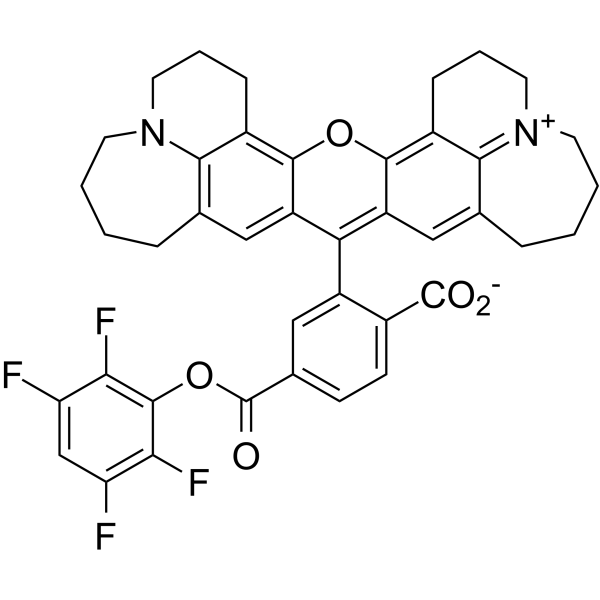 0 ImagesCat. No.: HY-D1107CAS No.: 2379390-73-3
-
PARP-1/2-IN-5
 0 ImagesCat. No.: HY-179349CAS No.: 489457-75-2PARP-1/2-IN-5 (Compound 12) is a PARP-1/2 inhibitor, with the IC50 values for PARP-1 and PARP-2 being 118 and 11 nM respectively. PARP-1/2-IN-5 can be used for the study of inflammatory diseases and neurodegenerative disorders.
-
BRD4-IN-41
 0 ImagesCat. No.: HY-115541CAS No.: 1877286-69-5BRD4-IN-41 is a BRD4 inhibitor with an IC50 of 34 nM. BRD4-IN-41 also inhibits JAK2, FLT3, RET, ROS1, NTRK3, PDGFRb, and FGFR1 kinases with IC50 values ranging from 0.9 nM to 43 nM. BRD4-IN-41 inhibits acetyl-lysine binding site of BRD4, downregulates c-MYC, reduces phosphorylated STAT3 levels, induces G1 cell cycle arrest and apoptosis, thereby inhibiting cancer cells growth. BRD4-IN-41 can be used for the research of cancer, such as multiple myeloma and acute myeloid leukemia.
-
PARP1/PRMT5-IN-1
 0 ImagesCat. No.: HY-189242CAS No.: 3133817-84-9PARP1/PRMT5-IN-1 is an inhibitor of PARP1 and PRMT5, with an IC50 of 0.60 nM against PARP1 and an IC50 of 4.67 nM against PRMT5. PARP1/PRMT5-IN-1 downregulates the homologous recombination (HR)-associated factors BRCA1, BRCA2, and RAD51, thereby suppressing homologous recombination function. PARP1/PRMT5-IN-1 induces the accumulation of DNA double-strand breaks. PARP1/PRMT5-IN-1 triggers apoptosis. PARP1/PRMT5-IN-1 is applicable for breast cancer research.
-
Acrofolione A
 0 ImagesCat. No.: HY-N16567CAS No.: 820975-61-9Acrofolione A is an acetophenone dimer isolated from Acronychia pendunculata with anticancer effects. Acrofolione A induces G0/G1 phase cell cycle arrest and apoptosis in human NALM-6 pre-B cell leukaemia cells. Acrofolione A can be used for leukaemia research.
-
Theophylline-platinum(IV) prodrug-1
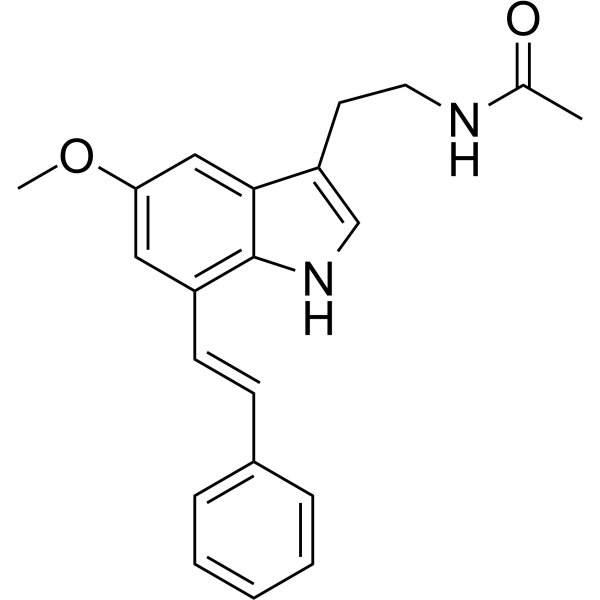
 0 ImagesCat. No.: HY-175257Theophylline-platinum(IV) prodrug-1 is a PARP-1 inhibitor. Theophylline-platinum(IV) prodrug-1 enhances DNA damage, ROS production, mitochondrial dysfunction, apoptosis and S-phase arrest, along with reducing invasion and metastasis in cells. Theophylline-platinum(IV) prodrug-1 exhibits superior antitumor activity in the xenograft SKOV3-BRCA1-KD tumor model. Theophylline-platinum(IV) prodrug-1 can be used for the study of ovarian cancer.
-
HYDAMTIQ
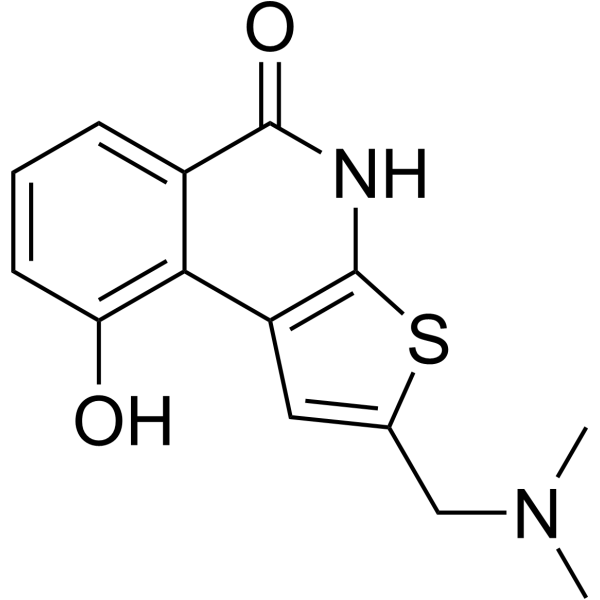 0 ImagesCat. No.: HY-155458CAS No.: 1201832-32-7HYDAMTIQ is a PARP-1/2 inhibitor (IC50: 29-38 nM) with anticancer, anti-inflammatory, and ischemic protective effects. HYDAMTIQ inhibits pulmonary PARP activity, is effective against allergen-induced cough and dyspnea, and inhibits bronchial hyperresponsiveness to methacholine. HYDAMTIQ has broad-spectrum tumor suppressor effects, including ovarian and breast cancers, prostate and pancreatic tumors, and glioblastoma multiforme. HYDAMTIQ has demonstrated in vivo efficacy in animal models of cerebral ischemia, asthma, cancer, and more.
-
PARP1-IN-45
 0 ImagesCat. No.: HY-178100PARP1-IN-45 (Compound 15) is a PARP1 inhibitor with an IC50 of 17 nM. PARP1-IN-45 effectively stimulates ATPase activity of ABCG2. PARP1-IN-45 can be used for cancers like ovarian cancer research.
-
BWA-6047
 0 ImagesCat. No.: HY-176128BWA-6047 is an oral active PROTAC degrader targeting AR/AR-V7 and GSPT1 with DC50 values of 3.7, 3.0 and 1.2 nM in 22Rv1 cells. BWA-6047 suppresses the expression of AR downstream target genes and and transcriptional activity. BWA-6047 inhibits cancer cells proliferation, causes G1 phase cell cycle arrest and induces apoptosis. BWA-6047 increases cleaved-PARP-1 and cleaved-caspase-3 levels. BWA-6047 reduces growth of LNCaP xenograft tumors in mice models without obvious toxicity. BWA-6047 can be used for the research of prostate cancer.




