



Survivin
Survivin is a member of the inhibitor of apoptosis (IAP) family. The survivin protein functions to inhibit caspase activation, thereby leading to negative regulation of apoptosis or programmed cell death. This has been shown by disruption of survivin induction pathways leading to increase in apoptosis and decrease in tumour growth. Survivin expression is highly regulated by the cell cycle and is only expressed in the G2-M phase. Survivin localizes to the mitotic spindle by interaction with tubulin during mitosis and may play a contributing role in regulating mitosis. Survivin is highly expressed in most cancers and associated with chemotherapy resistance, increased tumor recurrence, and shorter patient survival, making antisurvivin therapy an attractive cancer treatment strategy.
All Product Categories
-
Survivin Related Products (81)
Related Products (81)

-
Antibodies (3)
-
WMJ-J-09
 0 ImagesWMJ-J-09 is an HDAC inhibitor with IC50 values of 7.5 nM (HDAC1), 21.3 nM (HDAC2), 18.4 nM (HDAC3), 90.9 nM (HDAC8), 3.9 nM (HDAC6) and 8715.7 nM (HDAC4). WMJ-J-09 blocks the cell cycle and induces apoptosis in cancer cells. WMJ-J-09 induces cancer cell death through the LKB1-AMPK-p38MAPK-p63-survivin signaling cascade.WMJ-J-09 inhibits HDAC enzyme activity, leading to acetylation of key proteins and thereby regulating cancer cell death. WMJ-J-09 can be used in HCT116 cells and FaDu cells research[1][2].
-
23-Hydroxybetulinic acid (Standard)
 0 ImagesCat. No.: HY-N0566RCAS No.: 85999-40-2Synonyms: Anemosapogenin (Standard)23-Hydroxybetulinic acid (Standard) is the analytical standard of 23-Hydroxybetulinic acid (HY-N0566). This product is intended for research and analytical applications. 23-Hydroxybetulinic acid (Anemosapogenin) is an orally active triterpenoid with broad-spectrum anticancer activity. 23-Hydroxybetulinic acid reduces the levels of Bcl-2 and survivin, elevates the level of Bax, promotes the cleavage/activation of caspase-3 and caspase-9, and induces apoptosis via the endogenous mitochondrial pathway involving cytochrome C release and mitochondrial membrane potential disruption. 23-Hydroxybetulinic acid arrests the cell cycle at S and G1 phases, inhibits cancer cell proliferation, blocks the MAPK signaling pathway, regulates MMP2, and induces autophagic apoptosis by upregulating beclin-1. 23-Hydroxybetulinic acid inhibits the activity and efflux function of P-gp, increases the intracellular accumulation of chemotherapeutic drugs, and synergistically enhances cytotoxicity with Doxorubicin (HY-15142). 23-Hydroxybetulinic acid inhibits the phosphorylation and nuclear translocation of STAT6, blocks M2 macrophage polarization, and reduces M2 macrophage-mediated apoptosis resistance of colon cancer cells. 23-Hydroxybetulinic acid can be used in related studies on chronic myeloid leukemia, hepatocellular carcinoma, sarcoma 180, multidrug-resistant breast cancer, leukemia, Doxorubicin-induced cardiotoxicity, and colorectal cancer.
-
LLP-3
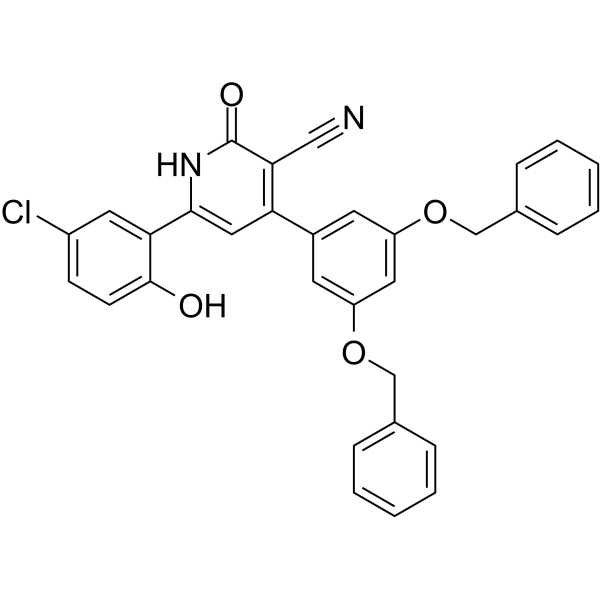 0 ImagesLLP-3 is a potent Survivin inhibitor that disrupts the Survivin-Ran interaction in cancer cells. LLP-3 can be used in the research of Glioblastoma multiforme (GBM).
-
Scopadulciol
 0 ImagesCat. No.: HY-183390CAS No.: 136565-26-9Scopadulciol is an orally effective β-catenin degrader, HSV-TK activator and proton pump inhibitor. By inducing β-catenin degradation, Scopadulciol downregulates the expression of downstream target genes such as cyclin D1, c-myc, and survivin; it also upregulates DR4/DR5 and downregulates Bcl-2, thereby exerting cytotoxicity and inducing apoptosis in cancer cells. Scopadulciol enhances the tumor-killing and bystander effects of prodrugs via activating HSV-TK, and can inactivate HSV-1. It shows synergistic antiviral effects when combined with Acyclovir (HY-17422) or Ganciclovir (HY-13637), with no cytotoxicity as a single agent. Scopadulciol can be applied in research related to bladder cancer, cervical cancer, glioblastoma, and digestive system cancers.
-
Anticancer agent 324
 0 ImagesCat. No.: HY-P11828Anticancer agent 324 is a Survivin inhibitor. Anticancer agent 324 competitively binds to Survivin’s linker region and triggers proteasomal IAP degradation. Anticancer agent 324 blocks Borealin binding and chromosomal passenger complex formation, and inhibits Survivin-CRM1 nuclear-cytoplasmic transport. Anticancer agent 324 activates extrinsic (caspase-8) and intrinsic (caspase-9) apoptotic pathways, activates executioner caspases-3 and caspases-7, and arrests cell cycle. Anticancer agent 324 can be used for the research of breast cancer.
-
Avicin D
 0 ImagesCat. No.: HY-N13338CAS No.: 197787-20-5Avicin D is a plant triterpenoid. Avicin D induces Autophagy by activation of AMPK. Avicin D inhibits mTOR and S6 kinase activity. Avicin D selectively induces Apoptosis and downregulates p-STAT-3, bcl-2, and Survivin. Avicin D has properties of being a selective Glucocorticoid receptor modulator. Avicin D inhibits NF-κB activation. Avicin D shows anti-tumor effects against cutaneous T-cell lymphomas.
-
CPA-7
 0 ImagesCat. No.: HY-122759CAS No.: 16961-77-6CPA7 is a novel Stat3 inhibitor. CPA7 downregulates survivin, Bcl-XL, and Mcl-1. CPA7 induces Apoptosis. CPA7 enhances the radiosensitivity of prostate cancer. CPA7 has anti-cancer effects against prostate cancer.
-
G721-0282
 0 ImagesG721-0282 is an orally active CHI3L1 inhibitor. G721-0282 can reduce the expression of inflammatory proteins and cytokines. G721-0282 inhibits the activation of the NF-κB signaling pathway. G721-0282 inhibits neuroinflammation and reduces anxious behavior. G721-0282 significantly inhibits the proliferation of osteosarcoma (OS) cells by suppressing the STAT3 signaling pathway. G721-0282 induces OS cell apoptosis by upregulating pro-apoptotic protein levels and downregulating anti-apoptotic protein levels. G721-0282 can be used for researches on neuroinflammatory conditions and cancer.
-
Acrofolione A
 0 ImagesCat. No.: HY-N16567CAS No.: 820975-61-9Acrofolione A is an acetophenone dimer isolated from Acronychia pendunculata with anticancer effects. Acrofolione A induces G0/G1 phase cell cycle arrest and apoptosis in human NALM-6 pre-B cell leukaemia cells. Acrofolione A can be used for leukaemia research.
-
Survivin-IN-2
 0 ImagesCat. No.: HY-175017Survivin-IN-2 is a survivin inhibitor. Survivin-IN-2 shows cytotoxicity in cells with IC50s of 0.53 μM (C4-2 cells) and 1.06 μM (PC-3 cells). Survivin-IN-2 effectively suppresses xenograft tumor growth without apparent toxicity and eliminates survivin in the tumors. Survivin-IN-2 can be used for the study of prostate cancer.
-
YAP/TAZ-TEAD-IN-2
 0 ImagesCat. No.: HY-168704YAP/TAZ-TEAD-IN-2 (Compound 51) is a YAP/TAZ-TEAD inhibitor that inhibits the interaction between YAP/TAZ and TEAD. YAP/TAZ-TEAD-IN-2 suppresses the transcriptional activity of TEAD, with an IC50 of 1.2 nM. YAP/TAZ-TEAD-IN-2 inhibits YAP/TAZ-TEAD target genes expression (Cyr61, CTGF, AXL and Survivin) and breast cancer cell proliferation.
-
MX107
 0 ImagesCat. No.: HY-123870CAS No.: 2170102-50-6MX107 is a selective and potent survivin inhibitor that suppresses triple-negative breast cancer (TNBC) cell proliferation. MX107 induces degradation of survivin and inhibitor-of-apoptosis proteins (IAPs), which inhibits nuclear factor κB (NF-κB) activation induced by DNA damage. MX107 enhances tumoricidal efficacy of genotoxic treatments synergized with chemotherapeutic drugs.
-
Topoisomerase I inhibitor 17
 0 ImagesCat. No.: HY-168739CAS No.: 2413582-45-1Topoisomerase I inhibitor 17 (Compound 7h) is a Topoisomerase I (Top1) inhibitor. Topoisomerase I inhibitor 17 reduces DDX5 and reverses the locking of Top1 activity by DDX5. Topoisomerase I inhibitor 17 induces Top1-mediated DNA damage and promotes reactive oxygen species (ROS) production. Topoisomerase I inhibitor 17 induces Apoptosis (reduces antiapoptotic proteins XIAP, Bcl-2, Survivin and up-regulates pro-apoptotic proteins Bax, γH2AX). Topoisomerase I inhibitor 17 also blocks the progression of the G2/M checkpoint and induces cell cycle arrest. Topoisomerase I inhibitor 17 significantly inhibits colony formation and cell migration in colorectal cancer cells. Topoisomerase I inhibitor 17 effectively reduces tumors in human PDX tumor mice.

-
Candidone
 0 ImagesCat. No.: HY-180324CAS No.: 77727-18-5Candidone is a type of flavanone phenolic compound with anti-cancer and antibacterial activities. Candidone inhibits the proliferation of hepatoblastoma and cholangiocarcinoma cells and induces their apoptosis by up-regulating p21, Bax, and caspase 3/9, and down-regulating Bcl-2 and survivin. It reduces the metastatic ability of cancer cells by inhibiting the expression of phosphorylated p38 and matrix metalloproteinase MMP-9. Candidone has inhibitory effects on multidrug-resistant bacterial strains. Candidone binds to the base pairs of DNA in a groove-binding manner, thereby slightly altering the conformation of DNA.
-
CK2-TN03
 0 ImagesCK2-TN03 is an ATP-competitive casein kinase 2 (CK2) inhibitor, with an IC50 of 165 nM and a Ki of 20 nM. CK2-TN03 inhibits CK2-mediated survivin activation and reduces CK2-dependent phosphorylation levels of BRD4/MYCN and AKT1. CK2-TN03 exerts anti-neuroblastoma effects by inhibiting survivin, leading to mitotic catastrophe and apoptosis of cancer cells. CK2-TN03 can be used in studies related to neuroblastoma.
-
Cucurbitacin IIa (Standard)
 0 ImagesCat. No.: HY-N1988RCAS No.: 58546-34-2Synonyms: Hemslecin A (Standard)Cucurbitacin IIa (Hemslecin A) (Standard) is the analytical standard for Cucurbitacin IIa (HY-N1988). This product is used for research and analytical applications. Cucurbitacin IIa is an orally active, blood-brain barrier-penetrating EGFR inhibitor with an IC50 of 1.455 nM for human EGFR. Cucurbitacin IIa induces caspase-3 dependent cell apoptosis, downregulates survivin expression, enhances autophagy levels, disrupts the actin cytoskeleton through actin aggregation, blocks the cell cycle at the G2/M phase, and inhibits the EGFR-MAPK signaling pathway to exert anti-inflammatory activity. Cucurbitacin IIa can be used in research on inflammatory-related diseases, depression, and non-small cell lung cancer and other cancers.
-
Proadifen hydrochloride (Standard)
 0 ImagesSynonyms: SKF-525A (Standard); U-5446 (Standard); RP-5171 (Standard)Proadifen (hydrochloride) (Standard) is the analytical standard of Proadifen (hydrochloride). This product is intended for research and analytical applications. Proadifen (SKF-525A) hydrochloride is a non-competitive Cytochrome P450 inhibitor with an IC50 value of 19 μM. Proadifen hydrochloride reduces monoamine oxidase A (MAO-A) activity and reverses the antidepressantlike behavioral effect of Imipramine (HY-B1490A) and Desipramine (HY-B1272A) in rats. Proadifen hydrochloride also reduces N, N-dimethyltryptamine (DMT) metabolism in liver microsomes and inhibits N-demethylationand Acridone (HY-W007771) formation. Proadifen hydrochloride augments Lipopolysaccharide (LPS) (HY-D1056)-induced fever and exacerbates Prostaglandin E2 (PGE2) (HY-101952) levels in the rat. Proadifen hydrochloride is promising for research of metabolism-related deseases, ovarian carcinoma, inflammation and dopamine neurons-related deseases[4].
-
K882
 0 ImagesCat. No.: HY-168893K882 (Compound 4e) is a Src inhibitor, with KD of 0.315 μM. K882 induces Apoptosis. K882 inhibits XIAP and Survivin. K882 inhibits the activation of PI3K/Akt/mTOR, Jak1/Stat3, Ras/MAPK signaling pathways. K882 shows anti-tumor activity against non-small cell lung cancer.
-
SC-60
 0 ImagesCat. No.: HY-W717425CAS No.: 1421677-31-7SC-60 is a derivative of Sorafenib (HY-10201). SC-60 exerts its anti-tumor effect by activating the phosphatase activity of SHP-1, thereby inhibiting the STAT3 signaling pathway. SC-60 exhibits strong proliferation inhibitory activity in various hepatocellular carcinoma (HCC) cell lines. SC-60 downregulates the expression of downstream anti-apoptotic proteins (such as Bcl-2, Cyclin D1, Survivin), ultimately inducing caspase-dependent apoptosis. SC-60 significantly inhibits tumor growth in xenograft tumor models. SC-60 can be used for the study of HCC.




