



Samuraciclib
Based on 12 publication(s) in Google Scholar
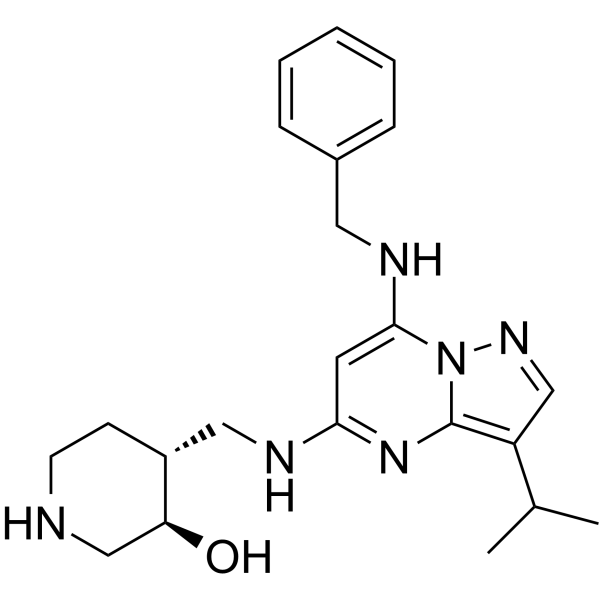
Samuraciclib (CT7001) is a potent, selective, ATP-competitive and orally active CDK7 inhibitor, with an IC50 of 41 nM. Samuraciclib displays 45-, 15-, 230- and 30-fold selectivity over CDK1, CDK2 (IC50 of 578 nM), CDK5 and CDK9, respectively. Samuraciclib inhibits the growth of breast cancer cell lines with GI50 values between 0.2-0.3 μM. Samuraciclib has anti-tumor effects.
Nur für Forschungszwecke. Wir verkaufen nicht an Patienten.
- Reinheit : 99.55%
- CAS. Nr.: 1805833-75-3
- Formel: C22H30N6O
- Molecular Weight:394.51
-
Speicherung:Powder -20°C, 3 years , 4°C, 2 years ; In solvent -80°C, 6 months , -20°C, 1 month

To place orders, for customer services and technical support, please contact: MedChemExpress USA
Tel: 609-228-6898 E-mail: [email protected] [email protected]


-
 Biologische Aktivität
-
Chemical Information
-
Lösungsmittel & Löslichkeit
- Protokoll
- Reinheit & Dokumentation
- Verweise
-
 Help & FAQs


Publications Citing Use of MedChemExpress (MCE) Samuraciclib
More- Signal Transduct Target Ther. 2025 Nov 6;10(1):363. [Abstract]
- Adv Sci (Weinh). 2025 Feb;12(5):e2413103. [Abstract]
- Cell Death Dis. 2019 Aug 9;10(8):602. [Abstract]
- Clin Cancer Res. 2024 May 1;30(9):1889-1905. [Abstract]
- Proc Natl Acad Sci U S A. 2019 Jun 25;116(26):12986-12995. [Abstract]
- EMBO J. 2025 Sep 8. [Abstract]
- Int J Mol Sci. 2022 Feb 24;23(5):2493. [Abstract]
- mBio. 2025 Dec 10;16(12):e0289825. [Abstract]
- Structure. 2024 Aug 8;32(8):1040-1048.e3. [Abstract]
- J Cancer Res Clin Oncol. 2023 Jul;149(8):5255-5263. [Abstract]
- Biochem Biophys Res Commun. 2024 Nov 26:735:150608. [Abstract]
- Res Sq. 2024 Jul 29.
 Customer Validation & Images

-
In Vivo Efficacy Study
-
Cell Proliferation/Viability Assay
-
Cell Proliferation/Viability Assay
-
WB
-
Cell Proliferation/Viability Assay


Biologische Aktivität
Beschreibung
|
CDK7/CycH/MAT1 41 nM (IC50) |
CDK2/cycE1 578 nM (IC50) |
CDK1 1.8 μM (IC50) |
CDK4 49 μM (IC50) |
CDK5 9.4 μM (IC50) |
CDK6 34 μM (IC50) |
CDK9 1.2 μM (IC50) |
Cellular Effect
|
Cell Line

|
Type | Value | Description | References |
|---|---|---|---|---|
| MDA-MB-453 | EC50 |
2.04 μM
Compound: CT7001
|
Antiproliferative activity against human MDA-MB-453 cells assessed as reduction in cell viability incubated for 5 days by CCK-8 assay
Antiproliferative activity against human MDA-MB-453 cells assessed as reduction in cell viability incubated for 5 days by CCK-8 assay
|
[PMID: 38586950] |
In Vitro
Samuraciclib (ICEC0942; 0-10 μM; 24 hours; HCT116 cells) treatment promotes cell apoptosis[1].
Samuraciclib (ICEC0942; 0-10 μM; 24 hours; HCT116 cells) treatment induces cell cycle arrest[1].
Samuraciclib (ICEC0942; 0-10 μM; 0-24 hours; HCT116 cells) treatment inhibits the phosphorylation of PolII CTD in a dose and time dependent manner in HCT116 colon cancer cells. Samuraciclib also inhibits phosphorylation of CDK1, CDK2 and retinoblastoma[1].
Samuraciclib (ICEC0942) inhibits the growth of MCF7, T47D, MDA-MB-231, HS578T, MDA-MB-468, MCF10A and HMEC cells with GI50 values of 0.18 μM, 0.32 μM, 0. 33 μM, 0.21 μM, 0.22 μM, 0.67 μM and 1.25 μM, respectively[1].
MedChemExpress (MCE) has not independently confirmed the accuracy of these methods. They are for reference only.
-
Cell Line:HCT116 cells
-
Concentration:0 µM, 0.1 µM, 1 µM and 10 µM
-
Incubation Time:24 hours
-
Result:Induced caspase 3/7 and demonstrated PARP cleavage.
-
Cell Line:HCT116 cells
-
Concentration:0 µM, 0.01 µM, 0.1 µM, 1 µM and 10 µM
-
Incubation Time:24 hours
-
Result:Showed accumulation of cells in G2/M.
-
Cell Line:HCT116 cells
-
Concentration:0 µM, 0.1 µM, 1 µM and 10 µM
-
Incubation Time:0 hour, 4 hours, 8 hours, 16 hours or 24 hours
-
Result:PolII CTD phosphorylation was inhibited in a dose and time dependent manner in HCT116 colon cancer cells.
In Vivo
The combination of Samuraciclib (ICEC0942) and ICI 47699 treatment shows complete growth arrest of estrogen receptor (ER)-positive tumor xenografts[1].
MedChemExpress (MCE) has not independently confirmed the accuracy of these methods. They are for reference only.
-
Animal Model:Female nu/nu-BALB/c athymic nude mice (7-week old) with MCF7 cells[1].
-
Dosage:100 mg/kg
-
Administration:Oral gavage; daily; for 14 days
-
Result:At day 14, tumor growth was inhibited by 60%.


Chemical Information
-
CAS. Nr. 1805833-75-3
-
Appearance Solid
-
Molecular Weight 394.51
-
Formel C22H30N6O
-
Color White to off-white
-
SMILES
O[C@H]1CNCC[C@@H]1CNC2=NC3=C(C(C)C)C=NN3C(NCC4=CC=CC=C4)=C2
-
Synonyms
CT7001; ICEC0942
-
Versand
Room temperature in continental US; may vary elsewhere.
-
Speicherung
Powder -20°C 3 years 4°C 2 years In solvent -80°C 6 months -20°C 1 month


Publications (12)
-
Journal Impact Factor
-
Most Recent
-
Signal Transduct Target Ther
CDK7-targeted therapy effectively disrupts cell cycle progression and oncogenic signaling in head and neck cancer. [Abstract]2025 Nov 6;10(1):363. PMID: 41193441 -
Adv Sci (Weinh)
Dual Inhibition of CDK4/6 and CDK7 Suppresses Triple-Negative Breast Cancer Progression via Epigenetic Modulation of SREBP1-Regulated Cholesterol Metabolism. [Abstract]2025 Feb;12(5):e2413103. PMID: 39656925 -
Cell Death Dis
CDK7 inhibitor THZ1 inhibits MCL1 synthesis and drives cholangiocarcinoma apoptosis in combination with BCL2/BCL-XL inhibitor ABT-263. [Abstract]2019 Aug 9;10(8):602. PMID: 31399555
Samuraciclib purchased from MedChemExpress. Usage Cited in: Cell Death Dis. 2019 Aug 9;10(8):602. [Abstract]
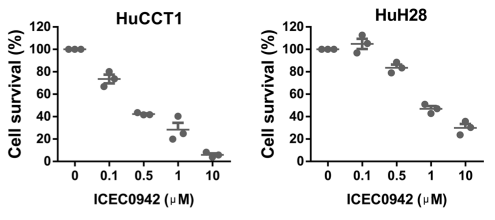
HuCCT1 and HuH28 cells were treated with a novel CDK7 inhibitor Samuraciclib hydrochloride (ICEC0942) at different concentrations for 72 h. Cell viability was measured by CCK-8 assay.
Samuraciclib purchased from MedChemExpress. Usage Cited in: Cell Death Dis. 2019 Aug 9;10(8):602. [Abstract]
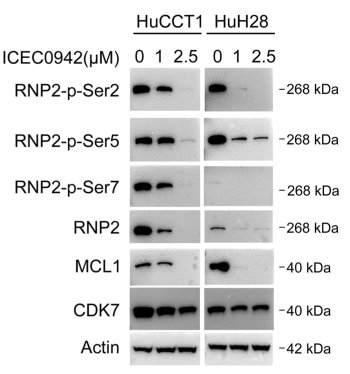
HuCCT1 and HuH28 cells were exposed to Samuraciclib hydrochloride (ICEC0942) at indicated concentrations for 24 h. RNP2, RNP2 phosphorylation and MCL1 expression were analyzed by western blotting. ICEC0942 caused a dose-dependent reduction of phosphorylation of RNP2 at S2, S5, and S7.
-
Clin Cancer Res
Selective CDK7 inhibition suppresses cell cycle progression and MYC signaling while enhancing apoptosis in therapy-resistant estrogen receptor positive breast cancer. [Abstract]2024 May 1;30(9):1889-1905. PMID: 38381406
Samuraciclib purchased from MedChemExpress. Usage Cited in: Clin Cancer Res. 2024 May 1;30(9):1889-1905. [Abstract]
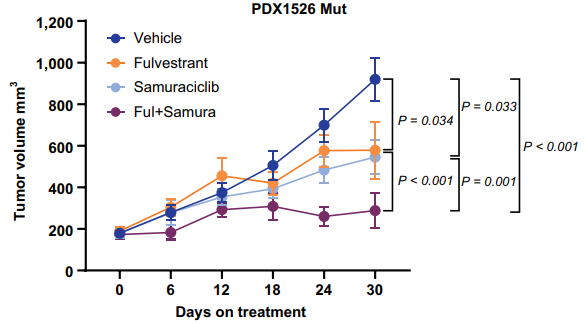
Tumor growth of ER-mutant PDX1526 in presence of vehicle, fulvestrant, Samuraciclib hydrochloride (samura) (30 mg/kg; P.O.; once daily), and fulvestrant + Samuraciclib hydrochloride (Ful+samura) for 28 days (mixed modelling with Tukey multiple comparisons test). Only significant P values are denoted.
-
Proc Natl Acad Sci U S A
CDK7 inhibition suppresses aberrant hedgehog pathway and overcomes resistance to smoothened antagonists. [Abstract]2019 Jun 25;116(26):12986-12995. PMID: 31182587
Samuraciclib purchased from MedChemExpress. Usage Cited in: Proc Natl Acad Sci U S A. 2019 Jun 25;116(26):12986-12995. [Abstract]
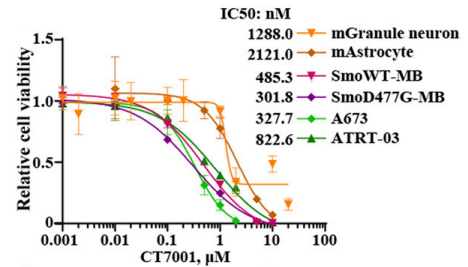
Dose–response curves of Hh-driven tumor lines and control cells in response to clinical trial used CDK7i compound Samuraciclib hydrochloride (CT7001). Cells were plated in 96-well plate in triplicate and treated with CT7001 at indicated concentrations for 72 h before cell viabilities were assessed. The results showed that CT7001 exhibited more potent inhibitory effect against Hh-driven tumor lines (IC50 ranging from ∼300 to 800 nM) compared with normal control neural cells (IC50 ranging from ∼1,300 to 2,100 nM).
Samuraciclib purchased from MedChemExpress. Usage Cited in: Proc Natl Acad Sci U S A. 2019 Jun 25;116(26):12986-12995. [Abstract]
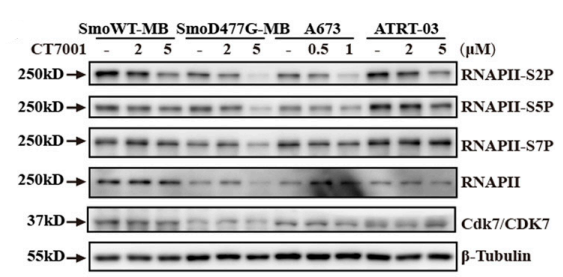
Immunoblot detecting phosphorylation levels at Ser2, Ser5, Ser7 of RNAPII C-terminal domain as well as Cdk7 and total RNAPII from Hh-driven cancer cell lines treated with Samuraciclib hydrochloride (CT7001) at indicated concentrations for 8 h. An anti–β-tubulin immunoblot is shown as loading control. CT7001 treatment induced dose-dependent reduction of phosphorylation at S2, S5, and S7 of RNAPII CTD.
Samuraciclib purchased from MedChemExpress. Usage Cited in: Proc Natl Acad Sci U S A. 2019 Jun 25;116(26):12986-12995. [Abstract]
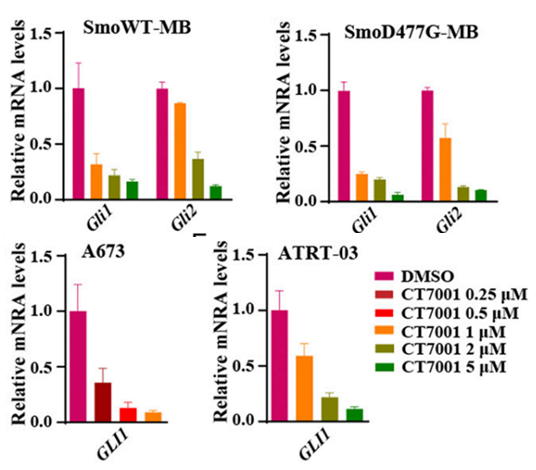
qRT-PCR analysis of Gli1 and Gli2 in SmoWT-MB and SmoD477G-MB cells, as well as Gli1 in A673 and ATRT-03 cells. Cells were treated with DMSO or Samuraciclib hydrochloride (CT7001) at indicated concentrations for 8 h.
-
EMBO J
Resistance to CDK7 inhibitors directed by acquired mutation of a conserved residue in cancer cells. [Abstract]2025 Sep 8. PMID: 40921851 -
Int J Mol Sci
Cyclin-Dependent Kinases (CDKs) and the Human Cytomegalovirus-Encoded CDK Ortholog pUL97 Represent Highly Attractive Targets for Synergistic Drug Combinations. [Abstract]2022 Feb 24;23(5):2493. PMID: 35269635 -
mBio
Functional insight into cyclin-dependent kinase (CDK)7 via chemical inhibition of the priority fungal pathogen Cryptococcus neoformans. [Abstract]2025 Dec 10;16(12):e0289825. PMID: 41171060 -
Structure
Protein engineering enables a soakable crystal form of human CDK7 primed for high-throughput crystallography and structure-based drug design. [Abstract]2024 Aug 8;32(8):1040-1048.e3. PMID: 38870939 -
J Cancer Res Clin Oncol
2023 Jul;149(8):5255-5263. PMID: 36401094
Samuraciclib purchased from MedChemExpress. Usage Cited in: J Cancer Res Clin Oncol. 2023 Jul;149(8):5255-5263. [Abstract]
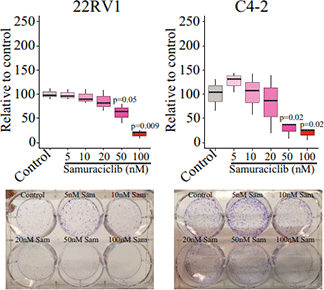
Colony-formation assay. Samuraciclib (5, 10, 20, 50, 100 nM; 7 days) signifcantly inhibits the colony-formation ability of the two CRPC models (C4-2 and 22RV1).
-
Biochem Biophys Res Commun
Interaction of CDK12 with NXF1 is a new node for the linking mechanism between transcription and transportation of mRNA. [Abstract]2024 Nov 26:735:150608. PMID: 39270556 -


Lösungsmittel & Löslichkeit
In Vitro:
DMSO : 100 mg/mL (253.48 mM; Need ultrasonic; Hygroscopic DMSO has a significant impact on the solubility of product, please use newly opened DMSO)
Please refer to the solubility information to select the appropriate solvent. Once prepared, please aliquot and store the solution to prevent product inactivation from repeated freeze-thaw cycles.
Storage method and period of stock solution: -80°C, 6 months; -20°C, 1 month. When stored at -80°C, please use it within 6 months. When stored at -20°C, please use it within 1 month.
Please refer to the solubility information to select the appropriate solvent. Once prepared, please aliquot and store the solution to prevent product inactivation from repeated freeze-thaw cycles.
Storage method and period of stock solution: -80°C, 6 months; -20°C, 1 month. When stored at -80°C, please use it within 6 months. When stored at -20°C, please use it within 1 month.
Konzentration (Stammlösung) × Volumen (Stammlösung) = Konzentration (Ziellösung) × Volumen (Ziellösung)
In Vivo:
Select the appropriate dissolution method based on your experimental animal and administration route.
- For the following dissolution methods, please ensure to first prepare a clear stock solution using an In Vitro approach and then sequentially add co-solvents:
- To ensure reliable experimental results, the clarified stock solution can be appropriately stored based on storage conditions. As for the working solution for In Vivo experiments, it is recommended to prepare freshly and use it on the same day.
- The percentages shown for the solvents indicate their volumetric ratio in the final prepared solution. If precipitation or phase separation occurs during preparation, heat and/or sonication can be used to aid dissolution.
Add each solvent one by one: 10% DMSO 40% PEG300 5% Tween-80 45% Saline
Solubility: ≥ 2.5 mg/mL (6.34 mM); Clear solution
This protocol yields a clear solution of ≥ 2.5 mg/mL (saturation unknown).
Taking 1 mL working solution as an example, add 100 μL DMSO stock solution (25.0 mg/mL) to 400 μL PEG300, and mix evenly; then add 50 μL Tween-80 and mix evenly; then add 450 μL Saline to adjust the volume to 1 mL.
Preparation of Saline: Dissolve 0.9 g sodium chloride in ddH₂O and dilute to 100 mL to obtain a clear Saline solution.
Add each solvent one by one: 10% DMSO 90% (20% SBE-β-CD in Saline)
Solubility: ≥ 2.5 mg/mL (6.34 mM); Clear solution
This protocol yields a clear solution of ≥ 2.5 mg/mL (saturation unknown).
Taking 1 mL working solution as an example, add 100 μL DMSO stock solution (25.0 mg/mL) to 900 μL 20% SBE-β-CD in Saline, and mix evenly.
Preparation of 20% SBE-β-CD in Saline (4°C, storage for one week): 2 g SBE-β-CD powder is dissolved in 10 mL Saline, completely dissolve until clear.
In Vivo Dissolution Calculator
Please enter the basic information of animal experiments:
-
-
-
-
Recommended: Prepare an additional quantity of animals to account for potential losses during experiments.
Please enter your animal formula composition:
-
%DMSO +
Recommended: Keep the proportion of DMSO in working solution below 2% if your animal is weak.
-
%+
-
+%Tween-80 + +
-
%Saline +
The co-solvents required include: DMSO, . All of co-solvents are available by MedChemExpress (MCE). , Tween 80. All of co-solvents are available by MedChemExpress (MCE).
Working solution concentration: 0.22 mg/mL
Method for preparing stock solution: mg drug dissolved in μL DMSO. Stock solution concentration: mg/mL.
1. Take μL DMSO stock solution;
2. Add μL .
μL , mix evenly;
3. Then add μL Tween 80, mix evenly;
4. Then add μL
Please ensure that the stock solution in the first step is dissolved to a clear state, and add co-solvents in sequence. You can use ultrasonic heating (ultrasonic cleaner, recommended frequency 20-40 kHz), vortexing, etc. to assist dissolution.


Reinheit & Dokumentation
-
Data Sheet (282 KB)
-
SDS (394 KB)
- English - EN (394 KB)
- Français - FR (394 KB)
- Deutsch - DE (394 KB)
- Norwegian - NO (394 KB)
- Español - ES (394 KB)
- Swedish - SV (394 KB)
- Italian - IT (394 KB)
- Korean - KR (394 KB)
- Portuguese - PT (394 KB)
-
Handling Instructions (2659 KB)
Verweise
[1]. Patel H, et al. ICEC0942, an Orally Bioavailable Selective Inhibitor of CDK7 for Cancer Treatment. Mol Cancer Ther. 2018 Jun;17(6):1156-1166. [Content Brief]
[2]. Hazel P, et al. Inhibitor Selectivity for Cyclin-Dependent Kinase 7: A Structural, Thermodynamic, and Modelling Study. ChemMedChem. 2017 Mar 7;12(5):372-380. [Content Brief]


Complete Stock Solution Preparation Table
Please refer to the solubility information to select the appropriate solvent. Once prepared, please aliquot and store the solution to prevent product inactivation from repeated freeze-thaw cycles.
Storage method and period of stock solution: -80°C, 6 months; -20°C, 1 month. When stored at -80°C, please use it within 6 months. When stored at -20°C, please use it within 1 month.
| Optional Solvent | Concentration Solvent Mass | 1 mg | 5 mg | 10 mg | 25 mg |
|---|---|---|---|---|---|
| DMSO | 1 mM | 2.5348 mL | 12.6739 mL | 25.3479 mL | 63.3697 mL |
| 5 mM | 0.5070 mL | 2.5348 mL | 5.0696 mL | 12.6739 mL | |
| 10 mM | 0.2535 mL | 1.2674 mL | 2.5348 mL | 6.3370 mL | |
| 15 mM | 0.1690 mL | 0.8449 mL | 1.6899 mL | 4.2246 mL | |
| 20 mM | 0.1267 mL | 0.6337 mL | 1.2674 mL | 3.1685 mL | |
| 25 mM | 0.1014 mL | 0.5070 mL | 1.0139 mL | 2.5348 mL | |
| 30 mM | 0.0845 mL | 0.4225 mL | 0.8449 mL | 2.1123 mL | |
| 40 mM | 0.0634 mL | 0.3168 mL | 0.6337 mL | 1.5842 mL | |
| 50 mM | 0.0507 mL | 0.2535 mL | 0.5070 mL | 1.2674 mL | |
| 60 mM | 0.0422 mL | 0.2112 mL | 0.4225 mL | 1.0562 mL | |
| 80 mM | 0.0317 mL | 0.1584 mL | 0.3168 mL | 0.7921 mL | |
| 100 mM | 0.0253 mL | 0.1267 mL | 0.2535 mL | 0.6337 mL |


Samuraciclib Related Classifications
HY-103712 Related Classifications
 Powered by Bioz