



4-Hydroxyestrone-d4

Based on 1 Customer Validation
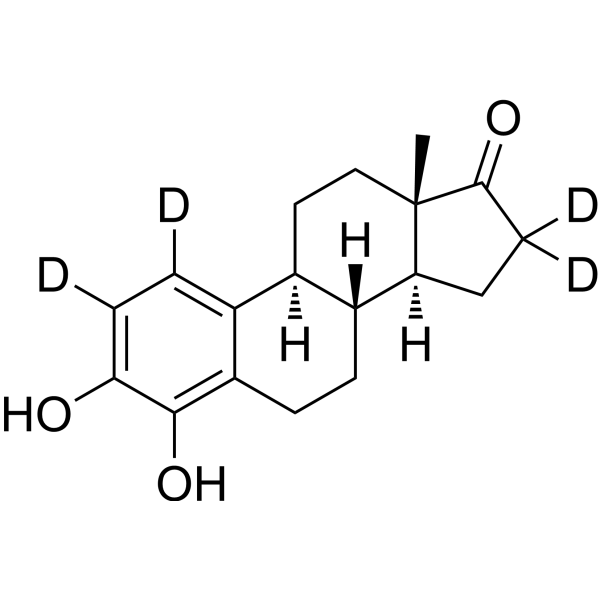
4-Hydroxyestrone (4-OHE1)-d4 is the deuterium labeled 4-Hydroxyestrone (HY-W009300). 4-Hydroxyestrone is a brain-penetrant estrogen metabolite. 4-Hydroxyestrone shows neuroprotective effects involving increased cytoplasmic localization of p53 resulting from SIRT1-mediated p53 deacetylation. 4-Hydroxyestrone relies on PDI to mediate its protective effect against chemically induced ferroptosis in estrogen receptor-negative cancer cells. 4-Hydroxyestrone inhibits lipid peroxidation and lipid-ROS accumulation. 4-Hydroxyestrone blocks preovulatory luteinizing hormone surges in Rattus norvegicus. 4-Hydroxyestrone can be used for the researches of neurodegeneration, breast cancer and endocrine disease.
연구목적의 판매만을 진행합니다. 환자를 대상으로 한 판매는 하지 않습니다.
- Purity : 99.35%
- CAS No.: 81586-98-3
- 화학식: C18H18D4O3
- 분자량:290.39
-
보관:
4°C, protect from light, stored under nitrogen
* In solvent : -80°C, 6 months; -20°C, 1 month (protect from light, stored under nitrogen)

To place orders, for customer services and technical support, please contact: MedChemExpress USA
Tel: 609-228-6898 E-mail: [email protected] [email protected]


-
 Biological Activity
-
Chemical Information
-
용액&용해도
- Protocol
- 순도&문서
- References
-
 Help & FAQs


All Endogenous Metabolite Isoforms
More

Biological Activity
제품 설명
In Vitro
Stable heavy isotopes of hydrogen, carbon, and other elements have been incorporated into drug molecules, largely as tracers for quantitation during the drug development process. Deuteration has gained attention because of its potential to affect the pharmacokinetic and metabolic profiles of drugs.
MedChemExpress (MCE) has not independently confirmed the accuracy of these methods. They are for reference only.
신청
1. This compound can be used as a tracer
2. This compound can be used as an internal standard for quantitative analysis by NMR, GC-MS, or LC-MS.


Chemical Information
-
CAS No. 81586-98-3
-
Unlabeled CAS 3131-23-5
-
Appearance Solid
-
분자량 290.39
-
화학식 C18H18D4O3
-
Color Off-white to gray
-
SMILES
C[C@@]12[C@](CC([2H])([2H])C2=O)([H])[C@@]3([H])[C@@](CC1)([H])C4=C([2H])C([2H])=C(O)C(O)=C4CC3
-
Synonyms
4-OHE1-d4
-
선적
Room temperature in continental US; may vary elsewhere.
-
보관
4°C, protect from light, stored under nitrogen
* In solvent : -80°C, 6 months; -20°C, 1 month (protect from light, stored under nitrogen)


용액&용해도
In Vitro:
Methanol : 10 mg/mL (34.44 mM; Need ultrasonic and warming)
Please refer to the solubility information to select the appropriate solvent. Once prepared, please aliquot and store the solution to prevent product inactivation from repeated freeze-thaw cycles.
Storage method and period of stock solution: -80°C, 6 months; -20°C, 1 month (protect from light, stored under nitrogen). When stored at -80°C, please use it within 6 months. When stored at -20°C, please use it within 1 month.
Please refer to the solubility information to select the appropriate solvent. Once prepared, please aliquot and store the solution to prevent product inactivation from repeated freeze-thaw cycles.
Storage method and period of stock solution: -80°C, 6 months; -20°C, 1 month (protect from light, stored under nitrogen). When stored at -80°C, please use it within 6 months. When stored at -20°C, please use it within 1 month.
Concentration (start) × Volume (start) = Concentration (final) × Volume (final)


순도&문서
-
Data Sheet (277 KB)
-
SDS (252 KB)
- English - EN (252 KB)
- Français - FR (252 KB)
- Deutsch - DE (252 KB)
- Norwegian - NO (252 KB)
- Español - ES (252 KB)
- Swedish - SV (252 KB)
- Italian - IT (252 KB)
- Korean - KR (252 KB)
- Portuguese - PT (252 KB)
-
Handling Instructions (2659 KB)
References
[1]. Choi HJ, et al. 4-Hydroxyestrone, an Endogenous Estrogen Metabolite, Can Strongly Protect Neuronal Cells Against Oxidative Damage. Sci Rep. 2020;10(1):7283. Published 2020 Apr 29. [Content Brief]
[2]. Wang H, et al. Strong Protection by 4-Hydroxyestrone against Erastin-Induced Ferroptotic Cell Death in Estrogen Receptor-Negative Human Breast Cancer Cells: Evidence for Protein Disulfide Isomerase as a Mechanistic Target for Protection. Biochemistry. 2024;63(8):984-999. [Content Brief]
[3]. Okatani Y, et al. Effects of 2-hydroxyestradiol-17 beta, 2-hydroxyestradiol-17 alpha, and 4-hydroxyestrone on the preovulatory luteinizing hormone surge in the rat: agonist and antagonist actions. Endocrinology. 1984;115(3):1090-1094. [Content Brief]


Complete Stock Solution Preparation Table
Please refer to the solubility information to select the appropriate solvent. Once prepared, please aliquot and store the solution to prevent product inactivation from repeated freeze-thaw cycles.
Storage method and period of stock solution: -80°C, 6 months; -20°C, 1 month (protect from light, stored under nitrogen). When stored at -80°C, please use it within 6 months. When stored at -20°C, please use it within 1 month.
| Optional Solvent | Concentration Solvent Mass | 1 mg | 5 mg | 10 mg | 25 mg |
|---|---|---|---|---|---|
| Methanol | 1 mM | 3.4436 mL | 17.2182 mL | 34.4364 mL | 86.0911 mL |
| 5 mM | 0.6887 mL | 3.4436 mL | 6.8873 mL | 17.2182 mL | |
| 10 mM | 0.3444 mL | 1.7218 mL | 3.4436 mL | 8.6091 mL | |
| 15 mM | 0.2296 mL | 1.1479 mL | 2.2958 mL | 5.7394 mL | |
| 20 mM | 0.1722 mL | 0.8609 mL | 1.7218 mL | 4.3046 mL | |
| 25 mM | 0.1377 mL | 0.6887 mL | 1.3775 mL | 3.4436 mL | |
| 30 mM | 0.1148 mL | 0.5739 mL | 1.1479 mL | 2.8697 mL |


4-Hydroxyestrone-d4 Related Classifications
HY-W009300S Related Classifications
 Powered by Bioz