



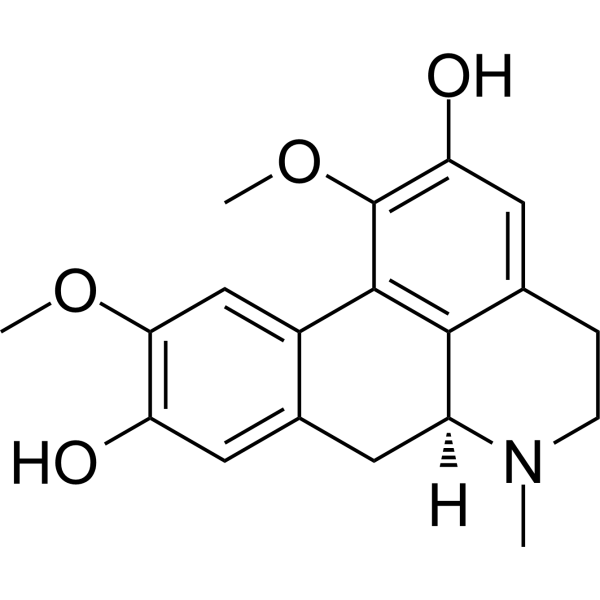
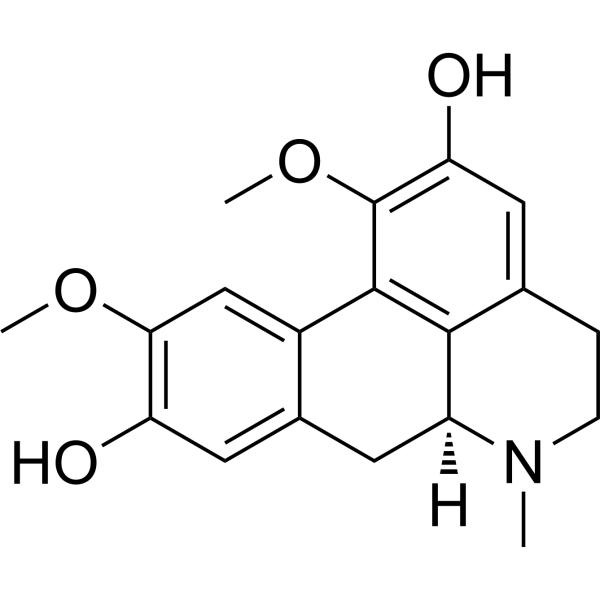
Boldine
Based on 1 publication(s) in Google Scholar
Boldine is an aporphine alkaloid telomerase (telomerase) inhibitor (IC50 of 0.17 μM for TERT) and a pannexin/connexin hemichannel blocker, with oral activity and blood-brain barrier permeability. Boldine inhibits telomerase activity through direct interaction with the telomerase ribonucleoprotein and non-competitive binding near the TERT active site, and downregulates hTERT mRNA while shifting alternative splicing toward non-functional transcripts. Boldine blocks Panx1, Cx43, Cx26, and Cx30 hemichannels as well as P2X7 receptor-mediated calcium influx. Boldine exhibits antioxidant, anti-inflammatory, antiproliferative, and cytotoxic activities by scavenging ROS, inhibiting NFκB, dephosphorylating SGK1, and reducing TNF-alpha levels. Boldine can be used in research on breast cancer, Alzheimer's disease, glioblastoma, diabetes, and spinal cord injury.
연구목적의 판매만을 진행합니다. 환자를 대상으로 한 판매는 하지 않습니다.
- Purity : 99.24%
- CAS No.: 476-70-0
- 화학식: C19H21NO4
- 분자량:327.37
-
보관:Powder -20°C, 3 years , 4°C, 2 years ; In solvent -80°C, 2 years , -20°C, 1 year

To place orders, for customer services and technical support, please contact: MedChemExpress USA
Tel: 609-228-6898 E-mail: [email protected] [email protected]


-
 Biological Activity
-
Chemical Information
-
용액&용해도
- Protocol
- 순도&문서
- References
-
 Help & FAQs


Publications Citing Use of MedChemExpress (MCE) Boldine
MoreAll P2X Receptor Isoforms
MoreAll Calcium Channel Isoforms
More

Biological Activity
제품 설명
Cellular Effect
|
Cell Line

|
Type | Value | Description | References |
|---|---|---|---|---|
| SH-SY5Y | IC50 |
81 μM
Compound: 5
|
Displacement of [125I]alpha-bungarotoxin from human alpha-7 nAChR expressed in SH-SY5Y cells
Displacement of [125I]alpha-bungarotoxin from human alpha-7 nAChR expressed in SH-SY5Y cells
|
[PMID: 17391965] |
| Vero | CC50 |
250 μM
Compound: 6
|
Cytotoxicity against african green monkey Vero cells
Cytotoxicity against african green monkey Vero cells
|
[PMID: 9584402] |
| Vero | ED50 |
125 μM
Compound: 6
|
Antiviral activity against Poliovirus 2 Sabin 2 infected in african green monkey Vero cells at 0.001 multiplicity of infection assessed as inhibition of virus-induced cytopathogenicity
Antiviral activity against Poliovirus 2 Sabin 2 infected in african green monkey Vero cells at 0.001 multiplicity of infection assessed as inhibition of virus-induced cytopathogenicity
|
[PMID: 9584402] |
In Vitro
Boldine (48 h) exhibits dose- and time-dependent cytotoxicity in HEK293, MDA-MB-231, and MCF-7 cells, with IC50 values of 110 μM, 150 μM, and 160 μM, respectively, while showing less toxicity to normal HFF cells[1].
Boldine (0-300 μM; 72 h) inhibits the growth of primary human GBM59, GBM96, and U87-MG glioblastoma cells in a concentration-dependent manner, with IC50 values of 68.6 μM, 141.7 μM, and 213.8 μM, respectively[4].
Boldine (50-300 μM; 15 min) inhibits hemichannel activity in patient-derived GBM59, GBM96, and U87-MG glioblastoma cells[4].
Boldine (0-160 μM; 48 h) significantly inhibits telomerase activity in MCF-7, MDA-MB-231, and HEK293 cells in a dose-dependent manner, with IC50 values of 60 μM, 29.1 μM, and 38.8 μM, respectively[1].
Boldine (0-160 μM; 48 h) decreases hTERT mRNA levels in MCF-7 cells in a dose-dependent manner[1].
Boldine (0-160 μM; 48 h) stimulates nonfunctional splice variants of hTERT, and in MCF-7 cells, the -b variant is the only detectable transcript at 160 μM[1].
Boldine (100-500 μM; 5 min) inhibits hemichannel activity in LPS-treated cultured mouse cortical astrocytes[3].
Boldine (100 μM) inhibits Panx1 hemichannels in HeLa-Panx1-YPF cells[3].
Boldine (50 μM; 15 min) inhibits hemichannel activity in rat SVZ neurosphere-derived NPCs[4].
Boldine (50-100 μM; 72 h) decreases the diameter of rat SVZ neurosphere-derived NPCs and disrupts the integrity of neurospheres[4].
Boldine (50 μM; 72 h) reduces the proliferation of NPCs derived from rat SVZ neurospheres, as evidenced by decreased BrdU incorporation[4].
Boldine (50 μM) blocks Cx26 and Cx30 hemichannels and blocks P2X7R in transfected HeLa cells[8].
Boldine (10-100 μM; 1 h) prevents LPS (HY-D1056)-induced activation of SGK1 and NFκB in cardiac fibroblasts isolated from neonatal Sprague-Dawley rats[2].
Boldine (100 μM; 1 h) prevents inflammatory responses induced by LPS, IFN-γ, and conditioned medium in neonatal Sprague-Dawley rat cardiac fibroblasts[2].
Boldine (100 μM; 1 h) prevents LPS-induced oxidative stress in cardiac fibroblasts isolated from neonatal Sprague-Dawley rats[2].
Boldine directly scavenges superoxide anions and highly reactive hydroxyl radicals[6].
Boldine (1-100 μM; 1 h (STZ); 30 min (iron/ascorbate)) attenuates lipid peroxidation, protein oxidation, and thiol oxidation induced by STZ (HY-13753) and iron/ascorbate in rat pancreatic homogenates in a dose-dependent manner[6].
MedChemExpress (MCE) has not independently confirmed the accuracy of these methods. They are for reference only.
-
Cell Line:MCF-7
-
Concentration:0, 10, 100, 160 μM
-
Incubation Time:48 h
-
Result:Caused a dose-dependent repression of transcripts of the hTERT gene.
-
Cell Line:MCF-7
-
Concentration:0, 10, 100, 160 μM
-
Incubation Time:48 h
-
Result:Decreased the full-length variant while the three shorter transcripts were still visible.
At 10 μM, the full-length transcript exhibited a marked decrease while all non-functional variants remained unchanged.
At 160 μM, the -b spliced form was the only detectable variant.
-
Cell Line:Cardiac fibroblasts (CF) isolated from neonatal Sprague-Dawley rats
-
Concentration:10, 50, 100 μM (NFκB phosphorylation); 100 μM (NFκB nuclear localization, SGK1/NDRG1 phosphorylation, SGK1 mRNA)
-
Incubation Time:1 h pretreatment followed by 1 μg/mL LPS for 6 h (NFκB phosphorylation, NFκB nuclear localization, SGK1/NDRG1 phosphorylation); 1 h pretreatment followed by 1 μg/mL LPS for 8 h (SGK1 mRNA)
-
Result:Prevented NFκB phosphorylation induced by LPS at 100 μM.
Reduced NFκB nuclear localization induced by LPS at 100 μM.
Inhibited LPS-induced activation of SGK1 at 100 μM, evidenced by reduced phosphorylation of SGK1 and its downstream target NDRG after 6 h of LPS treatment.
Decreased SGK1 mRNA expression after 8 h of LPS treatment at 100 μM.
-
Cell Line:Cardiac fibroblasts (CF) isolated from neonatal Sprague-Dawley rats and monocytes derived from rat spleen (SMC)
-
Concentration:100 μM (boldine); 1 μg/mL (LPS); 10 ng/mL (IFN-γ); conditioned medium (CM)
-
Incubation Time:1 h pretreatment (boldine); 6 h (LPS for protein); 24 h (LPS for adhesion); 4 h (co-incubation with SMC)
-
Result:Prevented the LPS-induced increase in pro-inflammatory cytokines IL-1β and TNF-α mRNA expression at 100 μM.
Inhibited the upregulation of ICAM1 and VCAM1 at both protein and mRNA levels at 100 μM.
Reduced monocyte adhesion on LPS-stimulated CFs at 100 μM.
Blocked the increase in ICAM1 and VCAM1 protein levels induced by IFN-γ and CM at 100 μM.
Reduced monocyte adhesion to CFs stimulated by IFN-γ and CM at 100 μM.
-
Cell Line:Rat subventricular zone (SVZ) neural progenitor cells (NPCs)
-
Concentration:50 μM
-
Incubation Time:72 h
-
Result:Reduced BrdU incorporation from 29.3% to 12.7%.
In Vivo
Boldine (100 mg/kg; p.o.; daily; 8 weeks) attenuates the development of STZ-induced diabetes in rats by preventing the increase in blood glucose levels, reducing body weight loss, and alleviating oxidative mitochondrial damage in multiple organs[6].
Boldine (2.5-40 mg/kg; i.p.) significantly inhibits Apomorphine (HY-12723)-induced yawning and penile erection in rats, with an inhibition rate exceeding 50%[7].
Boldine (50 mg/kg; p.o.; daily; starting from 3 dpi), administered starting 3 days after contusive SCI, significantly improves motor function, preserves white matter, and reduces glial reactivity in mice[8].
MedChemExpress (MCE) has not independently confirmed the accuracy of these methods. They are for reference only.
-
Animal Model:Sprague-Dawley rats (male, 250-260 g, streptozotocin-induced diabetes)[6]
-
Dosage:100 mg/kg
-
Administration:p.o.; daily; 8 weeks
-
Result:Attenuated the development of hyperglycemia and weight loss induced by STZ injection.
Reduced plasma glucose levels to 330.6 mg/dl at 4 weeks and 311.4 mg/dl at 8 weeks, compared to 505.2 mg/dl and 538.4 mg/dl in the STZ group.
Attenuated STZ-induced weight loss, with body weight at 8 weeks of 298 g versus 221 g in the STZ group.
Significantly lowered MDA levels in pancreas and liver mitochondria.
Significantly lowered carbonyl contents in pancreas and kidney mitochondria.
Decreased increased MnSOD activities in the pancreas and kidney.
Restored altered GSH-Px enzyme activities in the liver and pancreas.
-
Animal Model:Wistar (Charles River, France; male; 220 ± 40 g)[7]
-
Dosage:2.5 mg/kg; 10 mg/kg; 20 mg/kg; 40 mg/kg
-
Administration:i.p.; single dose
-
Result:Inhibited Apomorphine-induced yawning by more than 50% at 40 mg/kg.
Inhibited Apomorphine-induced penile erections by more than 50% at 40 mg/kg.
-
Animal Model:C57Bl6 (male and female, 4 months of age)[8]
-
Dosage:50 mg/kg
-
Administration:p.o.; daily; starting at 3 dpi
-
Result:Improved locomotor function as assessed by BMS scores in males at 7 dpi (3.41 vs. 2.29), 14 dpi (6.56 vs. 4.61), 21 dpi (7.44 vs. 5.57), and 28 dpi (7.94 vs. 6.11).
Improved locomotor function as assessed by BMS scores in females at 14 dpi (4.84 vs. 3.53), 21 dpi (5.89 vs. 4.88), and 28 dpi (6.46 vs. 5.00).
Showed a lower percentage of foot placement errors in the LRWT at 14 dpi (14.7% vs. 37.4% for males; 21.6% vs. 38.0% for females), 21 dpi (12.0% vs. 30.2% for males; 16.0% vs. 30.1% for females), and 28 dpi (8.9% vs. 23.3% for males; 11.2% vs. 22.0% for females).
Significantly increased spared white matter at 28 dpi and reduced lesion volume.
Reduced immunofluorescence for GFAP and Iba1 while increasing GAP43 fluorescence in sections rostral to the injury site at 14 dpi.
Reduced mRNA levels of Ccl2, IL-6, S100a, Cd68, Iba1, Gfap, and Mmp9, and increased mRNA levels of Snap25 and Gap43 at 14 dpi.
Showed significantly lower levels of Gfap and S100a8 mRNA in RNAscope in-situ hybridization at 14 dpi.
Identified 426 upregulated and 913 downregulated genes in the spinal cord segment caudal to the lesion at 14 dpi.
- RNA extraction experimental
- ROS/oxidative-stress fluorescent staining
- Transepithelial/transendothelial electrical resistance assay
- Ca2+ Staining Technique
- Research Protocol for Inflammation-related Diseases
- Breast Cancer Modeling
- Research Protocol for Metabolic Diseases
- CRISPR-Cas9 RNP editing of primary immune cells
- Cell Viability Determination by MTT Colorimetric Assay
- Alzheimer’s Disease Modeling


Chemical Information
-
CAS No. 476-70-0
-
Appearance Solid
-
분자량 327.37
-
화학식 C19H21NO4
-
Color Off-white to light yellow
-
SMILES
OC1=C(OC)C2=C3C(CCN(C)[C@@]3([H])CC4=CC(O)=C(OC)C=C24)=C1
-
Structure Classification
-
Initial Source
-
선적
Room temperature in continental US; may vary elsewhere.
-
보관
Powder -20°C 3 years 4°C 2 years In solvent -80°C 2 years -20°C 1 year


Publications (1)
-
Journal Impact Factor
-
Most Recent
-
Phytother Res
Total glucosides of white paeony capsule alleviate articular cartilage degeneration and aberrant subchondral bone remodeling in knee osteoarthritis. [Abstract]2025 Apr;39(4):1758-1775. PMID: 38649260


용액&용해도
In Vitro:
DMSO : 100 mg/mL (305.46 mM; Need ultrasonic; Hygroscopic DMSO has a significant impact on the solubility of product, please use newly opened DMSO)
Please refer to the solubility information to select the appropriate solvent. Once prepared, please aliquot and store the solution to prevent product inactivation from repeated freeze-thaw cycles.
Storage method and period of stock solution: -80°C, 2 years; -20°C, 1 year. When stored at -80°C, please use it within 2 years. When stored at -20°C, please use it within 1 year.
Please refer to the solubility information to select the appropriate solvent. Once prepared, please aliquot and store the solution to prevent product inactivation from repeated freeze-thaw cycles.
Storage method and period of stock solution: -80°C, 2 years; -20°C, 1 year. When stored at -80°C, please use it within 2 years. When stored at -20°C, please use it within 1 year.
Concentration (start) × Volume (start) = Concentration (final) × Volume (final)
In Vivo:
Select the appropriate dissolution method based on your experimental animal and administration route.
- For the following dissolution methods, please ensure to first prepare a clear stock solution using an In Vitro approach and then sequentially add co-solvents:
- To ensure reliable experimental results, the clarified stock solution can be appropriately stored based on storage conditions. As for the working solution for In Vivo experiments, it is recommended to prepare freshly and use it on the same day.
- The percentages shown for the solvents indicate their volumetric ratio in the final prepared solution. If precipitation or phase separation occurs during preparation, heat and/or sonication can be used to aid dissolution.
Add each solvent one by one: 10% DMSO 40% PEG300 5% Tween-80 45% Saline
Solubility: ≥ 2.5 mg/mL (7.64 mM); Clear solution
This protocol yields a clear solution of ≥ 2.5 mg/mL (saturation unknown).
Taking 1 mL working solution as an example, add 100 μL DMSO stock solution (25.0 mg/mL) to 400 μL PEG300, and mix evenly; then add 50 μL Tween-80 and mix evenly; then add 450 μL Saline to adjust the volume to 1 mL.
Preparation of Saline: Dissolve 0.9 g sodium chloride in ddH₂O and dilute to 100 mL to obtain a clear Saline solution.
Add each solvent one by one: 10% DMSO 90% (20% SBE-β-CD in Saline)
Solubility: ≥ 2.5 mg/mL (7.64 mM); Clear solution
This protocol yields a clear solution of ≥ 2.5 mg/mL (saturation unknown).
Taking 1 mL working solution as an example, add 100 μL DMSO stock solution (25.0 mg/mL) to 900 μL 20% SBE-β-CD in Saline, and mix evenly.
Preparation of 20% SBE-β-CD in Saline (4°C, storage for one week): 2 g SBE-β-CD powder is dissolved in 10 mL Saline, completely dissolve until clear.
In Vivo Dissolution Calculator
Please enter the basic information of animal experiments:
-
-
-
-
Recommended: Prepare an additional quantity of animals to account for potential losses during experiments.
Please enter your animal formula composition:
-
%DMSO +
Recommended: Keep the proportion of DMSO in working solution below 2% if your animal is weak.
-
%+
-
+%Tween-80 + +
-
%Saline +
The co-solvents required include: DMSO, . All of co-solvents are available by MedChemExpress (MCE). , Tween 80. All of co-solvents are available by MedChemExpress (MCE).
Working solution concentration: 0.22 mg/mL
Method for preparing stock solution: mg drug dissolved in μL DMSO. Stock solution concentration: mg/mL.
1. Take μL DMSO stock solution;
2. Add μL .
μL , mix evenly;
3. Then add μL Tween 80, mix evenly;
4. Then add μL
Please ensure that the stock solution in the first step is dissolved to a clear state, and add co-solvents in sequence. You can use ultrasonic heating (ultrasonic cleaner, recommended frequency 20-40 kHz), vortexing, etc. to assist dissolution.


순도&문서
-
Data Sheet (309 KB)
-
SDS (396 KB)
- English - EN (396 KB)
- Français - FR (396 KB)
- Deutsch - DE (396 KB)
- Norwegian - NO (396 KB)
- Español - ES (396 KB)
- Swedish - SV (396 KB)
- Italian - IT (396 KB)
- Korean - KR (396 KB)
- Portuguese - PT (396 KB)
-
Handling Instructions (2659 KB)
References
[2]. Catalán M, et al. Boldine prevents the inflammatory response of cardiac fibroblasts induced by SGK1-NFκB signaling pathway activation. Cellular signalling. 2024 Aug;120:111241. [Content Brief]
[3]. Yi C, et al. Inhibition of glial hemichannels by boldine treatment reduces neuronal suffering in a murine model of Alzheimer's disease. Glia. 2017 Oct;65(10):1607-1625. [Content Brief]


Complete Stock Solution Preparation Table
Please refer to the solubility information to select the appropriate solvent. Once prepared, please aliquot and store the solution to prevent product inactivation from repeated freeze-thaw cycles.
Storage method and period of stock solution: -80°C, 2 years; -20°C, 1 year. When stored at -80°C, please use it within 2 years. When stored at -20°C, please use it within 1 year.
| Optional Solvent | Concentration Solvent Mass | 1 mg | 5 mg | 10 mg | 25 mg |
|---|---|---|---|---|---|
| DMSO | 1 mM | 3.0546 mL | 15.2732 mL | 30.5465 mL | 76.3662 mL |
| 5 mM | 0.6109 mL | 3.0546 mL | 6.1093 mL | 15.2732 mL | |
| 10 mM | 0.3055 mL | 1.5273 mL | 3.0546 mL | 7.6366 mL | |
| 15 mM | 0.2036 mL | 1.0182 mL | 2.0364 mL | 5.0911 mL | |
| 20 mM | 0.1527 mL | 0.7637 mL | 1.5273 mL | 3.8183 mL | |
| 25 mM | 0.1222 mL | 0.6109 mL | 1.2219 mL | 3.0546 mL | |
| 30 mM | 0.1018 mL | 0.5091 mL | 1.0182 mL | 2.5455 mL | |
| 40 mM | 0.0764 mL | 0.3818 mL | 0.7637 mL | 1.9092 mL | |
| 50 mM | 0.0611 mL | 0.3055 mL | 0.6109 mL | 1.5273 mL | |
| 60 mM | 0.0509 mL | 0.2546 mL | 0.5091 mL | 1.2728 mL | |
| 80 mM | 0.0382 mL | 0.1909 mL | 0.3818 mL | 0.9546 mL | |
| 100 mM | 0.0305 mL | 0.1527 mL | 0.3055 mL | 0.7637 mL |


Boldine Related Classifications
HY-N6973 Related Classifications
 Powered by Bioz