



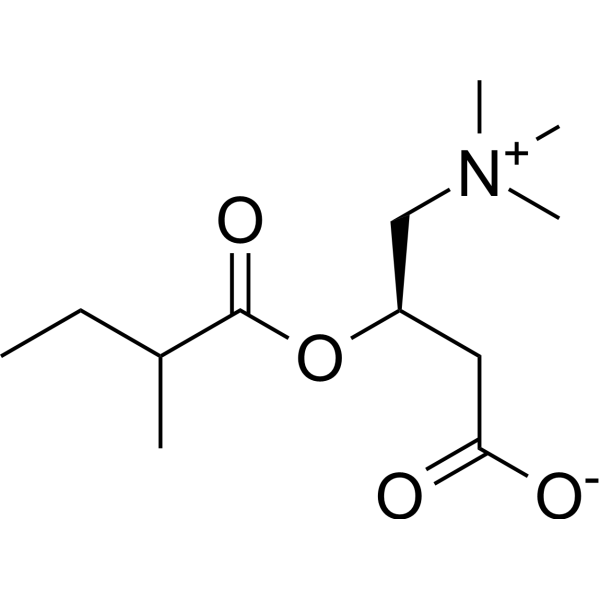
2-Methylbutyrylcarnitine

Based on 1 Customer Validation
2-Methylbutyrylcarnitine (2MBC) is an orally active short-chain branched-chain acylcarnitine and a gut microbiota co-metabolite produced from 2-methylbutyric acid via branched-chain amino acid catabolism. 2-Methylbutyrylcarnitine activates platelet integrin α2β1 (Kd = 10.6 μM), initiates the downstream p38‑cPLA2 signaling cascade, elevates TXA2 production, and thereby enhances platelet hyperreactivity. 2-Methylbutyrylcarnitine can be used in research on atherosclerosis and thrombosis.
For research use only. We do not sell to patients.
- Purity : 99.83%
- CAS No.: 256928-75-3
- Formula: C12H23NO4
- Molecular Weight:245.32
-
Storage:Powder -20°C, 3 years , 4°C, 2 years ; In solvent -80°C, 6 months , -20°C, 1 month

To place orders, for customer services and technical support, please contact: MedChemExpress USA
Tel: 609-228-6898 E-mail: [email protected] [email protected]


-
 Biological Activity
-
Chemical Information
-
Solvent & Solubility
- Protocols
- Purity & Documentation
- References
-
 Help & FAQs





Biological Activity
Description
IC50 & Target
[2]|
α2β1 10.6 μM (Kd) |
In Vitro
2-Methylbutyrylcarnitine (2MBC) (0.5-50 μM; 24 h) does not promote ox-LDL-induced lipid accumulation in RAW264.7 macrophages, nor does it affect the mRNA expression of scavenger receptors such as Cd36, SR-A1, and LOX-1; it does not alter the mRNA levels of IL-1β, TNF-α, and MCP-1 in lipopolysaccharide-stimulated RAW264.7 macrophages, and it also has no effect on the expression of genes related to inflammation, adhesion, and cholesterol metabolism in ox-LDL-stimulated HUVECs[1].
2‑Methylbutyrylcarnitine (2MBC) directly and specifically binds to purified integrin α2β1 protein with a KD of 10.6 mM[2].
2-methylbutyrylcarnitine (0.5 mM; 30 min) enhances ADP-stimulated platelet aggregation in rat platelet-rich plasma in a dose-dependent manner; it potentiates agonist-stimulated aggregation responses in human platelet-rich plasma and washed human platelets[2].
2-methylbutyrylcarnitine (0.5 mM; 60 min) increases the spreading of rat platelets on immobilized collagen by 94.5%; it enhances clot retraction, reducing clot volume in rat platelet-rich plasma[2].
2-methylbutyrylcarnitine (0.5 mM; 30 min) increases TXB2 generation and arachidonic acid release in ADP-stimulated rat platelets, and enhances agonist-induced cPLA2 and p38 MAPK phosphorylation in rat platelets[2].
2-Methylbutyrylcarnitine (0.5 mM)-induced enhancement of mouse platelet aggregation, clot retraction, and cPLA2 phosphorylation is abolished by integrin α2 gene knockout[2].
2-Methylbutyrylcarnitine is produced via in vitro transformation by gut microbiota from mouse feces[2].
MedChemExpress (MCE) has not independently confirmed the accuracy of these methods. They are for reference only. Further protocols information, click here.
-
Cell Line:RAW264.7 macrophages
-
Concentration:0.5 μM
-
Incubation Time:24 h
-
Result:Did not produce changes in the relative mRNA expression levels of IL-1β, TNF-α, and MCP-1 in lipopolysaccharide-stimulated RAW264.7 macrophages.
-
Cell Line:human umbilical vein endothelial cells (HUVECs)
-
Concentration:0.5 μM
-
Incubation Time:24 h
-
Result:Did not significantly change the relative mRNA expression levels of ICAM-1, MCP-1, IL-1β, TNF-α, IL-6, and IL-8 in ox-LDL-stimulated HUVECs.
Did not change the mRNA levels of SR-A1 and ABCA1 in ox-LDL-stimulated HUVECs.
In Vivo
2-methylbutyrylcarnitine (2MBC) (50 μg/kg-100 mg/kg; i.p.; single dose; 2 h before detection) dose-dependently accelerates FeCl3-induced carotid artery thrombosis in mice[2].
2-methylbutyrylcarnitine (100 μg/kg; i.p.; single dose; 2 h before detection) shortens the time to photochemical injury-induced carotid artery occlusion in mice by 38.6%[2].
2-methylbutyrylcarnitine (100 mg/kg; i.p.; single dose) increases mortality in a mouse model of thrombin-induced pulmonary artery thrombosis and nearly doubles pulmonary thrombus burden; inhibition of integrin α2β1 by BTT-3033 (HY-110112) reduces pulmonary thrombus formation in a mouse model of pulmonary artery thrombosis and blocks the prothrombotic effect in a mouse model of carotid artery injury; and integrin α2β1 knockout completely abolishes the prothrombotic effect of 2-methylbutyrylcarnitine in mice[2].
2-methylbutyrylcarnitine significantly elevates plasma D-dimer levels in a mouse model of venous stenosis thrombosis while reducing blood loss in the tail bleeding assay. Oral administration of 2-methylbutyric acid and refeeding in mice promote an increase in plasma 2-methylbutyrylcarnitine levels[2].
The prothrombotic effect associated with 2-methylbutyrylcarnitine is mediated by 2MBA through the gut microbiota: this prothrombotic effect is eliminated by antibiotic treatment, and fecal microbiota transplantation restores the effect; SARS-CoV-2 infection leads to elevated plasma levels in hACE2 mice[2].
MedChemExpress (MCE) has not independently confirmed the accuracy of these methods. They are for reference only.
-
Animal Model:C57BL/6J (male, 6-8 weeks old)[2]
-
Dosage:50 μg/kg; 100 μg/kg; 100 mg/kg
-
Administration:i.p. (single dose 2 h before assay)
-
Result:Shortened the occlusion time in a dose-dependent manner via i.p. injection.
-
Animal Model:C57BL/6J (female, 8 weeks old)[2]
-
Dosage:100 mg/kg
-
Administration:i.p.; single dose; 2 h before thrombin challenge
-
Result:Increased the 30-min mortality rate to 83.3%.
Significantly increased the infarct size of lungs indicated by Evans blue staining.
Almost doubled the amount of thrombi in lung tissues compared with the control group.
Elevated mean pulmonary artery pressure and peak pulmonary velocity in experiments using a lower non-lethal thrombin dose (40 U/kg).
Shortened peak attainment time in pulmonary arteries in experiments using a lower non-lethal thrombin dose (40 U/kg).
Significantly increased plasma thromboxane B2 (TXB2) levels in experiments using a lower non-lethal thrombin dose (40 U/kg).
-
Animal Model:C57BL/6J background integrin α2 knockout (α2-/-) mice and wild-type (WT) littermates (male, 10 weeks old)[2]
-
Dosage:100 mg/kg
-
Administration:i.p.; single dose; 2 h before assay
-
Result:Reduced the time to cessation of flow from 13 min 00 s to 6 min 40 s in WT mice.
Showed completely eliminated thrombosis-accelerating effect in α2-/- mice, with occlusion time at 16 min 00 s in the treated group compared with 17 min 15 s in the vehicle-treated α2-/- group.


Chemical Information
-
CAS No. 256928-75-3
-
Appearance Solid
-
Molecular Weight 245.32
-
Formula C12H23NO4
-
Color White to off-white
-
SMILES
CCC(C)C(O[C@H](CC([O-])=O)C[N+](C)(C)C)=O
-
Synonyms
2MBC
-
Structure Classification
-
Initial Source
-
Shipping
Room temperature in continental US; may vary elsewhere.
-
Storage
Powder -20°C 3 years 4°C 2 years In solvent -80°C 6 months -20°C 1 month


Solvent & Solubility
In Vitro:
H2O : 125 mg/mL (509.54 mM; ultrasonic and warming and heat to 60°C)
DMSO : 100 mg/mL (407.63 mM; Need ultrasonic; Hygroscopic DMSO has a significant impact on the solubility of product, please use newly opened DMSO)
Please refer to the solubility information to select the appropriate solvent. Once prepared, please aliquot and store the solution to prevent product inactivation from repeated freeze-thaw cycles.
Storage method and period of stock solution: -80°C, 6 months; -20°C, 1 month. When stored at -80°C, please use it within 6 months. When stored at -20°C, please use it within 1 month.
* Note: If you choose water as the stock solution, please dilute it to the working solution, then filter and sterilize it with a 0.22 μm filter before use.
Please refer to the solubility information to select the appropriate solvent. Once prepared, please aliquot and store the solution to prevent product inactivation from repeated freeze-thaw cycles.
Storage method and period of stock solution: -80°C, 6 months; -20°C, 1 month. When stored at -80°C, please use it within 6 months. When stored at -20°C, please use it within 1 month.
* Note: If you choose water as the stock solution, please dilute it to the working solution, then filter and sterilize it with a 0.22 μm filter before use.
Concentration (start) × Volume (start) = Concentration (final) × Volume (final)
In Vivo:
Select the appropriate dissolution method based on your experimental animal and administration route.
- For the following dissolution methods, please ensure to first prepare a clear stock solution using an In Vitro approach and then sequentially add co-solvents:
- To ensure reliable experimental results, the clarified stock solution can be appropriately stored based on storage conditions. As for the working solution for In Vivo experiments, it is recommended to prepare freshly and use it on the same day.
- The percentages shown for the solvents indicate their volumetric ratio in the final prepared solution. If precipitation or phase separation occurs during preparation, heat and/or sonication can be used to aid dissolution.
Add each solvent one by one: 10% DMSO 40% PEG300 5% Tween-80 45% Saline
Solubility: ≥ 2.5 mg/mL (10.19 mM); Clear solution
This protocol yields a clear solution of ≥ 2.5 mg/mL (saturation unknown).
Taking 1 mL working solution as an example, add 100 μL DMSO stock solution (25.0 mg/mL) to 400 μL PEG300, and mix evenly; then add 50 μL Tween-80 and mix evenly; then add 450 μL Saline to adjust the volume to 1 mL.
Preparation of Saline: Dissolve 0.9 g sodium chloride in ddH₂O and dilute to 100 mL to obtain a clear Saline solution.
Add each solvent one by one: 10% DMSO 90% (20% SBE-β-CD in Saline)
Solubility: ≥ 2.5 mg/mL (10.19 mM); Clear solution
This protocol yields a clear solution of ≥ 2.5 mg/mL (saturation unknown).
Taking 1 mL working solution as an example, add 100 μL DMSO stock solution (25.0 mg/mL) to 900 μL 20% SBE-β-CD in Saline, and mix evenly.
Preparation of 20% SBE-β-CD in Saline (4°C, storage for one week): 2 g SBE-β-CD powder is dissolved in 10 mL Saline, completely dissolve until clear.
In Vivo Dissolution Calculator
Please enter the basic information of animal experiments:
-
-
-
-
Recommended: Prepare an additional quantity of animals to account for potential losses during experiments.
Working solution concentration: 0.22 mg/mL
This product has good water solubility, please refer to the measured solubility data in water/PBS/Saline for details.

Protocols
-
Research Protocol for Microbiome Analysis
Microbiome analysis characterizes microbial communities in biological or environmental samples by measuring community composition, diversity, taxonomic structure, functional potential, and associations with host or environmental phenotypes. 16S rRNA gene amplicon sequencing is commonly used for bacterial and archaeal taxonomic profiling, while shotgun metagenomics provides higher taxonomic resolution and direct functional information, including microbial genes, pathways, viruses, fungi, and antimicrobial-resistance genes when sequencing depth and host-DNA contamination are adequately controlled. Microbiome results are strongly affected by sample collection, storage, DNA extraction, contamination, sequencing method, reference database, and bioinformatic pipeline; therefore, standardized protocols, negative controls, mock communities, and transparent analysis workflows are required. Unresolved issues include low-biomass contamination, compositional-data bias, inconsistent species-level c
-
Research Protocol for Cardiovascular Diseases
Cardiovascular disease can be modeled as maladaptive cardiac remodeling, where ischemic injury or pressure overload activates inflammatory signaling, fibroblast activation, extracellular-matrix deposition, cardiomyocyte hypertrophy, vascular remodeling, and progressive ventricular dysfunction. The TGF-β/SMAD axis is a central profibrotic pathway after myocardial injury and pressure overload, while innate immune and cytokine pathways regulate leukocyte recruitment, scar formation, and adverse remodeling. Key unresolved questions include which inflammatory signals are reparative versus harmful, when fibrosis is protective versus maladaptive, and whether pathway inhibition improves function without weakening necessary infarct healing or compensatory remodeling.


Purity & Documentation
-
Data Sheet (293 KB)
-
SDS (393 KB)
- English - EN (393 KB)
- Français - FR (393 KB)
- Deutsch - DE (393 KB)
- Norwegian - NO (393 KB)
- Español - ES (393 KB)
- Swedish - SV (393 KB)
- Italian - IT (393 KB)
- Korean - KR (393 KB)
- Portuguese - PT (393 KB)
-
Handling Instructions (2659 KB)
References


Complete Stock Solution Preparation Table
Please refer to the solubility information to select the appropriate solvent. Once prepared, please aliquot and store the solution to prevent product inactivation from repeated freeze-thaw cycles.
Storage method and period of stock solution: -80°C, 6 months; -20°C, 1 month. When stored at -80°C, please use it within 6 months. When stored at -20°C, please use it within 1 month.
| Optional Solvent | Concentration Solvent Mass | 1 mg | 5 mg | 10 mg | 25 mg |
|---|---|---|---|---|---|
| DMSO / H2O | 1 mM | 4.0763 mL | 20.3815 mL | 40.7631 mL | 101.9077 mL |
| 5 mM | 0.8153 mL | 4.0763 mL | 8.1526 mL | 20.3815 mL | |
| 10 mM | 0.4076 mL | 2.0382 mL | 4.0763 mL | 10.1908 mL | |
| 15 mM | 0.2718 mL | 1.3588 mL | 2.7175 mL | 6.7938 mL | |
| 20 mM | 0.2038 mL | 1.0191 mL | 2.0382 mL | 5.0954 mL | |
| 25 mM | 0.1631 mL | 0.8153 mL | 1.6305 mL | 4.0763 mL | |
| 30 mM | 0.1359 mL | 0.6794 mL | 1.3588 mL | 3.3969 mL | |
| 40 mM | 0.1019 mL | 0.5095 mL | 1.0191 mL | 2.5477 mL | |
| 50 mM | 0.0815 mL | 0.4076 mL | 0.8153 mL | 2.0382 mL | |
| 60 mM | 0.0679 mL | 0.3397 mL | 0.6794 mL | 1.6985 mL | |
| 80 mM | 0.0510 mL | 0.2548 mL | 0.5095 mL | 1.2738 mL | |
| 100 mM | 0.0408 mL | 0.2038 mL | 0.4076 mL | 1.0191 mL |
* Note: If you choose water as the stock solution, please dilute it to the working solution, then filter and sterilize it with a 0.22 μm filter before use.


2-Methylbutyrylcarnitine Related Classifications
HY-112948 Related Classifications
 Powered by Bioz