



Apoptosis
Apoptosis
Apoptosis is a distinctive form of cell death exhibiting specific morphological and biochemical characteristics, including cell membrane blebbing, chromatin condensation, genomic DNA fragmentation, and exposure of specific phagocytosis signaling molecules on the cell surface. Cells undergoing apoptosis differ from those dying through necrosis. Necrotic cells are usually recognized by the immune system as a danger signal and, thus, resulting in inflammation; in contrast, apoptotic death is quiet and orderly.
There are two major pathways of apoptotic cell death induction: The intrinsic pathway, also called the Bcl-2-regulated or mitochondrial pathway, is activated by various developmental cues or cytotoxic insults, such as viral infection, DNA damage and growth-factor deprivation, and is strictly controlled by the BCL-2 family of proteins. The extrinsic or death-receptor pathway is triggered by ligation of death receptors (members of the tumor necrosis factor (TNF) receptor family, such as Fas or TNF receptor-1 (TNFR1)) that contain an intracellular death domain, which can recruit and activate caspase-8 through the adaptor protein Fas-associated death domain (FADD; also known as MORT1) at the cell surface. This recruitment causes subsequent activation of downstream (effector) caspases, such as caspase-3, -6 or -7, without any involvement of the BCL-2 family.
Studies suggest that alterations in cell survival contribute to the pathogenesis of a number of human diseases, including cancer, viral infections, autoimmune diseases, neurodegenerative disorders, and AIDS (acquired immunodeficiency syndrome). Treatments designed to specifically alter the apoptotic threshold may have the potential to change the natural progression of some of these diseases.
All Product Categories
-
Apoptosis Inhibitors
(904)
View all products
-
Apoptosis Agonists
(7)
View all products
-
Apoptosis Antagonists
(9)
View all products
-
Apoptosis Activators
(363)
View all products
-
Apoptosis Modulators
(60)
View all products
-
Apoptosis Inducers
(7944)
View all products
-
Apoptosis Degrader
(1)
View all products
-
Apoptosis Controls
(33)
View all products
-
Apoptosis Related Products (9888)
Related Products (9888)

-
Antibodies (120)

-
NPS-1034 (Standard)
 0 ImagesCat. No.: HY-100509RCAS No.: 1221713-92-3
-
Taltobulin intermediate-11
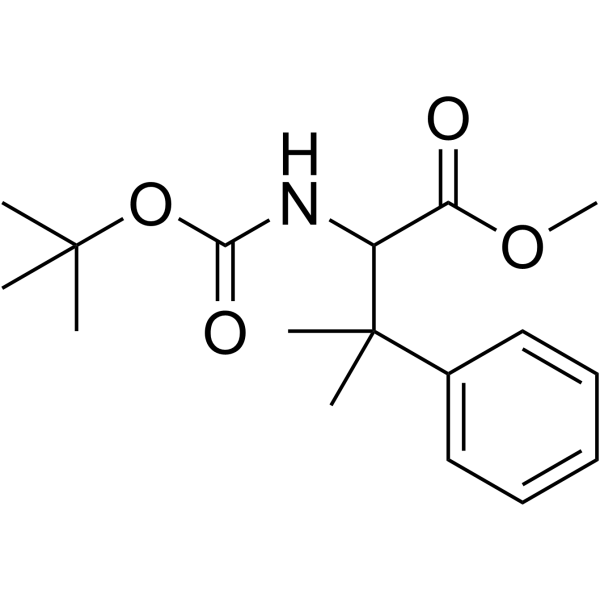 0 ImagesCat. No.: HY-46005CAS No.: 1822561-77-2Taltobulin intermediate-11 is an intermediate in the synthesis of Taltobulin (HY-15584). Taltobulin is a common toxin component in ADC preparation (ADC Cytotoxin), and it is also a powerful tubulin (Microtubule/Tubulin) inhibitor. Taltobulin disrupts tubulin polymerization, induces mitotic arrest, and induces apoptosis.
-
Forsythoside I (Standard)
 0 ImagesForsythoside I (Standard) is the analytical standard of Forsythoside I (HY-N5042). This product is intended for research and analytical applications. Forsythoside I is an orally active caffeoyl phenylethanoid glycoside (CPG) that can be isolated from Forsythia suspense (Thunb.) Vahl. Forsythoside I has anti-inflammatory activity and can exert a protective effect in a mouse model of acute lung injury.
-
Elesclomol (Standard)
 0 ImagesCat. No.: HY-12040RCAS No.: 488832-69-5Synonyms: STA-4783 (Standard)Elesclomol (Standard) is the analytical standard of Elesclomol (HY-12040). This product is intended for research and analytical applications. Elesclomol (STA-4783) is a potent copper ionophore and promotes copper-dependent cell death (cuproptosis). Elesclomol specifically binds ferredoxin 1 (FDX1) α2/α3 helices and β5 strand. Elesclomol inhibits FDX1-mediated Fe-S cluster biosynthesis. Elesclomol is an oxidative stress inducer that induces cancer cell apoptosis. Elesclomol is a reactive oxygen species (ROS) inducer. Elesclomol can be used for Menkes and associated disorders of hereditary copper deficiency research.
-
PKR-IN-C16 (Standard)
 0 ImagesCat. No.: HY-13977ARCAS No.: 608512-97-6PKR-IN-C16 (Standard) is the analytical standard of PKR-IN-C16 (HY-13977A). This product is intended for research and analytical applications. PKR-IN-C16 (Compound C16) is a specific double-stranded RNA-dependent protein Kinase (PKR) inhibitor. PKR-IN-C16 shows promising neuroprotective properties and can rescue acute brain lesions.
-
Microtubule-IN-10
 0 ImagesCat. No.: HY-165283CAS No.: 1027308-36-6Microtubule-IN-10 (compound 9) is an isocoumarin-type microtubule assembly inhibitor. Microtubule-IN-10 exerts an anti-tumor effect by inducing mitotic arrest and apoptosis in multiple myeloma cells. Microtubule-IN-10 can be used for the research of multiple myeloma.
-
FTI-277 TFA
 0 ImagesCat. No.: HY-110038CAS No.: 1217447-06-7FTI-277 TFA is a farnesyltransferase (FTase) inhibitor. FTI-277 TFA inhibits Ras farnesylation, blocks the phosphorylation of downstream ERK1/2 and mTOR, and reduces membrane-bound active N-ras protein. FTI-277 TFA activates caspase 3, upregulates Bim expression, induces cell apoptosis, suppresses regulatory T cell expansion, enhances macrophage phagocytosis, and improves bacterial clearance. FTI-277 TFA activates the PI3K/Akt signaling pathway, inhibits osteoblast differentiation, and reduces the proliferation ability of neuroblastoma cells. FTI-277 TFA can be used in research related to head and neck squamous cell carcinoma, neuroblastoma, sepsis, and vascular calcification.
-
Ganoderic acid R
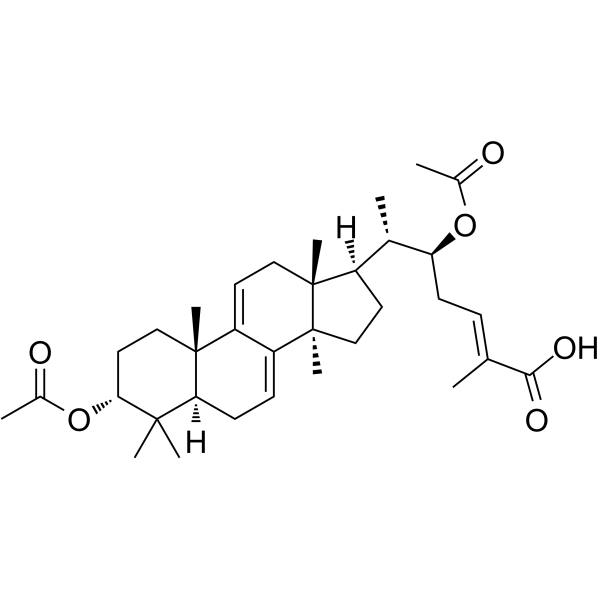 0 ImagesCat. No.: HY-N11638CAS No.: 103963-39-9Ganoderic acid R is a potent anticancer agent. Ganoderic acid R inhibits the growth by inducing apoptosis on tumor cell line. Ganoderic acid R possesses significant cytotoxicity on a multidrug resistance (MDR) tumor cell line (KB-A-1/Dox) and a sensitive tumor cell line (KB-A-1).

-
Tenacissoside C
 0 ImagesCat. No.: HY-N13123CAS No.: 107347-58-0Tenacissoside C is an anti-cancer compound that inhibits angiogenesis. Tenacissoside C induces apoptosis in cancer cells by down-regulating the expression of anti-apoptotic factors and activating caspase-9 and caspase-3. Tenacissoside C also causes cell cycle arrest in cancer cells and induces apoptosis through the mitochondrial pathway.
-
MMPSI (Standard)
 0 ImagesCat. No.: HY-103346RCAS No.: 220509-74-0MMPSI (Standard) is the analytical standard of MMPSI (HY-103346). This product is intended for research and analytical applications. MMPSI is a potent and selective small molecule caspase 3 and caspase 7 inhibitor with an IC50 of 1.7 μM for human caspase-3. MMPSI can significantly reduce ischemia-reperfusion-induced infarct size in the isolated rabbit heart, and reduce apoptosis in both the ischemic myocardium and isolated cardiomyocytes. MMPSI can be used for researching cardioprotection.
-
Alteminostat (Standard)
 0 ImagesCat. No.: HY-109109RCAS No.: 1246374-97-9Synonyms: CKD-581 (Standard)Alteminostat (Standard) is the analytical standard of Alteminostat (HY-109109). This product is intended for research and analytical applications. Alteminostat (CKd-581) is a potent HDAC inhibitor. Alteminostat inhibits the class I-II HDAC family via histone H3 and tubulin acetylation. Alteminostat can be used for lymphoma and multiple myeloma research.
-
SV119 hydrochloride
 0 ImagesCat. No.: HY-177345ACAS No.: 913816-12-3SV119 hydrochloride is a sigma-2 ligand with a Ki value of 5.2 nM. SV119 hydrochloride enhances the efficient transport of drugs across the plasma membrane of cancer cells. The conjugation of dm-Erastin with SV119 hydrochloride successfully overcomes the internalization barrier observed in pancreatic cancer, while preserving the inherent anti-tumor activity of Erastin (HY-15763). Additionally, SV119 hydrochloride demonstrates cytotoxic effects on triple-negative breast cancer (TNBC) cells and induces apoptosis.
-
Phenformin hydrochloride (Standard)
 0 ImagesSynonyms: Phenethylbiguanide hydrochloride (Standard)Phenformin (Phenethylbiguanide) hydrochloride (Standard) is the analytical standard of Phenformin hydrochloride (HY-16397). This product is intended for research and analytical applications. Phenformin hydrochloride (Phenethylbiguanide) is an orally active biguanide hypoglycemic agent. Phenformin hydrochloride inhibits mitochondrial respiratory chain complex I, leading to an increased AMP/ATP ratio, activation of AMPK, and subsequent inhibition of the mTOR pathway, thereby suppressing cell proliferation, inducing apoptosis and autophagy. Phenformin hydrochloride inhibits cancer stem cells (CSCs) and possesses potent antitumor potential.
-
BI-6C9 (Standard)
 0 ImagesCat. No.: HY-103661RCAS No.: 791835-21-7BI-6C9 (Standard) is the analytical standard of BI-6C9 (HY-103661). This product is intended for research and analytical applications. BI-6C9 is a highly specific BH3 interacting domain (Bid) inhibitor, which prevents mitochondrial outer membrane potential (MOMP) and mitochondrial fission, and protects the cells from mitochondrial apoptosis inducing factor (AIF) release and caspase-independent cell death in neurons.
-
Moexipril hydrochloride (Standard)
 0 ImagesCat. No.: HY-B0378ARCAS No.: 82586-52-5Synonyms: RS-10085 (Standard)Moexipril (hydrochloride) (Standard) is the analytical standard of Moexipril (hydrochloride). This product is intended for research and analytical applications. Moexipril hydrochloride (RS-10085) is an orally active inhibitor of angiotensin-converting enzyme (ACE), and becomes effective by being hydrolyzed to moexiprila (hydrochloride). Moexipril hydrochloride exhibits antihypertensive and neuroprotective effects-.
-
Vitamin K4 (Standard)
 0 ImagesVitamin K4 (Standard) is the analytical standard of Vitamin K4. This product is intended for research and analytical applications. Vitamin K4 is a chemically synthesized Vitamin K which plays an important role in the normal blood coagulation system. Vitamin K4 arrests the cells in S phase and induces apoptosis. Vitamin K4 can be used for the research of cancer, such as prostate cancer and osteosarcoma.
-
Bimiralisib hydrochloride
 0 ImagesCat. No.: HY-12868ACAS No.: 1820902-72-4Synonyms: PQR309 hydrochlorideBimiralisib hydrochloride (PQR309 hydrochloride) is an orally active, blood-brain barrier-penetrant PI3K/mTOR inhibitor with in vitro antiproliferative activity and in vivo antitumor activity. Bimiralisib hydrochloride induces G1 cell cycle arrest, apoptosis and cell death in cancer cells, while inhibiting cancer cell proliferation, migration, invasion, colony formation and spheroid generation. Bimiralisib hydrochloride upregulates the expression of E2F4. The combination of Bimiralisib hydrochloride with venetoclax enhances therapeutic efficacy in acute myeloid leukemia models. Bimiralisib hydrochloride can be used in cancer-related research.
-
Bucladesine sodium (GMP)
 0 ImagesCat. No.: HY-B0764GCAS No.: 16980-89-5Synonyms: Dibutyryl cAMP sodium (GMP); DBcAMP sodium (GMP)Bucladesine (Dibutyryl cAMP; DBcAMP) sodium (GMP) is a Bucladesine sodium (HY-B0764) produced by using GMP guidelines. Bucladesine (Dibutyryl cAMP; DBcAMP) is a membrane-permeable 3′, 5′-cyclic adenosine monophosphate (cAMP) analog. Bucladesine selectively activates cAMP dependent protein kinase (PKA) by increasing the intracellular level of cAMP. Bucladesine significantly attenuates MDMA-induced increases in hippocampal mitochondrial ROS formation, mitochondrial outer membrane damage, cytochrome c release, and hippocampal ADP/ATP ratio, thereby improving spatial learning and memory impairments. Bucladesine exhibit anti-nociceptive and anti-inflammation effect. Bucladesine can inhibit cancer cells proliferation, induce apoptosis. Bucladesine can be used for the researches of neurological disease, cancer, inflammation.




