



Cholinesterase (ChE)
Cholinesterase (ChE) is a family of enzymes present in the central nervous system, particularly in nervous tissue, muscle and red cells, which catalyze the hydrolysis of the neurotransmitter acetylcholine into choline and acetic acid, a reaction necessary to allow a cholinergic neuron to return to its resting state after activation. It is one of many important enzymes needed for the proper functioning of the nervous systems of humans.
There are two types: acetylcholinesterase (AChE, acetylcholine hydrolase) and butyrylcholinesterase (BChE, acylcholine acylhydrolase), also known as nonspecific cholinesterase or pseudocholinesterase. AChE is primarily found in the blood on red blood cell membranes, in neuromuscular junctions, and in neural synapses, while BChE is produced in the liver and found primarily in plasma. The difference between the two types of cholinesterase is their relative preferences for substrates: AChE hydrolyzes acetylcholine faster while BChE hydrolyzes butyrylcholine faster.
Cholinesterase (ChE) Isoform Specific Products
All Product Categories
-
Cholinesterase (ChE) Inhibitors
(947)
View all products
-
Cholinesterase (ChE) Agonists
(5)
View all products
-
Cholinesterase (ChE) Antagonists
(10)
View all products
-
Cholinesterase (ChE) Activators
(34)
View all products
-
Cholinesterase (ChE) Modulators
(11)
View all products
-
Cholinesterase (ChE) Chemical
(1)
View all products
-
Cholinesterase (ChE) Inducer
(1)
View all products
-
Cholinesterase (ChE) Controls
(6)
View all products
-
Cholinesterase (ChE) Substrates
(3)
View all products
-
Cholinesterase (ChE) Related Products (1096)
Related Products (1096)

-
Antibodies (2)
-
Cholinesterase (ChE) Isoform Comparison
-
Methiocarb
 0 ImagesMethiocarb (Mercaptodimethur) is an orally active carbamate insecticide. Methiocarb exerts dose-dependent toxic effects on onions. In addition to inhibiting acetylcholinesterase to induce cholinergic excitation, Methiocarb can induce lipid peroxidation in liver, kidney, brain and testicular tissues and alter reduced glutathione levels by generating ROS. Methiocarb can be used for agricultural pest control and research on oxidative stress-related cellular damage in mammals.
-
Pirimicarb-d6
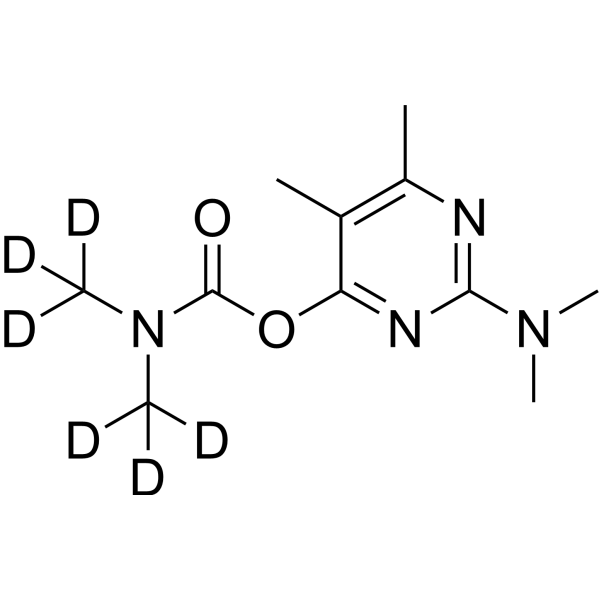 0 ImagesCat. No.: HY-119419SCAS No.: 1015854-66-6Pirimicarb-d6 is the deuterium labeled Pirimicarb (HY-119419). Pirimicarb is a fast-acting selective carbamate insecticide on a wide range of crops including cereals, sugar beet, potatoes, fruits and vegetables. Pirimicarb is an AChE inhibitor and an acaricide.
-
Cyanidin-3-O-galactoside chloride (Standard)
 0 ImagesCat. No.: HY-N4142RCAS No.: 27661-36-5Synonyms: Ideain chloride (Standard)Cyanidin-3-O-galactoside (chloride) (Standard) is the analytical standard of Cyanidin-3-O-galactoside (chloride). This product is intended for research and analytical applications. Cyanidin-3-O-galactoside chloride (Ideain chloride) is a component from extract peel of hawthorn fruit (EPHF) with the value of 179.4 mg/g. EPHF exhibits strong AChE inhibitory activity.

-
Ladostigil hemitartrate (Standard)
 0 ImagesCat. No.: HY-10400RCAS No.: 209394-46-7Synonyms: TV-3326 hemitartrate (Standard)Ladostigil hemitartrate (Standard) is the analytical standard of Ladostigil hemitartrate (HY-10400). This product is intended for research and analytical applications. Ladostigil (TV-3326) hemitartrate is an orally active dual inhibitor of cholinesterase and brain-selective monoamine oxidase (MAO), with IC50s of 37.1 and 31.8 μM for MAO-B and AChE, respectively. Ladostigil hemitartrate exhibits neuroprotective, antioxidant and anti-inflammatory activities. Ladostigil hemitartrate can be used for the research of depression and Alzheimer's disease. Ladostigil hemitartrate is a click chemistry reagent, it contains an Alkyne group and can undergo copper-catalyzed azide-alkyne cycloaddition (CuAAc) with molecules containing Azide groups.
-
Dehydroevodiamine hydrochloride (Standard)
 0 ImagesCat. No.: HY-N6029RCAS No.: 111664-82-5Dehydroevodiamine hydrochloride Standard is the analytical standard of Dehydroevodiamine hydrochloride (HY-N6029). This product is intended for research and analytical applications. Dehydroevodiamine hydrochloride is a blood-brain barrier-permeable, orally effective AChE and BACE1 inhibitor (IC50 = 40.96 μM). Dehydroevodiamine hydrochloride is isolated and extracted from Evodia rutaecarpa. Dehydroevodiamine hydrochloride attenuates neurotoxicity through multiple targets by inhibiting BACE1 to block Aβ production, inhibiting AChE activity, scavenging ROS, and suppressing calcium influx. Dehydroevodiamine hydrochloride can be used for research on Alzheimer's disease, cerebral ischemia, vascular dementia, and other cognitive disorder-related diseases.
-
Trimedoxime dichloride
 0 ImagesTrimedoxime dichloride (TMB-4 dichloride) is a blood-brain barrier-permeable cholinesterase reactivator. Trimedoxime dichloride reactivates cholinesterase inhibited by paraoxon, sarin, tabun and other agents, restricts the breakdown of acetylcholine and alleviates excessive cholinergic stimulation. Trimedoxime dichloride reduces mortality and prolongs survival time. Trimedoxime dichloride exhibits reactivation efficacy against AChE in rat tissues. Trimedoxime dichloride can be used in research related to organophosphate (paraoxon) poisoning and tabun poisoning.
-
WAY-361789
 0 ImagesCat. No.: HY-18039CAS No.: 1040718-40-8Synonyms: SEN15924WAY-361789 (SEN15924) is an orally active agonist for α7 nicotinic acetylcholine receptor (α7 nAChR) with an EC50 of 0.18 μM. WAY-361789 improves the cognitive function, exhibits potential in ameliorating Alzheimer’s Disease and schizophrenia.
-
Cornuside (Standard)
 0 ImagesCat. No.: HY-N0631RCAS No.: 131189-57-6Cornuside (Standard) is the analytical standard of Cornuside (HY-N0631). This product is intended for research and analytical applications. Cornuside is an iridoid glycoside with anti-allergic, anti-inflammatory, and neuroprotective activities. Cornuside exerts anti-allergic activity by downregulating the p38 MAPK, JNK, and NF-κB signaling pathways, and inhibits IgE-mediated histamine release from mast cells. Cornuside improves cognitive impairment in mice by inhibiting BACE1 activity (IC50 = 55.84 μg/mL) and enhancing ChAT activity. Cornuside inhibits LPS (HY-D1056)-induced inflammatory mediators, including iNOS, COX-2, PGE2, TNF-α, IL-6, and IL-1β, by suppressing NF-κB activation.
-
Vescalagin
 0 ImagesCat. No.: HY-N19401CAS No.: 36001-47-5Vescalagin is a hexahydroxyphenol. Vescalagin is isolable from Camu-camu (Myrciaria dubia) and immature wax apple fruits. Vescalagin exhibits inhibitory activity against a variety of enzymes, with a Ki value of 5.87 nM against AChE, 3.89 nM against BChE, 11.75 nM against hCA I, 16.23 nM against hCA II, and 16.08 nM against α-glucosidase. Vescalagin inhibits hCA I, hCA II and α-glucosidase in a non-competitive manner. Vescalagin downregulates JNK/p38 MAPK to protect pancreatic β-cells and improve insulin secretion in methylglyoxal-treated rats. Vescalagin reduces hyperglycemia and hypertriglyceridemia in rats fed a high-fructose diet. Vescalagin possesses anti-inflammatory and antioxidant properties.
-
Pridinol mesylate (Standard)
 0 ImagesPridinol mesylate (Standard) is the analytical standard of Pridinol mesylate (HY-B1343). This product is intended for research and analytical applications. Pridinol mesylate is an orally active, blood-brain permeable, muscarinic acetylcholine receptor (mAChR)-directed muscle relaxant. Pridinol mesylate reduces the conduction of impulses to spinal motor neurons and exerts muscle relaxant activity. Pridinol mesylate inhibits skeletal muscle contractures in diseases of both central and peripheral origin and can be used in research in the field of musculoskeletal diseases.
-
Thunberginol C
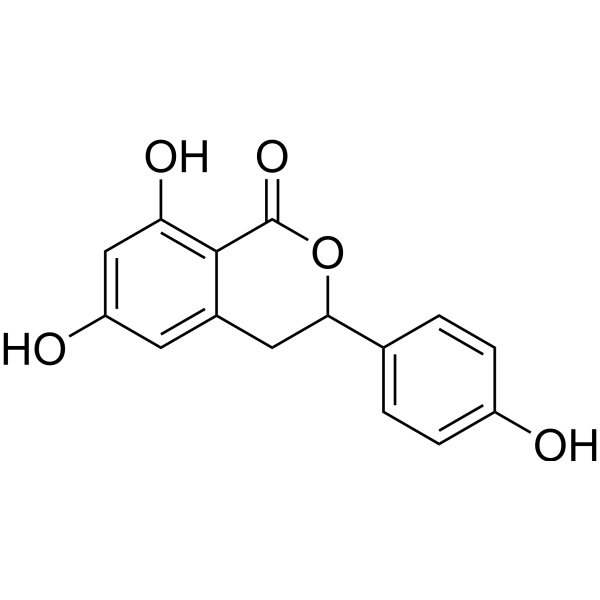 0 ImagesCat. No.: HY-N1151CAS No.: 147517-06-4Thunberginol C is an orally active, selective, and non-competitive inhibitor of AChE and BChE, with IC50 values of 41.96 and 42.36 μM, respectively. Thunberginol C exerts cytoprotective, pro-collagen type I restorative, MMP-1 inhibitory, hyaluronic acid restorative, anti-photoaging effects in skin cells. Thunberginol C exerts neuroprotective, anxiolytic, TNF-α inhibitory, neuroinflammation inhibitory, and oxidative stress inhibitory effects. Thunberginol C can be used for the research of Alzheimer’s disease, UVB-induced skin photoaging, allergic reactions, oral bacterial infections, and stress-induced anxiety.
-
Chlorphoxim
 0 ImagesCat. No.: HY-W747601CAS No.: 14816-20-7Chlorphoxim is a broad-spectrum and highly efficient insecticide. Chlorphoxim kills pests by inhibiting AChE. Chlorphoxim inhibits the activities of SOD and CAT in zebrafish embryos. Chlorphoxim induces oxidative stress in zebrafish embryos by activating ROS. Chlorphoxim induces apoptosis by upregulating the expression levels of Bax, Bcl2 and p53 in zebrafish embryos. Chlorphoxim exhibits neurotoxicity and developmental toxicity. Chlorphoxim is used in agricultural research for the control of various pests.
-
Isomalathion
 0 ImagesCat. No.: HY-W707749CAS No.: 3344-12-5Isomalathion is an isomer and impurity of Malathion (HY-B0943). Isomalathion inhibits Carboxyesterase and AChE, with an IC50 value of 3.2 μM against bovine acetylcholinesterase. Isomalathion moderately reduces CYP1A2 transcript levels, increases CYP2B6 transcript levels, and induces dose-dependent DNA damage. Malathion is an organophosphorus insecticide.
-
Buxbodine B
 0 ImagesCat. No.: HY-N2971CAS No.: 390362-51-3Buxbodine B is an inhibitor for acetylcholinesterase (AChE) with an IC50 of 50 μM. Buxbodine B can be used in research of Alzheimer's disease.
-
Arisugacin D
 0 ImagesCat. No.: HY-N13924CAS No.: 261950-94-1Arisugacin D is an acetylcholinesterase (AChE) inhibitor with an IC50 of 3.5 μM.

-
Aspulvinone H
 0 ImagesCat. No.: HY-N14093CAS No.: 57744-69-1Aspulvinone H is an orally active inhibitor of AChE, pancreatic lipase, glutamic-oxaloacetic transaminase 1, and α-glucosidase, with IC50 values of 25.95 μM, 47.06 μM, 5.91/6.91 μM, and 4.6 μM, respectively. It has a Ka of 2.14 μM against GOT1 and a Ki of 6.58 μM against α-glucosidase. Aspulvinone H inhibits cancer cell proliferation, interferes with glutamine metabolism, elevates ROS levels, and induces cell apoptosis and S-phase arrest. Aspulvinone H exhibits antibacterial activity against Staphylococcus aureus. Aspulvinone H inhibits the growth of pancreatic ductal adenocarcinoma xenografts. Aspulvinone H reduces postprandial blood glucose in mice. Aspulvinone H can be used in research related to pancreatic ductal adenocarcinoma, diabetes, and Staphylococcus aureus infection.
-
Amprolium hydrochloride (Standard)
 0 ImagesAmprolium (hydrochloride) (Standard) is the analytical standard of Amprolium (hydrochloride) (HY-B0937A). This product is intended for research and analytical applications. Amprolium hydrochloride is a thiamine transporter inhibitor and antiparasitic agent with oral activity and blood-brain barrier penetration. Amprolium hydrochloride blocks thiamine transport at the blood-brain barrier and intestine, and competitively inhibits thiamine pyrophosphokinase, inducing thiamine pyrophosphate deficiency and impairing carbohydrate synthesis. Amprolium hydrochloride induces oxidative stress, alters antioxidant enzyme activity, and inhibits acetylcholinesterase (AchE) activity. Amprolium hydrochloride disrupts reproductive organs and gametogenesis, and causes histopathological and ultrastructural damage to multiple organs. Amprolium hydrochloride induces thiamine deficiency, reduces body weight gain in mice, and causes psychomotor behavioral changes and nephropathy. Amprolium hydrochloride exhibits molluscicidal activity against the terrestrial snail Eobania vermiculata, and reduces the shedding of Eimeria meleagrimitis oocysts in feces and litter. Amprolium hydrochloride can be used for research on thiamine deficiency and coccidiosis.
-
Sinapine (Standard)
 0 ImagesCat. No.: HY-N5077RCAS No.: 18696-26-9Sinapine is an alkaloid isolated from seeds of the cruciferous species. Sinapine exhibits anti-inflammatory, anti-oxidant, anti-tumor, anti-angiogenic and radio-protective effects. Sinapine is also an acetylcholinesterase (AChE) inhibitor and can be used for the research of Alzheimer’s disease, ataxia, myasthenia gravis, and Parkinson’s disease.




