



HDAC
Histone deacetylases
HDAC (Histone deacetylases) are a class of enzymes that remove acetyl groups (O=C-CH3) from an ε-N-acetyl lysine amino acid on ahistone, allowing the histones to wrap the DNA more tightly. This is important because DNA is wrapped around histones, and DNA expression is regulated by acetylation and de-acetylation. Its action is opposite to that of histone acetyltransferase. HDAC proteins are now also called lysine deacetylases (KDAC), to describe their function rather than their target, which also includes non-histone proteins. Together with the acetylpolyamine amidohydrolases and the acetoin utilization proteins, the histone deacetylases form an ancient protein superfamily known as the histone deacetylase superfamily.
HDAC Isoform Specific Products
-
HDAC
(390)
View all products
-
HDAC1
(317)
View all products
-
HDAC2
(210)
View all products
-
HDAC3
(204)
View all products
-
HDAC4
(72)
View all products
-
HDAC5
(56)
View all products
-
HDAC6
(335)
View all products
-
HDAC7
(53)
View all products
-
HDAC8
(188)
View all products
-
HDAC9
(41)
View all products
-
HDAC10
(67)
View all products
-
HDAC11
(71)
View all products
-
HD1
(3)
View all products
-
HD2
(4)
View all products
All Product Categories
-
HDAC Inhibitors
(778)
View all products
-
HDAC Antagonists
(3)
View all products
-
HDAC Activators
(14)
View all products
-
HDAC Modulators
(4)
View all products
-
HDAC MDM2 Inhibitor
(1)
View all products
-
HDAC Degraders
(44)
View all products
-
HDAC Controls
(4)
View all products
-
HDAC Substrates
(3)
View all products
-
HDAC Ligands
(14)
View all products
-
HDAC 관련 제품 (913)
관련 제품 (913)

-
Antibodies (16)
-
HDAC Signaling Pathway
-
HDAC Isoform Comparison
-
HDAC6-IN-76
 0 ImagesCat. No.: HY-181805CAS No.: 3110559-06-0HDAC6-IN-76 (Compound G25) is a selective HDAC6 inhibitor with an IC50 of 12 nM. HDAC6-IN-76 induces Autophagy in a p53-dependent manner. HDAC6-IN-76 induces Apoptosis in a p53-dependent manner. HDAC6-IN-76 exhibits anticancer activity against hematologic malignancies, including acute myeloid leukemia.
-
Valproic acid β-D-glucuronide-d15
 0 ImagesCat. No.: HY-W769286Valproic acid β-D-glucuronide-d15 is the deuterium labeled Valproic acid β-D-glucuronide (HY-W400496). Valproic acid β-D-glucuronide is the major urinary metabolite of Valproic acid (HY-10585).
-
A2AAR/HDAC-IN-2
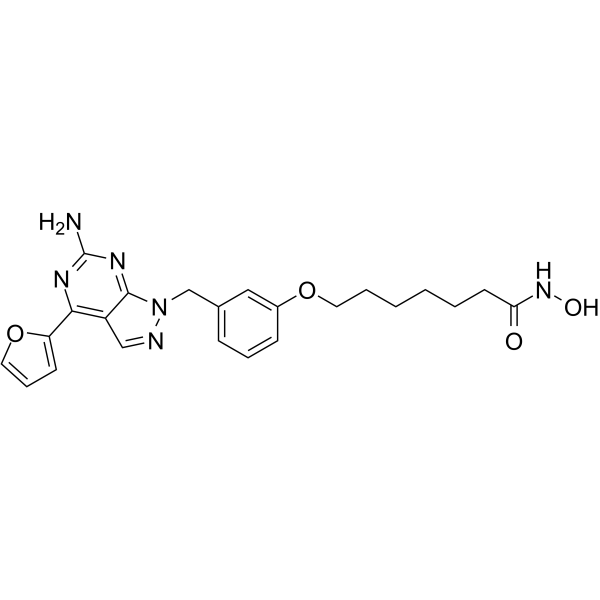 0 ImagesCat. No.: HY-143325CAS No.: 2767560-94-9A2AAR/HDAC-IN-2 is a potent A2AAR/HDAC dual inhibitor, with good binding affinity for A2AAR (Ki=10.3 nM) and good inhibitory activity against HDAC1 (IC50=18.5 nM). A2AAR/HDAC-IN-2 can be used in study of antitumor.
-
JN210
 0 ImagesCat. No.: HY-189074JN210 is a dual inhibitor of DCN1 and HDAC, with an IC50 of 94.26 nM against human DCN1. JN210 disrupts the UBE2M-DCN1 protein-protein interaction, blocks the neddylation modification of cullin-RING ligases, inhibits HDAC activity and induces histone hyperacetylation. JN210 impairs DNA damage repair function, induces cell apoptosis, exerts cytotoxicity and inhibits tumor growth. JN210 can be used for the research of non-small cell lung cancer.
-
HDAC-IN-49
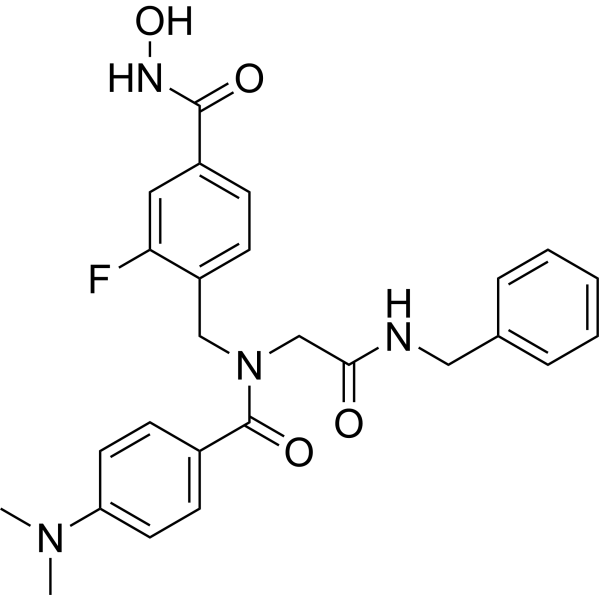 0 ImagesCat. No.: HY-151897CAS No.: 3035173-63-5
-
HDAC1-IN-5
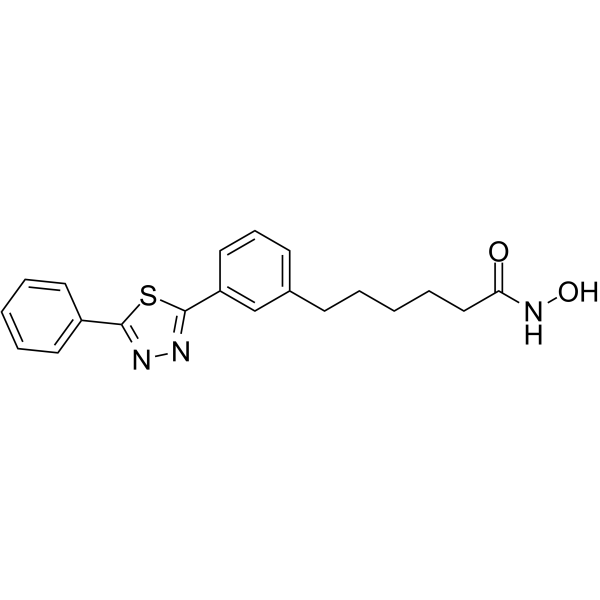 0 ImagesCat. No.: HY-151153HDAC1-IN-5 is a potent HDAC1 inhibitor with IC50 values of 15 nM and 20 nM for HDAC1 and HDAC6, respectively. HDAC1-IN-5 can enhance the acetylation of histone H3 and α-tubulin, as well as promote the activation of caspase 3 in cancer cells, thereby inducing apoptosis. HDAC1-IN-5 induces chromatin damage by binding with DNA. HDAC1-IN-5 has strong inhibitory activity against tumor growth in xenograft mice.
-
HDAC6-IN-60
 0 ImagesCat. No.: HY-174265CAS No.: 3095060-37-7
-
anti-TNBC agent-12
 0 ImagesCat. No.: HY-178487anti-TNBC agent-12 (Compound 23a) is a multi-target antitumor agent targeting HDAC6 (IC50=30.3 nM), DNA, and inducing nitric oxide (NO) release. anti-TNBC agent-12 induces tumor cell apoptosis and G2/M phase cell cycle arrest. anti-TNBC agent-12 is promising for research of triple-negative breast cancer (TNBC).
-
IHCH-3185
 0 ImagesCat. No.: HY-181877IHCH-3185 is an orally active class I HDAC inhibitor (HDAC1 IC50 =102.9 nM) and A2AR antagonist (A2AR Ki =7.6 nM). IHCH-3185 reverses immune gene silencing by inducing histone acetylation and blocks the adenosine signaling pathway to relieve T-cell suppression. IHCH-3185 exhibits antiproliferative activity, induces cell cycle arrest, and significantly improves the tumor microenvironment. IHCH-3185 reduces the proportion of regulatory T cells, increases the CD8+/Treg ratio, and upregulates the expression of key factors such as H2-K1, Cxcl9 and Cxcl10. IHCH-3185 shows significant antitumor potential in CT26 and MC38 mouse tumor models and is suitable for related cancer research.
-
HDAC6-IN-29
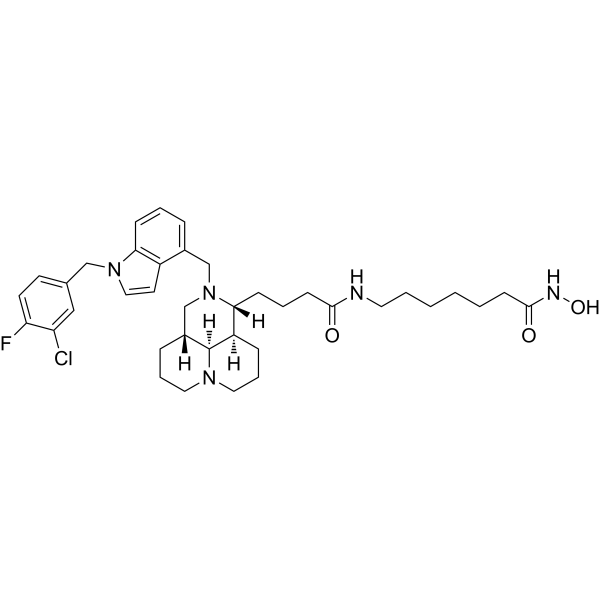 0 ImagesCat. No.: HY-157401HDAC6-IN-29 (compound 11g), hydroxamic analogue, is a HDAC6 inhibitor. HDAC6-IN-29 has potent antiproliferative activity against CAL-51 cells (IC50 = 1.17 μM) and is able to induce apoptosis and cause accumulation of cells in the S phase of the cell cycle. HDAC6-IN-29 can be used for the research of cancer.
-
HDAC6-IN-59
 0 ImagesCat. No.: HY-174149CAS No.: 2998932-98-0HDAC6-IN-59 (Compound 38k) is a highly selective histone deacetylase 6 (HDAC6) inhibitor (IC50=3.12 nM, with 352-fold selectivity over HDAC1). HDAC6-IN-59 is promising for research of esophageal cancer.
-
HDAC-IN-33
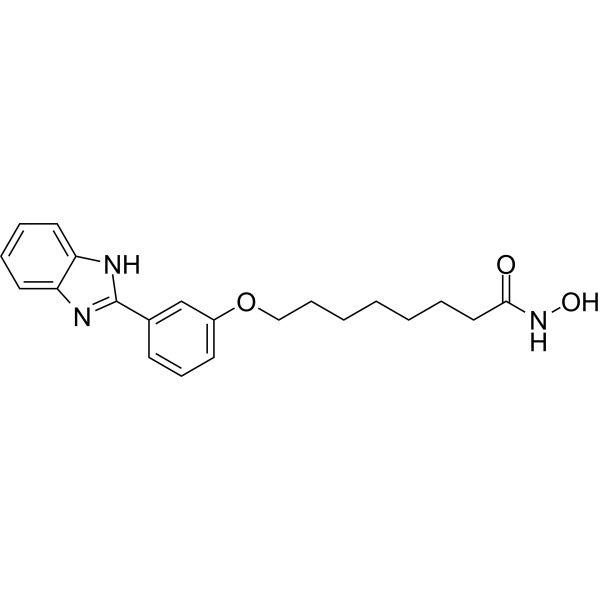 0 ImagesCat. No.: HY-145688CAS No.: 2766688-19-9
-
HDAC2-IN-3
 0 ImagesCat. No.: HY-182321CAS No.: 2652579-44-5HDAC2-IN-3 is a selective, orally active, blood-brain barrier permeable HDAC2 inhibitor with an IC50 of 14 nM. HDAC2-IN-3 upregulates histone acetylation levels in cells and in vivo, and enhances long-term potentiation (LTP) in the hippocampus. HDAC2-IN-3 can be used for the research of Alzheimer's disease.

-
HDAC6-IN-43
 0 ImagesCat. No.: HY-161524CAS No.: 3037978-19-8HDAC6-IN-43 (compound 26) is a potent HDAC inhibitor. HDAC6-IN-43 effectively inhibits several HDACs, notably HDAC1, HDAC2, and HDAC6 (IC50 < 150 nM), displaying a particularly high sensitivity towards HDAC6 (IC50 = 11 nM). HDAC6-IN-43 can be used for the research of autosomal dominant polycystic kidney disease (ADPKD).
-
HDAC-IN-93
 0 ImagesCat. No.: HY-178104HDAC-IN-93 is a HDAC inhibitor with promising total pan-HDAC inhibitory activity. HDAC-IN-93 demonstrates significant broad-spectrum antiproliferative activity across various cancer cell lines. HDAC-IN-93 induces cell apoptosis along with necrosis. HDAC-IN-93 can be used for the studies of prostate cancer and breast cancer.

-
PI3K/HDAC-IN-4
 0 ImagesCat. No.: HY-172889CAS No.: 3085191-45-0PI3K/HDAC-IN-4 (Compound 31f) is a PI3K/HDAC dual inhibitor (IC50: 0.2μM). PI3K/HDAC-IN-4 shows high selectivity for HDAC1-3 (IC50 values of 75.5 nM, 70.9 nM, and 1.9 nM, respectively). PI3K/HDAC-IN-4 is a potent PIK3 inhibitor with IC50 values of 2.5 nM, 80.5 nM, 10.0 nM, and 57.2 nM for PI3Kα, β, δ, and γ, respectively. PI3K/HDAC-IN-4 significantly induces tumor cell apoptosis by simultaneously inhibiting the PI3K/AKT/mTOR signaling pathway and HDAC1-3. PI3K/HDAC-IN-4 exhibits potent antiproliferative activity in a variety of tumor cell lines (e.g., MV4-11, Jeko-1, HL60, and MCF-7, with IC50 values of 0.2, 0.9, 0.8, and 1.5 μM, respectively). PI3K/HDAC-IN-4 can be used in the study of lymphoma and leukemia.




