



Reactive Oxygen Species (ROS)
Reactive oxygen species (ROS), such as superoxide anion (O2-), hydrogen peroxide (H2O2), and hydroxyl radical (HO•), consist of radical and non-radical oxygen species formed by the partial reduction of oxygen. Cellular ROS are generated endogenously during mitochondrial oxidative metabolism as well as in cellular response to xenobiotics, cytokines, and bacterial invasion.
ROS also activates MAPK pathways by the direct inhibition of MAPK phosphatases. Through PTEN, the PI3K pathway is subject to reversible redox regulation by ROS generated by growth factor stimulation. The activation of autophagy may be a cellular defense mechanism in response to ROS.
All Product Categories
-
Reactive Oxygen Species (ROS) Inhibitors
(1091)
View all products
-
Reactive Oxygen Species (ROS) Agonists
(37)
View all products
-
Reactive Oxygen Species (ROS) Antagonists
(2)
View all products
-
Reactive Oxygen Species (ROS) Activators
(525)
View all products
-
Reactive Oxygen Species (ROS) Modulators
(22)
View all products
-
Reactive Oxygen Species (ROS) MDM2 Inhibitor
(1)
View all products
-
Reactive Oxygen Species (ROS) Inducers
(645)
View all products
-
Reactive Oxygen Species (ROS) Controls
(5)
View all products
-
Reactive Oxygen Species (ROS) Substrates
(3)
View all products
-
Reactive Oxygen Species (ROS) Related Products (2859)
Related Products (2859)

-
Antibodies (8)
-
RSL3 (Standard)
 0 ImagesSynonyms: (1S,3R)-RSL3 (Standard)RSL3 (Standard) is the analytical standard of RSL3 (HY-100218A). This product is intended for research and analytical applications. RSL3 ((1S,3R)-RSL3) is an inhibitor of glutathione peroxidase 4 (GPX4) (ferroptosis activator), reduces the expression of GPX4 protein, and induces ferroptotic death of head and neck cancer cell. RSL3 increases the expression of p62 and Nrf2 and inactivates Keap1 in HN3-rslR cells.
-
Jionoside D
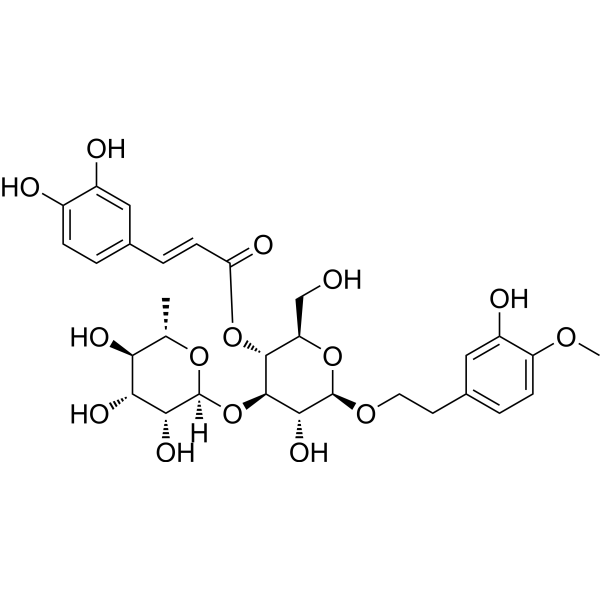 0 ImagesCat. No.: HY-N0025CAS No.: 120406-34-0Jionoside D is a hydroxycinnamic acid ester with antioxidant property. Jionoside D has scavenging activity of intracellular reactive oxygen species (ROS) and of DPPH radical, and lipid peroxidation inhibitory activity. Jionoside D reduces the apoptotic cells induced by H2O2 in V79-4 cells. Jionoside D increases the activities of cellular antioxidant enzymes, SOD and catalase.
-
NucPE1 (Standard)
 0 ImagesCat. No.: HY-101859RCAS No.: 1404091-23-1Synonyms: Nuc-H2O2 Probe (Standard)NucPE1 (Standard) (Nuc-H2O2 Probe (Standard)) is the analytical standard of NucPE1 (HY-101859). This product is intended for research and analytical applications. NucPE1 (Nuc-H2O2 Probe) is a nuclear-localized fluorescent hydrogen peroxide that is specifically localized to cellular nuclei without appended targeting moieties.
-
Avermectin B1 (Standard)
 0 ImagesSynonyms: Abamectin (Standard); Avermectin B1a-Avermectin B1b mixt. (Standard)Avermectin B1 (Standard) is the analytical standard of Avermectin B1. This product is intended for research and analytical applications. Avermectin B1 (Abamectin) is a mixture of two similar segments of avermectin. Avermectin B1 is an orally anti-infection agent, which can be used in the research of parasitic worms, insect pests, agriculture and animal husbandry. Avermectin B1 can also induce the production of ROS and induces cytotoxicity, apoptosis and autophagy.
-
Saquinavir (Standard)
 0 ImagesSynonyms: Ro 31-8959 (Standard)Saquinavir (Standard) (Ro 31-8959 (Standard)) is the analytical standard of Saquinavir (HY-17007). This product is intended for research and analytical applications. Saquinavir (Ro 31-8959) is an orally active HIV protease inhibitor that can be used in the research of AIDS. Saquinavir also has anti-inflammatory activity and can induce apoptosis of human red blood cells.
-
Timosaponin E2
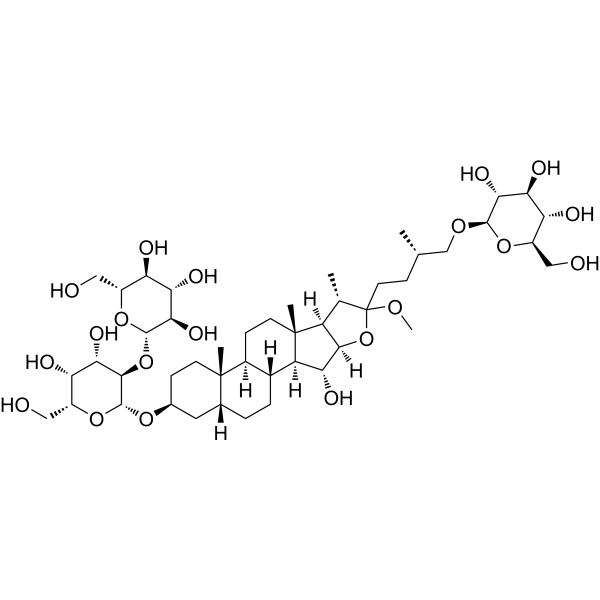 0 ImagesCat. No.: HY-N12649CAS No.: 222018-47-5Timosaponin E2 is an antiinflammatory agent, and inhibits active oxygen production.
-
α-Synuclein-IN-24
 0 ImagesCat. No.: HY-184819CAS No.: 2883627-56-1α-Synuclein-IN-24 is an α-synuclein (α-Syn) aggregation inhibitor with an IC50 of 4.0 μM. α-Synuclein-IN-24 stabilizes the secondary conformation of α-synuclein monomers, inhibits β-sheet formation, reduces oligonucleation during the aggregation lag phase, dissociates preformed aggregates, and blocks reaggregation. α-Synuclein-IN-24 reduces α-synuclein inclusions in neuronal cells and scavenges ROS. α-Synuclein-IN-24 can be used for the research of Parkinson's disease.
-
2-Hexadecenal
 0 ImagesCat. No.: HY-121683ACAS No.: 3163-37-9Synonyms: (E/Z)-16:1 Aldehyde
-
Isoacteoside (Standard)
 0 ImagesSynonyms: Isoverbascoside (Standard)Isoacteoside (Standard) is the analytical standard of Isoacteoside. This product is intended for research and analytical applications. Isoacteoside is a natural product that can significantly inhibit the formation of glycation end products. Isoacteoside Standard regulates the AKT/PI3K/m-TOR/NF-κB signaling pathway, induces apoptosis in OVCAR-3 cell. Isoacteoside Standard exhibits antitumor, anti-inflammatory, anti-obesity and neuroprotective activities.
-
TFGF-18
 0 ImagesCat. No.: HY-171031CAS No.: 2222662-20-4TFGF-18 is a GSK-3β inhibitor (IC50: 0.59 μM). TFGF-18 inhibits LPS-induced microglia activation and proinflammatory mediators release via inhibiting GSK-3β and downstream p65/NF-κB signaling. TFGF-18 inhibits neuronal apoptosis and oxidative stress, inhibits expressions of Bax, caspase3 and cleaved-caspase3 and increases the expression of Bcl-2. TFGF-18 has neuroprotection effect, inhibit neuroinflammation and attenuates cognitive impairment.
-
DGAT-1 inhibitor 2 (Standard)
 0 ImagesCat. No.: HY-50670RCAS No.: 942999-61-3DGAT-1 inhibitor 2 (Standard) is the analytical standard of DGAT-1 inhibitor 2 (HY-50670). This product is intended for research and analytical applications. DGAT-1 inhibitor 2 is an orally active DGAT-1 inhibitor with IC50 values of 15 nM and 9 nM for human DGAT-1 and rat DGAT-1, respectively. DGAT-1 inhibitor 2 increases ROS concentration, GRP78, and PERK protein abundance. DGAT-1 inhibitor 2 increases SREBF1, CPT1A, and MTTP mRNA in fatty acid-treated cells. DGAT-1 inhibitor 2 improves obesity.
-
Aloe vera
 0 ImagesCat. No.: HY-N13301CAS No.: 85507-69-3Aloe vera is an herbal plant known for its anti-inflammatory, antibacterial, anticancer, antioxidant, heart-protective, and wound-healing properties. Aloe vera can be used in research for tumors, diabetes, bone diseases, and cardiovascular diseases.
-
Dexpramipexole-d3 dihydrochloride
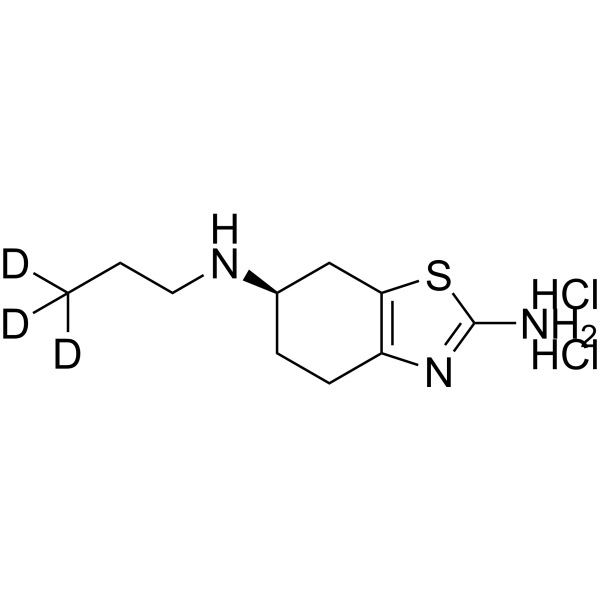 0 ImagesCat. No.: HY-17355BSCAS No.: 1432230-09-5Synonyms: (R)-Pramipexole-d3 dihydrochloride; R-(+)-Pramipexole-d3 dihydrochloride; KNS-760704-d3 dihydrochlorideDexpramipexole-d3 ((R)-Pramipexole-d3) dihydrochloride is the deuterium labeled Dexpramipexole. Dexpramipexole ((R)-Pramipexole) dihydrochloride is an orally active, blood-brain barrier permeable mitochondrial protective agent. Dexpramipexole dihydrochloride upregulates the expression of Parkin, PINK1, GPX4 and FSP1; binds to mitochondrial F1/Fo-ATP synthase; blocks the Nav1.8 sodium channel; and inhibits the activation of the NLRP3 inflammasome. Dexpramipexole dihydrochloride induces mitophagy, inhibits ferroptosis, pyroptosis, apoptosis, neuroinflammation and eosinophilopoiesis; maintains mitochondrial function and redox homeostasis; reduces reactive oxygen species production; and decreases myocardial infarct size. Dexpramipexole dihydrochloride is applicable to studies on eosinophilic asthma, myocardial ischemia/reperfusion injury, sepsis-associated encephalopathy, analgesia, and more.
-
Swertianolin (Standard)
 0 ImagesCat. No.: HY-N2192RCAS No.: 23445-00-3Swertianolin (Standard) is the analytical standard of Swertianolin (HY-N2192). This product is intended for research and analytical applications. Swertianolin is a xanthone glycoside. Swertianolin can be isolated from plants of the Gentianaceae family (e.g., Gentiana campestris and Swertia punicea). Swertianolin inhibits p38 phosphorylation and NF-κB activation, and reduces NO and ROS production. Swertianolin exhibits anti-Helicobacter pylori activity with an IC50 of 6.1 μM and a minimum bactericidal concentration of 91.7 μM. Swertianolin modulates immune function in sepsis. Swertianolin is useful in the research of diseases such as Alzheimer's disease, hepatitis B, Helicobacter pylori infection, and sepsis.
-
2,4′-Dihydroxybenzophenone (Standard)
 0 ImagesCat. No.: HY-W014223RCAS No.: 131-56-6Synonyms: Ultraviolet absorber UV-0 (Standard)2,4′-Dihydroxybenzophenone (Standard) is the analytical standard of 2,4′-Dihydroxybenzophenone. This product is intended for research and analytical applications. 2,4′-Dihydroxybenzophenone (Ultraviolet absorber UV-0) occupies the hydrophobic pocket of MD2 and blocks the dimerization of TLR4. 2,4′-Dihydroxybenzophenone inhibits the LPS induced mtROS production, and LPS induced inflammatory response by downregulating pro-inflammatory mediators and decreasing the expression of MyD88, p-IRAK4, and NF-κB. 2,4′-Dihydroxybenzophenone is also a UV absorber.
-
Zaluzanin C
 0 ImagesCat. No.: HY-N15415CAS No.: 16838-87-2Zaluzanin C is a sesquiterpene lactone and antifungal agent. Zaluzanin C is isolated from the leaves of Vernonia arborea. Zaluzanin C inhibits mtROS-mediated NF-κB activity, as well as LPS- and TNF-α-induced mtROS production. Zaluzanin C alleviates mtROS-mediated mitochondrial dysfunction, enhances Mitophagy, and increases the mRNA levels of fatty acid oxidation genes and mitochondrial biogenesis factors. Zaluzanin C inhibits the formation of advanced glycation end products and α-glucosidase activity. Zaluzanin C improves intracellular lipid accumulation. Zaluzanin C exhibits anti-inflammatory, antioxidant, antifungal, anticancer and pro-osteogenic activities. Zaluzanin C can be used in studies related to non-alcoholic fatty liver disease and obesity.
-
Antimicrobial agent-51
 0 ImagesCat. No.: HY-184420CAS No.: 1822599-86-9Antimicrobial agent-51 is an antifungal agent that increases ROS levels, reduces mitochondrial membrane potential, alters hyphal morphology, and impairs cell membrane integrity. Antimicrobial agent-51 inhibits succinate dehydrogenase (SDH) with an IC50 of 0.76 μg/mL against Colletotrichum gloeosporioides. Antimicrobial agent-51 exhibits control efficacy against Alternaria solani on tomato fruits and shows low toxicity to plant and mammalian cells. Antimicrobial agent-51 can be used for the research of plant fungal diseases.
-
Simvastatin acid-d3 ammonium
 0 ImagesCat. No.: HY-119695AS2Synonyms: Tenivastatin-d3 ammoniumSimvastatin acid-d3 (Tenivastatin-d3) ammonium is deuterium-labeled Simvastatin acid (ammonium) (HY-119695A).
-
AMP423
 0 ImagesCat. No.: HY-119289CAS No.: 219501-57-2AMP423 is an oxidation inducer and cell cycle regulator. AMP423 induces necrosis, apoptosis, and reactive oxygen species production. AMP423 induces inhibition of protein synthesis, reduction of thiol levels, and S-phase cell accumulation, and exhibits antitumor activity. AMP423 can be used in research related to multiple myeloma and follicular B-cell lymphoma.
-
ETM-305
 0 ImagesCat. No.: HY-177966CAS No.: 250159-76-3ETM-305 is a degradation product of the anticancer agent ET-743 (HY-50936). ET-743 (Ecteinascidin 743; Trabectedin) is a tetrahydroisoquinoline alkaloid that binds to the minor groove of DNA, blocks the transcription of stress-induced proteins, induces DNA backbone cleavage and cancer cell apoptosis, and increases ROS production in MCF-7 and MDA-MB-453 cells. Trabectedin is used in the research of soft tissue sarcoma and ovarian cancer.




