



Reactive Oxygen Species (ROS)
Reactive oxygen species (ROS), such as superoxide anion (O2-), hydrogen peroxide (H2O2), and hydroxyl radical (HO•), consist of radical and non-radical oxygen species formed by the partial reduction of oxygen. Cellular ROS are generated endogenously during mitochondrial oxidative metabolism as well as in cellular response to xenobiotics, cytokines, and bacterial invasion.
ROS also activates MAPK pathways by the direct inhibition of MAPK phosphatases. Through PTEN, the PI3K pathway is subject to reversible redox regulation by ROS generated by growth factor stimulation. The activation of autophagy may be a cellular defense mechanism in response to ROS.
All Product Categories
-
Reactive Oxygen Species (ROS) Inhibitors
(1057)
View all products
-
Reactive Oxygen Species (ROS) Agonists
(37)
View all products
-
Reactive Oxygen Species (ROS) Antagonists
(2)
View all products
-
Reactive Oxygen Species (ROS) Activators
(513)
View all products
-
Reactive Oxygen Species (ROS) Modulators
(22)
View all products
-
Reactive Oxygen Species (ROS) MDM2 Inhibitor
(1)
View all products
-
Reactive Oxygen Species (ROS) Inducers
(630)
View all products
-
Reactive Oxygen Species (ROS) Controls
(5)
View all products
-
Reactive Oxygen Species (ROS) Substrates
(3)
View all products
-
Reactive Oxygen Species (ROS) Related Products (2800)
Related Products (2800)

-
Antibodies (8)
-
Graveoline (Standard)
 0 ImagesGraveoline (Standard) is the analytical standard of Graveoline (HY-12538). This product is intended for research and analytical applications. Graveoline (Rutamine) is an orally active alkaloid with various activities such as antifungal, antiparasitic, anti-inflammatory, and antitumor effects. Graveoline can induce tumor cell apoptosis and autophagy through a reactive oxygen species-mediated pathway. Graveoline has an MIC of 500 μg/mL for Candida albicans. Graveoline can be used in the research of various diseases such as tumors and liver injury.
-
Methiocarb
 0 ImagesMethiocarb (Mercaptodimethur) is an orally active carbamate insecticide. Methiocarb exerts dose-dependent toxic effects on onions. In addition to inhibiting acetylcholinesterase to induce cholinergic excitation, Methiocarb can induce lipid peroxidation in liver, kidney, brain and testicular tissues and alter reduced glutathione levels by generating ROS. Methiocarb can be used for agricultural pest control and research on oxidative stress-related cellular damage in mammals.
-
Antibacterial agent 351
 0 ImagesCat. No.: HY-184284CAS No.: 2798832-23-0Antibacterial agent 351 is a broad-spectrum antibacterial agent. Antibacterial agent 351 binds to the allosteric site of PBP2a, induces conformational changes, and reduces the level of PBP2a in MRSA. Antibacterial agent 351 acts as a DNA intercalator to interfere with bacterial DNA function. Antibacterial agent 351 disrupts bacterial redox homeostasis via excessive production of ROS and RNS, depletes intracellular GSH, induces lipid peroxidation, and triggers bacterial cell death. Antibacterial agent 351 enhances the activity of Metronidazole (HY-B0318) against anaerobic bacteria and extends the antibacterial spectrum of Metronidazole to aerobic bacteria. Antibacterial agent 351 can be used in the research of bacterial infections (including MRSA infections).
-
Methyl aminolevulinate hydrochloride (Standard)
 0 ImagesMethyl aminolevulinate hydrochloride (Standard) is the analytical standard of Methyl aminolevulinate hydrochloride. This product is intended for research and analytical applications. Methyl aminolevulinate hydrochloride is a sensitizer used in photodynamic therapy (PDT). Methyl aminolevulinate hydrochloride penetrates the skin and induces the production of photoactive porphyrins including protoporphyrin IX in cells; upon exposure to appropriate light, it generates ROS, which triggers cellular oxidation and cell death. Methyl aminolevulinate hydrochloride acts as a photo-damage reversing agent through epidermal reconstruction, cytokine-mediated activation of dermal fibroblasts, elastin breakdown, new collagen formation, and compression of dilated capillaries. Methyl aminolevulinate hydrochloride reduces the expression of the proliferation marker Ki-67 and the early skin carcinogenesis marker TP53. Methyl aminolevulinate hydrochloride delays the onset of ultraviolet-induced skin tumors and reduces tumor burden in hairless mice. Methyl aminolevulinate hydrochloride is applicable to research related to actinic keratosis and basal cell carcinoma.
-
ROS inducer 9
 0 ImagesCat. No.: HY-172602CAS No.: 3081689-97-3ROS inducer 9 (compound 4e) is an antibacterial agent with a MIC value of 0.25 μg/mL against E. coli. ROS inducer 9 kills bacteria by inhibiting GSH activity and increasing ROS levels. ROS inducer 9 shows low toxicity to erythrocytes and RAW 264.7 cells.
-
Benzylurea (Standard)
 0 ImagesCat. No.: HY-W010253RCAS No.: 538-32-9Benzylurea (Standard) is the analytical standard of Benzylurea (HY-W010253). This product is intended for research and analytical applications. Benzylurea is a benzylamide. Benzylurea is an anti-inflammatory agent. Benzylurea inhibits LPS (HY-D1056)-induced upregulation of MTCH2 expression and regulates pathways associated with mitochondrial function, inflammation and cell survival. Benzylurea alleviates LPS-induced proliferation inhibition and apoptosis of periodontal ligament fibroblasts, as well as the release of proinflammatory cytokines. Benzylurea can be used in studies related to periodontitis.
-
Picoxystrobin (Standard)
 0 ImagesPicoxystrobin (Standard) is the analytical standard of Picoxystrobin (HY-136355). This product is intended for research and analytical applications. Picoxystrobin is a strobilurin fungicide. Picoxystrobin controls plant diseases by inhibiting mitochondrial respiration. Picoxystrobin is highly toxic to zebrafish embryos, causing developmental abnormalities, oxidative stress, and immunotoxicity.
-
Neouralenol
 0 ImagesCat. No.: HY-N15622CAS No.: 139163-16-9Neouralenol is a free radical scavenger. Neouralenol can be isolated from licorice roots. Neouralenol scavenges hydroxyl radicals and hydroperoxyl radicals.
-
RANKL-IN-2
 0 ImagesCat. No.: HY-181079CAS No.: 2667022-87-7RANKL-IN-2 is an orally active RANKL inhibitor with Kd values of 3.21 μM and 4.625 μM in the SPR and MST assays, respectively. RANKL-IN-2 binds to RANKL to interfere with RANKL-RANK interaction. RANKL-IN-2 suppresses osteoclastogenesis by inhibiting ROS, MAPK and NF-κB pathways. RANKL-IN-2 inhibits osteoclastogenesis via inhibition of RANKL-induced osteoclast formation, bone resorption, and osteoclast-specific gene and protein expressions in vitro.RANKL-IN-2 prevents bone loss in ovariectomized osteoporosis mice.RANKL-IN-2 can be used for the research of osteoporosis.
-
Antibacterial agent 292
 0 ImagesCat. No.: HY-178212CAS No.: 3065015-86-0Antibacterial agent 292 is a 3-pyrazolylindole derivative. Antibacterial agent 292 is an anti-bacterial agent. Antibacterial agent 292 shows potent inhibitory activity against Xanthomonas oryzae pv oryzae (Xoo) and Xanthomonas axonopodis pv citri (Xac), with EC50 values of 2.54 and 3.49 μg/mL. Antibacterial agent 292 can suppress biofilm formation, bacterial motility, and extracellular polysaccharide production, induce morphological alterations and promote ROS accumulation, ultimately triggers bacterial apoptosis. Antibacterial agent 292 down-regulates the expression of genes associated with the type VI secretion system (T6SS). Antibacterial agent 292 can be used in rice bacterial blight and citrus canker.
-
Dehydroevodiamine hydrochloride (Standard)
 0 ImagesCat. No.: HY-N6029RCAS No.: 111664-82-5Dehydroevodiamine hydrochloride Standard is the analytical standard of Dehydroevodiamine hydrochloride (HY-N6029). This product is intended for research and analytical applications. Dehydroevodiamine hydrochloride is a blood-brain barrier-permeable, orally effective AChE and BACE1 inhibitor (IC50 = 40.96 μM). Dehydroevodiamine hydrochloride is isolated and extracted from Evodia rutaecarpa. Dehydroevodiamine hydrochloride attenuates neurotoxicity through multiple targets by inhibiting BACE1 to block Aβ production, inhibiting AChE activity, scavenging ROS, and suppressing calcium influx. Dehydroevodiamine hydrochloride can be used for research on Alzheimer's disease, cerebral ischemia, vascular dementia, and other cognitive disorder-related diseases.
-
Anti-MRSA agent 36
 0 ImagesCat. No.: HY-178476CAS No.: 3096122-10-7Anti-MRSA agent 36 (Compound III13) is an antibacterial agent with strong anti MRSA activity (MIC = 1 μg/mL). Anti-MRSA agent 36 targets phosphatidylglycerol (PG) on bacterial membranes, disrupting membrane integrity, leading to DNA leakage and increased ROS. Anti-MRSA agent 36 has advantages such as low cytotoxicity, low hemolysis, difficulty in inducing drug resistance, and good plasma stability. Anti-MRSA agent 36 can be used for the study of skin abscess and systemic infection models.
-
5-O-Methylvisammioside (Standard)
 0 ImagesCat. No.: HY-N0442RCAS No.: 84272-85-5Synonyms: 4'-O-β-D-Glucosyl-5-O-methylvisamminol (Standard)5-O-Methylvisammioside (4'-O-β-D-Glucosyl-5-O-methylvisamminol) (Standard) is the analytical standard of 5-O-Methylvisammioside. This product is intended for research and analytical applications. 5-O-Methylvisammioside is an orally active natural chromone glycoside and multiple biological activities. 5-O-Methylvisammioside inhibits ferroptosis by activating the Nrf2/HO-1 signaling axis. 5-O-Methylvisammioside alleviates intestinal barrier damage by inhibiting the ROS/NF-κB/NLRP3 pathway. 5-O-Methylvisammioside exerts a protective effect against acute liver injury by reducing ALT/AST, decreasing inflammatory infiltration, and inhibiting IκB-α phosphorylation and NF-κB nuclear translocation. 5-O-Methylvisammioside blocks the HMGB1/RAGE/MEK/ERK signaling axis to exert anti-tumor and anti-angiogenic effects. 5-O-Methylvisammioside improves depression-like behaviors by inhibiting Src kinase and the NF-κB pathway.
-
Cephaeline (Standard)
 0 ImagesSynonyms: (-)-Cephaeline (Standard); NSC 32944 free base (Standard)Cephaeline ((-)-Cephaeline), a desmethyl analog of Emetine, is a phenolic alkaloid in Indian Ipecac roots isolated from the Cephaelis ipecacuanha. Cephaeline exhibits potent inhibition of both Zika virus (ZIKV) and Ebola virus (EBOV) infections. Cephaeline is an inductor of histone H3 acetylation and an inhibitor of mucoepidermoid carcinoma cancer stem cells (MEC), which promotes ferroptosis by inhibiting NRF2 to exert anti-lung cancer efficacy.
-
DA29
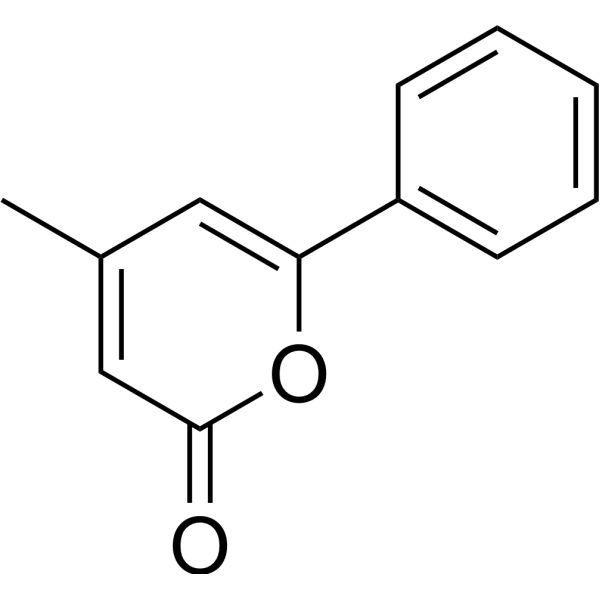
 0 ImagesCat. No.: HY-187371DA29 is a human caseinolytic protease P (hClpP) activator, with an EC50 of 0.85 μM and a Kd of 185 nM. DA29 binds to the hydrophobic allosteric pocket of this enzyme, activates its proteolytic function, and displaces hClpX from the hClpXP complex. DA29 induces mitochondrial dysfunction and ROS accumulation. DA29 exerts cytotoxic effects on cancer cells and organoids. DA29 can be used in the research of diffuse intrinsic pontine glioma.
-
α-Synuclein-IN-22
 0 ImagesCat. No.: HY-184817CAS No.: 2883627-63-0α-Synuclein-IN-22 is an α-Synuclein inhibitor with an IC50 of 2.7 μM against human α-Syn. α-Synuclein-IN-22 exerts anti-aggregation effects by stabilizing the native conformation of α-Syn, inhibiting the formation of β-sheet aggregates and inclusion bodies, and dissociating mature fibrils into functional monomers. α-Synuclein-IN-22 scavenges ROS and shows low cytotoxicity. α-Synuclein-IN-22 can be used in research related to Parkinson's disease.

-
L-Ascorbic acid 2-phosphate trisodium (Standard)
 0 ImagesSynonyms: 2-Phospho-L-ascorbic acid trisodium (Standard)L-Ascorbic acid 2-phosphate (trisodium) (Standard) is the analytical standard of L-Ascorbic acid 2-phosphate (trisodium). This product is intended for research and analytical applications. L-Ascorbic acid 2-phosphate trisodium (2-Phospho-L-ascorbic acid trisodium) is a long-acting vitamin C derivative that can stimulate collagen formation and expression[1]. L-Ascorbic acid 2-phosphate trisodium (2-Phospho-L-ascorbic acid trisodium) can be used as a culture medium supplement for the osteogenic differentiation of human adipose stem cells (hASCs). L-Ascorbic acid 2-phosphate trisodium (2-Phospho-L-ascorbic acid trisodium) increases alkaline phosphatase (ALP) activity and expression of runx2A in hASCs during the osteogenic differentiation[2][3].
-
SET-12
 0 ImagesCat. No.: HY-179710CAS No.: 2241572-39-2SET-12 is an antiparasitic agent with high activity and selectivity against the Leishmania amazonensis. SET-12 exhibits excellent activity against the pre-flagellated form of the Leishmania amazonensis, with an IC₅₀ of 10.89 μM and a selectivity index (SI) of up to 12.1. SET-12 is also effective against the non-flagellated form within cells, with an IC₅₀ of 3.81 μM and a further increased selectivity index (SI) to 34.5. SET-12 causes signs of parasite cell apoptosis, including mitochondrial damage and accumulation of ROS.




