



Reactive Oxygen Species (ROS)
Reactive oxygen species (ROS), such as superoxide anion (O2-), hydrogen peroxide (H2O2), and hydroxyl radical (HO•), consist of radical and non-radical oxygen species formed by the partial reduction of oxygen. Cellular ROS are generated endogenously during mitochondrial oxidative metabolism as well as in cellular response to xenobiotics, cytokines, and bacterial invasion.
ROS also activates MAPK pathways by the direct inhibition of MAPK phosphatases. Through PTEN, the PI3K pathway is subject to reversible redox regulation by ROS generated by growth factor stimulation. The activation of autophagy may be a cellular defense mechanism in response to ROS.
All Product Categories
-
Reactive Oxygen Species (ROS) Inhibitors
(1091)
View all products
-
Reactive Oxygen Species (ROS) Agonists
(37)
View all products
-
Reactive Oxygen Species (ROS) Antagonists
(2)
View all products
-
Reactive Oxygen Species (ROS) Activators
(525)
View all products
-
Reactive Oxygen Species (ROS) Modulators
(22)
View all products
-
Reactive Oxygen Species (ROS) MDM2 Inhibitor
(1)
View all products
-
Reactive Oxygen Species (ROS) Inducers
(645)
View all products
-
Reactive Oxygen Species (ROS) Controls
(5)
View all products
-
Reactive Oxygen Species (ROS) Substrates
(3)
View all products
-
Reactive Oxygen Species (ROS) Related Products (2859)
Related Products (2859)

-
Antibodies (8)
-
Garlic oil
 0 ImagesGarlic oil is an orally effective anti-inflammatory, antioxidant, and anticancer agent. Garlic oil inhibits the activation of NF-κB, NFκB2 and NLRP3 inflammasome, and induces the expression of GSTA1, HO-1 and NQO-1. Garlic oil reduces the Bcl-2/Bax protein ratio and activates NNK-induced apoptosis (apoptosis) in lung tissues. Garlic oil attenuates NNK-induced apoptosis in MRC-5 cells and reduces excessive ROS production. Garlic oil alleviates pyroptosis (pyroptosis) and exerts a protective effect against acute lung injury in mice. Garlic oil inhibits lung tumorigenesis in mice and improves small intestinal motility in rats with type 2 diabetes. Garlic oil can be used in research related to acute lung injury, lung cancer, peptic ulcer, type 2 diabetes and hypertension.
-
Cinidon-ethyl
 0 ImagesCat. No.: HY-W747602CAS No.: 142891-20-1Cinidon-ethyl is a herbicide. Cinidon-ethyl blocks the conversion of protoporphyrinogen IX to protoporphyrin IX, disrupts the tetrapyrrole biosynthetic process, and leads to the accumulation of protoporphyrin IX and the generation of ROS. Cinidon-ethyl induces the expression of peroxidase and defense-related genes in wheat. Cinidon-ethyl triggers light-dependent ethylene and ethane release, tissue dehydration and necrosis in sensitive broadleaf weeds. Cinidon-ethyl is applicable to research related to the control of broadleaf weeds in wheat fields.
-
Quinclorac (Standard)
 0 ImagesCat. No.: HY-B0871RCAS No.: 84087-01-4Quinclorac (Standard) is the analytical standard of Quinclorac (HY-B0871). This product is intended for research and analytical applications. Quinclorac is a highly selective quinoline carboxylic acid synthetic auxin herbicide. Quinclorac weakly inhibits HPPD, accompanied by a transient decrease in carotenoids. Quinclorac upregulates ACC synthase (ACS), leading to the co-accumulation of ethylene and cyanide, while increasing the ABA/IAA ratio, which induces ROS burst, membrane lipid peroxidation (MDA) and lethal growth inhibition. Residual Quinclorac in soil can cause abnormal growth of subsequent tobacco crops. In calli of Phaseolus vulgaris, Quinclorac induces oxidative stress (increased MDA and decreased RGR), but cells after stepwise pressurized acclimation acquire a constitutive antioxidant state, which remains stable after de-acclimation and tolerates oxidative damage caused by Quinclorac. Quinclorac can be used in studies related to herbicide action mechanisms, bioremediation of soil residues, and adaptive responses of plant cells to oxidative stress.
-
Anti-MRSA agent 33 iodide
 0 ImagesCat. No.: HY-175295AAnti-MRSA agent 33 iodide is an anti-Methicillin (HY-121544)-resistant Staphylococcus aureus (MRSA) agent, with MIC values of 2-4 μg/mL. Anti-MRSA agent 33 iodide demonstrates effective biofilm eradication and minimal cytotoxicity toward mammalian cells. Anti-MRSA agent 33 iodide specifically binds to phosphatidylglycerol (PG) on bacterial membranes, leading to membrane disruption, excessive production of ROS, and metabolic collapse, ultimately resulting in bacterial cell death. Anti-MRSA agent 33 iodide reduces bacterial load in a murine skin infection model.
-
DMBT
 0 ImagesCat. No.: HY-183377CAS No.: 1260071-76-8DMBT is an orally effective anti-tumor metastasis and anti-angiogenesis agent. DMBT downregulates key molecules such as EGFR/p-Akt/HIF-1α/VEGF/MMP-9, inhibits the HIF-1α/VE-cadherin (cadherin)/MMPs and Nrf2/HO-1 signaling pathways, and reduces hypoxia-induced ROS levels as well as the secretion and activity of MMP-9. DMBT inhibits hypoxia-induced vasculogenic mimicry, cancer cell migration, invasion and metastasis, and exhibits no obvious cytotoxicity to normal cells. DMBT reduces the area of laser-induced choroidal neovascularization lesions. DMBT can be used in studies related to breast cancer, melanoma and macular degeneration.
-
Calcium propionate, meets analytical specification of E282 (Standard)
 0 ImagesCat. No.: HY-B1580ARCAS No.: 4075-81-4Synonyms: Bioban-C, meets analytical specification of E282 (Standard)Calcium propionate, meets analytical specification of E282 (Standard) (Bioban-C, meets analytical specification of E282 (Standard)) is the analytical standard of Calcium propionate, meets analytical specification of E282 (HY-B1580A). This product is intended for research and analytical applications. Calcium propionate, meets analytical specification of E282 is a calcium salt of Propionic acid with oral activity, which can be hydrolyzed into propionate and calcium ions. Calcium propionate, meets analytical specification of E282 elevates intracellular ROS levels in tumor cells, depletes GSH, reduces mitochondrial membrane potential, and thereby induces tumor cell apoptosis. In mouse colitis models, Calcium propionate, meets analytical specification of E282 modulates inflammatory factors such as IFN-γ, calprotectin, and Pglyrp3, ameliorating intestinal inflammation and metabolic disorders. In ruminants, Calcium propionate, meets analytical specification of E282 serves as a gluconeogenic precursor, regulating rumen fermentation and microbial diversity; in high-fat diet rats, it alters gut microbiota composition and affects blood biochemical parameters. Calcium propionate, meets analytical specification of E282 is commonly used as a food and feed additive, and is also used in research related to hypocalcemia, dyslipidemia, colitis, and lung cancer.
-
ETMTC
 0 ImagesCat. No.: HY-183448CAS No.: 117666-86-1ETMTC is an orally active anti-inflammatory and antioxidant agent. ETMTC inhibits IKK-mediated phosphorylation and degradation of IkBα, blocks nuclear translocation and activation of NF-κB, and reduces the expression of ICAM-1, VCAM-1, E-selectin, Th2 cytokines and eosinophil chemokines. ETMTC abrogates neutrophil adhesion to endothelial monolayers and inhibits TNF-α-induced ROS production. ETMTC activates Nrf2, and enhances the activities of mitochondrial complex I and IV. ETMTC reduces lipid peroxidation levels, oxidative DNA damage, cytochrome c and caspase 9 activity, and decreases goblet cell metaplasia and subepithelial fibrosis. ETMTC can be used for the research of inflammatory diseases and asthma.
-
CORM-401 (Standard)
 0 ImagesCat. No.: HY-109804RCAS No.: 1001015-18-4CORM-401 (Standard) is the analytical standard of CORM-401 (HY-109804). This product is intended for research and analytical applications. CORM-401 is an oxidant-sensitive CO-releasing molecule. CORM-401 induces NO increase in the regulation of endothelial calcium signalling. CORM-401 reduces TNF-α/CHX and H2O2-induced ROS production. CORM-401 uncouples mitochondrial respiration and inhibits glycolysis.
-
10-Undecenoic acid (copper)
 0 ImagesCat. No.: HY-B0914BCAS No.: 35322-29-3Synonyms: Undecylenic acid (copper)10-Undecenoic acid copper (Undecylenic acid copper) is an antifungal agent. 10-Undecenoic acid copper inhibits Aβ oligomerization, scavenges ROS and inhibits μ-calpain activity. 10-Undecenoic acid copper has neuroprotective effects. 10-Undecenoic acid copper has anticancer effects on a variety of tumors. 10-Undecenoic acid copper inhibits C. albicans biofilm formation and MRSA infection. 10-Undecenoic acid copper inhibits quorum sensing signals of Bacillus subtilis and Pseudomonas aeruginosa.
-
PDIC-NC
 0 ImagesCat. No.: HY-169483CAS No.: 2633013-75-7PDIC-NC is a STING agonist. PDIC-NC is cytotoxic to tumor cells and induces ROS explosion, apoptosis and autophagy. PDIC-NC has lung specific distribution and can be used in the study of lung cancer.
-
Lobenzarit disodium (Standard)
 0 ImagesCat. No.: HY-107360RCAS No.: 64808-48-6Synonyms: CCA (Standard)Lobenzarit disodium (Standard) (CCA (Standard)) is the analytical standard of Lobenzarit (disodium) (HY-107360). This product is intended for research and analytical applications. Lobenzarit disodium (CCA) is an anti-arthritic and anti-oxidative agent.
-
Cannabidiphorol
 0 ImagesCat. No.: HY-W874892CAS No.: 55824-13-0Synonyms: CBDPCannabidiphorol (CBDP) is a phytocannabinoid that increases the production of reactive oxygen species (ROS) and activates cellular pathways related to ROS signaling. Cannabidiphorol inhibits cell viability of breast cancer cells.
-
Apple Cider Vinegar Powder
 0 ImagesCat. No.: HY-N13221Apple Cider Vinegar Powder is a soluble powdered form of apple cider vinegar. Apple Cider Vinegar Powder has anti-bacterial, anti-oxidant, and antibiotic properties and can help maintain the acid-base balance in the blood. Apple Cider Vinegar Powder can lower blood sugar and lipid levels. Apple Cider Vinegar Powder is used in research related to tumors, diabetes, and cardiovascular diseases.
-
3-Demethylcolchicine (Standard)
 0 ImagesCat. No.: HY-W021267RCAS No.: 7336-33-63-Demethylcolchicine (Standard) is the analytical standard of 3-Demethylcolchicine. This product is intended for research and analytical applications. 3-Demethylcolchicine, a colchicine metabolite, possesses a hydroxy-group on its carbon ring that could participate in radical scavenging and markedly inhibits the carrageenin edema.
-
11-oxo-mogroside V (Standard)
 0 ImagesCat. No.: HY-N0501RCAS No.: 126105-11-111-oxo-mogroside V (Standard) is the analytical standard of 11-oxo-mogroside V. This product is intended for research and analytical applications. 11-oxo-mogroside V is a natural sweetener that exhibits strong antioxidant activity. It exhibits significant inhibitory effects on reactive oxygen species (O2-, H2O2 and *OH) with EC50 of 4.79, 16.52, and 146.17 μg/mL, respectively.
-
Iron sucrose solution
 0 ImagesCat. No.: HY-FLB2068CAS No.: 8047-67-4Synonyms: Iron saccharate solutionIron Sucrose solution is mainly composed of Iron sucrose (HY-B2068). Iron sucrose (Iron saccharate) is a intravenous iron preparation and a pro-oxidant agent. Iron sucrose has the potential for iron deficiency anemia treatment.
-
Dihydroartemisinin-d
 0 ImagesCat. No.: HY-N0176S6CAS No.: 252043-36-0Synonyms: Dihydroqinghaosu-d; β-Dihydroartemisinin-d; Artenimol-dDihydroartemisinin-d (Dihydroqinghaosu-d) is the d-labeled Dihydroartemisinin (HY-N0176). Dihydroartemisinin is an orally active metabolite of rtemisinin (HY-B0094) and antimalarial agent. Dihydroartemisinin induces Autophagy by inhibiting NF-κB activation. Dihydroartemisinin promotes ROS accumulation. Dihydroartemisinin exhibits anticancer activity in esophageal cancer cells. Dihydroartemisinin shows schistosomicidal activity against juvenile and adult worms of Schistosoma japonicum, reduces worm burden, and displays antiparasitic activity. Dihydroartemisinin can be used in research related to multiple myeloma, promyelocytic leukemia, esophageal cancer, and Schistosoma japonicum infection.
-
Phototherapeutic agent-1
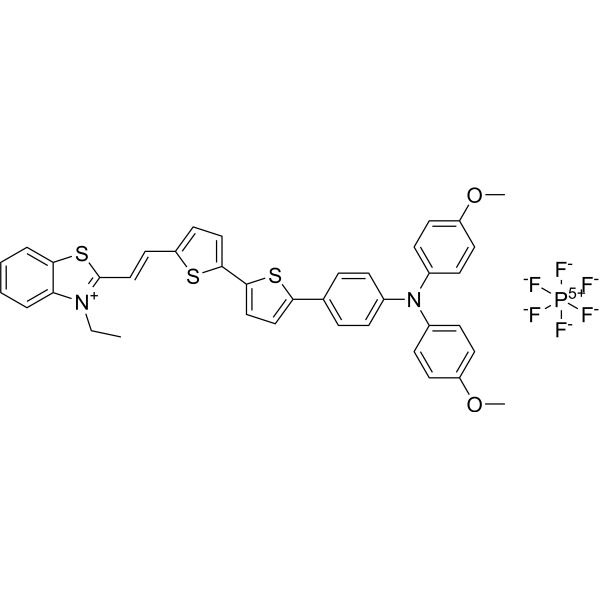 0 ImagesCat. No.: HY-D1468CAS No.: 2555045-67-3Phototherapeutic agent-1 is a multi-modal light diagnosis agent with aggregation-induced emission properties. have certain Phototherapeutic agent-1 has certain reactive oxygen species (ROS) generation capacity in illumination condition. Phototherapeutic agent-1 can effectively kill cancer cells and tumor tissue.
-
Lipid peroxidation inhibitor 1
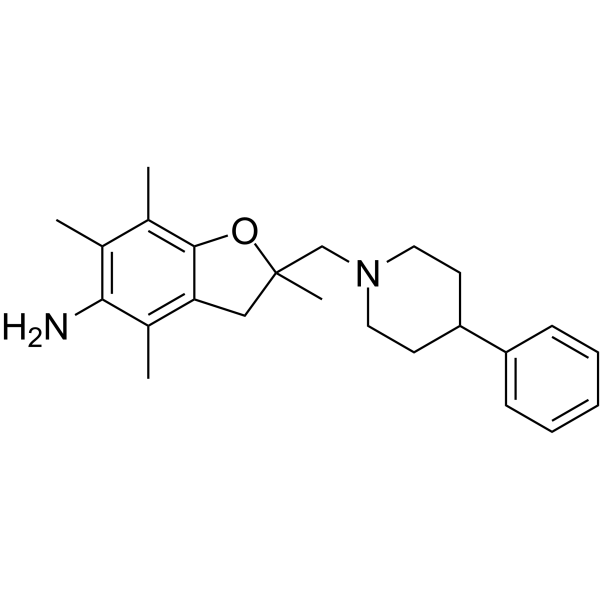 0 ImagesCat. No.: HY-U00319CAS No.: 142873-41-4Lipid peroxidation inhibitor 1 is a lipid peroxidation inhibitor with an IC50 of 0.07 μM.




