



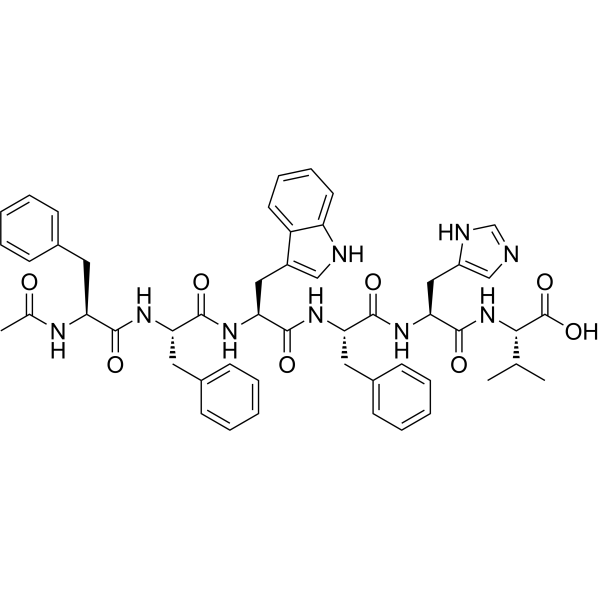
Acetyl hexapeptide-49

Based on 1 Customer Validation
Acetyl hexapeptide-49 is an antiviral agent and barrier repair agent. Acetyl hexapeptide-49 regulates the PAR-2-mediated neurogenic inflammatory axis, reducing the release of related inflammatory factors and CGRP. Acetyl hexapeptide-49 promotes wound healing and barrier recovery. Acetyl hexapeptide-49 blocks bHLH-like motif-mediated binding, disrupts TLE1-IAV NP and SARS-CoV-2 nucleocapsid-TLE1 interactions, reduces TLE1-KLF4 complex formation, and relieves interferon suppression. Acetyl hexapeptide-49 inhibits IAV polymerase activity and enhances innate antiviral signaling, protecting mice against H1N1 and SARS-CoV-2 challenge in vivo. Acetyl hexapeptide-49 can be used in research related to sensitive skin, influenza A virus infection, and SARS-CoV-2 infection.
For research use only. We do not sell to patients.
- Purity : 96.58%
- CAS No.: 1969409-70-8
- Formula: C51H58N10O7
- Molecular Weight:923.07
-
Storage:
Sealed storage, away from moisture.
Powder -80°C, 2 years , -20°C, 1 year* In solvent : -80°C, 6 months; -20°C, 1 month (sealed storage, away from moisture)

To place orders, for customer services and technical support, please contact: MedChemExpress USA
Tel: 609-228-6898 E-mail: [email protected] [email protected]


-
 Biological Activity
-
Chemical Information
-
Solvent & Solubility
- Protocols
- Purity & Documentation
- References
-
 Help & FAQs




Biological Activity
Description
|
IL-6 |
IL-8 |
H1N1 5.11 μM (EC50) |
SARS-COV-2 1.397 μM (EC50) |
In Vitro
Acetyl hexapeptide-49 (27-108 μM) disrupts the interaction of TLE1 with IAV NP and KLF4 in cell experiments[2].
Acetyl hexapeptide-49 (24 h) inhibits TLE1-enhanced IAV polymerase activity in minigenome assays[2].
Acetyl hexapeptide-49 (48 h) exhibits in vitro antiviral activity against H1N1 (EC50 5.11 μM), H5N1 (EC50 14.28 μM), and SARS-CoV-2 (EC50 1.397 μM), with CC50 values of 530.2 μM and 467.8 μM in their respective cell lines[2].
Acetyl hexapeptide-49 disrupts the SARS-CoV-2 N-TLE1 interaction in cell-based co-IP experiments[2].
Acetyl hexapeptide-49 is identified as an antiviral peptide against H1N1 in vitro through screening of a 779-peptide library[2].
MedChemExpress (MCE) has not independently confirmed the accuracy of these methods. They are for reference only.
In Vivo
Acetyl hexapeptide-49 (5 mg/kg; i.p.; daily from 12 h post-infection to 4 dpi) reduces SARS-CoV-2 BA.5.2 viral titers in the lungs and nasal turbinates and alleviates lung histopathology in K18-hACE2 mice[2].
MedChemExpress (MCE) has not independently confirmed the accuracy of these methods. They are for reference only.
-
Animal Model:BALB/c (female, 6-8 weeks old)[2]
-
Dosage:5 mg/kg
-
Administration:i.p.; daily from 12 h to 14 dpi
-
Result:Mice showed 80% survival over 14 days, compared with 0% in vehicle-treated mice.
At 3, 5, and 7 dpi, inhibition of mouse lung virus titers was comparable to the oseltamivir group.
H&E staining showed a milder degree of bronchiolar infiltration and lung tissue damage.
-
Animal Model:K18-hACE2 (female, 6-8 weeks old)[2]
-
Dosage:5 mg/kg
-
Administration:i.p.; daily from 12 h post-infection to 4 dpi
-
Result:At 4 dpi, viral titers in nasal turbinates were reduced to an extent comparable to the nirmatrelvir group, and a 1 log10 reduction in the lungs was achieved.
H&E staining showed markedly alleviated bronchiolar infiltration and reduced lung tissue damage.


Chemical Information
-
CAS No. 1969409-70-8
-
Appearance Solid
-
Molecular Weight 923.07
-
Formula C51H58N10O7
-
Color White to off-white
-
Sequence
Ac-Phe-Phe-Trp-Phe-His-Val-NH2
-
Sequence Shortening
Ac-FFWFHV-NH2
-
Shipping
Room temperature in continental US; may vary elsewhere.
-
Storage
Sealed storage, away from moisture
Powder -80°C 2 years -20°C 1 year * In solvent : -80°C, 6 months; -20°C, 1 month (sealed storage, away from moisture)


Solvent & Solubility
In Vitro:
DMSO : 25 mg/mL (27.08 mM; Need ultrasonic; Hygroscopic DMSO has a significant impact on the solubility of product, please use newly opened DMSO)
Please refer to the solubility information to select the appropriate solvent. Once prepared, please aliquot and store the solution to prevent product inactivation from repeated freeze-thaw cycles.
Storage method and period of stock solution: -80°C, 6 months; -20°C, 1 month (sealed storage, away from moisture). When stored at -80°C, please use it within 6 months. When stored at -20°C, please use it within 1 month.
Concentration (start) × Volume (start) = Concentration (final) × Volume (final)


Purity & Documentation
-
Data Sheet (281 KB)
-
SDS (254 KB)
- English - EN (254 KB)
- Français - FR (254 KB)
- Deutsch - DE (254 KB)
- Norwegian - NO (254 KB)
- Español - ES (254 KB)
- Swedish - SV (254 KB)
- Italian - IT (254 KB)
- Korean - KR (254 KB)
- Portuguese - PT (254 KB)
-
Handling Instructions (2659 KB)
References
[1]. Resende DISP, et al. Usage of Synthetic Peptides in Cosmetics for Sensitive Skin. Pharmaceuticals (Basel, Switzerland). 2021 Jul 21;14(8):702. [Content Brief]
[2]. Yang X, et al. Host transcriptional corepressor TLE1 is commonly exploited by RNA viruses for replication. Molecular cell. 2026 Aug 06;86(15):2950-2965.e9. [Content Brief]


Complete Stock Solution Preparation Table
Please refer to the solubility information to select the appropriate solvent. Once prepared, please aliquot and store the solution to prevent product inactivation from repeated freeze-thaw cycles.
Storage method and period of stock solution: -80°C, 6 months; -20°C, 1 month (sealed storage, away from moisture). When stored at -80°C, please use it within 6 months. When stored at -20°C, please use it within 1 month.
| Optional Solvent | Concentration Solvent Mass | 1 mg | 5 mg | 10 mg | 25 mg |
|---|---|---|---|---|---|
| DMSO | 1 mM | 1.0833 mL | 5.4167 mL | 10.8334 mL | 27.0835 mL |
| 5 mM | 0.2167 mL | 1.0833 mL | 2.1667 mL | 5.4167 mL | |
| 10 mM | 0.1083 mL | 0.5417 mL | 1.0833 mL | 2.7084 mL | |
| 15 mM | 0.0722 mL | 0.3611 mL | 0.7222 mL | 1.8056 mL | |
| 20 mM | 0.0542 mL | 0.2708 mL | 0.5417 mL | 1.3542 mL | |
| 25 mM | 0.0433 mL | 0.2167 mL | 0.4333 mL | 1.0833 mL |


Acetyl hexapeptide-49 Related Classifications
HY-P5227 Related Classifications
 Powered by Bioz
Keywords