



PMX464
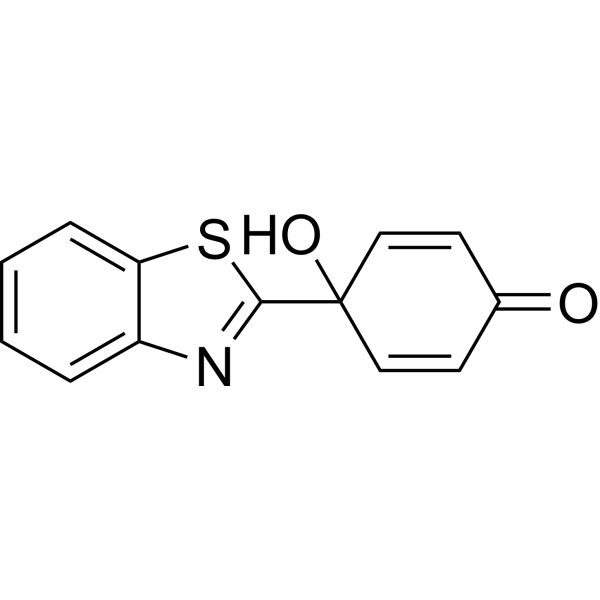
PMX464 (AW 464) is a thiol-reactive quinol compound and an inhibitor of the thioredoxin-thioredoxin reductase (Trx/TrxR) system, with an IC50 value of 6.5 μM against TrxR. PMX464 acts by irreversibly inhibiting the thioredoxin (Trx-1) system, blocking HIF-1α transcriptional activation and the NF-κB inflammatory pathway, inducing apoptosis, attenuating platelet function and inhibiting thrombosis, and specifically disrupting the trypanothione antioxidant metabolic network in parasites. PMX464 is used in research concerning malignant tumors (colorectal cancer, breast cancer, renal cancer, and leukemia), pulmonary inflammation, African sleeping sickness, and antithrombotic applications.
Nur für Forschungszwecke. Wir verkaufen nicht an Patienten.
- CAS. Nr.: 485842-97-5
- Formel: C13H9NO2S
- Molecular Weight:243.28
-
Speicherung:
Please store the product under the recommended conditions in the Certificate of Analysis.

To place orders, for customer services and technical support, please contact: MedChemExpress USA
Tel: 609-228-6898 E-mail: [email protected] [email protected]


-
 Biologische Aktivität
-
Chemical Information
- Protokoll
- Reinheit & Dokumentation
- Verweise
-
 Help & FAQs



Alle Parasite Isoform-spezifische Produkte anzeigen
More

Biologische Aktivität
Beschreibung
|
NF-κB |
CXCR1 |
Trypanosoma 77 nM (EC50) |
TrxR1 6.5 μM (IC50) |
HIF-1α |
HIF-2α |
Cellular Effect
|
Cell Line

|
Type | Value | Description | References |
|---|---|---|---|---|
| Panel NCI-60 (60 carcinoma cell lines) | GI50 |
0.23 μM
Compound: 2
|
Mean in vitro GI50 value against 60 human cancer cell line was determined
Mean in vitro GI50 value against 60 human cancer cell line was determined
|
15658878 |
| A549 | IC50 |
0.5 μM
Compound: 1
|
Growth inhibition of human A549 cells after 72 hrs by MTT assay
Growth inhibition of human A549 cells after 72 hrs by MTT assay
|
17343370 |
| MRC5 | EC50 |
0.18 μM
Compound: 4, PMX 464
|
Cytotoxicity against human MRC5 cells after 3 days by resazurin-based fluorescence assay
Cytotoxicity against human MRC5 cells after 3 days by resazurin-based fluorescence assay
|
22264753 |
| HCT-116 | GI50 |
0.11 μM
Compound: PMX 464
|
Antitumor activity against human HCT116 cells by MTT assay
Antitumor activity against human HCT116 cells by MTT assay
|
16908135 |
| MDA-MB-468 | GI50 |
0.41 μM
Compound: PMX 464
|
Antitumor activity against human MDA-MB-468 cells by MTT assay
Antitumor activity against human MDA-MB-468 cells by MTT assay
|
16908135 |
| MRC5 | EC50 |
175 nM
|
The impact on cell viability is relatively minor.
The impact on cell viability is relatively minor.
|
21212280 |
| Panel NCI-60 (60 carcinoma cell lines) | GI50 |
0.23 μM
Compound: PMX 464
|
Antitumor activity against human NCI60 cells
Antitumor activity against human NCI60 cells
|
16908135 |
| HCT-116 | IC50 |
0.03 μM
Compound: 1
|
Growth inhibition of human HCT116 cells after 72 hrs by MTT assay
Growth inhibition of human HCT116 cells after 72 hrs by MTT assay
|
17343370 |
| HT-29 | IC50 |
0.38 μM
Compound: 7a
|
Inhibitory activity against HT-29 colon cancer cell line
Inhibitory activity against HT-29 colon cancer cell line
|
12570375 |
| HT-29 | GI50 |
0.59 μM
Compound: PMX 464
|
Antitumor activity against human HT29 cells by MTT assay
Antitumor activity against human HT29 cells by MTT assay
|
16908135 |
| MCF7 | IC50 |
0.35 μM
Compound: 7a
|
Inhibitory activity against MCF-7 mammary carcinoma cell line
Inhibitory activity against MCF-7 mammary carcinoma cell line
|
12570375 |
| MDA-MB-468 | IC50 |
0.79 μM
Compound: 7a
|
Inhibitory activity against MDA-468 mammary carcinoma cell line
Inhibitory activity against MDA-468 mammary carcinoma cell line
|
12570375 |
| HCT-116 | IC50 |
0.04 μM
Compound: 7a
|
Inhibitory activity against HCT116 colon cancer cell line
Inhibitory activity against HCT116 colon cancer cell line
|
12570375 |
| HCT-116 | GI50 |
0.11 μM
|
Significantly inhibits cell activity.
Significantly inhibits cell activity.
|
18180330 |
| MCF7 | GI50 |
0.44 μM
Compound: PMX 464
|
Antitumor activity against human MCF7 cells by MTT assay
Antitumor activity against human MCF7 cells by MTT assay
|
16908135 |
In Vitro
PMX464 (AW 464) (0.01-250 μM; 16-48 h) inhibits cell viability in MDA-MB-468 (IC50 = 8.2 μM under hypoxia; IC50 = 6.5 μM under normoxia), MDA-MB-231, and MDA-MB-435 cells, as well as RCC4 and 786-0 renal cancer cell lines, under both hypoxic and normoxic conditions; it also inhibits hypoxia-induced vascular endothelial growth factor (VEGF) secretion (IC50 = 2.3 μM)[1].
PMX464 (AW 464) (1-10 μM; 16 h) upregulates HIF-1α and HIF-2α protein expression in MDA-MB-468 and RCC4 cells (under hypoxic conditions) but downregulates the expression of HIF targets (CA-IX, BNIP3)[1].
PMX464 (AW464) (30 min) inhibits the activity of the cell-free Trx1/TrxR1 system (IC50 = 23 μM)[2].
PMX464 (AW 464) (1 μM-100 μM; 6-8 h) induces apoptosis in HL-60 leukemia cells without triggering an oxidative stress burst[2].
PMX464 (0.001-10 μM; 72 h) inhibits proliferation and colony formation in HT29 colorectal cancer cells (showing greater potency under hypoxic conditions) and induces G1/S cell cycle arrest and mild apoptosis[3].
PMX464 (0.001-1 μM; 72 h) functionally inhibits Trx1 activity and feedback-upregulates TrxR1 protein expression in HT29 colorectal cancer cells, without altering Trx1 protein levels[3].
PMX464 (0.5-1 μM; 72 h) inhibits proliferation in proliferating human umbilical vein endothelial cells (HUVECs) but shows weaker effects in quiescent HUVECs and MRCV fibroblasts[3].
PMX464 (10-30 μM; 30 min pretreatment followed by 24 h stimulation) inhibits the expression of ICAM-1, CXCL8, and GM-CSF, as well as neutrophil adhesion and migration, in IL-1β- or TNF-α-stimulated A549 lung epithelial cells[4].
PMX464 (30 μM; 30 min pretreatment) inhibits the NF-κB inflammatory pathway in IL-1β-stimulated A549 cells[4].
PMX464 (0.6-1 μM; 30 min pretreatment followed by 24 h stimulation) inhibits cytokine-induced ICAM-1 expression in human lung microvascular endothelial cells (HLMVECs)[4].
PMX464 (1-12 h) binds effectively to trypanosome-related targets T(SH)2 (KD = 0.43 μM), GSH (KD = 6.2 μM), and L-cysteine (KD = 27 μM)[5].
PMX464 (73 h) effectively kills bloodstream-form Trypanosoma brucei (S427) (EC50 = 77 nM) but has a minimal effect on normal human fibroblasts (MRC-5) (EC50 = 175 nM)[5].
PMX464 (30-90 min) inhibits the expression of trypanosome-related targets T(SH)2 (IC50 = 5.8 μM (30 min), IC50 = 1.8 μM (90 min)), TDPX (IC50 = 15.6 μM (30 min), IC50 = 6.0 μM (90 min)), and TryP (IC50 = 14.1 μM)[5].
PMX464 (50-500 nM; 4-16 h) rapidly kills Trypanosoma brucei cells and depletes intracellular levels of trypanothione (T(SH)2) and tryparedoxin peroxidase (TryP), without altering the protein levels of TryR, TryX, and TDPX[5].
PMX464 (48-72 h) potently inhibits cell growth across the NCI-60 human cancer cell line panel, with mean GI50 and LC50 values of 0.23 μM and 3.39 μM, respectively; notably, the GI50 value for HCT 116 cells is 0.11 μM[6].
PMX464 (0.5-5 μM; 16 h) modulates target activity in a dose-dependent manner in HCT 116 cells[6].
PMX464 (1-30 μM; 60 min) inhibits TrxR activity in a concentration-dependent manner in an in vitro rat recombinant TrxR enzyme system[6].
PMX464 (15 μM; 5-60 min) inhibits TrxR activity in a time-dependent manner in an in vitro rat recombinant TrxR enzyme system[6].
PMX464 (1-50 μM; 30 min) causes NADPH-dependent, irreversible inhibition of TrxR activity in an in vitro rat recombinant TrxR enzyme system; this inhibitory effect is partially attenuated by physiological concentrations of glutathione (GSH) in systems containing 0.5 mM or 1 mM GSH (HY-D0187). PMX464 demonstrates selectivity for mammalian TrxR[6].
PMX464 (100 μM; 3-60 min) binds to and reduces free selenol groups in an in vitro rat recombinant TrxR enzyme system[6].
PMX464 (30 µM; 30 min) reduces the extent of cell-surface free thiol labeling in washed human platelets[7].
PMX464 (0.1-100 µM; 3 min) inhibits CRP-XL-induced and U46619 (HY-108566)-induced (0.1 µM) intracellular Ca2+ release in Fura-2-loaded (HY-101897) washed human platelets in a concentration-dependent manner, with IC50 values of 10 µM and 20 µM, respectively[7].
PMX464 (30 µM; 10-30 min) does not alter GPVI receptor surface levels in human whole blood[7].
PMX464 (3-100 µM; 30 s-30 min) selectively inhibits CRP-XL-induced platelet aggregation in human platelet-rich plasma (PRP) in a time- and concentration-dependent manner; in human whole blood (under fluid shear conditions), it inhibits type I collagen surface thrombus formation and reduces surface coverage without causing GPIb degradation or surface shedding[7].
PMX464 (30 µM) attenuates Ristocetin (HY-138053)-induced platelet agglutination in human platelet-rich plasma (PRP)[7].
PMX464 attenuates CRP-XL-induced reactive oxygen species (ROS) generation in washed human platelets and inhibits clot retraction in human platelet-rich plasma (PRP)[7].
MedChemExpress (MCE) has not independently confirmed the accuracy of these methods. They are for reference only.
-
Cell Line:MDA-MB-468 cells, RCC4 cells
-
Concentration:1 μM, 2.5 μM, 10 μM
-
Incubation Time:16 h
-
Result:Upregulated HIF-1α and HIF-2α protein expression.
Downregulated the expression of HIF targets (CA-IX, BNIP3) in MDA-MB-468 and RCC4 cells.
-
Cell Line:HL-60 cells
-
Concentration:1 μM
-
Incubation Time:8 h
-
Result:Induced phosphatidylserine externalization and this apoptotic process was almost completely blocked by the pan-caspase inhibitor z-VAD-fmk.
-
Cell Line:HT29, HUVEC, MRCV cell lines
-
Concentration:0.001 μM,0.01 μM, 0.1 μM, 0.5 μM, 1 μM, 5 μM, 10 μM
-
Incubation Time:72 h
-
Result:Inhibited the proliferation and colony formation of HT29, with increased sensitivity under hypoxia.
Inhibited the growth of proliferating HUVEC but showed relative resistance in quiescent HUVEC and MRCV fibroblasts.
-
Cell Line:HT29 cell line
-
Concentration:0.01 μM, 0.1 μM, 1 μM
-
Incubation Time:24 h
-
Result:Caused cell cycle arrest in the G1/S phase, which was particularly evident at low doses under hypoxic conditions.
-
Cell Line:HT29 cell line
-
Concentration:0.001 μM,0.01 μM, 0.1 μM, 0.5 μM, 1 μM
-
Incubation Time:72 h
-
Result:Functionally inhibited Trx1 activity and feedback-upregulated TrxR1 protein expression in HT29 colorectal cancer cells, without altering Trx1 protein levels.
-
Cell Line:A549 cell line
-
Concentration:10 μM, 30 μM
-
Incubation Time:30 min pretreatment followed by 24 hours of cytokine stimulation
-
Result:Significantly reduced IL-1β-induced release of ICAM-1, CXCL8, and GM-CSF.
-
Cell Line:A549 cell line
-
Concentration:10 μM, 30 μM
-
Incubation Time:30 min pretreatment followed by 24 hours of cytokine stimulation
-
Result:Markedly decreased neutrophil adhesion to epithelial cells and migration towards conditioned medium.
-
Cell Line:A549 cell line
-
Concentration:30 μM
-
Incubation Time:30 min pretreatment followed by 5, 15, 30, 45, 60, 120, 360 min stimulation
-
Result:Prevented the rapid initial degradation of IκBα induced by IL-1β.
Completely inhibited IL-1β-induced IκBα (Ser32/Ser36) phosphorylation.
-
Cell Line:Trypanosoma brucei
-
Concentration:0 nM, 50 nM, 100 nM, 150 nM, 200 nM, 250 nM, 300 nM
-
Incubation Time:16 h
-
Result:Depleted the TryP protein band in a dose-dependent manner, while the cellular content of TryR, TryX, and TDPX was not significantly altered.
-
Cell Line:Trypanosoma brucei
-
Concentration:500 nM
-
Incubation Time:0 h, 4 h, 6 h, 8 h, 10 h, 12 h
-
Result:Exerted a rapid cytocidal effect in Trypanosoma brucei, where parasites stop growing after 4 hours and begin to die.
-
Cell Line:HCT 116 cells
-
Concentration:0.5 μM, 1 μM, 3 μM, 5 μM
-
Incubation Time:16 h
-
Result:Modulated target activity in a dose-dependent manner in HCT 116 cells.
Slightly upregulated TrxR and Trx activities and induces TrxR protein expression at sublethal concentrations (0.5 and 1 μM); whereas at high doses (3 and 5 μM) that induced apoptosis, it significantly reduced intracellular TrxR activity without altering TrxR or Trx protein expression levels.
-
Cell Line:Washed human platelets
-
Concentration:30 µM
-
Incubation Time:30 min
-
Result:Did not alter the protein levels or induce shedding of GPIb.


Chemical Information
-
CAS. Nr. 485842-97-5
-
Molecular Weight 243.28
-
Formel C13H9NO2S
-
SMILES
O=C1C=CC(O)(C2=NC3=CC=CC=C3S2)C=C1
-
Synonyms
AW 464
-
Versand
Room temperature in continental US; may vary elsewhere.
-
Speicherung
Please store the product under the recommended conditions in the Certificate of Analysis.


Reinheit & Dokumentation
Verweise
[1]. Jones DT, et al. Novel thioredoxin inhibitors paradoxically increase hypoxia-inducible factor-alpha expression but decrease functional transcriptional activity, DNA binding, and degradation. Clin Cancer Res. 2006 Sep 15;12(18):5384-94. [Content Brief]
[2]. Pallis M, et al. Induction of apoptosis without redox catastrophe by thioredoxin-inhibitory compounds. Biochem Pharmacol. 2003 Nov 1;66(9):1695-705. [Content Brief]
[3]. Mukherjee A, et al. A cellular and molecular investigation of the action of PMX464, a putative thioredoxin inhibitor, in normal and colorectal cancer cell lines. Br J Pharmacol. 2007 Aug;151(8):1167-75. [Content Brief]
[4]. Callister ME, et al. PMX464, a thiol-reactive quinol and putative thioredoxin inhibitor, inhibits NF-kappaB-dependent proinflammatory activation of alveolar epithelial cells. Br J Pharmacol. 2008 Nov;155(5):661-72. [Content Brief]
[5]. König J, et al. Antitumor quinol PMX464 is a cytocidal anti-trypanosomal inhibitor targeting trypanothione metabolism. J Biol Chem. 2011 Mar 11;286(10):8523-8533. [Content Brief]
[6]. Chew EH, et al. Thioredoxin reductase inhibition by antitumor quinols: a quinol pharmacophore effect correlating to antiproliferative activity. FASEB J. 2008 Jun;22(6):2072-83. [Content Brief]
[7]. Metcalfe C,et al. Thioredoxin Inhibitors Attenuate Platelet Function and Thrombus Formation. PLoS One. 2016 Oct 7;11(10):e0163006. [Content Brief]

Calculators
Konzentration (Stammlösung) × Volumen (Stammlösung) = Konzentration (Ziellösung) × Volumen (Ziellösung)


PMX464 Related Classifications
HY-108534 Related Classifications
 Powered by Bioz