



Trijuganone C
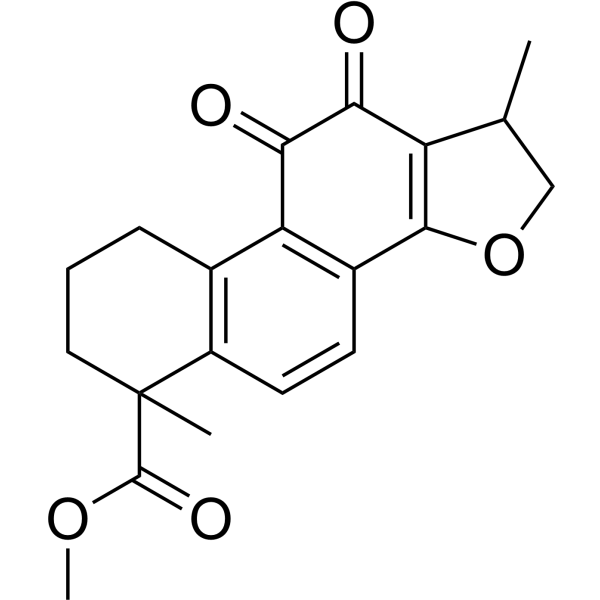
Trijuganone C is a tanshinone-type diterpenoid compound. Trijuganone C can be isolated from the roots of Salvia miltiorrhiza Bunge. Trijuganone C induces chromatin condensation, DNA fragmentation, activation of Caspase-3, -8 and -9, as well as cleavage of PARP. Trijuganone C activates Bid and Bax, leading to loss of mitochondrial membrane potential and inducing the release of cytochrome c from mitochondria into the cytosol. Trijuganone C exerts antiproliferative effects through Apoptosis induction mediated by Mitochondrial dysfunction and Caspase activation. Trijuganone C exhibits significant antiproliferative activity against leukemia cells and colon cancer cells.
Nos produits utilisent uniquement pour la recherche. Nous ne vendons pas aux patients.
- CAS No.: 135247-94-8
- Formule: C20H20O5
- Masse moléculaire:340.37
-
Stockage:
Please store the product under the recommended conditions in the Certificate of Analysis.

To place orders, for customer services and technical support, please contact: MedChemExpress USA
Tel: 609-228-6898 E-mail: [email protected] [email protected]


-
 Activité biologique
-
Chemical Information
- Pureté et documentation
- Références
-
 Help & FAQs


Voir tous les produits spécifiques à Isoform DNA/RNA Synthesis
MoreVoir tous les produits spécifiques à Isoform Caspase
More

Activité biologique
Description
IC50 & Target
[1]|
Caspase-8 |
Caspase-9 |
Caspase-3 |
Bax |
In Vitro
Trijuganone C (6.25-25 μM; 24 h) potently inhibits the proliferation of HL-60, Jurkat and U937 leukemia cell lines, with IC50 values of 6.1, 8.9 and 13.4 μM respectively after 24 h of treatment[1].
Trijuganone C (24 h) potently inhibits the proliferation of colon cancer cell lines DLD-1, COLO 205 and Caco-2 (IC50 6.1-8.4 μM), exerts moderate inhibitory effects on other cancer cell lines and some normal cell lines, and shows no activity against HepG2, WRL 68 and NB1RGB cells after 24 h of treatment[1].
Trijuganone C (12.5 μM; 24 h) induces chromatin condensation, a marker of apoptosis, in leukemia HL-60 cells[1].
Trijuganone C (3.125-25 μM; 24 h) induces dose-dependent apoptotic DNA fragmentation in leukemia cell line HL-60[1].
Trijuganone C (12.5 μM; 3-12 h) induces time-dependent activation of PARP, caspase-3, caspase-8 and caspase-9 in HL-60 leukemia cells[1].
Trijuganone C (12.5 μM; 3-12 h) induces the release of mitochondrial cytochrome c into the cytosol in a time-dependent manner in HL-60 leukemia cells[1].
Trijuganone C (12.5 μM; 3-12 h) induces time-dependent activation (cleavage into t-Bid) of the pro-apoptotic protein Bid, and promotes the translocation of Bax from the cytoplasm to mitochondria, with no effect on the anti-apoptotic proteins Bcl-2 or Bcl-xL[1].
MedChemExpress (MCE) has not independently confirmed the accuracy of these methods. They are for reference only.
-
Cell Line:HL-60, Jurkat, U937
-
Concentration:6.25 μM, 12.5 μM, 25 μM
-
Incubation Time:24 h
-
Result:Significantly suppressed the growth of all three leukemia cell lines.
Exhibited IC50 values of 6.1 μM for HL-60, 8.9 μM for Jurkat, and 13.4 μM for U937 cells.
-
Cell Line:DLD-1, COLO 205, Caco-2, HCT-15, PC-3, LNCap FGC, MCF-7, HepG2, MRC-7, WRL 68, NB1RGB
-
Concentration:<25 μM
-
Incubation Time:24 h
-
Result:Strongly suppressed growth of colon cancer cell lines DLD-1 (IC50 = 6.1 μM), COLO 205 (IC50 = 7.2 μM), and Caco-2 (IC50 = 8.4 μM).
Weakly suppressed growth of colon cancer HCT-15 (IC50 = 13.2 μM), prostate cancer PC-3 (IC50 = 11.2 μM) and LNCap FGC (IC50 = 13.7 μM), breast cancer MCF-7 (IC50 = 16.7 μM), and normal lung MRC-7 (IC50 = 17.1 μM).
Had no effect on liver cancer HepG2, normal liver WRL 68, and normal fibroblast NB1RGB (IC50 >25 μM for all three).
-
Cell Line:HL-60
-
Concentration:12.5 μM
-
Incubation Time:3 h, 6 h, 9 h, 12 h
-
Result:Induced time-dependent cleavage of full-length PARP to its cleaved form.
Induced time-dependent activation of caspase-3, caspase-8, and caspase-9 (conversion from pro-caspase to active form).\nInduced time-dependent accumulation of cytochrome c in the cytosolic fraction.\nInduced time-dependent cleavage of Bid to its active truncated form (t-Bid), but had no effect on antiapoptotic Bcl-2 and Bcl-xL levels.
Promoted time-dependent translocation of Bax from the cytosol to the mitochondrial fraction.


Chemical Information
-
CAS No. 135247-94-8
-
Masse moléculaire 340.37
-
Formule C20H20O5
-
SMILES
O=C([C@@]1(C)CCCC2=C1C=CC(C3=C4[C@@H](C)CO3)=C2C(C4=O)=O)OC
-
Structure Classification
-
Initial Source
-
Livraison
Room temperature in continental US; may vary elsewhere.
-
Stockage
Please store the product under the recommended conditions in the Certificate of Analysis.


Pureté et documentation
Références

Calculators
Concentration (start) × Volume (start) = Concentration (final) × Volume (final)


Trijuganone C Related Classifications
HY-N8617 Related Classifications
 Powered by Bioz