



Isoxazole

Based on 1 Customer Validation
Isoxazole is a member of the five-membered heterocycle drug scaffold. Isoxazole has been used as a BET bromodomain inhibitor and can improve β-cell function in a diabetic mouse model. Isoxazole and its derivatives exhibit broad biological activities (such as antimicrobial, antibacterial, antifungal, antiviral, anticancer, anti-inflammatory, immunomodulatory, analgesic, anti-tuberculosis, and anti-diabetic effects). For example, the bicyclic Isoxazole can act as an HSP90 inhibitor, and the tricyclic Isoxazole is promising as a selective multidrug resistance protein (MRP1) inhibitor.
For research use only. We do not sell to patients.
- Purity : 99.98%
- CAS No.: 288-14-2
- Formula: C3H3NO
- Molecular Weight:69.06
-
Storage:Pure form -20°C, 3 years ; In solvent -80°C, 6 months , -20°C, 1 month


To place orders, for customer services and technical support, please contact: MedChemExpress USA
Tel: 609-228-6898 E-mail: [email protected] [email protected]


-
 Biological Activity
-
Chemical Information
-
Solvent & Solubility
- Protocols
- Purity & Documentation
- References
-
 Help & FAQs


-

HY-W010649R
Isoxazole (Standard)Drug Scaffold -
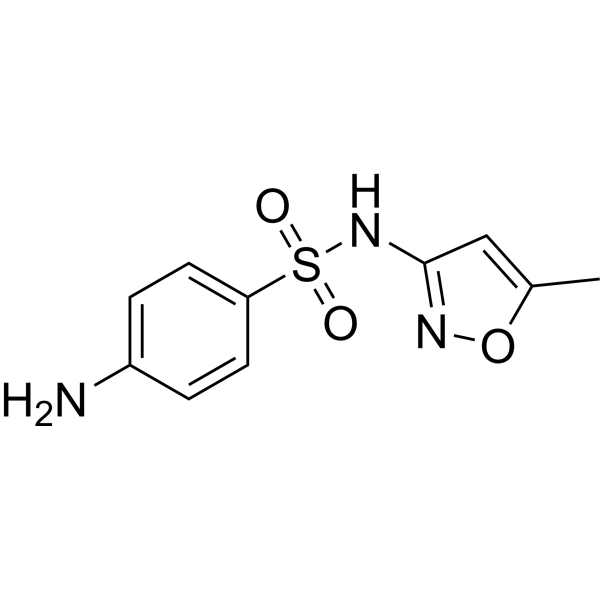
HY-B0322
SulfamethoxazoleSulfonamide Antibiotic -

HY-W010434
Leflunomide impurity 4Drug Impurity -

HY-B0322R
Sulfamethoxazole (Standard)Standard of Sulfamethoxazole -

HY-W010434R
5-Methylisoxazole-4-carboxylic acid (Standard) -
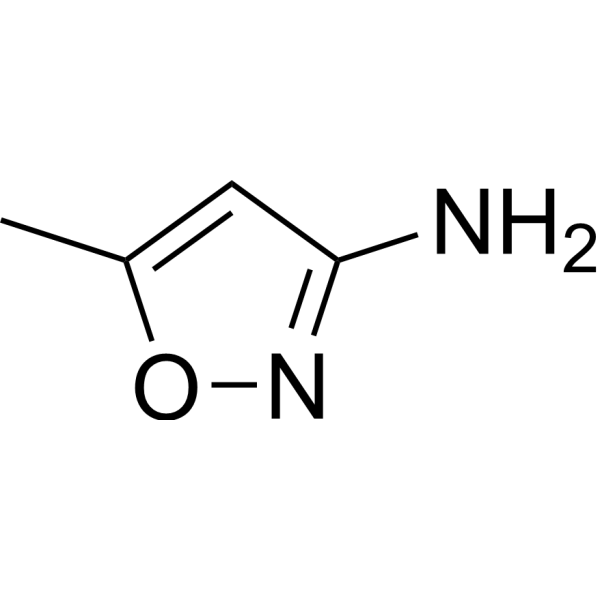
HY-W041676
5-Methylisoxazol-3-amineBiochemical Reagent -

HY-W103317
1,2-BenzisoxazoleAldehyde Oxidase Substrate -

HY-B0322B
Sulfamethoxazole 1000 µg/mL in methanolSulfonamide Antibiotic -

HY-W032938
COX-1-IN-4COX-1 Inhibitor -
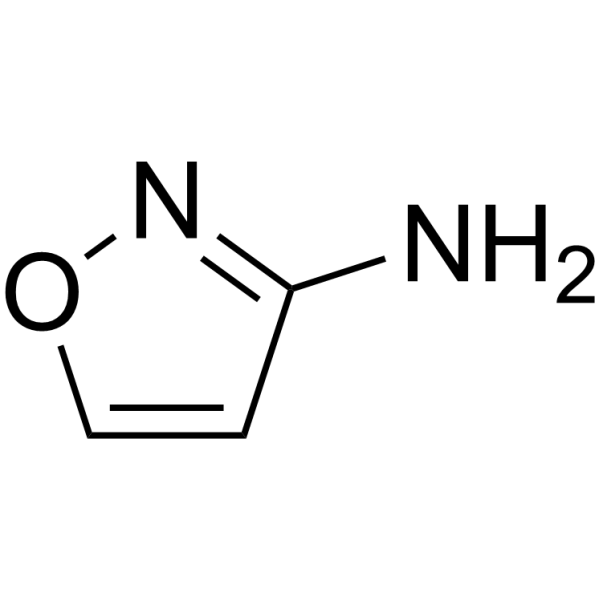
HY-W007329
Isoxazol-3-amineBiochemical Reagent -
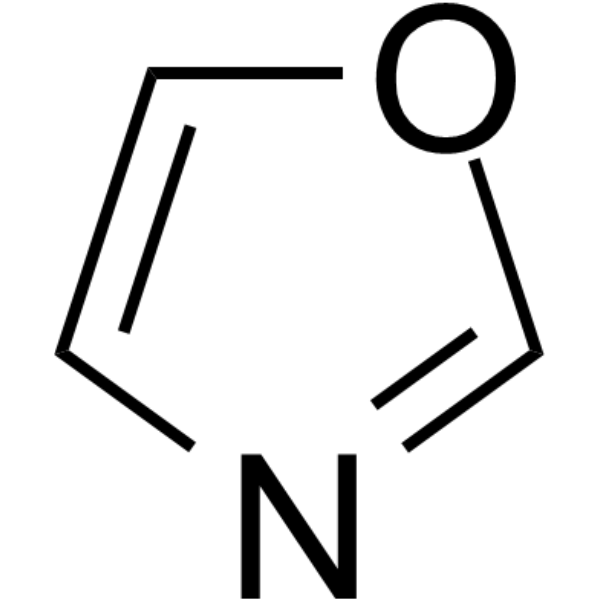
HY-34631
OxazoleBiochemical Reagent -

HY-69155
Oxazole-4-carboxylic acidMetal-organic Framework
All Antibiotic Isoforms
More

Biological Activity
Description
IC50 & Target
|
Multidrug resistance proteins (MRPs) |
In Vitro
Isoxazole (20 µM, 48 hours) improves β-cell function by inhibiting excessive proliferation of MIN6 cells (mouse pancreatic β-cells) and altering the gene expression profile of MIN6 cells (enhancing the neuroendocrine phenotype)[5].
MedChemExpress (MCE) has not independently confirmed the accuracy of these methods. They are for reference only. Further protocols information, click here.
-
Cell Line:MIN6 mouse β-cell line
-
Concentration:20 µM
-
Incubation Time:48 h
-
Result:Significantly upregulates gene expression of STMN2.
-
Cell Line:MIN6 mouse β-cell line
-
Concentration:20 µM
-
Incubation Time:48 h
-
Result:Upregulates STMN2 protein expression.
-
Cell Line:INS1E mouse β-cell line
-
Concentration:20 µM
-
Incubation Time:72 h
-
Result:Reduced cell number, indicating inhibition of cell proliferation.
In Vivo
MedChemExpress (MCE) has not independently confirmed the accuracy of these methods. They are for reference only.
-
Animal Model:Diabetes model in PANIC-ATTAC mice induced by dimerizer (e.g., AP20187 (HY-13992))[5]
-
Dosage:16 mg/kg
-
Administration:Intraperitoneal injection (i.p.), once daily for 4 weeks
-
Result:Significant reduced blood glucose after oral glucose tolerance test (OGTT). Caused that pancreas insulin content increased approaching significance.


Chemical Information
-
CAS No. 288-14-2
-
Appearance Liquid (Density: 1.078 g/cm3)
-
Molecular Weight 69.06
-
Formula C3H3NO
-
Color Colorless to light yellow
-
SMILES
C1=CON=C1
-
Shipping
Room temperature in continental US; may vary elsewhere.
-
Storage
Pure form -20°C 3 years In solvent -80°C 6 months -20°C 1 month


Solvent & Solubility
In Vitro:
DMSO : 100 mg/mL (1448.02 mM; Need ultrasonic; Hygroscopic DMSO has a significant impact on the solubility of product, please use newly opened DMSO)
Please refer to the solubility information to select the appropriate solvent. Once prepared, please aliquot and store the solution to prevent product inactivation from repeated freeze-thaw cycles.
Storage method and period of stock solution: -80°C, 6 months; -20°C, 1 month. When stored at -80°C, please use it within 6 months. When stored at -20°C, please use it within 1 month.
Please refer to the solubility information to select the appropriate solvent. Once prepared, please aliquot and store the solution to prevent product inactivation from repeated freeze-thaw cycles.
Storage method and period of stock solution: -80°C, 6 months; -20°C, 1 month. When stored at -80°C, please use it within 6 months. When stored at -20°C, please use it within 1 month.
Concentration (start) × Volume (start) = Concentration (final) × Volume (final)

Protocols
-
Research Protocol for Infectious Diseases
Infectious-disease experiments test how pathogens interact with host barriers, innate immune receptors, inflammatory signaling, pathogen replication, and tissue injury; pattern-recognition receptors such as TLRs, RIG-I-like receptors, NOD-like receptors, and inflammasomes detect microbial molecules and activate NF-κB, interferon, and cytokine responses. The central hypothesis is that infection severity reflects the balance between pathogen burden and host response: protective inflammation restricts pathogen growth, whereas excessive or mislocalized inflammation contributes to tissue damage and disease phenotype. Unresolved questions include which host pathways are protective versus pathogenic, why some infection models fail to translate to human disease, and which combined readouts best predict clinically relevant infection outcomes.
-
Research Protocol for Inflammation-related Diseases
The NLRP3 inflammasome is a cytosolic innate immune signaling platform that integrates priming signals and danger-signal activation to promote caspase-1 activation, maturation of IL-1β and IL-18, and gasdermin D-mediated pyroptotic cell death. The core experimental logic is to determine whether inflammatory disease phenotypes are driven by increased NLRP3 expression, ASC-containing inflammasome assembly, caspase-1 cleavage, GSDMD cleavage, and extracellular release of IL-1β/IL-18 rather than by nonspecific cell injury alone. The pathway is strongly linked to inflammation-related disease phenotypes because monosodium urate crystals activate NALP3/NLRP3 inflammasome signaling in gout-like crystal inflammation, cholesterol crystals activate NLRP3 inflammasomes in atherogenesis models, and DSS-induced intestinal inflammation has been reported to involve NLRP3 inflammasome activity. However, experimental colitis studies also show context-dependent protective effects of NLRP3 inflammasome co
-
How to Choose the Right Model Animal
Choosing the right model animal is a validity-driven decision in which the species, strain, sex, age, genetic background, disease-induction method, outcome measures, and welfare burden must match the scientific question rather than laboratory tradition or convenience. A model should be selected by judging face validity, construct validity, and predictive validity: whether it resembles the human phenotype, whether it reproduces relevant mechanisms, and whether results are likely to predict human biology or treatment response. Animal studies often fail to translate because of species differences, weak disease resemblance, poor experimental design, inadequate reporting, publication bias, and underuse of randomization, blinding, and sample-size justification. Unresolved questions include how to rank competing models objectively, how much human-disease complexity must be reproduced for a given objective, and when non-animal systems such as organoids, ex vivo tissue, or computational models


Purity & Documentation
-
Data Sheet (285 KB)
-
SDS (466 KB)
- English - EN (466 KB)
- Français - FR (466 KB)
- Deutsch - DE (466 KB)
- Norwegian - NO (466 KB)
- Español - ES (466 KB)
- Swedish - SV (466 KB)
- Italian - IT (466 KB)
- Korean - KR (466 KB)
- Portuguese - PT (466 KB)
-
Handling Instructions (2659 KB)
References
[1]. Zhu J, et al. The recent progress of isoxazole in medicinal chemistry. Bioorg Med Chem. 2018 Jul 23;26(12):3065-3075. [Content Brief]
[2]. Sysak A, et al. Isoxazole ring as a useful scaffold in a search for new therapeutic agents. Eur J Med Chem. 2017 Sep 8;137:292-309. [Content Brief]
[3]. Norman BH, et al. Tricyclic isoxazoles are novel inhibitors of the multidrug resistance protein (MRP1)[J]. Bioorg Med Chem Lett. 2002 Mar 25;12(6):883-6. [Content Brief]
[4]. Agrawal N, Mishra P. The synthetic and therapeutic expedition of isoxazole and its analogs[J]. Med Chem Res. 2018;27(5):1309-1344. [Content Brief]
[5]. Kalwat MA, et al. Isoxazole Alters Metabolites and Gene Expression, Decreasing Proliferation and Promoting a Neuroendocrine Phenotype in β-Cells. ACS Chem Biol. 2016 Apr 15;11(4):1128-36. [Content Brief]


Complete Stock Solution Preparation Table
Please refer to the solubility information to select the appropriate solvent. Once prepared, please aliquot and store the solution to prevent product inactivation from repeated freeze-thaw cycles.
Storage method and period of stock solution: -80°C, 6 months; -20°C, 1 month. When stored at -80°C, please use it within 6 months. When stored at -20°C, please use it within 1 month.
| Optional Solvent | Concentration Solvent Mass | 1 mg | 5 mg | 10 mg | 25 mg |
|---|---|---|---|---|---|
| DMSO | 1 mM | 14.4802 mL | 72.4008 mL | 144.8016 mL | 362.0041 mL |
| 5 mM | 2.8960 mL | 14.4802 mL | 28.9603 mL | 72.4008 mL | |
| 10 mM | 1.4480 mL | 7.2401 mL | 14.4802 mL | 36.2004 mL | |
| 15 mM | 0.9653 mL | 4.8267 mL | 9.6534 mL | 24.1336 mL | |
| 20 mM | 0.7240 mL | 3.6200 mL | 7.2401 mL | 18.1002 mL | |
| 25 mM | 0.5792 mL | 2.8960 mL | 5.7921 mL | 14.4802 mL | |
| 30 mM | 0.4827 mL | 2.4134 mL | 4.8267 mL | 12.0668 mL | |
| 40 mM | 0.3620 mL | 1.8100 mL | 3.6200 mL | 9.0501 mL | |
| 50 mM | 0.2896 mL | 1.4480 mL | 2.8960 mL | 7.2401 mL | |
| 60 mM | 0.2413 mL | 1.2067 mL | 2.4134 mL | 6.0334 mL | |
| 80 mM | 0.1810 mL | 0.9050 mL | 1.8100 mL | 4.5251 mL | |
| 100 mM | 0.1448 mL | 0.7240 mL | 1.4480 mL | 3.6200 mL |


Isoxazole Related Classifications
HY-W010649 Related Classifications
 Powered by Bioz