



Patritumab
Based on 2 publication(s) in Google Scholar
Patritumab (AMG 888; U3-1287) is a neutralizing antibody targeting HER3 (ErbB3) that binds to the extracellular domain and induces HER3 internalization. Patritumab prevents heregulin binding, downregulates cell surface HER3, and blocks ligand-induced HER3 phosphorylation and downstream PI3K/AKT signaling. Patritumab in combination with dual HER2 blockade enhances apoptosis and growth inhibition in HER2-overexpressing breast cancer cells, and enhances antitumor effects in xenograft tumors. Patritumab can be used for research on breast cancer.
Nos produits utilisent uniquement pour la recherche. Nous ne vendons pas aux patients.
- Pureté : 99.28%
- CAS No.: 1262787-83-6
- Masse moléculaire:146.86 kDa
-
Stockage:Shipping with dry ice
Please store the product under the recommended conditions in the Certificate of Analysis.


To place orders, for customer services and technical support, please contact: MedChemExpress USA
Tel: 609-228-6898 E-mail: [email protected] [email protected]


-
 Activité biologique
-
Chemical Information
- Protocole
- Pureté et documentation
- Références
-
 Help & FAQs


-

HY-P9907
TrastuzumabHER2 Blocking Antibody -

HY-P99507
ZenocutuzumabAnti-HER2/HER3 Antibody -

HY-P99813
Patritumab deruxtecanHER3-Directed ADC -

HY-P99268
SeribantumabHER3 Antibody -

HY-P99045
SacituzumabAnti-TROP-2 Antibody -

HY-P99676
IzalontamabAnti-EGFR/HER3 Antibody -

HY-P99391
TelisotuzumabAnti-c-Met Antibody -

HY-P9977
AmivantamabEGFR-MET Dual Antibody -

HY-P9907A
Trastuzumab (anti-HER2)HER2 Blocking Antibody -

HY-P99843
DatopotamabAnti-TROP2 Antibody -

HY-P99854
DisitamabAnti-HER2 Antibody -

HY-P9904
AtezolizumabAnti-PD-L1 Antibody
Publications Citing Use of MedChemExpress (MCE) Patritumab
More Customer Validation & Images

-
WB
Voir tous les produits spécifiques à Isoform EGFR
More

Activité biologique
Description
Isotype
Human IgG1(K214R) kappa
Recommend Isotype Controls
Species Reactivity
Human
|
HER3 |
HER2 |
PI3K |
Akt |
In Vitro
Patritumab (10 μg/mL) significantly inhibits MCF7 breast cancer cell viability only in the presence of Erlotinib (HY-50896)[2].
Patritumab (100 μg/mL; 120 h), in triple combination with Trastuzumab (HY-P9907) and Pertuzumab (HY-P9912), potently reduces the viability of SKBR3-HRG and BT474-HRG cells even at the lowest Trastuzumab concentration[4].
Patritumab (50 μg/mL; 120 h) combined with Pertuzumab and Trastuzumab reverses heregulin-induced drug resistance in the BT-474, MDA-MB-453, and HCC1419 paracrine models[4].
Patritumab (120 h) in combination with Pertuzumab synergistically inhibits the viability of SKBR3-HRG and BT474-HRG cells, with median-effect CI values of 0.11 and 0.13, respectively[4].
Patritumab (120 h) combined with Pertuzumab reduces cell viability in BT-474, MDA-MB-453, and HCC1419 paracrine heregulin models[4].
Patritumab (U3-1287) (20 μg/mL; 0-48 h) downregulates HER3 protein from 1 h to 48 h in BT474, SKBR3, and MDA453 cells[5].
Patritumab (20 μg/mL; 24 h) blocks HER2 inhibitor-induced cell surface HER3 upregulation and reduces cell surface HER3 levels in BT474, SKBR3, and MDA453 cells[5].
Patritumab (20 μg/mL; 24 h) enhances the inhibition of HER3 and AKT signaling pathways when HER2 blockade is added in BT474, SKBR3, and MDA453 cells[5].
Patritumab (20 μg/mL; every 2-3 days) reduces the 2D growth of BT474, SKBR3, and MDA453 cells when combined with Lapatinib plus Trastuzumab[5].
Patritumab (20 μg/mL; 12-16 days) reduces 3D Matrigel colony formation in BT474, SKBR3, and MDA453 cells when combined with Lapatinib plus Trastuzumab[5].
Patritumab (20 μg/mL; 24 h) reduces HER3 and AKT signaling in HR6 cells when combined with Lapatinib plus Trastuzumab[5].
MedChemExpress (MCE) has not independently confirmed the accuracy of these methods. They are for reference only.
-
Cell Line:HER2-positive breast cancer SKBR3-HRG and BT474-HRG cells
-
Concentration:100 μg/mL
-
Incubation Time:120 h
-
Result:Triple combination with Trastuzumab and Pertuzumab drastically decreased viable cell counts even at the lowest Trastuzumab concentration in both SKBR3-HRG and BT474-HRG cells.
-
Cell Line:BT-474, MDA-MB-453, and HCC1419 HER2-positive breast cancer cells
-
Concentration:50 μg/mL
-
Incubation Time:120 h
-
Result:BT-474, MDA-MB-453, and HCC1419 cells developed resistance to Trastuzumab in the presence of heregulin.
Adding Pertuzumab to Trastuzumab reversed this resistance in these paracrine models.
-
Cell Line:BT474, SKBR3, and MDA453 cells
-
Concentration:20 μg/mL
-
Incubation Time:1, 4, 14, 24, and 48 h
-
Result:HER3 protein showed a modest decrease starting at 1 h and lasting through 48 h in BT474, SKBR3, and MDA453 cells.
-
Cell Line:BT474, SKBR3, and MDA453 cells
-
Concentration:20 μg/mL
-
Incubation Time:24 h
-
Result:Dual HER2 inhibition increased cell-surface HER3 in all three cell lines.
Addition to dual HER2 inhibition blocked this increase and almost completely downregulated cell-surface HER3 levels.
-
Cell Line:BT474, SKBR3, and MDA453 cells
-
Concentration:20 μg/mL
-
Incubation Time:48 h
-
Result:Did not induce apoptosis alone.
Addition to Lapatinib plus Trastuzumab resulted in a clear increase in apoptosis in all cell lines.
-
Cell Line:BT474, SKBR3, and MDA453 cells
-
Concentration:20 μg/mL
-
Incubation Time:24 h
-
Result:p-HER3 was lower in cells with the triple combination.
Enhanced inhibition of S473 p-Akt in SKBR3 and MDA453 cells.
T308 p-Akt was lower in BT474 and SKBR3 cells with all three inhibitors than with other conditions.
-
Cell Line:HR6 cells
-
Concentration:20 μg/mL
-
Incubation Time:24 h
-
Result:Addition to lapatinib plus trastuzumab reduced p-HER3, total HER3, and S473 p-Akt levels.
In Vivo
Patritumab (25 mg/kg; intraperitoneal injection; once weekly; for 3 weeks) combined with Trastuzumab (10 mg/kg) partially inhibits the growth of BT474-HRG xenograft tumors[4].
Patritumab (25 mg/kg; intraperitoneal injection; once weekly; for 3 weeks) combined with Pertuzumab (25 mg/kg) inhibits BT474-HRG tumor growth, induces tumor regression, and suppresses HER3 in vivo[4].
Patritumab (25 mg/kg; intraperitoneal injection; once weekly; for 3 weeks) combined with Pertuzumab (25 mg/kg) and Trastuzumab (10 mg/kg) produces the strongest anti-tumor effect against BT474-HRG, including complete clearance of three out of seven tumors, and inhibits HER3 in vivo[4].
Patritumab (25 mg/kg; intraperitoneal injection; once weekly; for 3 weeks) combined with Pertuzumab (25 mg/kg) and Trastuzumab (10 mg/kg) produces maximal tumor regression in JIMT-1 xenograft tumors[4].
MedChemExpress (MCE) has not independently confirmed the accuracy of these methods. They are for reference only.
-
Animal Model:KSN nude (male, 6 weeks of age at purchase)[2]
-
Dosage:100 µg/mouse
-
Administration:i.p.; twice on days 0 and 7
-
Result:In BT474 xenograft-bearing nude mice, tumor growth was significantly inhibited compared with isotype control.
-
Animal Model:BALB/cAJcl-nu/nu athymic nude (female, 7 weeks old)[4]
-
Dosage:25 mg/kg
-
Administration:i.p.; once weekly; 3 weeks
-
Result:The Trastuzumab-containing double combination partially prevented BT474-HRG tumor growth in vivo.
-
Animal Model:BALB/cAJcl-nu/nu athymic nude (female, 7 weeks old)[4]
-
Dosage:25 mg/kg
-
Administration:i.p.; once weekly; 3 weeks
-
Result:The Pertuzumab-containing double combination significantly prevented BT474-HRG tumor growth and mediated tumor regression compared with vehicle.
In vivo HER3 immunoblot PD showed suppressed HER3 expression in the Pertuzumab-containing double-combination arm relative to control.
-
Animal Model:BALB/cAJcl-nu/nu athymic nude (female, 7 weeks old)[4]
-
Dosage:25 mg/kg
-
Administration:i.p.; once weekly; 3 weeks
-
Result:Triple combination significantly prevented BT474-HRG tumor growth and mediated tumor regression compared with vehicle; three of seven tumors were completely eradicated.
In vivo HER3 immunoblot PD showed suppressed HER3 expression in the triple-combination arm relative to control.
-
Animal Model:BALB/cAJcl-nu/nu athymic nude (female, 7 weeks old)[4]
-
Dosage:25 mg/kg
-
Administration:i.p.; once weekly; 3 weeks
-
Result:Triple combination induced significant tumor regression in JIMT-1 xenografts compared with controls and produced the maximum antitumor effect among the regimens.
- Western Blot
- Annexin V plus membrane-impermeant dye apoptosis staining
- Breast Cancer Modeling
- Kinase activity and phosphorylation assays
- Detection of Apoptosis
- TUNEL staining for apoptotic DNA fragmentation
- Patient-Derived Xenograft (PDX)
- Apoptosis Solutions
- Splenic/Portal-Vein Liver Metastasis Xenograft
- Protocol for Kinase activity and phosphorylation assays
- Subcutaneous Cell-Line-Derived Xenograft
- Orthotopic Cell-Line Xenograft
- Intraperitoneal/Peritoneal Dissemination Xenograft
Essai clinique
| NCT Number | Sponsor | Condition | Start Date |
Phase

|
|---|---|---|---|---|
| NCT01329991 | 2011-05 | PHASE1 |
Gene ID
Accession
Conjugated
Unconjugated
Reconstitution
The product can be reconstituted/diluted with sterile PBS or saline.
Format
-
Human IgG1 kappa

Application
ELISA, FACS, Functional assay
Verified Bioactivity
-
 Flow cytometric analysis of 1×10⁶ MCF-7 cells labelling HER3 (red) with Patritumab (HY-P99275). Cells were fixed with 4% paraformaldehyde and permeabilised with 90% methanol. Then stained with the primary antibody at 1/200 dilution for an hour at 4℃. Alexa Goat Anti-Human IgG H&L (AF488) (HY-P83776) was used as the secondary antibody at 1/1,000 dilution for 30 minutes at 4℃. Human IgG1(K214R) kappa Isotype Control (HY-P99995, blue) was used as the isotype control.
-
 Immobilized Human HER3/ERBB3 Protein (ECD, His Tag) can bind Patritumab. The EC50 for this effect is 1.41 ng/mL.
-
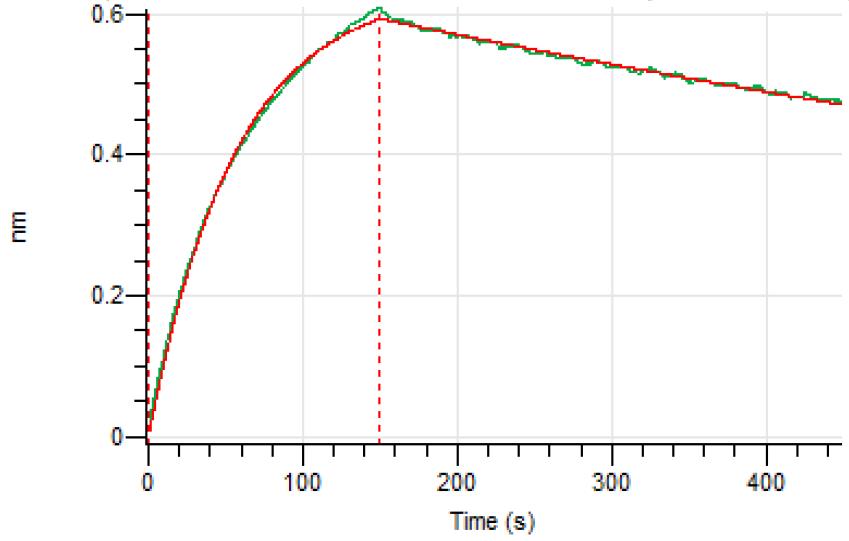 Loaded Patritumab on AHC2 biosensor, can bind HER3 Protein, Human (HEK293, His, HY-P72625) with an affinity constant of 1.804E-09 M as determined in BLI assay.


Chemical Information
-
CAS No. 1262787-83-6
-
Appearance Liquid
-
Masse moléculaire 146.86 kDa
-
Color Colorless to light yellow
-
SMILES
[Patritumab]
-
Synonyms
AMG 888; U3-1287
-
Livraison
Shipping with dry ice.
-
Formulation
Please refer to the lot-specific COA for specific buffer information.
-
Stockage
Please store the product under the recommended conditions in the Certificate of Analysis.


Publications (2)
-
Journal Impact Factor
-
Most Recent
-
Clin Cancer Res
ERBB3 overexpression is enriched in diverse patient populations with castration-sensitive prostate cancer and is associated with a unique AR activity signature. [Abstract]2024 Apr 15;30(8):1530-1543. PMID: 38306015
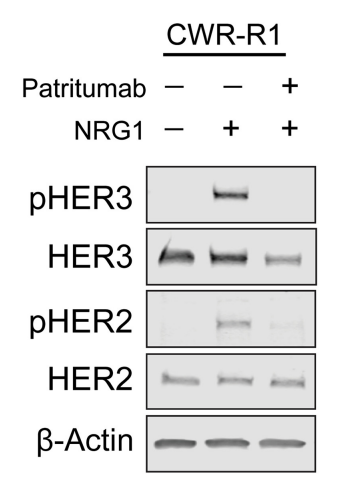
Patritumab purchased from MedChemExpress. Usage Cited in: Clin Cancer Res. 2024 Apr 15;30(8):1530-1543. [Abstract]
Patritumab (10 μM; 2 h) reduced pHER3 after NRG1 stimulation (100 ng/mL; 15 min) in CWR-R1 cells.
-


Pureté et documentation
-
Fiche technique (292 KB)
-
SDS (251 KB)
- English - EN (251 KB)
- Français - FR (251 KB)
- Deutsch - DE (251 KB)
- Norwegian - NO (251 KB)
- Español - ES (251 KB)
- Swedish - SV (251 KB)
- Italian - IT (251 KB)
- Korean - KR (251 KB)
- Portuguese - PT (251 KB)
-
Inhibitory Antibodies User Guide (603 KB)
Références

Calculators
Concentration (start) × Volume (start) = Concentration (final) × Volume (final)


Patritumab Related Classifications
HY-P99275 Related Classifications
 Powered by Bioz
Keywords