



HDAC
Histone deacetylases
HDAC Isoform Specific Products
-
HDAC
(392)
View all products
-
HDAC1
(317)
View all products
-
HDAC2
(210)
View all products
-
HDAC3
(204)
View all products
-
HDAC4
(72)
View all products
-
HDAC5
(56)
View all products
-
HDAC6
(337)
View all products
-
HDAC7
(53)
View all products
-
HDAC8
(188)
View all products
-
HDAC9
(41)
View all products
-
HDAC10
(67)
View all products
-
HDAC11
(71)
View all products
-
HD1
(3)
View all products
-
HD2
(4)
View all products
All Product Categories
-
HDAC Inhibitors
(780)
View all products
-
HDAC Antagonists
(3)
View all products
-
HDAC Activators
(14)
View all products
-
HDAC Modulators
(4)
View all products
-
HDAC MDM2 Inhibitor
(1)
View all products
-
HDAC Degraders
(45)
View all products
-
HDAC Controls
(4)
View all products
-
HDAC Substrates
(3)
View all products
-
HDAC Ligands
(15)
View all products
-
HDAC Related Products (917)
Related Products (917)

-
Antibodies (16)
-
HDAC Signaling Pathway
-
HDAC Isoform Comparison
-
Valproic acid β-D-glucuronide
 0 ImagesCat. No.: HY-W400496CAS No.: 60113-83-9
 -
loading...Please select quantityGet Quote
August 31
-
Please select quantity
August 31
Get Quote
loading... -
- M133
-
loading...Please select quantityGet Quote
August 31
-
Please select quantity
August 31
Get Quote
loading... -

-
Belinostat (Standard)
 0 ImagesCat. No.: HY-10225RCAS No.: 866323-14-0Synonyms: PXD101 (Standard); PX105684 (Standard)Belinostat (Standard) is the analytical standard of Belinostat (HY-10225). This product is intended for research and analytical applications. Belinostat (PXD101; PX105684) is a potent HDAC inhibitor with an IC50 of 27 nM in HeLa cell extracts.
 -
loading...Please select quantityGet Quote
August 31
-
Please select quantity
August 31
Get Quote
loading... -
-
Rhamnetin (Standard)
 0 ImagesRhamnetin (Standard) is the analytical standard of Rhamnetin. This product is intended for research and analytical applications. Rhamnetin is a quercetin derivative found in Coriandrum sativum, inhibits secretory phospholipase A2 and histone deacetylase 2 (HDAC2). Rhamnetin exhibits antitumor, antioxidant and anti-inflammatory activity.
 -
loading...Please select quantityGet Quote
August 31
-
Please select quantity
August 31
Get Quote
loading... -
-
Romidepsin (Standard)
 0 ImagesCat. No.: HY-15149RCAS No.: 128517-07-7Synonyms: FK 228 (Standard); FR 901228 (Standard); NSC 630176 (Standard)Romidepsin (Standard) is the analytical standard of Romidepsin (HY-15149). This product is intended for research and analytical applications. Romidepsin (FK 228) is a Histone deacetylase (HDAC) inhibitor with anti-tumor activities. Romidepsin (FK 228) inhibits HDAC1, HDAC2, HDAC4, and HDAC6 with IC50s of 36 nM, 47 nM, 510 nM and 1.4 μM, respectively. Romidepsin (FK 228) is produced by Chromobacterium violaceum, induces cell G2/M phase arrest and apoptosis.
 -
loading...Please select quantityGet Quote
August 31
-
Please select quantity
August 31
Get Quote
loading... -
-
Tasquinimod (Standard)
 0 ImagesSynonyms: ABR-215050 (Standard)Tasquinimod (Standard) is the analytical standard of Tasquinimod. This product is intended for research and analytical applications. Tasquinimod is an oral antiangiogenic agent, which has the potential for castration-resistant prostate cancer treatment. Tasquinimod binds to the regulatory Zn2+ binding domain of HDAC4 with Kd of 10-30 nM. Tasquinimod also is a S100A9 inhibitor.
 -
loading...Please select quantityGet Quote
August 31
-
Please select quantity
August 31
Get Quote
loading... -
-
TMU 35435
 0 ImagesCat. No.: HY-164539CAS No.: 2231800-32-9
 -
loading...Please select quantityGet Quote
August 31
-
Please select quantity
August 31
Get Quote
loading... -
-
Dihydrochlamydocin analog-1
 0 ImagesCat. No.: HY-P2178CAS No.: 157618-75-2Dihydrochlamydocin analog-1 (compound 2) is a Chlamydocin (HY-115761) analogue that inhibits histone H4 peptide deacetylation with IC50 of 30 nM.
 -
loading...Please select quantityGet Quote
August 31
-
Please select quantity
August 31
Get Quote
loading... -
-
Givinostat hydrochloride monohydrate (Standard)
 0 ImagesSynonyms: ITF-2357 hydrochloride monohydrate (Standard)Givinostat (hydrochloride monohydrate) (Standard) is the analytical standard of Givinostat (hydrochloride monohydrate). This product is intended for research and analytical applications. Givinostat hydrochloride monohydrate (ITF-2357 hydrochloride monohydrate) is a HDAC inhibitor with an IC50 of 198 and 157 nM for HDAC1 and HDAC3, respectively.
 -
loading...Please select quantityGet Quote
August 31
-
Please select quantity
August 31
Get Quote
loading... -
-
Entinostat (Standard)
 0 ImagesCat. No.: HY-12163RCAS No.: 209783-80-2Synonyms: MS-275 (Standard); SNDX-275 (Standard)Entinostat (Standard) is the analytical standard of Entinostat (HY-12163). This product is intended for research and analytical applications. Entinostat is an oral and selective class I HDAC inhibitor, with IC50s of 243 nM, 453 nM, and 248 nM for HDAC1, HDAC2, and HDAC3, respectively.
 -
loading...Please select quantityGet Quote
August 31
-
Please select quantity
August 31
Get Quote
loading... -
-
Remetinostat (Standard)
 0 ImagesCat. No.: HY-100365RCAS No.: 946150-57-8Synonyms: SHP-141 (Standard)Remetinostat (Standard) is the analytical standard of Remetinostat (HY-100365). This product is intended for research and analytical applications. Remetinostat (SHP-141) is a hydroxamic acid-based histone deacetylase (HDAC) inhibitor. Remetinostat alleviates Imiquimod (HY-B0180)-induced psoriatic dermatitis. Remetinostat can be used for study of cutaneous T-cell lymphoma.
 -
loading...Please select quantityGet Quote
August 31
-
Please select quantity
August 31
Get Quote
loading... -
-
ST7612AA1
 0 ImagesCat. No.: HY-12926CAS No.: 1428535-92-5ST7612AA1 is a histone deacetylase (HDAC) inhibitor that controls chromatin condensation and DNA transcription by removing acetyl groups from histones. ST7612AA1 is also a potent HIV reactivation inducer, and its reactivation activity is exerted without activating or proliferating CD4+T cells, and can be used in the study of HIV reactivation strategies and elimination of viral reservoirs.
 -
loading...Please select quantityGet Quote
August 31
-
Please select quantity
August 31
Get Quote
loading... -
-
Z-MAL
 0 ImagesCat. No.: HY-176545CAS No.: 642463-22-7
 -
loading...Please select quantityGet Quote
August 31
-
Please select quantity
August 31
Get Quote
loading... -
- Nicoxamat
-
loading...Please select quantityGet Quote
August 31
-
Please select quantity
August 31
Get Quote
loading... -

-
HDAC1-IN-12
 0 ImagesCat. No.: HY-181010HDAC1-IN-12 is a Plasmodium falciparum HDAC1 (PfHDAC1) inhibitor with an IC50 of 4.1 nM against Pf3D7. HDAC1-IN-12 inhibits PfHDAC1, upregulates histone H3 acetylation in P. falciparum parasites, downregulates malaria invasion-related gene expression, and exhibits favorable safety profiles, improved physicochemical properties, and potent in vivo antimalarial activity. HDAC1-IN-12 can be used for the research of malaria.
 -
loading...Please select quantityGet Quote
August 31
-
Please select quantity
August 31
Get Quote
loading... -
-
PD-L1/HDAC-IN-1
 0 ImagesCat. No.: HY-172167CAS No.: 2923313-69-1PD-L1/HDAC-IN-1 (Compound 14) is the inhibitor for PD-L1 and HDAC that inhibits PD-1/PD-L1 interaction, HDAC2 and HDAC3 with IC50 of 88.10, 27.98 and 14.47 nM, respectively. PD-L1/HDAC-IN-1 exhibits slight cytotoxicity in MCF-7 (IC50=19.34 μM). PD-L1/HDAC-IN-1 upregulates the expression of PD-L1 and CXCL10, promoting anti-tumour immune response by recruiting T-cell infiltration into TME.
 -
loading...Please select quantityGet Quote
August 31
-
Please select quantity
August 31
Get Quote
loading... -
- BATCP
-
loading...Please select quantityGet Quote
August 31
-
Please select quantity
August 31
Get Quote
loading... -
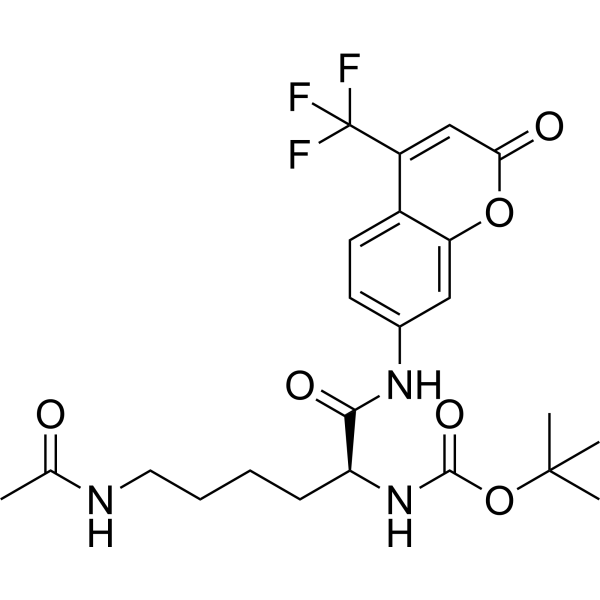
-
Butyrylhydroxamic acid
 0 ImagesButyrylhydroxamic acid (N-Hydroxybutanamide) is a potent inhibitor of histone deacetylase (HDAC). Butyrylhydroxamic acid enhances memory in behavioral models of rodents and can be used as memory enhancers, mood stabilizers, and β-chain hemoglobin disease studies.
 -
loading...Please select quantityGet Quote
August 31
-
Please select quantity
August 31
Get Quote
loading... -
-
J1038
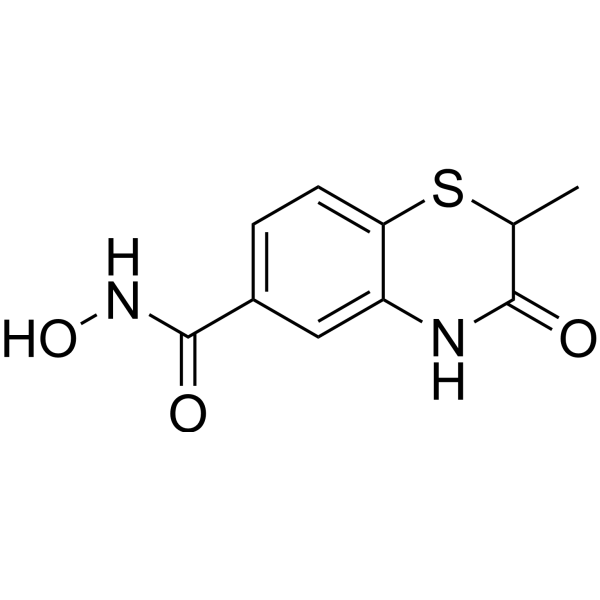 0 ImagesCat. No.: HY-111028CAS No.: 949727-86-0Synonyms: T 5979345
 -
loading...Please select quantityGet Quote
August 31
-
Please select quantity
August 31
Get Quote
loading... -
-
WT-161 (Standard)
 0 ImagesCat. No.: HY-100871RCAS No.: 1206731-57-8WT-161 (Standard) is the analytical standard of WT-161 (HY-100871). This product is intended for research and analytical applications. WT-161 is a potent and selective HDAC6 inhibitor with an IC50 of 0.40 nM. WT-161 also inhibits metallo-β-lactamase domain-containing protein 2 (MBLAC2).
 -
loading...Please select quantityGet Quote
August 31
-
Please select quantity
August 31
Get Quote
loading... -
No matching results
No matching results
No matching results
No matching results
No matching results
No matching results
No matching results
No matching results
No matching results
No matching results

TCR, GPCR and HDAC II interaction: Diverse agonists act through G-protein-coupled receptors (GPCRs) to activate the PKC-PKD axis, CaMK, Rho, or MHC binding to antigens stimulates TCR to activate PKD, leading to phosphorylation of class II HDACs. Phospho-HDACs dissociate from MEF2, bind 14-3-3, and are exported to the cytoplasm through a CRM1-dependent mechanism. CRM1 is inhibited by leptomycin B (LMB). Release of MEF2 from class II HDACs allows p300 to dock on MEF2 and stimulate gene expression. Dephosphorylation of class II HDACs in the cytoplasm enables reentry into the nucleus[1].
TLR: TLR signaling is initiated by ligand binding to receptors. The recruitment of TLR domain-containing adaptor protein MyD88 is repressed by HDAC6, whereas NF-κB and MTA-1 can be negatively regulated by HDAC1/2/3 and HDAC2, respectively. Acetylation by HATs enhance MKP-1 which inhibits p38-mediated inflammatory responses, while HDAC1/2/3 inhibits MKP-1 activity. HDAC1 and HDAC8 repress, whereas HDAC6 promotes, IRF function in response to viral challenge. HDAC11 inhibits IL-10 expression and HDAC1 and HDAC2 represses IFNγ-dependent activation of the CIITA transcription factor, thus affecting antigen presentation[2][3].
IRNAR: IFN-α/β induce activation of the type I IFN receptor and then bring the receptor-associated JAKs into proximity. JAK adds phosphates to the receptor. STATs bind to the phosphates and then phosphorylated by JAKs to form a dimer, leading to nuclear translocation and gene expression. HDACs positively regulate STATs and PZLF to promote antiviral responses and IFN-induced gene expression[2][3].
Cell cycle: In G1 phase, HDAC, Retinoblastoma protein (RB), E2F and polypeptide (DP) form a repressor complex. HDAC acts on surrounding chromatin, causing it to adopt a closed chromatin conformation, and transcription is repressed. Prior to the G1-S transition, phosphorylation of RB by CDKs dissociates the repressor complex. Transcription factors (TFs) gain access to their binding sites and, together with the now unmasked E2F activation domain. E2F is then free to activate transcription by contacting basal factors or by contacting histone acetyltransferases, such as CBP, that can alter chromatin structure[4].
The function of non-histone proteins is also regulated by HATs/HDACs. p53: HDAC1 impairs the function of p53. p53 is acetylated under conditions of stress or HDAC inhibition by its cofactor CREB binding protein (CBP) and the transcription of genes involved in differentiation is activated. HSP90: HSP90 is a chaperone that complexes with other chaperones, such as p23, to maintain correct conformational folding of its client proteins. HDAC6 deacetylates HSP90. Inhibition of HDAC6 would result in hyperacetylated HSP90, which would be unable to interact with its co-chaperones and properly lead to misfolded client proteins being targeted for degradation via the ubiquitin-proteasome system[5][6].
Reference:
[1]. Vega RB, et al. Protein kinases C and D mediate agonist-dependent cardiac hypertrophy through nuclear export of histone deacetylase 5.Mol Cell Biol. 2004 Oct;24(19):8374-85.
[2]. Shakespear MR, et al. Histone deacetylases as regulators of inflammation and immunity. Trends Immunol. 2011 Jul;32(7):335-43.
[3]. Suliman BA, et al. HDACi: molecular mechanisms and therapeutic implications in the innate immune system.Immunol Cell Biol. 2012 Jan;90(1):23-32.
[4]. Brehm A, et al. Retinoblastoma protein meets chromatin.Trends Biochem Sci. 1999 Apr;24(4):142-5.
[5]. Butler R, et al. Histone deacetylase inhibitors as therapeutics for polyglutamine disorders.Nat Rev Neurosci. 2006 Oct;7(10):784-96
[6]. Minucci S, et al. Histone deacetylase inhibitors and the promise of epigenetic (and more) treatments for cancer.Nat Rev Cancer. 2006 Jan;6(1):38-51.
Your Search Returned No Results.
Sorry. There is currently no product that acts on isoform Bcl-2, Bcl-W and Bim together.Please
try each isoform separately.



