



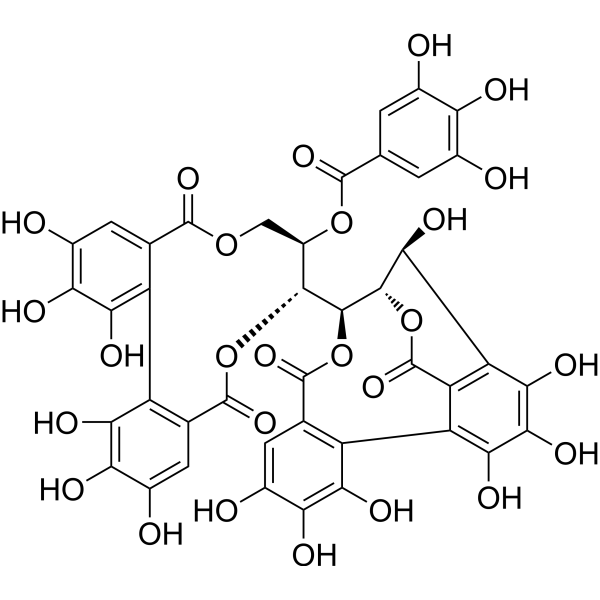
Casuarinin

Based on 1 Customer Validation
Casuarinin is an orally active antiproliferative, anti-inflammatory, antifungal, virucidal and gastroprotective agent. Casuarinin upregulates the expression of p21/WAF1, Fas/APO‑1, mFasL, sFasL and HSP‑70, arrests cell cycle, induces apoptosis and inhibits cancer cell proliferation. Casuarinin inhibits TNF‑α-induced phosphorylation of MAPK and activation of NF‑κB, downregulates the expression of iNOS, NF‑κB, COX‑2 and ICAM‑1, and reduces the production of proinflammatory mediators. Casuarinin attenuates ethanol-induced activation of caspase‑3 and elevation of TNF‑α, inhibits the growth of Candida albicans, and inhibits HSV‑2. Casuarinin can be used in research related to mammary adenocarcinoma, inflammatory skin diseases, gastric ulcers, candidiasis and herpes simplex virus infections.
For research use only. We do not sell to patients.
- CAS No.: 79786-01-9
- Formula: C41H28O26
- Molecular Weight:936.65
-
Storage:
-20°C, sealed storage, away from moisture and light
* In solvent : -80°C, 6 months; -20°C, 1 month (sealed storage, away from moisture and light)

To place orders, for customer services and technical support, please contact: MedChemExpress USA
Tel: 609-228-6898 E-mail: [email protected] [email protected]


-
 Biological Activity
-
Chemical Information
- Protocols
- Purity & Documentation
- References
-
 Help & FAQs


All Caspase Isoforms
More

Biological Activity
Description
|
p38 MAPK |
NF-κB |
COX-2 |
Caspase 3 |
iNOS |
HSP70 |
TNF-α |
HSV-2 |
In Vitro
Casuarinin (0.5-10 μM; 48 h) dose-dependently inhibits the proliferation of human breast adenocarcinoma MCF-7 cells with an IC50 of 6.04 μM[1].
Casuarinin (5-10 μM; 24 h) induces G0/G1 phase cell cycle arrest in human breast adenocarcinoma MCF-7 cells[1].
Casuarinin (0.5-10 μM; 48 h) increases the percentage of apoptotic nuclei in human breast adenocarcinoma MCF-7 cells in a dose-independent manner[1].
Casuarinin (5-10 μM; 6-48 h) time- and dose-dependently induces DNA fragmentation and apoptosis in human breast adenocarcinoma MCF-7 cells, with maximal effects observed at 48 h, while showing no effect on p53 protein expression at concentrations up to 10 μM within 48 h; it also time- and dose-dependently upregulates p21/WAF1, Fas/APO-1 receptor, mFasL and sFasL expression, with maximal induction detected at 24 h[1].
Casuarinin (10 μM; 48 h) exerts antiproliferative and proapoptotic effects in human breast adenocarcinoma MCF-7 cells, and these effects are significantly attenuated by pre-incubation with 250 ng/mL ZB4 (to block the Fas/FasL system) or 10 μM Z-IETD-FMK (to inhibit caspase-8) for 1 h prior to treatment[1].
Casuarinin (10 μM; 48 h, preceded by 1 h pre-incubation with 10 μM Z-IETD-FMK) has its antiproliferative and proapoptotic effects significantly reduced by blocking caspase-8 with Z-IETD-FMK in human breast adenocarcinoma MCF-7 cells after 48 h[1].
Casuarinin (5-10 μM; 12-48 h) time- and dose-dependently activates caspase-8 in human breast adenocarcinoma MCF-7 cells[1].
Casuarinin (5-20 μg/mL; 1 h pretreatment) dose-dependently inhibits TNF-α-induced ICAM-1 mRNA and protein expression in HaCaT human keratinocyte cells prior to TNF-α stimulation[2].
Casuarinin (5-20 μg/mL) dose-dependently reduces TNF-α-induced THP-1 monocyte adhesion to HaCaT human keratinocyte cells[2].
Casuarinin (5-20 μg/mL) blocks TNF-α-induced NF-κB activation in HaCaT human keratinocyte cells by inhibiting IκBα degradation, p65 phosphorylation and nuclear translocation, NF-κB DNA binding, and NF-κB promoter activity[2].
Casuarinin (5-20 μg/mL) dose-dependently inhibits TNF-α-induced phosphorylation of ERK and p38 MAPK (but not JNK) in HaCaT human keratinocyte cells, and also suppresses TNF-α-induced mRNA and protein expression of IL-6, IL-1β, IL-8, and MCP-1 in a concentration-dependent manner in the same cell line[2].
Casuarinin (24-48 h) exhibits antifungal activity against Candida albicans ATCC 64548, Candida albicans SC5314, Candida krusei ATCC 6258, Candida parapsilosis ATCC 22019, and Candida tropicalis ATCC 750, with the lowest MIC of 26 μg/mL against Candida krusei ATCC 6258[4].
Casuarinin (72 h) potently inhibits HSV-2 growth in Vero cells with an IC50 of 3.6 μM, has a CC50 of 89 μM in Vero cells, and exhibits a selectivity index of 25 in the XTT assay[5].
Casuarinin (1 h adsorption, 2 days total post-overlay) inhibits HSV-2 plaque formation in Vero cells with an IC50 of 1.5 μM and exhibits a selectivity index of 59 in the plaque reduction assay[5].
Casuarinin (0.5-50 μM; 6 h) exhibits potent virucidal activity against cell-free HSV-2 at 25 μM[5].
Casuarinin (10 μM; added 0-12 h post-infection, total 24 h infection time) inhibits HSV-2 yield in Vero cells by at least 90% even when added up to 12 h post-infection, indicating activity against late events of HSV-2 infection[5].
Casuarinin (3 h at 4°C, 48 h total post-overlay) inhibits HSV-2 attachment to Vero cells in a dose-dependent manner[5].
Casuarinin (10 μM; added after 3 h attachment, evaluated 10-minute intervals post-warming) inhibits HSV-2 penetration into Vero cells by over 85% within 10 minutes of treatment[5].
MedChemExpress (MCE) has not independently confirmed the accuracy of these methods. They are for reference only.
-
Cell Line:human breast adenocarcinoma MCF-7 cells
-
Concentration:0.5, 2.5, 5, 10 μM
-
Incubation Time:48 h
-
Result:Exhibited a dose-dependent antiproliferative effect.
Inhibited MCF-7 cell proliferation by 72.3% at 10 μM after 48 h.
Had an IC50 value of 6.04 μM.
-
Cell Line:human breast adenocarcinoma MCF-7 cells
-
Concentration:5, 10 μM
-
Incubation Time:24 h
-
Result:Increased the G0/G1 phase population to 55.9% at 5 μM.
Further increased the G0/G1 phase population to 67.6% at 10 μM.
-
Cell Line:human breast adenocarcinoma MCF-7 cells
-
Concentration:5, 10 μM
-
Incubation Time:6, 12 ,24, 48 h
-
Result:Induced apoptosis in human breast adenocarcinoma MCF-7 cells.
-
Cell Line:human breast adenocarcinoma MCF-7 cells
-
Concentration:5-10 μM
-
Incubation Time:6, 12 ,24, 48 h
-
Result:Detected DNA fragmentation as early as 12 h post-treatment, with the maximal effect at 48 h.
Increased apoptosis at 48 h in a dose-dependent manner.
Showed no effect on p53 protein expression at concentrations up to 10 μM for 48 h.
Increased p21/WAF1 protein levels as early as 6 h post-treatment, with maximum induction at 24 h.
Upregulated Fas/APO-1 receptor, mFasL and sFasL expression as early as 6 h post-treatment in a dose-dependent manner, reaching maximum effects at 24 h.
-
Cell Line:HaCaT human keratinocyte cells
-
Concentration:5, 10, 20, 30 μg/mL
-
Incubation Time:24 h
-
Result:Did not significantly alter HaCaT cell viability at concentrations up to 30 μg/mL.
Established a non-toxic range of 5, 10, and 20 μg/mL for subsequent experiments.
-
Cell Line:HaCaT human keratinocyte cells stimulated with TNF-α
-
Concentration:5, 10, 20 μg/mL
-
Incubation Time:1 h (pretreatment); 20 min (TNF-α incubation)
-
Result:Dose-dependently abolished TNF-α-induced phosphorylation of ERK and p38 MAPK.
Reduced phosphorylation of ERK and p38 MAPK by statistically significant levels at 10 μg/mL and 20 μg/mL compared to TNF-α alone.
Had only a minimal effect on JNK phosphorylation levels.
-
Cell Line:HaCaT human keratinocyte cells stimulated with TNF-α
-
Concentration:5, 10, 20 μg/mL
-
Incubation Time:1 h (pretreatment); 20 min (TNF-α incubation)
-
Result:Inhibited TNF-α-induced ICAM-1 mRNA expression in HaCaT human keratinocyte cells prior to TNF-α stimulation.
Suppressed TNF-α-induced mRNA of IL-6, IL-1β, IL-8, and MCP-1 in a concentration-dependent manner.
In Vivo
MedChemExpress (MCE) has not independently confirmed the accuracy of these methods. They are for reference only.
-
Animal Model:Sprague Dawley (male, 200-220 g, ethanol-induced gastric ulcer)[3]
-
Dosage:25 mg/kg; 50 mg/kg; 100 mg/kg
-
Administration:p.o.; single dose
-
Result:Reduced ulcerated area by 45.44%, increased titratable acidity, decreased MDA by 30.23%, elevated acidic mucin reactivity to 2.82% and enhanced HSP-70 expression versus the ulcer group.
Reduced ulcerated area by 77.9%, increased titratable acidity, elevated GSH and catalase levels, decreased MDA, TNF-α and caspase-3 activity, restored PGE2, increased acidic mucin reactivity to 3.28%, enhanced HSP-70 expression and suppressed NF-κB and COX-2 immunoexpression.
Reduced ulcerated area by 98.90%, increased mucin content and decreased titratable acidity by 42.32%; normalized GSH, catalase, MDA, TNF-α, caspase-3 and PGE2; elevated acidic mucin reactivity to 6.47%; downregulated NF-κB, COX-2 and iNOS to near-normal levels and enhanced HSP-70 expression.
- RNA extraction experimental
- Western Blot
- Annexin V plus membrane-impermeant dye apoptosis staining
- BrdU Incorporation Assay
- Somatic Cell Culture
- CFSE Dye Dilution Proliferation Assay
- Dye-dilution cell tracking and proliferation staining
- Protocol for Cell Cycle
- CCK-8/WST-8 Cell Proliferation Assay
- Research Protocol for Inflammation-related Diseases
- Cell Counting-Based Growth Curve Assay
- Colony Formation (Clonogenic) Assay
- Cell Viability Determination by MTT Colorimetric Assay
- Kinase activity and phosphorylation assays
- EdU Incorporation Assay (Click Chemistry-Based DNA Synthesis Measurement)
- Detection of Apoptosis
- TUNEL staining for apoptotic DNA fragmentation
- Ki-67 Immunostaining Proliferation Assay
- Flow cytometric DNA-content cell-cycle staining
- PCNA Immunodetection Proliferation Assay
- Protocol for Cell Counting and Cell Density Analysis
- Apoptosis Solutions
- Protocol for Kinase activity and phosphorylation assays
- MTT Cell Proliferation Assay


Chemical Information
-
CAS No. 79786-01-9
-
Appearance Solid
-
Molecular Weight 936.65
-
Formula C41H28O26
-
Color Light yellow to light brown
-
SMILES
OC1=C(O)C(O)=C(C2=C(C(O3)=O)C=C(O)C(O)=C2O)C(C(OC[C@@H](OC(C4=CC(O)=C(O)C(O)=C4)=O)[C@@H]3[C@H](OC(C5=C6C(O)=C(O)C(O)=C5)=O)[C@@H](O7)[C@@H](O)C8=C(C6=C(O)C(O)=C8O)C7=O)=O)=C1
-
Structure Classification
-
Shipping
Room temperature in continental US; may vary elsewhere.
-
Storage
-20°C, sealed storage, away from moisture and light
* In solvent : -80°C, 6 months; -20°C, 1 month (sealed storage, away from moisture and light)


Purity & Documentation
-
Data Sheet (310 KB)
-
SDS (252 KB)
- English - EN (252 KB)
- Français - FR (252 KB)
- Deutsch - DE (252 KB)
- Norwegian - NO (252 KB)
- Español - ES (252 KB)
- Swedish - SV (252 KB)
- Italian - IT (252 KB)
- Korean - KR (252 KB)
- Portuguese - PT (252 KB)
-
Handling Instructions (2659 KB)
References
[1]. Kuo PL, et al. Casuarinin from the bark of Terminalia arjuna induces apoptosis and cell cycle arrest in human breast adenocarcinoma MCF-7 cells. Planta Med. 2005;71(3):237-243. [Content Brief]
[2]. Kwon DJ, et al. Casuarinin suppresses TNF-α-induced ICAM-1 expression via blockade of NF-κB activation in HaCaT cells. Biochem Biophys Res Commun. 2011;409(4):780-785. [Content Brief]
[3]. Al-Sayed E, et al. Protective Role of Casuarinin from Melaleuca leucadendra against Ethanol-Induced Gastric Ulcer in Rats. Planta Med. 2020;86(1):32-44. [Content Brief]
[4]. Souza-Moreira TM, et al. Anti-Candida targets and cytotoxicity of casuarinin isolated from Plinia cauliflora leaves in a bioactivity-guided study. Molecules. 2013;18(7):8095-8108. Published 2013 Jul 9. [Content Brief]
[5]. Cheng HY, et al. Antiherpes simplex virus type 2 activity of casuarinin from the bark of Terminalia arjuna Linn. Antiviral Res. 2002;55(3):447-455. [Content Brief]

Calculators
Concentration (start) × Volume (start) = Concentration (final) × Volume (final)


Casuarinin Related Classifications
HY-N12717 Related Classifications
 Powered by Bioz