



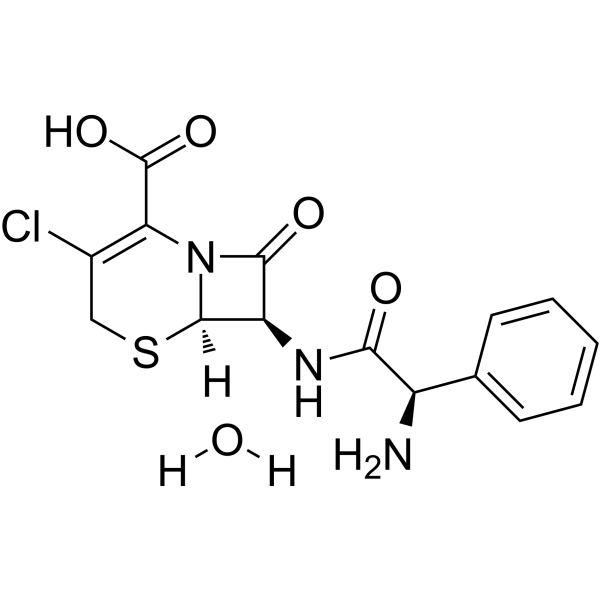
Cefaclor monohydrate
Based on 2 publication(s) in Google Scholar
Cefaclor is a well-absorbed orally active cephalosporin antibiotic. Cefaclor can specifically bind to specific for penicillin-binding protein 3 (PBP3). Cefaclor can be used for the research of depression and kinds of infections caused by bacteria, such as respiratory tract infections, bacterial bronchitis, pharyngitis and skin infections.
Nos produits utilisent uniquement pour la recherche. Nous ne vendons pas aux patients.
- Pureté : 99.11%
- CAS No.: 70356-03-5
- Formule: C15H16ClN3O5S
- Masse moléculaire:385.82
-
Stockage:Powder -20°C, 3 years ; In solvent -80°C, 6 months , -20°C, 1 month

To place orders, for customer services and technical support, please contact: MedChemExpress USA
Tel: 609-228-6898 E-mail: [email protected] [email protected]


-
 Activité biologique
-
Chemical Information
-
Solvant et solubilité
- Pureté et documentation
- Références
-
 Help & FAQs



Publications Citing Use of MedChemExpress (MCE) Cefaclor monohydrate
MoreVoir tous les produits spécifiques à Isoform Antibiotic
MoreVoir tous les produits spécifiques à Isoform 5-HT Receptor
More

Activité biologique
Description
IC50 & Target
|
β-lactam |
5-HT Receptor |
hOAT1 |
hPepT1-human peptide transporter 1 |
hPepT2-human peptide transporter 2 |
CD63 |
BDNF |
In Vitro
Cefaclor (0-500 μg/mL, 12-24 h) shows obvious antibacterial activity against 556 Gram-positive and Gram-negative isolates. The MIC values of most strains are lower than 3.1 μg/mL, and the MIC value of Staph. aureus is 1 μg/mL in vitro[4].
Cefaclor (60/500 μM, 30 min) is mainly transported by hPepT2 and hPepT1 in the MDCK stably transduced cell line overexpressing hOAT1, hPepT1 and hPepT2[2].
Cefaclor (0.16 mg/mL, 30 min) can induce allergic reactions by directly activating basophils and mast cells[3].
MedChemExpress (MCE) has not independently confirmed the accuracy of these methods. They are for reference only.
In Vivo
MedChemExpress (MCE) has not independently confirmed the accuracy of these methods. They are for reference only.
-
Animal Model:C57BL/6J mice (male, 5 weeks old)[1]
-
Dosage:200 mg/kg/day, once a day for 5 days.
-
Administration:p.o.
-
Result:Significantly decreased serotonin levels in the hippocampus and BDNF in mice.
Cefaclor-induced gut dysbiosis caused anxiety and depression through the microbiota-gut-blood–brain and the microbiota-gut-vagus nerve-brain pathway.


Chemical Information
-
CAS No. 70356-03-5
-
Appearance Solid
-
Masse moléculaire 385.82
-
Formule C15H16ClN3O5S
-
Color Off-white to light yellow
-
SMILES
O=C(C(N12)=C(Cl)CS[C@]2([H])[C@H](NC([C@H](N)C3=CC=CC=C3)=O)C1=O)O.[H]O[H]
-
Livraison
Room temperature in continental US; may vary elsewhere.
-
Stockage
Powder -20°C 3 years In solvent -80°C 6 months -20°C 1 month


Publications (2)
-
Journal Impact Factor
-
Most Recent
-
Nat Commun
2023 Mar 22;14(1):1594. PMID: 36949052 -
ACS Environ Au
Machine Learning-Assisted Recognition of Environmental Sulfur-Containing Chemicals in Nontargeted Mass Spectrometry Analysis of Inadequate Mass Resolution. [Abstract]2025 Aug 5;5(6):573-582. PMID: 41277996


Solvant et solubilité
In Vitro:
DMSO : 5.83 mg/mL (15.11 mM; ultrasonic and warming and heat to 60°C; Hygroscopic DMSO has a significant impact on the solubility of product, please use newly opened DMSO)
Please refer to the solubility information to select the appropriate solvent. Once prepared, please aliquot and store the solution to prevent product inactivation from repeated freeze-thaw cycles.
Storage method and period of stock solution: -80°C, 6 months; -20°C, 1 month. When stored at -80°C, please use it within 6 months. When stored at -20°C, please use it within 1 month.
Please refer to the solubility information to select the appropriate solvent. Once prepared, please aliquot and store the solution to prevent product inactivation from repeated freeze-thaw cycles.
Storage method and period of stock solution: -80°C, 6 months; -20°C, 1 month. When stored at -80°C, please use it within 6 months. When stored at -20°C, please use it within 1 month.
Concentration (start) × Volume (start) = Concentration (final) × Volume (final)


Pureté et documentation
-
Fiche technique (278 KB)
-
SDS (393 KB)
- English - EN (393 KB)
- Français - FR (393 KB)
- Deutsch - DE (393 KB)
- Norwegian - NO (393 KB)
- Español - ES (393 KB)
- Swedish - SV (393 KB)
- Italian - IT (393 KB)
- Korean - KR (393 KB)
- Portuguese - PT (393 KB)
-
Instruction de manipulation (2659 KB)
Références
[1]. 引用1 :Joo MK, et al. Cefaclor causes vagus nerve-mediated depression-like symptoms with gut dysbiosis in mice. Sci Rep. 2023 Sep 19;13(1):15529. [Content Brief]
[2]. Li M, et al. Interactions of amoxicillin and cefaclor with human renal organic anion and peptide transporters. Drug Metab Dispos. 2006 Apr;34(4):547-55. [Content Brief]
[3]. Yoo HS, et al. Immunologic evaluation of immediate hypersensitivity to cefaclor. Yonsei Med J. 2014 Nov;55(6):1473-83. [Content Brief]
[4]. Neu HC, et al. Cefaclor: in vitro spectrum of activity and beta-lactamase stability. Antimicrob Agents Chemother. 1978 Apr;13(4):584-8. [Content Brief]


Complete Stock Solution Preparation Table
Please refer to the solubility information to select the appropriate solvent. Once prepared, please aliquot and store the solution to prevent product inactivation from repeated freeze-thaw cycles.
Storage method and period of stock solution: -80°C, 6 months; -20°C, 1 month. When stored at -80°C, please use it within 6 months. When stored at -20°C, please use it within 1 month.
| Optional Solvent | Concentration Solvent Mass | 1 mg | 5 mg | 10 mg | 25 mg |
|---|---|---|---|---|---|
| DMSO | 1 mM | 2.5919 mL | 12.9594 mL | 25.9188 mL | 64.7971 mL |
| 5 mM | 0.5184 mL | 2.5919 mL | 5.1838 mL | 12.9594 mL | |
| 10 mM | 0.2592 mL | 1.2959 mL | 2.5919 mL | 6.4797 mL | |
| 15 mM | 0.1728 mL | 0.8640 mL | 1.7279 mL | 4.3198 mL |


Cefaclor monohydrate Related Classifications
HY-B0198A Related Classifications
 Powered by Bioz