



Medrysone
Based on 1 publication(s) in Google Scholar
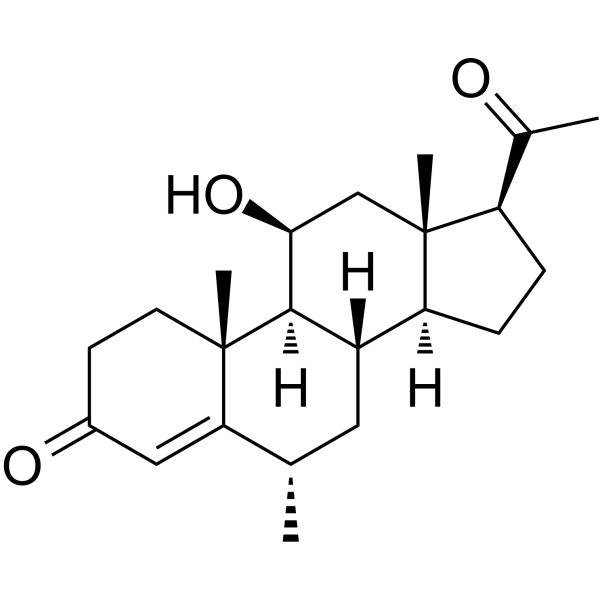
Medrysone (HMS; 6α-Methyl-11β-hydroxyprogesterone) is a STAT6 modulator and M2 macrophage polarization inducer. Medrysone enhances IL-4-triggered STAT6 activation, upregulates the expression of M2 markers, and promotes the secretion of VEGF and CCL2. Medrysone also enhances the pro-migratory activity of M2-like macrophages toward endothelial cells. By regulating macrophage polarization and related repair pathways, Medrysone significantly promotes corneal wound repair in a rat mechanical injury model. Medrysone can be used for research related to corneal injury.
Nos produits utilisent uniquement pour la recherche. Nous ne vendons pas aux patients.
- Pureté : 99.79%
- CAS No.: 2668-66-8
- Formule: C22H32O3
- Masse moléculaire:344.49
-
Stockage:Powder -20°C, 3 years , 4°C, 2 years ; In solvent -80°C, 2 years , -20°C, 1 year

To place orders, for customer services and technical support, please contact: MedChemExpress USA
Tel: 609-228-6898 E-mail: [email protected] [email protected]


-
 Activité biologique
-
Chemical Information
-
Solvant et solubilité
- Protocole
- Pureté et documentation
- Références
-
 Help & FAQs


Publications Citing Use of MedChemExpress (MCE) Medrysone
MoreVoir tous les produits spécifiques à Isoform VEGFR
More

Activité biologique
Description
IC50 & Target
|
STAT6 |
CCR2 |
In Vitro
Medrysone (5 μM; 24 h) promotes M2 polarization of RAW264.7 and BMDM cells via a STAT6-dependent pathway, increases the proportion of CD206-positive cells, and exerts enhanced effects when used in combination with IL-4; whereas silencing STAT6 abolishes the increase in CD206-positive cells[1].
When used in combination with IL-4, Medrysone (5 μM; 24 h) upregulates the mRNA expression levels of M2 marker genes (Mrc1, IL10, Fizz1, Arg1, CD11b) in RAW264.7 cells, with the levels being higher than those observed with either agent alone[1].
When used in combination with IL-4, Medrysone (5 μM; 24 h) significantly promotes the secretion of VEGF and CCL2 by RAW264.7 cells and increases the protein level of p-STAT6[1].
Medrysone (5 μM; 24 h) enhances the pro-migratory and pro-wound healing activities of RAW264.7 cell-conditioned medium on C166 vascular endothelial cells, with the strongest effect observed when combined with IL-4[1].
Medrysone (100 nM; 21 d) increases ALP activity and supports the long-term adhesion of human mesenchymal stem cells (hMSCs) on TCPS for up to 21 days, but it induces significantly less mineralized matrix deposition compared to osteogenic complete medium supplemented with dexamethasone[2].
MedChemExpress (MCE) has not independently confirmed the accuracy of these methods. They are for reference only.
-
Cell Line:RAW264.7 murine macrophage cells
-
Concentration:5 μM
-
Incubation Time:24 h
-
Result:Increased p-STAT6 levels relative to control when used alone.
Further enhanced p-STAT6 levels to a relative value of 1.44 (short exposure) when combined with IL-4, which is higher than the 0.75 relative value observed with IL-4 alone.
-
Cell Line:C166 murine vascular endothelial cells, RAW264.7 murine macrophage cells
-
Concentration:5 μM
-
Incubation Time:24 h (treatment of RAW264.7 cells)
-
Result:Increased C166 cell migration to a fold change of approximately 0.9 when using conditioned medium from Medrysone-treated RAW264.7 cells.
Increased C166 cell migration to a fold change of approximately 2.3 when using conditioned medium from RAW264.7 cells treated with both Medrysone and IL-4, which is higher than the fold change of approximately 1.8 observed with conditioned medium from IL-4-treated cells.\n
Enhanced C166 cell wound closure when using conditioned medium from Medrysone-treated RAW264.7 cells.
Induced the strongest wound closure when using conditioned medium from RAW264.7 cells treated with both Medrysone and IL-4.
-
Cell Line:human mesenchymal stem cells (hMSCs)
-
Concentration:1 nM; 10 nM; 100 nM
-
Incubation Time:up to 21 days
-
Result:Supported cell proliferation comparable to cells grown in complete osteogenic media (OG+) over 21 days at 100 nM, with cells remaining attached to TCPS throughout the study.
Increased ALP activity slightly relative to OG+ at 14 days, and by ~25% relative to OG+ at 21 days at 100 nM.
Elevated relative CBFA1 expression slightly above day 0 levels at 14, 18, and 21 days, but lower than OG+ levels at 18 days at 100 nM.
Increased relative osteocalcin expression over time, with levels slightly elevated above day 0 but lower than OG+ at 21 days at 100 nM.
Resulted in significantly less mineralized matrix deposition relative to OG+, with only minimal Alizarin Red staining observed after 21 days at 100 nM.
In Vivo
MedChemExpress (MCE) has not independently confirmed the accuracy of these methods. They are for reference only.
-
Animal Model:male, 6-8 weeks old[1]
-
Dosage:5 μM
-
Administration:topical; every 6 hours; 48 hours
-
Result:Significantly reduced the percentage of fluorescein-positive corneal area at 48 hours.
Significantly upregulated mRNA expression of M2 macrophage markers Mrc1 (p < 0.01), Fizz1 (p < 0.01), Arg1 (p < 0.05), and CD11b (p < 0.05).
Essai clinique
| NCT Number | Sponsor | Condition | Start Date |
Phase

|
|---|---|---|---|---|
| NCT01329991 | Plexxikon| | 2011-05 | PHASE1 |


Chemical Information
-
CAS No. 2668-66-8
-
Appearance Solid
-
Masse moléculaire 344.49
-
Formule C22H32O3
-
Color White to off-white
-
SMILES
CC([C@H]1CC[C@@]2([H])[C@]3([H])C[C@H](C)C4=CC(CC[C@]4(C)[C@@]3([H])[C@@H](O)C[C@]12C)=O)=O
-
Synonyms
HMS; 6α-Methyl-11β-hydroxyprogesterone
-
Livraison
Room temperature in continental US; may vary elsewhere.
-
Stockage
Powder -20°C 3 years 4°C 2 years In solvent -80°C 2 years -20°C 1 year


Publications (1)
-
Journal Impact Factor
-
Most Recent
-
Nat Commun
Coronavirus envelope protein activates TMED10-mediated unconventional secretion of inflammatory factors. [Abstract]2024 Oct 8;15(1):8708. PMID: 39379362


Solvant et solubilité
In Vitro:
DMSO : 50 mg/mL (145.14 mM; ultrasonic and warming and heat to 60°C; Hygroscopic DMSO has a significant impact on the solubility of product, please use newly opened DMSO)
Ethanol : ≥ 25 mg/mL (72.57 mM)
H2O : < 0.1 mg/mL (insoluble)
* "≥" means soluble, but saturation unknown.
Please refer to the solubility information to select the appropriate solvent. Once prepared, please aliquot and store the solution to prevent product inactivation from repeated freeze-thaw cycles.
Storage method and period of stock solution: -80°C, 2 years; -20°C, 1 year. When stored at -80°C, please use it within 2 years. When stored at -20°C, please use it within 1 year.
Please refer to the solubility information to select the appropriate solvent. Once prepared, please aliquot and store the solution to prevent product inactivation from repeated freeze-thaw cycles.
Storage method and period of stock solution: -80°C, 2 years; -20°C, 1 year. When stored at -80°C, please use it within 2 years. When stored at -20°C, please use it within 1 year.
Concentration (start) × Volume (start) = Concentration (final) × Volume (final)
In Vivo:
Select the appropriate dissolution method based on your experimental animal and administration route.
- For the following dissolution methods, please ensure to first prepare a clear stock solution using an In Vitro approach and then sequentially add co-solvents:
- To ensure reliable experimental results, the clarified stock solution can be appropriately stored based on storage conditions. As for the working solution for In Vivo experiments, it is recommended to prepare freshly and use it on the same day.
- The percentages shown for the solvents indicate their volumetric ratio in the final prepared solution. If precipitation or phase separation occurs during preparation, heat and/or sonication can be used to aid dissolution.
Add each solvent one by one: 10% DMSO 90% (20% SBE-β-CD in Saline)
Solubility: ≥ 2.5 mg/mL (7.26 mM); Clear solution
This protocol yields a clear solution of ≥ 2.5 mg/mL (saturation unknown).
Taking 1 mL working solution as an example, add 100 μL DMSO stock solution (25.0 mg/mL) to 900 μL 20% SBE-β-CD in Saline, and mix evenly.
Preparation of 20% SBE-β-CD in Saline (4°C, storage for one week): 2 g SBE-β-CD powder is dissolved in 10 mL Saline, completely dissolve until clear.
Add each solvent one by one: 10% EtOH 40% PEG300 5% Tween-80 45% Saline
Solubility: 2.5 mg/mL (7.26 mM); Suspended solution; Need ultrasonic
This protocol yields a suspended solution of 2.5 mg/mL. Suspended solution can be used for oral and intraperitoneal injection.
Taking 1 mL working solution as an example, add 100 μL EtOH stock solution (25.0 mg/mL) to 400 μL PEG300, and mix evenly; then add 50 μL Tween-80 and mix evenly; then add 450 μL Saline to adjust the volume to 1 mL.
Preparation of Saline: Dissolve 0.9 g sodium chloride in ddH₂O and dilute to 100 mL to obtain a clear Saline solution.
Add each solvent one by one: 10% EtOH 90% (20% SBE-β-CD in Saline)
Solubility: ≥ 2.5 mg/mL (7.26 mM); Clear solution
This protocol yields a clear solution of ≥ 2.5 mg/mL (saturation unknown).
Taking 1 mL working solution as an example, add 100 μL EtOH stock solution (25.0 mg/mL) to 900 μL 20% SBE-β-CD in Saline, and mix evenly.
Preparation of 20% SBE-β-CD in Saline (4°C, storage for one week): 2 g SBE-β-CD powder is dissolved in 10 mL Saline, completely dissolve until clear.
Add each solvent one by one: 10% EtOH 90% Corn Oil
Solubility: ≥ 2.5 mg/mL (7.26 mM); Clear solution
This protocol yields a clear solution of ≥ 2.5 mg/mL (saturation unknown). If the continuous dosing period exceeds half a month, please choose this protocol carefully.
Taking 1 mL working solution as an example, add 100 μL EtOH stock solution (25.0 mg/mL) to 900 μL Corn oil, and mix evenly.
In Vivo Dissolution Calculator
Please enter the basic information of animal experiments:
-
-
-
-
Recommended: Prepare an additional quantity of animals to account for potential losses during experiments.
Please enter your animal formula composition:
-
%DMSO +
Recommended: Keep the proportion of DMSO in working solution below 2% if your animal is weak.
-
%+
-
+%Tween-80 + +
-
%Saline +
The co-solvents required include: DMSO, . All of co-solvents are available by MedChemExpress (MCE). , Tween 80. All of co-solvents are available by MedChemExpress (MCE).
Working solution concentration: 0.22 mg/mL
Method for preparing stock solution: mg drug dissolved in μL DMSO. Stock solution concentration: mg/mL.
1. Take μL DMSO stock solution;
2. Add μL .
μL , mix evenly;
3. Then add μL Tween 80, mix evenly;
4. Then add μL
Please ensure that the stock solution in the first step is dissolved to a clear state, and add co-solvents in sequence. You can use ultrasonic heating (ultrasonic cleaner, recommended frequency 20-40 kHz), vortexing, etc. to assist dissolution.


Pureté et documentation
-
Fiche technique (284 KB)
-
SDS (393 KB)
- English - EN (393 KB)
- Français - FR (393 KB)
- Deutsch - DE (393 KB)
- Norwegian - NO (393 KB)
- Español - ES (393 KB)
- Swedish - SV (393 KB)
- Italian - IT (393 KB)
- Korean - KR (393 KB)
- Portuguese - PT (393 KB)
-
Instruction de manipulation (2659 KB)
Références
[1]. Zhu Y, et al. Medrysone promotes corneal injury repair by promoting M2-like polarization of macrophages. BMC Ophthalmol. 2023;23(1):503. Published 2023 Dec 11. [Content Brief]
[2]. Brey DM, et al. High-throughput screening of a small molecule library for promoters and inhibitors of mesenchymal stem cell osteogenic differentiation. Biotechnol Bioeng. 2011;108(1):163-174. [Content Brief]


Complete Stock Solution Preparation Table
Please refer to the solubility information to select the appropriate solvent. Once prepared, please aliquot and store the solution to prevent product inactivation from repeated freeze-thaw cycles.
Storage method and period of stock solution: -80°C, 2 years; -20°C, 1 year. When stored at -80°C, please use it within 2 years. When stored at -20°C, please use it within 1 year.
| Optional Solvent | Concentration Solvent Mass | 1 mg | 5 mg | 10 mg | 25 mg |
|---|---|---|---|---|---|
| Ethanol / DMSO | 1 mM | 2.9028 mL | 14.5142 mL | 29.0284 mL | 72.5710 mL |
| 5 mM | 0.5806 mL | 2.9028 mL | 5.8057 mL | 14.5142 mL | |
| 10 mM | 0.2903 mL | 1.4514 mL | 2.9028 mL | 7.2571 mL | |
| 15 mM | 0.1935 mL | 0.9676 mL | 1.9352 mL | 4.8381 mL | |
| 20 mM | 0.1451 mL | 0.7257 mL | 1.4514 mL | 3.6286 mL | |
| 25 mM | 0.1161 mL | 0.5806 mL | 1.1611 mL | 2.9028 mL | |
| 30 mM | 0.0968 mL | 0.4838 mL | 0.9676 mL | 2.4190 mL | |
| 40 mM | 0.0726 mL | 0.3629 mL | 0.7257 mL | 1.8143 mL | |
| 50 mM | 0.0581 mL | 0.2903 mL | 0.5806 mL | 1.4514 mL | |
| 60 mM | 0.0484 mL | 0.2419 mL | 0.4838 mL | 1.2095 mL | |
| DMSO | 80 mM | 0.0363 mL | 0.1814 mL | 0.3629 mL | 0.9071 mL |
| 100 mM | 0.0290 mL | 0.1451 mL | 0.2903 mL | 0.7257 mL |


Medrysone Related Classifications
HY-B1076 Related Classifications
 Powered by Bioz