



Roxatidine
Based on 1 publication(s) in Google Scholar
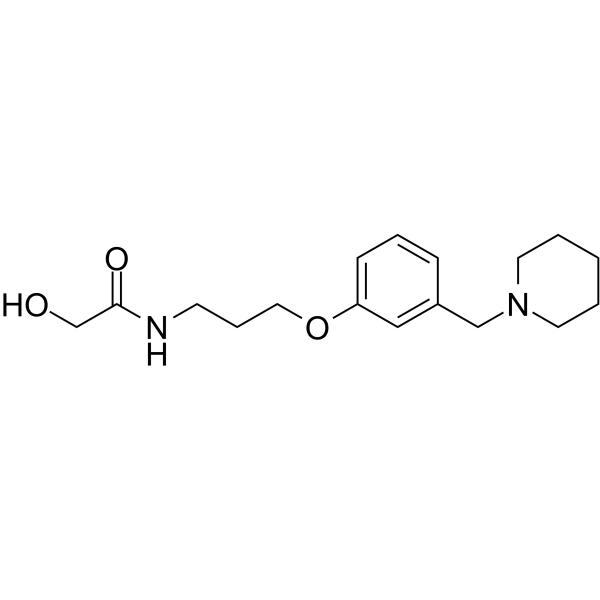
Roxatidine is an active metabolite of Roxatidine acetate hydrochloride, is an orally active histamine H2-receptor antagonist. Roxatidine, an anti-ulcer agent, suppresses histamine release (thus inhibiting proton secretion) and inhibits the production of VEGF-1, an important marker of inflammation and angiogenesis. Anti-allergic inflammatory effect. Roxatidine is promising for research of gastric and duodenal ulcers.
For research use only. We do not sell to patients.
- Purity : 98.25%
- CAS No.: 78273-80-0
- Formula: C17H26N2O3
- Molecular Weight:306.41
-
Storage:Pure form -20°C, 3 years , 4°C, 2 years ; In solvent -80°C, 6 months , -20°C, 1 month

To place orders, for customer services and technical support, please contact: MedChemExpress USA
Tel: 609-228-6898 E-mail: [email protected] [email protected]


-
 Biological Activity
-
Chemical Information
-
Solvent & Solubility
- Protocols
- Purity & Documentation
- References
-
 Help & FAQs



Publications Citing Use of MedChemExpress (MCE) Roxatidine
MoreAll Histamine Receptor Isoforms
MoreAll Caspase Isoforms
More

Biological Activity
Description
IC50 & Target
|
H2 Receptor |
In Vitro
Roxatidine (6.25-25 μM, 6 h 30 min) suppresses the PMACI-induced production of pro-inflammatory cytokines, NF-κB and caspase-1 activation, activation of p38 MAPK in HMC-1[1].
Roxatidine (40-120 μM, 1 h) inhibits the production of PGE2, NO, and histamine induced by LPS, as well as the expression of COX-2, iNOS, and HDC in RAW 264.7 cells[2].
MedChemExpress (MCE) has not independently confirmed the accuracy of these methods. They are for reference only.
-
Cell Line:HMC-1 cells
-
Concentration:6.25-25 μM
-
Incubation Time:6 h 30 min
-
Result:Down-regulated the PMACI-induced TNF-α, IL-6, and IL-1β production and their mRNA expression in a dose-dependent manner.
-
Cell Line:HMC-1 cells
-
Concentration:6.25-25 μM
-
Incubation Time:60 min
-
Result:Suppressed the PMACI-stimulated nuclear translocations of p65 subunit of NF-κB, phosphorylation and degradation of IκB-α, the PMACI-induced activation of p38 MAPK in HMC-1.
In Vivo
MedChemExpress (MCE) has not independently confirmed the accuracy of these methods. They are for reference only.
-
Animal Model:Compound 48/80-induced anaphylactic shock mouse model[1]
-
Dosage:20 mg/kg
-
Administration:p.o., a single dose for 1h before Compound 48/80 injection
-
Result:Increased the survival rate to 20% at 60 min after compound 48/80 injection.
Clinical Trial
| NCT Number | Sponsor | Condition | Start Date |
Phase

|
|---|---|---|---|---|
| NCT01329991 | Plexxikon| | 2011-05 | PHASE1 |


Chemical Information
-
CAS No. 78273-80-0
-
Appearance Oil
-
Molecular Weight 306.41
-
Formula C17H26N2O3
-
Color Colorless to light yellow
-
SMILES
O=C(NCCCOC1=CC=CC(CN2CCCCC2)=C1)CO
-
Shipping
Room temperature in continental US; may vary elsewhere.
-
Storage
Pure form -20°C 3 years 4°C 2 years In solvent -80°C 6 months -20°C 1 month


Publications (1)
-
Journal Impact Factor
-
Most Recent


Solvent & Solubility
In Vitro:
DMSO : 100 mg/mL (326.36 mM; Need ultrasonic; Hygroscopic DMSO has a significant impact on the solubility of product, please use newly opened DMSO)
Please refer to the solubility information to select the appropriate solvent. Once prepared, please aliquot and store the solution to prevent product inactivation from repeated freeze-thaw cycles.
Storage method and period of stock solution: -80°C, 6 months; -20°C, 1 month. When stored at -80°C, please use it within 6 months. When stored at -20°C, please use it within 1 month.
Please refer to the solubility information to select the appropriate solvent. Once prepared, please aliquot and store the solution to prevent product inactivation from repeated freeze-thaw cycles.
Storage method and period of stock solution: -80°C, 6 months; -20°C, 1 month. When stored at -80°C, please use it within 6 months. When stored at -20°C, please use it within 1 month.
Concentration (start) × Volume (start) = Concentration (final) × Volume (final)


Purity & Documentation
-
Data Sheet (271 KB)
-
SDS (392 KB)
- English - EN (392 KB)
- Français - FR (392 KB)
- Deutsch - DE (392 KB)
- Norwegian - NO (392 KB)
- Español - ES (392 KB)
- Swedish - SV (392 KB)
- Italian - IT (392 KB)
- Korean - KR (392 KB)
- Portuguese - PT (392 KB)
-
Handling Instructions (2659 KB)
References
[1]. Lee M, et al. Roxatidine attenuates mast cell-mediated allergic inflammation via inhibition of NF-κB and p38 MAPK activation. Sci Rep. 2017;7:41721. Published 2017 Jan 31. [Content Brief]
[2]. Collins JD, et al. Pharmacokinetics of roxatidine in healthy volunteers. Drugs. 1988;35 Suppl 3:41-7. [Content Brief]
[3]. Cho EJ, et al. Roxatidine suppresses inflammatory responses via inhibition of NF-κB and p38 MAPK activation in LPS-induced RAW 264.7 macrophages. J Cell Biochem. 2011 Dec;112(12):3648-59. [Content Brief]


Complete Stock Solution Preparation Table
Please refer to the solubility information to select the appropriate solvent. Once prepared, please aliquot and store the solution to prevent product inactivation from repeated freeze-thaw cycles.
Storage method and period of stock solution: -80°C, 6 months; -20°C, 1 month. When stored at -80°C, please use it within 6 months. When stored at -20°C, please use it within 1 month.
| Optional Solvent | Concentration Solvent Mass | 1 mg | 5 mg | 10 mg | 25 mg |
|---|---|---|---|---|---|
| DMSO | 1 mM | 3.2636 mL | 16.3182 mL | 32.6364 mL | 81.5911 mL |
| 5 mM | 0.6527 mL | 3.2636 mL | 6.5273 mL | 16.3182 mL | |
| 10 mM | 0.3264 mL | 1.6318 mL | 3.2636 mL | 8.1591 mL | |
| 15 mM | 0.2176 mL | 1.0879 mL | 2.1758 mL | 5.4394 mL | |
| 20 mM | 0.1632 mL | 0.8159 mL | 1.6318 mL | 4.0796 mL | |
| 25 mM | 0.1305 mL | 0.6527 mL | 1.3055 mL | 3.2636 mL | |
| 30 mM | 0.1088 mL | 0.5439 mL | 1.0879 mL | 2.7197 mL | |
| 40 mM | 0.0816 mL | 0.4080 mL | 0.8159 mL | 2.0398 mL | |
| 50 mM | 0.0653 mL | 0.3264 mL | 0.6527 mL | 1.6318 mL | |
| 60 mM | 0.0544 mL | 0.2720 mL | 0.5439 mL | 1.3599 mL | |
| 80 mM | 0.0408 mL | 0.2040 mL | 0.4080 mL | 1.0199 mL | |
| 100 mM | 0.0326 mL | 0.1632 mL | 0.3264 mL | 0.8159 mL |


Roxatidine Related Classifications
HY-137941 Related Classifications
 Powered by Bioz