



D927

Based on 1 Customer Validation
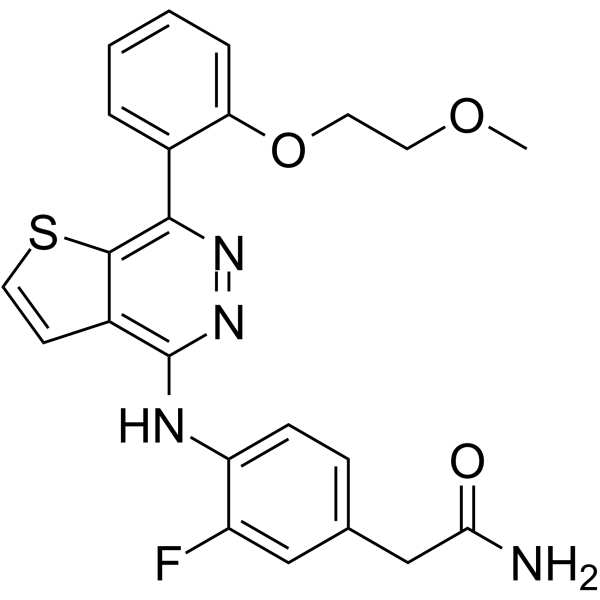
D927 (DS11252927) is an orally active glucose transporter type 4 (GLUT4) translocation activator with an EC50 of 0.14 μM. D927 enhances the binding affinity of PI3Kα catalytic subunit p110α to canonical RAS proteins (KRAS4A, KRAS4B) and RRAS, RRAS2, MRAS. D927 activates the PI3Kα-AKT pathway (increasing phosphorylation of AKT, p70S6 kinase) without affecting the RAF-ERK1/2 pathway. D927 improves hyperglycemia in type 1 and type 2 diabetes mice model. D927 can be used for the study of glucose homeostasis disorders and diabetes.
Nos produits utilisent uniquement pour la recherche. Nous ne vendons pas aux patients.
- Pureté : 99.46%
- CAS No.: 2253733-37-6
- Formule: C23H21FN4O3S
- Masse moléculaire:452.50
-
Stockage:Powder -20°C, 3 years , 4°C, 2 years ; In solvent -80°C, 6 months , -20°C, 1 month

To place orders, for customer services and technical support, please contact: MedChemExpress USA
Tel: 609-228-6898 E-mail: [email protected] [email protected]


-
 Activité biologique
-
Chemical Information
-
Solvant et solubilité
- Protocole
- Pureté et documentation
- Références
-
 Help & FAQs





Activité biologique
Description
IC50 & Target
[1][2]|
GLUT4 0.14 μM (EC50) |
PI3Kα |
In Vitro
D927 (Compound 26b) potently activates glucose transporter type 4 (GLUT4) translocation with an EC50 of 0.14 μM[1].
D927 (30-300 nM, 5 min) increases pAKT (Ser473) levels without affecting pMEK and pERK1/2 in various human cancer cell lines (PC3, RKO, SW1573, HCT15, SW620)[2].
D927 (10-10000 nM, 10 min) synergistically enhances insulin-induced AKT activation in L6 myotubes[2].
D927 (300 nM, 1-24 h) activates PI3Kα-AKT pathway by increasing phosphorylation of AKT (Ser473, Thr308) and p70S6 kinase (Thr389) in L6 myotubes without affecting RAF-ERK1/2 pathway[2].
D927 (1 μM, 1 h) promotes binding of KRAS (wild-type, G12D), MRAS, and RRAS2 to p110α in HEK293 cells[2].
D927 (600 nM, 5 min) induces pAKT (Ser473) accumulation mainly through RRAS2 in mouse embryo fibroblasts (MEFs)[2].
MedChemExpress (MCE) has not independently confirmed the accuracy of these methods. They are for reference only.
-
Cell Line:L6 myotubes
-
Concentration:300 nM
-
Incubation Time:1min, 10 min, 2h, 8h, 12h, 24 h
-
Result:Increased the phosphorylation of AKT (Ser473, Thr308) and p70S6 kinase (Thr389).
Had no substantial effect on the phosphorylation of ERK1/2 and MEK.
-
Cell Line:Human cancer cell lines (RKO, SW1573, HCT15, SW620, PC3)
-
Concentration:30, 300 nM
-
Incubation Time:5 min
-
Result:Increased the phosphorylation of AKT (Ser473).
-
Cell Line:L6 myotubes
-
Concentration:10, 100, 1000, 10000 nM combined with 100 nM Insulin
-
Incubation Time:10 min
-
Result:Increased the phosphorylation of AKT (Ser473).
Reduced the phosphorylation of AKT, ERK, and S6K.
In Vivo
D927 (30 mg/kg, p.o., single dose 30 min before glucose infusion) shows glucose-lowering effects in Zucker fatty rats[2].
D927 (10 mg/kg, p.o., single dose 15 min before glucose loading) improves hyperglycemia in db/db mice (type 2 diabetes model) during oral glucose tolerance test[2].
D927 (0.01%-0.03%, p.o., 27 days) ameliorates hyperglycemia in STZ-B6 mice (type 1 diabetes model)[2].
MedChemExpress (MCE) has not independently confirmed the accuracy of these methods. They are for reference only.
-
Animal Model:Zucker fatty rats (overnight-fasted)[2]
-
Dosage:30 mg/kg
-
Administration:p.o. for a single dose 30 min before glucose infusion
-
Result:Rapidly lowered blood glucose concentrations.
Increased glucose infusion rates and glucose turnover rates at steady state (90-120 min).
Significantly enhanced glucose uptake in soleus, gastrocnemius, and heart.
Decreased plasma insulin levels.
-
Animal Model:10-week-old male db/db mice with high basal plasma glucose level (over 500 mg/mL) were used as the severe diabetic model, with 2 h-fasting before oral administration[1].
-
Dosage:3, 10, 30 mg/kg
-
Administration:p.o. for a single dose
-
Result:Achieved significant blood glucose reduction with Emax values of 220 mg/dL, 393 mg/dL, and 435 mg/dL at doses of 3, 10, and 30 mg/kg, respectively.
-
Animal Model:6-week-old db/db mice (type 2 diabetes model)[2]
-
Dosage:10 mg/kg
-
Administration:p.o. for a single dose 15 min before glucose infusion
-
Result:Acutely improved hyperglycemia in oral glucose tolerance test, with reduced blood glucose AUC (0-120 min).
Did not affect insulin secretion during acute treatment.
After 24 days of chronic administration, significantly reduced glycated hemoglobin, with effects comparable to insulin.
No change in food intake.
-
Animal Model:STZ-B6 mice (type 1 diabetes model, insulin-deficient)[2]
-
Dosage:0.01%, 0.03%
-
Administration:p.o. for 27 days
-
Result:Reduced glycated hemoglobin, with effects comparable to 0.1 U/day insulin.
No change in food intake.
Increased body and tissue weight.


Chemical Information
-
CAS No. 2253733-37-6
-
Appearance Solid
-
Masse moléculaire 452.50
-
Formule C23H21FN4O3S
-
Color White to light yellow
-
SMILES
COCCOC1=CC=CC=C1C2=C(SC=C3)C3=C(NC4=CC=C(CC(N)=O)C=C4F)N=N2
-
Synonyms
DS11252927
-
Livraison
Room temperature in continental US; may vary elsewhere.
-
Stockage
Powder -20°C 3 years 4°C 2 years In solvent -80°C 6 months -20°C 1 month


Solvant et solubilité
In Vitro:
DMSO : 100 mg/mL (220.99 mM; ultrasonic and warming and heat to 60°C; Hygroscopic DMSO has a significant impact on the solubility of product, please use newly opened DMSO)
Please refer to the solubility information to select the appropriate solvent. Once prepared, please aliquot and store the solution to prevent product inactivation from repeated freeze-thaw cycles.
Storage method and period of stock solution: -80°C, 6 months; -20°C, 1 month. When stored at -80°C, please use it within 6 months. When stored at -20°C, please use it within 1 month.
Please refer to the solubility information to select the appropriate solvent. Once prepared, please aliquot and store the solution to prevent product inactivation from repeated freeze-thaw cycles.
Storage method and period of stock solution: -80°C, 6 months; -20°C, 1 month. When stored at -80°C, please use it within 6 months. When stored at -20°C, please use it within 1 month.
Concentration (start) × Volume (start) = Concentration (final) × Volume (final)
In Vivo:
Select the appropriate dissolution method based on your experimental animal and administration route.
- For the following dissolution methods, please ensure to first prepare a clear stock solution using an In Vitro approach and then sequentially add co-solvents:
- To ensure reliable experimental results, the clarified stock solution can be appropriately stored based on storage conditions. As for the working solution for In Vivo experiments, it is recommended to prepare freshly and use it on the same day.
- The percentages shown for the solvents indicate their volumetric ratio in the final prepared solution. If precipitation or phase separation occurs during preparation, heat and/or sonication can be used to aid dissolution.
Add each solvent one by one: 10% DMSO 40% PEG300 5% Tween-80 45% Saline
Solubility: ≥ 2.5 mg/mL (5.52 mM); Clear solution
This protocol yields a clear solution of ≥ 2.5 mg/mL (saturation unknown).
Taking 1 mL working solution as an example, add 100 μL DMSO stock solution (25.0 mg/mL) to 400 μL PEG300, and mix evenly; then add 50 μL Tween-80 and mix evenly; then add 450 μL Saline to adjust the volume to 1 mL.
Preparation of Saline: Dissolve 0.9 g sodium chloride in ddH₂O and dilute to 100 mL to obtain a clear Saline solution.
Add each solvent one by one: 10% DMSO 90% (20% SBE-β-CD in Saline)
Solubility: ≥ 2.5 mg/mL (5.52 mM); Clear solution
This protocol yields a clear solution of ≥ 2.5 mg/mL (saturation unknown).
Taking 1 mL working solution as an example, add 100 μL DMSO stock solution (25.0 mg/mL) to 900 μL 20% SBE-β-CD in Saline, and mix evenly.
Preparation of 20% SBE-β-CD in Saline (4°C, storage for one week): 2 g SBE-β-CD powder is dissolved in 10 mL Saline, completely dissolve until clear.
In Vivo Dissolution Calculator
Please enter the basic information of animal experiments:
-
-
-
-
Recommended: Prepare an additional quantity of animals to account for potential losses during experiments.
Please enter your animal formula composition:
-
%DMSO +
Recommended: Keep the proportion of DMSO in working solution below 2% if your animal is weak.
-
%+
-
+%Tween-80 + +
-
%Saline +
The co-solvents required include: DMSO, . All of co-solvents are available by MedChemExpress (MCE). , Tween 80. All of co-solvents are available by MedChemExpress (MCE).
Working solution concentration: 0.22 mg/mL
Method for preparing stock solution: mg drug dissolved in μL DMSO. Stock solution concentration: mg/mL.
1. Take μL DMSO stock solution;
2. Add μL .
μL , mix evenly;
3. Then add μL Tween 80, mix evenly;
4. Then add μL
Please ensure that the stock solution in the first step is dissolved to a clear state, and add co-solvents in sequence. You can use ultrasonic heating (ultrasonic cleaner, recommended frequency 20-40 kHz), vortexing, etc. to assist dissolution.


Pureté et documentation
-
Fiche technique (286 KB)
-
SDS (251 KB)
- English - EN (251 KB)
- Français - FR (251 KB)
- Deutsch - DE (251 KB)
- Norwegian - NO (251 KB)
- Español - ES (251 KB)
- Swedish - SV (251 KB)
- Italian - IT (251 KB)
- Korean - KR (251 KB)
- Portuguese - PT (251 KB)
-
Instruction de manipulation (2659 KB)
Références
[1]. Tsuji T, et al. Discovery of novel pyridazine derivatives as glucose transporter type 4 (GLUT4) translocation activators. Bioorg Med Chem Lett. 2019 Jul 15;29(14):1785-1790. [Content Brief]
[2]. Terayama K, et al. Molecular glues that facilitate RAS binding to PI3Kα promote glucose uptake without insulin. Science. 2025 Jul 24;389(6758):402-408. [Content Brief]


Complete Stock Solution Preparation Table
Please refer to the solubility information to select the appropriate solvent. Once prepared, please aliquot and store the solution to prevent product inactivation from repeated freeze-thaw cycles.
Storage method and period of stock solution: -80°C, 6 months; -20°C, 1 month. When stored at -80°C, please use it within 6 months. When stored at -20°C, please use it within 1 month.
| Optional Solvent | Concentration Solvent Mass | 1 mg | 5 mg | 10 mg | 25 mg |
|---|---|---|---|---|---|
| DMSO | 1 mM | 2.2099 mL | 11.0497 mL | 22.0994 mL | 55.2486 mL |
| 5 mM | 0.4420 mL | 2.2099 mL | 4.4199 mL | 11.0497 mL | |
| 10 mM | 0.2210 mL | 1.1050 mL | 2.2099 mL | 5.5249 mL | |
| 15 mM | 0.1473 mL | 0.7366 mL | 1.4733 mL | 3.6832 mL | |
| 20 mM | 0.1105 mL | 0.5525 mL | 1.1050 mL | 2.7624 mL | |
| 25 mM | 0.0884 mL | 0.4420 mL | 0.8840 mL | 2.2099 mL | |
| 30 mM | 0.0737 mL | 0.3683 mL | 0.7366 mL | 1.8416 mL | |
| 40 mM | 0.0552 mL | 0.2762 mL | 0.5525 mL | 1.3812 mL | |
| 50 mM | 0.0442 mL | 0.2210 mL | 0.4420 mL | 1.1050 mL | |
| 60 mM | 0.0368 mL | 0.1842 mL | 0.3683 mL | 0.9208 mL | |
| 80 mM | 0.0276 mL | 0.1381 mL | 0.2762 mL | 0.6906 mL | |
| 100 mM | 0.0221 mL | 0.1105 mL | 0.2210 mL | 0.5525 mL |


D927 Related Classifications
HY-128574 Related Classifications
 Powered by Bioz