



ICL-CCIC-0019

Based on 1 Customer Validation
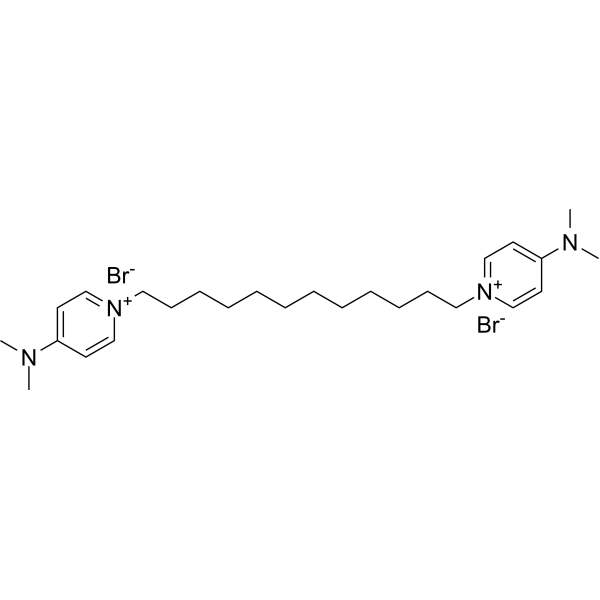
ICL-CCIC-0019 is a CHKA inhibitor with a human IC50 of 270 nM. ICL-CCIC-0019 blocks choline phosphorylation and phosphatidylcholine synthesis via the CDP-choline pathway. ICL-CCIC-0019 inhibits choline uptake, mitochondrial respiration, TCA cycle flux, de novo fatty acid synthesis, and mitochondrial membrane potential, while inducing G1 phase arrest, ER stress, caspase-dependent apoptosis, AMPK activation, glycolysis, acetate uptake, and mitochondrial network disruption. ICL-CCIC-0019 can be used for cancer research.
For research use only. We do not sell to patients.
- Purity : 97.80%
- CAS No.: 936498-64-5
- Formula: C26H44Br2N4
- Molecular Weight:572.46
-
Storage:
-20°C, sealed storage, away from moisture and light
* In solvent : -80°C, 6 months; -20°C, 1 month (sealed storage, away from moisture and light)

To place orders, for customer services and technical support, please contact: MedChemExpress USA
Tel: 609-228-6898 E-mail: [email protected] [email protected]


-
 Biological Activity
-
Chemical Information
-
Solvent & Solubility
- Protocols
- Purity & Documentation
- References
-
 Help & FAQs




Biological Activity
Description
IC50 & Target
[1]|
CHKA 270 nM (IC50) |
Cellular Effect
|
Cell Line

|
Type | Value | Description | References |
|---|---|---|---|---|
| HCT-116 | GI50 |
0.64 μM
|
Antiproliferative activity against human HCT-116 colorectal cancer cells with reported GI50 from Figure 1.
Antiproliferative activity against human HCT-116 colorectal cancer cells with reported GI50 from Figure 1.
|
34371769 |
| A549 | GI50 |
0.38 μM
|
Antiproliferative activity against human A549 lung cancer cells with reported GI50 from Figure 1.
Antiproliferative activity against human A549 lung cancer cells with reported GI50 from Figure 1.
|
34371769 |
| Panel NCI-60 cells | GI50 |
1.12 μM
|
Antiproliferative activity against NCI-60 panel assessed as median GI50 after 72 hrs continuous exposure by SRB assay.
Antiproliferative activity against NCI-60 panel assessed as median GI50 after 72 hrs continuous exposure by SRB assay.
|
27206796 |
| Breast cancer cell line | GI50 |
0.627 μM
|
Antiproliferative activity against breast cancer cell lines assessed as median GI50 after 72 hrs continuous exposure by SRB assay.
Antiproliferative activity against breast cancer cell lines assessed as median GI50 after 72 hrs continuous exposure by SRB assay.
|
27206796 |
| Non-small cell lung cancer cells | GI50 |
0.751 μM
|
Antiproliferative activity against non-small cell lung cancer cell lines assessed as median GI50 after 72 hrs continuous exposure by SRB assay.
Antiproliferative activity against non-small cell lung cancer cell lines assessed as median GI50 after 72 hrs continuous exposure by SRB assay.
|
27206796 |
In Vitro
ICL-CCIC-0019 shows submicromolar GI50 values in HCT-116 and A549 cells and 30-120 µM in normal MCF-10A and ST-T1B cells[1].
ICL-CCIC-0019 (72 h) inhibits proliferation of HCT-116, A549, HepG2, and Caco-2 cells with a mean GI50 of 0.5 µM[1].
ICL-CCIC-0019 (72 h) inhibits proliferation across eight prostate and colon cancer cell lines with a mean GI50 of 0.6 µM[1].
ICL-CCIC-0019 (72 h) inhibits cancer cell growth with an NCI-60 median GI50 of 1.12 μM[2].
ICL-CCIC-0019 (1-10 μM; 24 h) depletes PCho and rewires glycolysis/TCA metabolism in HCT116 cells[2].
ICL-CCIC-0019 (0.98-10 μM; 1-6 h pre-incubation/pulse/chase) inhibits choline uptake and PCho/lipid labeling in HCT116 cells with an EC50 of 0.98 μM[2].
ICL-CCIC-0019 (10 μM; 24-48 h) induces G1 arrest and apoptosis in HCT116 and other cancer cell lines[2].
ICL-CCIC-0019 (10 µM) is a CHKA inhibitor with a reported Δ49N CHKA2 IC50 of 0.27 µM and 53% CHKA inhibition at 10 µM[1].
ICL-CCIC-0019 (0.25-10 μM; 24 h) suppresses mitochondrial respiration and activates AMPK in HCT116 cells, with citrate synthase depletion in A549 models[2].
ICL-CCIC-0019 (1-10 μM; 24-48 h) induces ER stress markers in HCT116 cells without ROS generation[2].
ICL-CCIC-0019 (50 µM; 1-2 h) is taken up by HCT-116 cells in a time-dependent manner and reaches approximately twofold higher intracellular levels than CK145 at 1-2 h[1].
ICL-CCIC-0019 (50 µM; 4 h) is taken up by C4-2B prostate cancer cells with mean uptake of 24.9-34.1 % µg-1 protein and uptake is independent of serum[1].
ICL-CCIC-0019 (0.27-10 μM) inhibits CHKA with an IC50 of 0.27 μM and shows low off-target kinase inhibition at 10 μM[2].
MedChemExpress (MCE) has not independently confirmed the accuracy of these methods. They are for reference only.
-
Cell Line:HCT116, HUH-7, and MDA-MB-468 cells
-
Concentration:1 μM; 10 μM
-
Incubation Time:24 h (G1 arrest); 48 h (sub-G1 and caspase-3/7 apoptosis)
-
Result:Dose-dependently arrested cells in G1 after 24 h (2-fold increase at 10 μM) and increased the sub-G1 population 3.7-fold after 48 h.
Caspase-3/7-mediated apoptosis was seen after 48 h exposure to ICL-CCIC-0019 in HCT116, HUH-7, and MDA-MB-468 cells.
-
Cell Line:HCT116 cells
-
Concentration:1 μM; 10 μM
-
Incubation Time:24 h; 48 h
-
Result:Increased the expression of ER stress markers ATF4, IRE1α, HSP70, and HSP90.
Parmacokinetics
In Vivo
ICL-CCIC-0019 (10 mg/kg; i.p.; single dose) reduces tumor 18F-D4-FCH uptake and choline kinase flux in HCT116 xenografts in female BALB/c nude mice[2].
MedChemExpress (MCE) has not independently confirmed the accuracy of these methods. They are for reference only.
-
Animal Model:BALB/c nude (female, 6-8 weeks old)[2]
-
Dosage:5 mg/kg
-
Administration:i.p.; once daily; days 1-3 followed by 11-day recovery period
-
Result:Resulted in potent antitumor activity in HCT116 xenografts.
-
Animal Model:BALB/c nude (female, 6-8 weeks old)[2]
-
Dosage:10 mg/kg
-
Administration:i.p.; single dose
-
Result:In HCT116 xenografts, [18F]-D4-FCH AUC0-60 was 191.9 (%ID/mL)*min in vehicle-treated controls, 145.8 (%ID/mL)*min at 24 hours after ICL-CCIC-0019, 139.4 (%ID/mL)*min at 48 hours after ICL-CCIC-0019, and 187.7 (%ID/mL)*min at 6 hours after ICL-CCIC-0019.
Kinetic modeling showed that tumor Kr decreased by 73% at 24 hours and 75% at 48 hours compared with control.
Tumor Ki decreased after 48 hours.
- Kinase activity and phosphorylation assays
- Western Blot
- Mitochondrial membrane-potential fluorescent assay
- Detection of Apoptosis
- TUNEL staining for apoptotic DNA fragmentation
- Annexin V plus membrane-impermeant dye apoptosis staining
- Fluorescent plasma-membrane potential dye assay
- Mitochondrial membrane-potential and mitochondrial mass staining
- Apoptosis Solutions
- Protocol for Kinase activity and phosphorylation assays


Chemical Information
-
CAS No. 936498-64-5
-
Appearance Solid
-
Molecular Weight 572.46
-
Formula C26H44Br2N4
-
Color White to off-white
-
SMILES
CN(C)C1=CC=[N+](C=C1)CCCCCCCCCCCC[N+]2=CC=C(C=C2)N(C)C.[Br-].[Br-]
-
Shipping
Room temperature in continental US; may vary elsewhere.
-
Storage
-20°C, sealed storage, away from moisture and light
* In solvent : -80°C, 6 months; -20°C, 1 month (sealed storage, away from moisture and light)


Solvent & Solubility
In Vitro:
DMSO : 8.33 mg/mL (14.55 mM; Need ultrasonic; Hygroscopic DMSO has a significant impact on the solubility of product, please use newly opened DMSO)
Please refer to the solubility information to select the appropriate solvent. Once prepared, please aliquot and store the solution to prevent product inactivation from repeated freeze-thaw cycles.
Storage method and period of stock solution: -80°C, 6 months; -20°C, 1 month (sealed storage, away from moisture and light). When stored at -80°C, please use it within 6 months. When stored at -20°C, please use it within 1 month.
Concentration (start) × Volume (start) = Concentration (final) × Volume (final)
In Vivo:
Select the appropriate dissolution method based on your experimental animal and administration route.
- For the following dissolution methods, please ensure to first prepare a clear stock solution using an In Vitro approach and then sequentially add co-solvents:
- To ensure reliable experimental results, the clarified stock solution can be appropriately stored based on storage conditions. As for the working solution for In Vivo experiments, it is recommended to prepare freshly and use it on the same day.
- The percentages shown for the solvents indicate their volumetric ratio in the final prepared solution. If precipitation or phase separation occurs during preparation, heat and/or sonication can be used to aid dissolution.
Add each solvent one by one: 10% DMSO 90% (20% SBE-β-CD in Saline)
Solubility: ≥ 0.83 mg/mL (1.45 mM); Clear solution
This protocol yields a clear solution of ≥ 0.83 mg/mL (saturation unknown).
Taking 1 mL working solution as an example, add 100 μL DMSO stock solution (8.3 mg/mL) to 900 μL 20% SBE-β-CD in Saline, and mix evenly.
Preparation of 20% SBE-β-CD in Saline (4°C, storage for one week): 2 g SBE-β-CD powder is dissolved in 10 mL Saline, completely dissolve until clear.
In Vivo Dissolution Calculator
Please enter the basic information of animal experiments:
-
-
-
-
Recommended: Prepare an additional quantity of animals to account for potential losses during experiments.
Please enter your animal formula composition:
-
%DMSO +
Recommended: Keep the proportion of DMSO in working solution below 2% if your animal is weak.
-
%+
-
+%Tween-80 + +
-
%Saline +
The co-solvents required include: DMSO, . All of co-solvents are available by MedChemExpress (MCE). , Tween 80. All of co-solvents are available by MedChemExpress (MCE).
Working solution concentration: 0.22 mg/mL
Method for preparing stock solution: mg drug dissolved in μL DMSO. Stock solution concentration: mg/mL. * In solvent : -80°C, 6 months; -20°C, 1 month (sealed storage, away from moisture and light)
1. Take μL DMSO stock solution;
2. Add μL .
μL , mix evenly;
3. Then add μL Tween 80, mix evenly;
4. Then add μL
Please ensure that the stock solution in the first step is dissolved to a clear state, and add co-solvents in sequence. You can use ultrasonic heating (ultrasonic cleaner, recommended frequency 20-40 kHz), vortexing, etc. to assist dissolution.


Purity & Documentation
-
Data Sheet (275 KB)
-
SDS (251 KB)
- English - EN (251 KB)
- Français - FR (251 KB)
- Deutsch - DE (251 KB)
- Norwegian - NO (251 KB)
- Español - ES (251 KB)
- Swedish - SV (251 KB)
- Italian - IT (251 KB)
- Korean - KR (251 KB)
- Portuguese - PT (251 KB)
-
Handling Instructions (2659 KB)
References


Complete Stock Solution Preparation Table
Please refer to the solubility information to select the appropriate solvent. Once prepared, please aliquot and store the solution to prevent product inactivation from repeated freeze-thaw cycles.
Storage method and period of stock solution: -80°C, 6 months; -20°C, 1 month (sealed storage, away from moisture and light). When stored at -80°C, please use it within 6 months. When stored at -20°C, please use it within 1 month.
| Optional Solvent | Concentration Solvent Mass | 1 mg | 5 mg | 10 mg | 25 mg |
|---|---|---|---|---|---|
| DMSO | 1 mM | 1.7468 mL | 8.7342 mL | 17.4685 mL | 43.6712 mL |
| 5 mM | 0.3494 mL | 1.7468 mL | 3.4937 mL | 8.7342 mL | |
| 10 mM | 0.1747 mL | 0.8734 mL | 1.7468 mL | 4.3671 mL |


ICL-CCIC-0019 Related Classifications
HY-115840 Related Classifications
 Powered by Bioz