



Atranorin

Based on 1 Customer Validation
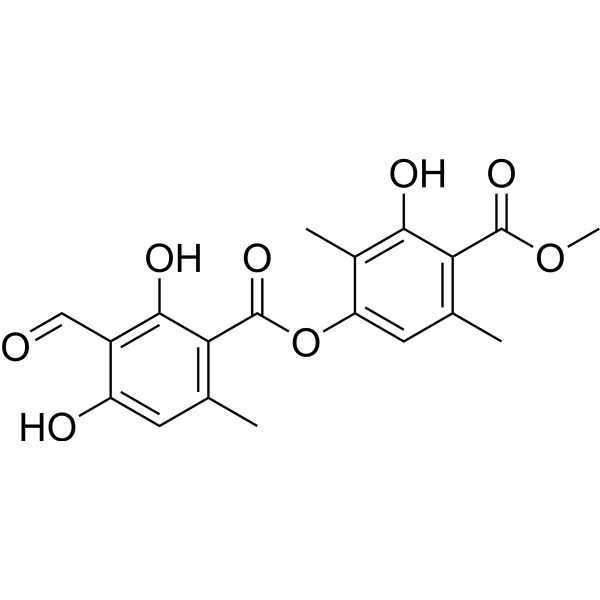
Atranorin is a secondary metabolite of lichens and AKT inhibitor. Atranorin possesses multiple activities such as antibacterial, anti-inflammatory, antioxidant, anti-glycation, analgesic, and anti-tumor effects. Atranorin has IC50 values for scavenging DPPH and ABTS free radicals of 117 μM and less than 10 μM, respectively. Additionally, Atranorin also exhibits effects in promoting wound healing. Atranorin can be used in the research of various diseases, including myelodysplastic syndromes, tumors, and inflammatory conditions.
연구목적의 판매만을 진행합니다. 환자를 대상으로 한 판매는 하지 않습니다.
- Purity : 99.68%
- CAS No.: 479-20-9
- 화학식: C19H18O8
- 분자량:374.34
-
보관:Powder -20°C, 3 years ; In solvent -80°C, 6 months , -20°C, 1 month

To place orders, for customer services and technical support, please contact: MedChemExpress USA
Tel: 609-228-6898 E-mail: [email protected] [email protected]


-
 Biological Activity
-
Chemical Information
-
용액&용해도
- Protocol
- 순도&문서
- References
-
 Help & FAQs





Biological Activity
제품 설명
Cellular Effect
|
Cell Line

|
Type | Value | Description | References |
|---|---|---|---|---|
| HaCaT | IC50 |
>5 μM
Compound: 4
|
Antiproliferative activity against human HaCaT cells
Antiproliferative activity against human HaCaT cells
|
[PMID: 10395495] |
| PMNL | IC50 |
6 μM
Compound: 4
|
Inhibition of LTB4 biosynthesis in A-23187-stimulated bovine PMNL cells
Inhibition of LTB4 biosynthesis in A-23187-stimulated bovine PMNL cells
|
[PMID: 10395494] |
In Vitro
Atranorin (0.01-10 μg/mL; 3 h) protects SH-SY5Y cells from H2O2-induced cytotoxicity[1].
Atranorin (24 h) inhibits the expression of PD-L1 and TIM-3 in THP-1, KG-1 and Mono-Mac-1 cells, with the mechanism related to AKT pathway inhibition[2].
Atranorin (0-10 μg/mL; 24-72 h) suppresses the migration and invasion of A549 cells. The mechanism involves the inhibition of AP-1, Wnt, STAT pathways and RhoGTPase activity[3].
MedChemExpress (MCE) has not independently confirmed the accuracy of these methods. They are for reference only. Further protocols information, click here.
In Vivo
Atranorin (1-5%; topical application as an ointment; once daily; 3-21 days) promotes wound healing in a rat excisional wound model[4].
MedChemExpress (MCE) has not independently confirmed the accuracy of these methods. They are for reference only.
-
Animal Model:C57BL/6 mice aged 8 weeks old treated LLC cells[3]
-
Dosage:10 mg/kg
-
Administration:Intraperitoneal injection; once every 3 days; 2 weeks
-
Result:Significantly reduced tumor volume, tumor weight, and nuclear Ki-67 immunoreactivity.
Downregulated target genes (e.g., KITENIN, STAT, c-myc) in tumor tissues.
-
Animal Model:Male Wistar rats (220-260 g) with full-thickness excisional wounds created by an 8 mm biopsy punch on the back[4]
-
Dosage:1% and 5% in ointment form
-
Administration:Topical application as an ointment; once daily; 3, 7, 14 and 21 days
-
Result:Reduced wound areas significantly on days 3, 7, and 14 (particularly with 5% atranorin).
Induced earlier granulation tissue formation with increased fibroblastic and vascular components.
Improved collagen deposition and organization (with more type I collagen and dense interlaced arrangement in the 5% group).
Modulated myofibroblasts differentiation (reduced early myofibroblasts in the 5% group and promoted timely apoptosis by day 21).


Chemical Information
-
CAS No. 479-20-9
-
Appearance Solid
-
분자량 374.34
-
화학식 C19H18O8
-
Color White to off-white
-
SMILES
O=C(OC1=CC(C)=C(C(OC)=O)C(O)=C1C)C2=C(C)C=C(O)C(C=O)=C2O
-
Structure Classification
-
Initial Source
-
선적
Room temperature in continental US; may vary elsewhere.
-
보관
Powder -20°C 3 years In solvent -80°C 6 months -20°C 1 month


용액&용해도
In Vitro:
DMSO : 12.5 mg/mL (33.39 mM; ultrasonic and warming and heat to 60°C; Hygroscopic DMSO has a significant impact on the solubility of product, please use newly opened DMSO)
Please refer to the solubility information to select the appropriate solvent. Once prepared, please aliquot and store the solution to prevent product inactivation from repeated freeze-thaw cycles.
Storage method and period of stock solution: -80°C, 6 months; -20°C, 1 month. When stored at -80°C, please use it within 6 months. When stored at -20°C, please use it within 1 month.
Please refer to the solubility information to select the appropriate solvent. Once prepared, please aliquot and store the solution to prevent product inactivation from repeated freeze-thaw cycles.
Storage method and period of stock solution: -80°C, 6 months; -20°C, 1 month. When stored at -80°C, please use it within 6 months. When stored at -20°C, please use it within 1 month.
Concentration (start) × Volume (start) = Concentration (final) × Volume (final)

Protocol
-
Research Protocol for Infectious Diseases
Infectious-disease experiments test how pathogens interact with host barriers, innate immune receptors, inflammatory signaling, pathogen replication, and tissue injury; pattern-recognition receptors such as TLRs, RIG-I-like receptors, NOD-like receptors, and inflammasomes detect microbial molecules and activate NF-κB, interferon, and cytokine responses. The central hypothesis is that infection severity reflects the balance between pathogen burden and host response: protective inflammation restricts pathogen growth, whereas excessive or mislocalized inflammation contributes to tissue damage and disease phenotype. Unresolved questions include which host pathways are protective versus pathogenic, why some infection models fail to translate to human disease, and which combined readouts best predict clinically relevant infection outcomes.
-
Cell migration
Cell migration is a method that plays an important role in wound healing, cell differentiation, embryonic development, etc.
-
Research Protocol for Inflammation-related Diseases
The NLRP3 inflammasome is a cytosolic innate immune signaling platform that integrates priming signals and danger-signal activation to promote caspase-1 activation, maturation of IL-1β and IL-18, and gasdermin D-mediated pyroptotic cell death. The core experimental logic is to determine whether inflammatory disease phenotypes are driven by increased NLRP3 expression, ASC-containing inflammasome assembly, caspase-1 cleavage, GSDMD cleavage, and extracellular release of IL-1β/IL-18 rather than by nonspecific cell injury alone. The pathway is strongly linked to inflammation-related disease phenotypes because monosodium urate crystals activate NALP3/NLRP3 inflammasome signaling in gout-like crystal inflammation, cholesterol crystals activate NLRP3 inflammasomes in atherogenesis models, and DSS-induced intestinal inflammation has been reported to involve NLRP3 inflammasome activity. However, experimental colitis studies also show context-dependent protective effects of NLRP3 inflammasome co
-
Cell-Exclusion Zone Migration Assay
The Cell-Exclusion Zone (CEZ) migration assay is an in vitro 2D cell migration method in which a defined cell-free area is created using removable physical barriers such as silicone stoppers, allowing cells to be seeded around the barrier and subsequently migrate into the cleared zone after barrier removal. This approach enables quantification of collective cell migration by monitoring repopulation of the initially cell-free region over time using microscopy-based imaging. Compared with scratch-based wound healing assays, barrier-based exclusion methods are designed to avoid mechanical damage to the extracellular matrix and reduce injury-induced effects on boundary cells, thereby improving interpretability of migration behavior in vitro. The assay readout is typically the progressive reduction in the cell-free area or the number of cells invading the exclusion zone, reflecting coordinated cell motility relevant to physiological processes such as wound healing, epithelial repair, and ca


순도&문서
-
Data Sheet (276 KB)
-
SDS (393 KB)
- English - EN (393 KB)
- Français - FR (393 KB)
- Deutsch - DE (393 KB)
- Norwegian - NO (393 KB)
- Español - ES (393 KB)
- Swedish - SV (393 KB)
- Italian - IT (393 KB)
- Korean - KR (393 KB)
- Portuguese - PT (393 KB)
-
Handling Instructions (2659 KB)
References
[1]. Melo MG, et al. Redox properties and cytoprotective actions of atranorin, a lichen secondary metabolite. Toxicol In Vitro. 2011 Mar;25(2):462-8. [Content Brief]
[3]. Zhou R, et al. The lichen secondary metabolite atranorin suppresses lung cancer cell motility and tumorigenesis. Sci Rep. 2017 Aug 15;7(1):8136. [Content Brief]


Complete Stock Solution Preparation Table
Please refer to the solubility information to select the appropriate solvent. Once prepared, please aliquot and store the solution to prevent product inactivation from repeated freeze-thaw cycles.
Storage method and period of stock solution: -80°C, 6 months; -20°C, 1 month. When stored at -80°C, please use it within 6 months. When stored at -20°C, please use it within 1 month.
| Optional Solvent | Concentration Solvent Mass | 1 mg | 5 mg | 10 mg | 25 mg |
|---|---|---|---|---|---|
| DMSO | 1 mM | 2.6714 mL | 13.3568 mL | 26.7137 mL | 66.7842 mL |
| 5 mM | 0.5343 mL | 2.6714 mL | 5.3427 mL | 13.3568 mL | |
| 10 mM | 0.2671 mL | 1.3357 mL | 2.6714 mL | 6.6784 mL | |
| 15 mM | 0.1781 mL | 0.8905 mL | 1.7809 mL | 4.4523 mL | |
| 20 mM | 0.1336 mL | 0.6678 mL | 1.3357 mL | 3.3392 mL | |
| 25 mM | 0.1069 mL | 0.5343 mL | 1.0685 mL | 2.6714 mL | |
| 30 mM | 0.0890 mL | 0.4452 mL | 0.8905 mL | 2.2261 mL |


Atranorin Related Classifications
HY-N2907 Related Classifications
 Powered by Bioz