



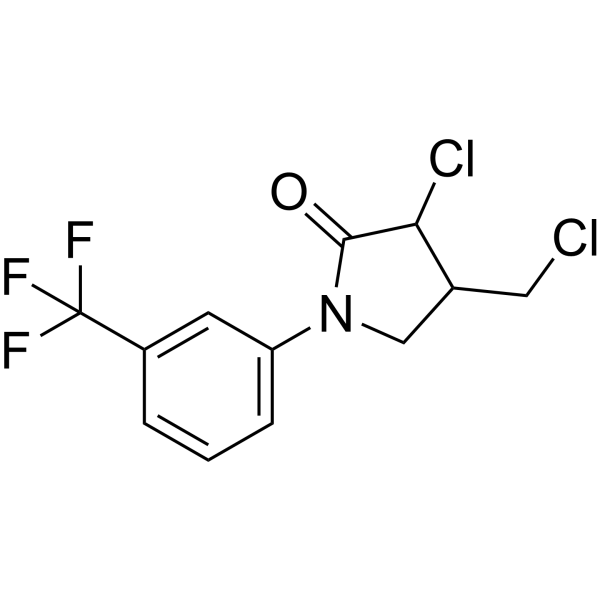
Flurochloridone

Based on 1 Customer Validation
Flurochloridone (R-40244) is an orally active herbicide and an inducer of ER stress, apoptosis, and cytotoxicity. Flurochloridone upregulates GRP78 and activates the PERK-eIF2α-ATF4 UPR axis, ATF6, CHOP, Bax, and Bim. Flurochloridone decreases Akt, p-Akt, GSK3β, and p-GSK3β levels, and induces ROS, oxidative stress, γ-glutamyl cycle activation, and GSH accumulation. Flurochloridone inhibits mitochondrial respiration and ATP production while enhancing glycolysis and cell viability inhibition. Flurochloridone inhibits spermatogonial proliferation, spermatocyte meiosis, and sperm mitochondrial membrane potential, and induces Sertoli cell apoptosis and mitochondrial damage. Flurochloridone non-competitively binds phytoene desaturase, blocking phytoene desaturation and carotenoid synthesis, leading to leaf bleaching and phytotoxicity. Flurochloridone can be used for research on male reproductive toxicity, hepatotoxicity, and as a herbicide.
연구목적의 판매만을 진행합니다. 환자를 대상으로 한 판매는 하지 않습니다.
- Purity : 99.61%
- CAS No.: 61213-25-0
- 화학식: C12H10Cl2F3NO
- 분자량:312.12
-
보관:Powder -20°C, 3 years , 4°C, 2 years ; In solvent -80°C, 6 months , -20°C, 1 month

To place orders, for customer services and technical support, please contact: MedChemExpress USA
Tel: 609-228-6898 E-mail: [email protected] [email protected]


-
 Biological Activity
-
Chemical Information
-
용액&용해도
- Protocol
- 순도&문서
- References
-
 Help & FAQs




Biological Activity
제품 설명
In Vitro
Flurochloridone (20-200 μM; 6-24 h) inhibits the cell viability of mouse TM4 Sertoli cells in a dose-dependent manner[1].
Flurochloridone (1-100 µM; 24 h) decreases the expression of AKT, p-AKT, GSK3β, and p-GSK3β and reduces the p-GSK3β/GSK3β ratio in BRL-3A cells[2].
Flurochloridone (20-2000 μg/L; 7 days) causes severe bleaching and a significant reduction in photosynthetic pigment content in Lemna minor and Ceratophyllum demersum, with the chlorophyll a/b ratio in Lemna minor decreasing significantly at concentrations above 300 μg/L[3].
Flurochloridone (20-2000 μg/L; 7 days) significantly inhibits the growth parameters (leaf area, fresh weight, length) of Lemna minor and Ceratophyllum demersum at 20-300 μg/L, partially recovers at 1000-2000 μg/L, and significantly induces stem elongation in Ceratophyllum demersum at 1000-2000 μg/L[3].
Flurochloridone (0-160 μM; 6 h) induces apoptosis in mouse TM4 Sertoli cells in a dose-dependent manner[1].
Flurochloridone (0-160 μM; 6-24 h) upregulates the pro-apoptotic proteins Bim and Bax in mouse TM4 Sertoli cells in a dose-dependent manner[1].
Flurochloridone (0-160 μM; 6-24 h) induces ER stress and activates the unfolded protein response signaling pathway, upregulating GRP78, phosphorylated-eIF2α, ATF4, and ATF6 in mouse TM4 Sertoli cells[1].
Flurochloridone (0-160 μM; 6-24 h) upregulates CHOP in mouse TM4 Sertoli cells in a dose-dependent manner[1].
Flurochloridone (1-100 µM; 24 h) induces cytotoxicity, oxidative stress, and mitochondrial permeability transition in BRL-3A cells[2].
Flurochloridone (1-100 µM; 24 h) promotes the mRNA expression of GCLC, GCLM, and NQO1 in BRL-3A cells[2].
Flurochloridone (20-2000 μg/L; 7 days) induces differential antioxidant enzyme responses in Lemna minor and Ceratophyllum demersum, with both SOD and POD activated in both plants at 100 μg/L, and POD activity in Ceratophyllum demersum significantly higher than that in Lemna minor[3].
Flurochloridone (20-2000 μg/L; 7 days) induces significant membrane lipid peroxidation in Ceratophyllum demersum at concentrations above 1000 μg/L, whereas in Lemna minor, MDA content peaks at 20 μg/L and does not differ significantly from the control group[3].
Flurochloridone (20-2000 μg/L; 7 days) significantly reduces the soluble protein content in Lemna minor (at ≤300 μg/L) and in Ceratophyllum demersum (at 300-2000 μg/L), and the soluble protein level in Lemna minor is significantly higher than that in Ceratophyllum demersum[3].
Flurochloridone (1-100 µM; 24 h) impairs mitochondrial respiration and shifts energy metabolism from mitochondrial respiration to glycolysis in BRL-3A cells[2].
MedChemExpress (MCE) has not independently confirmed the accuracy of these methods. They are for reference only.
-
Cell Line:TM4 Sertoli cells
-
Concentration:20, 40, 80, 160, 200 μM
-
Incubation Time:6, 12, 24 h
-
Result:Inhibited cell viability in a dose-dependent manner.
Viability began to decline at 40 μM at 12 h.
Cell viability was more damaged at 6 h than at 12 h and 24 h.
-
Cell Line:TM4 Sertoli cells
-
Concentration:20, 40, 80, 160, 200 μM
-
Incubation Time:6, 12, 24 h
-
Result:Significantly increased cytotoxicity in a dose-dependent manner.
Cytotoxicity increased at 20 μM at 6 h and 24 h, and was more serious at 160 μM at 12 h.
Cytotoxicity was more damaged at 12 h than at 6 h and 24 h.
-
Cell Line:TM4 Sertoli cells
-
Concentration:0, 40, 80, 160 μM
-
Incubation Time:6 h
-
Result:The proportion of apoptotic cells was 6.2% at 0 μM, 7.3% at 40 μM, 9.8% at 80 μM, and 13.2% at 160 μM, increased in a dose-dependent manner.
-
Cell Line:TM4 Sertoli cells
-
Concentration:0, 40, 80, 160 μM
-
Incubation Time:6, 12, 24 h
-
Result:Up-regulated the levels of pro-apoptotic proteins Bim and Bax in a dose-dependent manner.
Bim was up-regulated at 6, 12, and 24 h, while Bax was up-regulated only at 6 and 12 h, with no significant up-regulation at 24 h.\nUp-regulated the expression of ER stress marker protein GRP78 in a dose-dependent manner, and activated downstream proteins phosphorylated-eIF2α, ATF4, and ATF6 over time.\nUp-regulated the protein level of CHOP in a dose-dependent manner.
-
Cell Line:BRL-3A
-
Concentration:1, 10, 100 µM
-
Incubation Time:24 h
-
Result:Decreased cell viability significantly.
Increased reactive oxygen species levels markedly.
Increased mitochondrial permeability transition pore.
-
Cell Line:BRL-3A
-
Concentration:1, 10, 100 µM
-
Incubation Time:24 h
-
Result:Promoted GCLC mRNA expression by 1.15 times.
Promoted GCLM mRNA expression by 1.58 times.
Promoted NQO1 mRNA expression by 1.45 times.
-
Cell Line:BRL-3A
-
Concentration:1, 10, 100 µM
-
Incubation Time:24 h
-
Result:Reduced Akt protein expression significantly.
Reduced p-Akt protein expression significantly.
Decreased GSK3β protein levels.
Decreased p-GSK3β protein levels.
Did not change the ratio of p-Akt to AKT.
Decreased the ratio of p-GSK3β/GSK3β significantly.
In Vivo
MedChemExpress (MCE) has not independently confirmed the accuracy of these methods. They are for reference only.
-
Animal Model:C57BL/6 (male, 6-7 weeks old)[4]
-
Dosage:365 mg/kg/day; 730 mg/kg/day
-
Administration:p.o.; once daily; 28 consecutive days
-
Result:Significantly decreased testicular weight and gonadosomatic index in a dose-dependent manner.
Decreased sperm concentration and motility dose-dependently; progressive motility significantly decreased in the high-dose group.
In the 730 mg/kg/day group, decreased average path velocity (VAP) to 63.74 μm/s and curvilinear velocity (VCL) to 110.60 μm/s.
In the 365 and 730 mg/kg/day groups, decreased the amplitude of lateral head displacement (ALH) to 6.11 μm/s and 5.46 μm/s, respectively.
Increased sperm abnormality rate to 68.8% (365 mg/kg/day) and 80.2% (730 mg/kg/day) compared to 53.6% in control.
Reduced the mitochondrial membrane potential (MMP) of sperm in a dose-dependent manner.
Significantly reduced Ki67-positive cells in seminiferous tubules and disturbed meiosis.
Significantly increased the accumulation of residual bodies in the lumen and decreased the diameter of seminiferous tubules and thickness of the seminiferous epithelium in a dose-dependent manner.
Showed a significant dose-dependent increase in apoptotic cells near the basement membrane.
Showed a significant dose-dependent reduction in the number of Sertoli cells.
- Reproductive and Developmental Toxicity Study
- Mitochondrial membrane-potential fluorescent assay
- Mammalian live/dead viability and cytotoxicity staining
- Annexin V plus membrane-impermeant dye apoptosis staining
- ROS/oxidative-stress fluorescent staining
- CCK-8/WST-8 Cell Proliferation Assay
- Cell Viability Determination by MTT Colorimetric Assay
- Detection of Apoptosis
- TUNEL staining for apoptotic DNA fragmentation
- Cell Cytotoxicity Assay
- Fluorescent plasma-membrane potential dye assay
- Mitochondrial membrane-potential and mitochondrial mass staining
- Apoptosis Solutions
- Hepatotoxicity Study
- MTT Cell Proliferation Assay


Chemical Information
-
CAS No. 61213-25-0
-
Appearance Solid
-
분자량 312.12
-
화학식 C12H10Cl2F3NO
-
Color Light yellow to brown
-
SMILES
O=C1N(CC(C1Cl)CCl)C2=CC=CC(C(F)(F)F)=C2
-
Synonyms
R-40244
-
선적
Room temperature in continental US; may vary elsewhere.
-
보관
Powder -20°C 3 years 4°C 2 years In solvent -80°C 6 months -20°C 1 month


용액&용해도
In Vitro:
DMSO : 175 mg/mL (560.68 mM; Need ultrasonic; Hygroscopic DMSO has a significant impact on the solubility of product, please use newly opened DMSO)
Please refer to the solubility information to select the appropriate solvent. Once prepared, please aliquot and store the solution to prevent product inactivation from repeated freeze-thaw cycles.
Storage method and period of stock solution: -80°C, 6 months; -20°C, 1 month. When stored at -80°C, please use it within 6 months. When stored at -20°C, please use it within 1 month.
Please refer to the solubility information to select the appropriate solvent. Once prepared, please aliquot and store the solution to prevent product inactivation from repeated freeze-thaw cycles.
Storage method and period of stock solution: -80°C, 6 months; -20°C, 1 month. When stored at -80°C, please use it within 6 months. When stored at -20°C, please use it within 1 month.
Concentration (start) × Volume (start) = Concentration (final) × Volume (final)


순도&문서
-
Data Sheet (295 KB)
-
SDS (393 KB)
- English - EN (393 KB)
- Français - FR (393 KB)
- Deutsch - DE (393 KB)
- Norwegian - NO (393 KB)
- Español - ES (393 KB)
- Swedish - SV (393 KB)
- Italian - IT (393 KB)
- Korean - KR (393 KB)
- Portuguese - PT (393 KB)
-
Handling Instructions (2659 KB)
References


Complete Stock Solution Preparation Table
Please refer to the solubility information to select the appropriate solvent. Once prepared, please aliquot and store the solution to prevent product inactivation from repeated freeze-thaw cycles.
Storage method and period of stock solution: -80°C, 6 months; -20°C, 1 month. When stored at -80°C, please use it within 6 months. When stored at -20°C, please use it within 1 month.
| Optional Solvent | Concentration Solvent Mass | 1 mg | 5 mg | 10 mg | 25 mg |
|---|---|---|---|---|---|
| DMSO | 1 mM | 3.2039 mL | 16.0195 mL | 32.0390 mL | 80.0974 mL |
| 5 mM | 0.6408 mL | 3.2039 mL | 6.4078 mL | 16.0195 mL | |
| 10 mM | 0.3204 mL | 1.6019 mL | 3.2039 mL | 8.0097 mL | |
| 15 mM | 0.2136 mL | 1.0680 mL | 2.1359 mL | 5.3398 mL | |
| 20 mM | 0.1602 mL | 0.8010 mL | 1.6019 mL | 4.0049 mL | |
| 25 mM | 0.1282 mL | 0.6408 mL | 1.2816 mL | 3.2039 mL | |
| 30 mM | 0.1068 mL | 0.5340 mL | 1.0680 mL | 2.6699 mL | |
| 40 mM | 0.0801 mL | 0.4005 mL | 0.8010 mL | 2.0024 mL | |
| 50 mM | 0.0641 mL | 0.3204 mL | 0.6408 mL | 1.6019 mL | |
| 60 mM | 0.0534 mL | 0.2670 mL | 0.5340 mL | 1.3350 mL | |
| 80 mM | 0.0400 mL | 0.2002 mL | 0.4005 mL | 1.0012 mL | |
| 100 mM | 0.0320 mL | 0.1602 mL | 0.3204 mL | 0.8010 mL |


Flurochloridone Related Classifications
HY-121337 Related Classifications
 Powered by Bioz
Keywords