102 Results for "

stem bark

" in MedChemExpress (MCE) Product Catalog:
Products (102)

102 Results for "stem bark" in MCE Product Catalog:

Cat. No.: HY-N19721
CAS No.: 514214-46-1
Brasimarin B is a 4-phenylcoumarin compound found in the stem bark of Calophyllum brasiliense. Brasimarin B inhibits TPA (HY-18739)-induced EBV-EA activation in Raji cells .
loading...
    loading...
Cat. No.: HY-N17356
CAS No.: 57959-88-3
Atalaphyllidine is a natural product. Atalaphyllidine can be isolated from the stem bark of Glycosmis chlorosperma. Atalaphyllidine inhibits DYRK1A kinase activity with an IC50 of 2.2 μM. Atalaphyllidine can be used in the research of neurodegenerative diseases .
loading...
    loading...
Cat. No.: HY-N7890
CAS No.: 1240792-57-7
Isomoreollic acid is a cage xanthonoid. Isomoreollic acid exhibits cytotoxicity against colon cancer cells, with an IC50 > 10 μM for proteasome inhibition. Isomoreollic acid is present in the stem bark of Garcinia lateriflora. Isomoreollic acid can be used in colon cancer research .
loading...
    loading...
Cat. No.: HY-N17510
CAS No.: 2060544-99-0
Regiafuran A is a prenylated 2-arylbenzofuran derivative and free radical scavenger (IC50=1.9 μg/mL). Regiafuran A is isolated from the stem bark of Chlorophora regia. In a competitive enzyme immunoassay for PGE2, Regiafuran A shows no anti-inflammatory potential .
loading...
    loading...
Cat. No.: HY-N17803
CAS No.: 17093-86-6
Synonyms: 3,3',4',7-Tetramethoxyflavone
Fisetin tetramethyl ether (3,3',4',7-Tetramethoxyflavone) is a flavonoid compound. Fisetin tetramethyl ether can be isolated from the stem bark of Derris indica. Fisetin tetramethyl ether shows no inhibitory activity against the formation of advanced glycation end products .
loading...
    loading...
Cat. No.: HY-N18179
CAS No.: 15575-49-2
8-Acetonylidihydrochelerythrine is a benzophenanthridine alkaloid found in the stem bark of Zanthoxylum gilletii. 8-Acetonylidihydrochelerythrine inhibits growth of Chloroquine (HY-17589A)-resistant and Chloroquine-sensitive Plasmodium falciparum strains. 8-Acetonylidihydrochelerythrine can be used for the research of malaria .
loading...
    loading...
Cat. No.: HY-N20709
CAS No.: 119061-09-5
Euchrenone B1 is a flavonoid. Euchrenone B1 can be isolated from the stem bark of Maackia amurensis and the roots of Euchresta formosana. Euchrenone B1 exhibits anticancer activity against cervical cancer, melanoma, breast cancer, and liver cancer .
loading...
    loading...
Cat. No.: HY-N9303
CAS No.: 67920-48-3
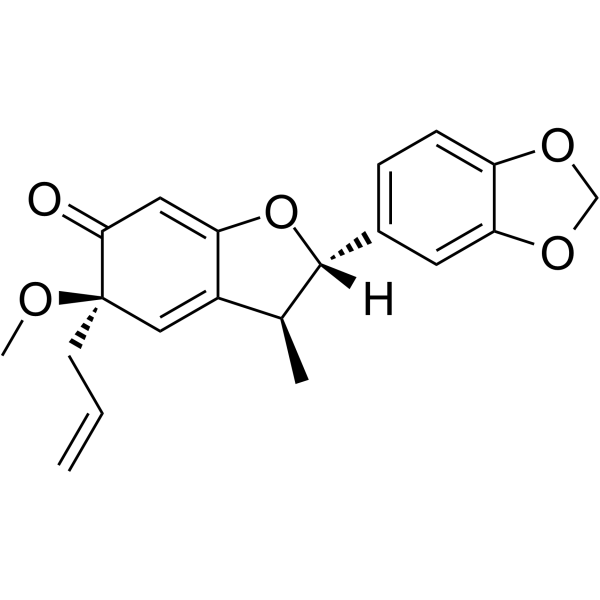
1,6-Dihydro-4,7'-Epoxy-1-Methoxy-3',4'-Methylenedioxy-6-Oxo-3,8'-Lignan is a Neolignan from stem bark of Ocotea veraguensis .
loading...
    loading...
Cat. No.: HY-N18386
CAS No.: 1384897-64-6
Altissimacoumarin F (Compound 4) is a terpenylated coumarin. Altissimacoumarin F can be isolated from the stem bark of Ailanthus altissima. Altissimacoumarin F enhances SIRT1 activity, decreases p53 transcriptional activity. Altissimacoumarin F can be used for the research of age-related disorders .
loading...
    loading...
Cat. No.: HY-N18222
CAS No.: 34490-82-9
Dihydroavicine is a benzophenanthridine alkaloid antibacterial agent isolated from the stem bark of Zanthoxylum rhoifolium. Dihydroavicine inhibits the growth of Gram-positive bacteria, Gram-negative bacteria, and Candida albicans. Dihydroavicine shows no activity against Saccharomyces cerevisiae and Cryptococcus neoformans. Dihydroavicine can be used for the research of bacterial infections and candidal infections .
loading...
    loading...
Cat. No.: HY-N21753
CAS No.: 36048-23-4
Dehydrodicatechin A is a biflavan catechin dimer and antioxidant. Dehydrodicatechin A is isolated from the roots of Hagenia abyssinica, the stem bark of Choerospondias axillaries, the stems of Entada phaseoloides, and Calligonum comosum. Dehydrodicatechin A exhibits ABTS + radical cation, DPPH, ABTS, and superoxide anion radical scavenging activities, as well as ferric reducing/antioxidant power. Dehydrodicatechin A inhibits Lipase. Dehydrodicatechin A is used in studies on polycystic ovary syndrome, Ehrlich ascites, and Doxorubicin (HY-15142)-induced cardiotoxicity .
loading...
    loading...
Cat. No.: HY-N16748
CAS No.: 32042-35-6
Heptazoline is a carbazole alkaloid that can be isolated from the stem bark of Clausena excavata. Heptazoline exhibits significant antiplatelet aggregation activity (inhibiting platelet aggregation induced by arachidonic acid, collagen, etc.) and certain vasodilatory activity (inhibiting norepinephrine-induced contraction of rat aorta). Heptazoline can be used in antithrombotic research in the cardiovascular field .
loading...
    loading...
Cat. No.: HY-N20722
CAS No.: 57539-70-5
Synonyms: Cussonoside A
Pulsatiloside C (Cussonoside A) is an orally active triterpenoid saponin. Pulsatiloside C can be isolated from the roots of Pulsatilla campanella and the stem bark of Cussonia barteri. Pulsatiloside C exhibits sedative activity. Pulsatiloside C reduces locomotor activity in male Swiss albino mice. Pulsatiloside C shows no molluscicidal activity against Biomphalaria glabrata .
loading...
    loading...
Cat. No.: HY-N17985
CAS No.: 119742-55-1
Kalopanaxsaponin H is an hederagenin glycoside (saponin) with no hypoglycemic activity upon intraperitoneal injection. Kalopanaxsaponin H can be metabolized by human intestinal bacteria into Kalopanaxsaponin I, Kalopanaxsaponin A, hederagenin 3-O-α-L-arabinopyranoside and hederagenin, among which Kalopanaxsaponin I and hederagenin are the main metabolites. Kalopanaxsaponin H is isolated from the stem bark of Kalopanax pictus and is used in diabetes-related research .
loading...
    loading...
Cat. No.: HY-N19792
CAS No.: 1810706-07-0
6-(3'-Methyl-1',3'-butadienyl)-5,7-dimethoxycoumarin is a cytotoxic coumarin compound that can be isolated from the stem bark of Toddalia asiatica. 6-(3'-Methyl-1',3'-butadienyl)-5,7-dimethoxycoumarin can be used for the research of small cell lung cancer .
loading...
    loading...
Cat. No.: HY-N17763
CAS No.: 41607-21-0
Styraxlignolide G is a furanofuran-type lignan compound that can be isolated from the stem bark of Styrax japonica. Styraxlignolide G exhibits very weak DPPH free radical scavenging activity, while its hydrolyzed aglycone molecule possesses antioxidant activity (IC50=186.7 μM) and is involved in antioxidant-related regulation in the body. Styraxlignolide G can be used in the study of inflammatory diseases.
loading...
    loading...
Cat. No.: HY-N19724
CAS No.: 62346-20-7
Buddledin A is a 5-LOX inhibitor (IC50 = 50.4 μM) and a COX inhibitor (IC50 = 13.7 μM). Buddedin A inhibits arachidonic acid metabolism via the 5-LOX and COX pathways, suppresses fungal growth, and exerts toxic effects on fish. Buddedin A may play an ecological role in protecting plant roots and stem barks from fungal infection. Buddedin A can be used in studies related to fungal infections .
loading...
    loading...
Cat. No.: HY-N21864
CAS No.: 1303438-53-0
Cathayanon J is a flavanone natural product with 2R configuration, which is found in the stem bark of Morus cathayana. Cathayanon J exhibits weak cytotoxicity against A549, Bel 7402, BGC-823, HCT-8 and A2780 human cancer cells, with IC50 values of 4.67, 5.95, 6.70, 5.86 and 5.79 μg/mL, respectively. Cathayanon J can be used in cancer-related research .
loading...
    loading...
Cat. No.: HY-N3426A
CAS No.: 2097138-89-9
(2R)-Kazinol B is a prenylated flavane enantiomer found in the stem and root barks of Daphne giraldii, and it is also an isomer of Kazinol B (HY-N3426). (2R)-Kazinol B exerts selective cytotoxicity against liver cancer cells, induces apoptosis via both intrinsic and extrinsic pathways, and triggers protective autophagy through AMPK activation. (2R)-Kazinol B can be used in the research of liver cancer .
loading...
    loading...
Cat. No.: HY-N17604
CAS No.: 33909-74-9
(6aR,11aR)-Edunol (compound 10) is a pterocarpan and antiproliferative agent. (6aR,11aR)-Edunol can be found in the roots of Lonchocarpus bussei and the stem bark of Lonchocarpus eriocalyx. (6aR,11aR)-Edunol exerts antiproliferative effects against drug-sensitive leukemia cells and multidrug-resistant leukemia cells. (6aR,11aR)-Edunol can be used for the research of leukemia .
loading...
    loading...

