



Royal Jelly acid
Based on 6 publication(s) in Google Scholar
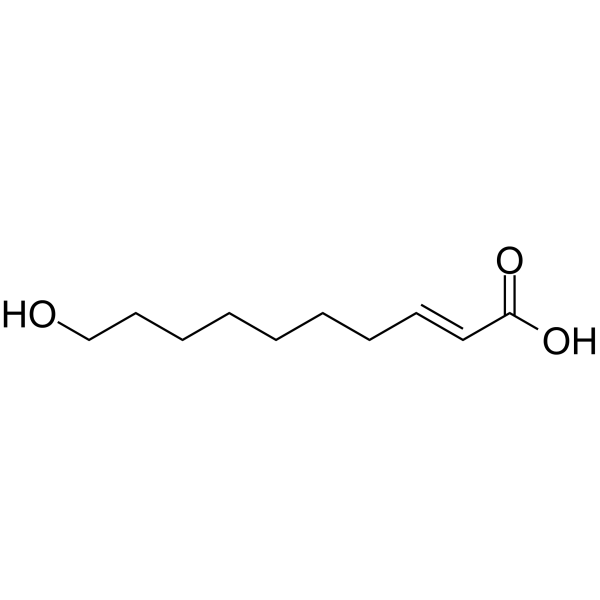
Royal Jelly Acid ((E)-Queen Bee Acid) is a major fatty acid found in royal jelly with oral bioavailability, exhibiting anti-inflammatory, anticancer, antimalarial, antiprotozoal, and neuroregulatory activities. Royal Jelly Acid can be used for research in various fields, including cancer, infections, immune inflammation, and neurological diseases.
For research use only. We do not sell to patients.
- Purity : 99.95%
- CAS No.: 14113-05-4
- Formula: C10H18O3
- Molecular Weight:186.25
-
Storage:Powder -20°C, 3 years , 4°C, 2 years ; In solvent -80°C, 2 years , -20°C, 1 year

To place orders, for customer services and technical support, please contact: MedChemExpress USA
Tel: 609-228-6898 E-mail: [email protected] [email protected]


-
 Biological Activity
-
Chemical Information
-
Solvent & Solubility
- Protocols
- Purity & Documentation
- References
-
 Help & FAQs


-
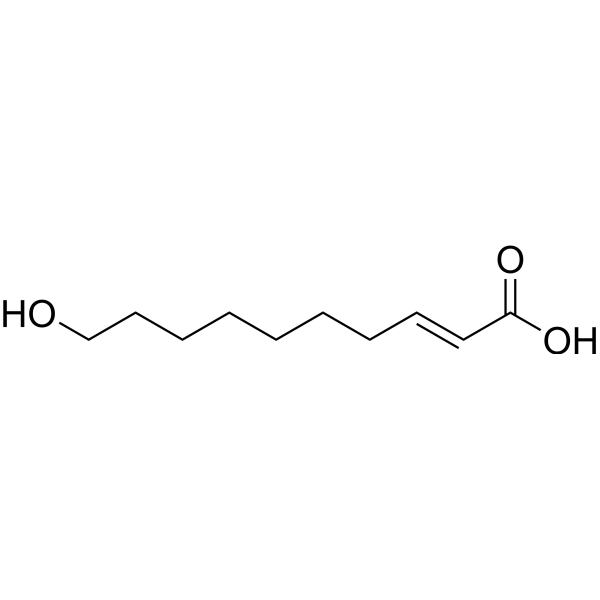
HY-N1363R
Royal Jelly acid (Standard)Royal Jelly Fatty Acid -
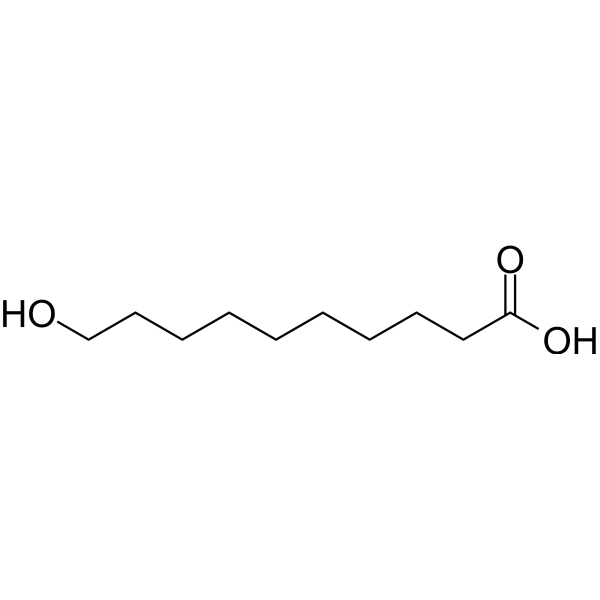
HY-Y0148
10-Hydroxydecanoic acidSaturated Fatty Acid -
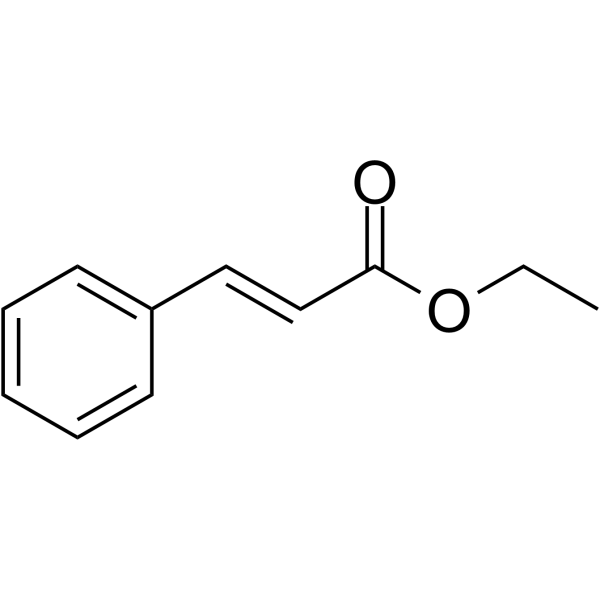
HY-Y0121
Ethyl cinnamateVascular Relaxant, Nematocide, Tissue Clearing Reagent -

HY-Y0148R
10-Hydroxydecanoic acid (Standard)Saturated Fatty Acid -

HY-Y0121R
Ethyl cinnamate (Standard)Vascular Relaxant, Nematocide, Tissue Clearing Reagent
Publications Citing Use of MedChemExpress (MCE) Royal Jelly acid
More Customer Validation & Images

-
Cell Proliferation/Viability Assay

-
Cell Imaging/Staining

-
Cell Migration/Invasion Assay

-
RT-PCR

-
WB

All Endogenous Metabolite Isoforms
MoreAll Parasite Isoforms
More

Biological Activity
Description
In Vitro
Royal Jelly Acid (1-4 mM, 24 h) reduces NO production in RAW264.7 cells[3]. Royal Jelly Acid (1-4 mM, 24 h) inhibits IFN-β-induced NF-κB p65 phosphorylation in RAW264.7 cells, suggesting its regulatory role in inflammatory signaling pathways[3]. Royal Jelly Acid (10-100 μM, 24 h) reduces neurotrophic factor expression in Wistar rat cortical astrocytes[4]. Royal Jelly Acid (12.5-100 μg/mL, 72 h) exhibits strong antiplasmodial activity in Plasmodium falciparum K1 strain[5]. Royal Jelly Acid (1-8 μg/mL, 48 h) exhibits antileishmanial activity in Leishmania major amastigotes [5]. Royal Jelly Acid (1.25-250 μg/mL, 24 h) induces cytotoxicity in MCF-7 breast cancer cells [7]
MedChemExpress (MCE) has not independently confirmed the accuracy of these methods. They are for reference only. Further protocols information, click here.
-
Cell Line:RAW264.7 cells (mouse macrophages)
-
Concentration:1-4 mM
-
Incubation Time:24 h
-
Result:Inhibited LPS-induced iNOS mRNA expression.
-
Cell Line:RAW264.7 cells (mouse macrophages)
-
Concentration:1-4 mM
-
Incubation Time:24 h
-
Result:Inhibited IFN-β-induced NF-κB p65 phosphorylation.
-
Cell Line:Cortical astrocytes (Wistar rats)
-
Concentration:10, 100 µM
-
Incubation Time:24 h
-
Result:Reduced LPS-induced BDNF and GDNF mRNA expression levels; Slightly decreased IGF-1 mRNA expression in unstimulated cells.
-
Cell Line:MCF-7 breast cancer cells
-
Concentration:1.25, 12.5, 50, 125, 250 µg/mL
-
Incubation Time:24 h
-
Result:Exhibited cytotoxic activity with LC50 of 190 µg/mL.
In Vivo
MedChemExpress (MCE) has not independently confirmed the accuracy of these methods. They are for reference only.
-
Animal Model:MOG35–55-induced experimental autoimmune encephalomyelitis (EAE) C57BL/6 mouse model[6]
-
Dosage:3 mg/kg (low dose) or 6 mg/kg (high dose)
-
Administration:Oral gavage (p.o.), once daily for 25 days
-
Result:Reduced EAE scores, prevented body weight loss, and decreased leukocyte infiltration and demyelination in the CNS.


Chemical Information
-
CAS No. 14113-05-4
-
Appearance Solid
-
Molecular Weight 186.25
-
Formula C10H18O3
-
Color White to off-white
-
SMILES
O=C(O)/C=C/CCCCCCCO
-
Synonyms
(E)-Queen Bee Acid; (E)-10-Hydroxy-2-decenoic acid
-
Structure Classification
-
Initial Source
-
Shipping
Room temperature in continental US; may vary elsewhere.
-
Storage
Powder -20°C 3 years 4°C 2 years In solvent -80°C 2 years -20°C 1 year


Publications (6)
-
Journal Impact Factor
-
Most Recent
-
Nat Commun
10-hydroxy-2-decenoic acid prevents osteoarthritis by targeting aspartyl β hydroxylase and inhibiting chondrocyte senescence in male mice preclinically. [Abstract]2024 Sep 4;15(1):7712. PMID: 39231947 -
Phytomedicine
Royal jelly acid suppresses hepatocellular carcinoma tumorigenicity by inhibiting H3 histone lactylation at H3K9la and H3K14la sites. [Abstract]2023 Sep:118:154940. PMID: 37453194
Royal Jelly acid purchased from MedChemExpress. Usage Cited in: Phytomedicine. 2023 Sep:118:154940. [Abstract]
Effect of Royal Jelly acid (RJA) (5, 10, 20, 50, 100 μM) treatment on the cell viabilities of Hep3B and HCCLM3 cells.
Royal Jelly acid purchased from MedChemExpress. Usage Cited in: Phytomedicine. 2023 Sep:118:154940. [Abstract]
Colony formation of Hep3B and HCCLM3 cells treated with 10 μM and 20 μM Royal Jelly acid (RJA) as well as 2 μg/mL CDDP.
Royal Jelly acid purchased from MedChemExpress. Usage Cited in: Phytomedicine. 2023 Sep:118:154940. [Abstract]
Results of scratch experiments on Hep3B and HCCLM3 cells treated with 10 μM and 20 μM Royal Jelly acid (RJA) (10, 20 μM) as well as 2 μg/mL CDDP.
Royal Jelly acid purchased from MedChemExpress. Usage Cited in: Phytomedicine. 2023 Sep:118:154940. [Abstract]
The expression of CDK2, CCND1 (cyclin D1) and CCNE1 (cyclin E1) genes were detected, and 2 μg/mL CDDP was used as a positive control treated with Royal Jelly acid (RJA) (10, 20 μM).
Royal Jelly acid purchased from MedChemExpress. Usage Cited in: Phytomedicine. 2023 Sep:118:154940. [Abstract]
Western blotting detection of CDK2, CCND1 (cyclin D1) and CCNE1 (cyclin E1) with Royal Jelly acid (RJA) (10, 20 μM) treatments, 2 μg/mL CDDP was used as a positive control.

Royal Jelly acid purchased from MedChemExpress. Usage Cited in: Phytomedicine. 2023 Sep:118:154940. [Abstract]
Images of tumors treated with Royal Jelly acid (10, 20 mg/kg, i.p.).

Royal Jelly acid purchased from MedChemExpress. Usage Cited in: Phytomedicine. 2023 Sep:118:154940. [Abstract]
Histological evaluation according to the H&E, Immunohistochemical staining of MKI67 (Ki67) and Immunofluorescent staining of Pan Kla treated with Royal Jelly acid (10, 20 mg/kg, i.p.).
-
Food Res Int
Metabolic profiling unravels the effects of enhanced output and harvesting time on royal jelly quality. [Abstract]2021 Jan:139:109974. PMID: 33509520 -
Int J Biol Macromol
Light-crosslinked gelatin methacrylate hydrogel prevents intervertebral disc degeneration by delivering 10-hydroxy-2-decenoic acid to inhibit ferroptosis via NF-κB signaling. [Abstract]2025 Oct 21;331(Pt 2):148454. PMID: 41130468 -
-
Heliyon
Queen bee acid pretreatment attenuates myocardial ischemia/reperfusion injury by enhancing autophagic flux. [Abstract]2024 Jun 21;10(12):e33371. PMID: 39021954


Solvent & Solubility
In Vitro:
DMSO : 100 mg/mL (536.91 mM; Need ultrasonic; Hygroscopic DMSO has a significant impact on the solubility of product, please use newly opened DMSO)
Please refer to the solubility information to select the appropriate solvent. Once prepared, please aliquot and store the solution to prevent product inactivation from repeated freeze-thaw cycles.
Storage method and period of stock solution: -80°C, 2 years; -20°C, 1 year. When stored at -80°C, please use it within 2 years. When stored at -20°C, please use it within 1 year.
Please refer to the solubility information to select the appropriate solvent. Once prepared, please aliquot and store the solution to prevent product inactivation from repeated freeze-thaw cycles.
Storage method and period of stock solution: -80°C, 2 years; -20°C, 1 year. When stored at -80°C, please use it within 2 years. When stored at -20°C, please use it within 1 year.
Concentration (start) × Volume (start) = Concentration (final) × Volume (final)
In Vivo:
Select the appropriate dissolution method based on your experimental animal and administration route.
- For the following dissolution methods, please ensure to first prepare a clear stock solution using an In Vitro approach and then sequentially add co-solvents:
- To ensure reliable experimental results, the clarified stock solution can be appropriately stored based on storage conditions. As for the working solution for In Vivo experiments, it is recommended to prepare freshly and use it on the same day.
- The percentages shown for the solvents indicate their volumetric ratio in the final prepared solution. If precipitation or phase separation occurs during preparation, heat and/or sonication can be used to aid dissolution.
Add each solvent one by one: 10% DMSO 40% PEG300 5% Tween-80 45% Saline
Solubility: ≥ 2.5 mg/mL (13.42 mM); Clear solution
This protocol yields a clear solution of ≥ 2.5 mg/mL (saturation unknown).
Taking 1 mL working solution as an example, add 100 μL DMSO stock solution (25.0 mg/mL) to 400 μL PEG300, and mix evenly; then add 50 μL Tween-80 and mix evenly; then add 450 μL Saline to adjust the volume to 1 mL.
Preparation of Saline: Dissolve 0.9 g sodium chloride in ddH₂O and dilute to 100 mL to obtain a clear Saline solution.
Add each solvent one by one: 10% DMSO 90% (20% SBE-β-CD in Saline)
Solubility: ≥ 2.5 mg/mL (13.42 mM); Clear solution
This protocol yields a clear solution of ≥ 2.5 mg/mL (saturation unknown).
Taking 1 mL working solution as an example, add 100 μL DMSO stock solution (25.0 mg/mL) to 900 μL 20% SBE-β-CD in Saline, and mix evenly.
Preparation of 20% SBE-β-CD in Saline (4°C, storage for one week): 2 g SBE-β-CD powder is dissolved in 10 mL Saline, completely dissolve until clear.
For the following dissolution methods, please prepare the working solution directly:
It is recommended to prepare fresh solutions and use them promptly within a short period of time.
The percentages shown for the solvents indicate their volumetric ratio in the final prepared solution. If precipitation or phase separation occurs during preparation, heat and/or sonication can be used to aid dissolution.
Add each solvent one by one: 0.5% CMC-Na/saline water
Solubility: 10 mg/mL (53.69 mM); Suspended solution; Need ultrasonic
In Vivo Dissolution Calculator
Please enter the basic information of animal experiments:
-
-
-
-
Recommended: Prepare an additional quantity of animals to account for potential losses during experiments.
Please enter your animal formula composition:
-
%DMSO +
Recommended: Keep the proportion of DMSO in working solution below 2% if your animal is weak.
-
%+
-
+%Tween-80 + +
-
%Saline +
The co-solvents required include: DMSO, . All of co-solvents are available by MedChemExpress (MCE). , Tween 80. All of co-solvents are available by MedChemExpress (MCE).
Working solution concentration: 0.22 mg/mL
Method for preparing stock solution: mg drug dissolved in μL DMSO. Stock solution concentration: mg/mL.
1. Take μL DMSO stock solution;
2. Add μL .
μL , mix evenly;
3. Then add μL Tween 80, mix evenly;
4. Then add μL
Please ensure that the stock solution in the first step is dissolved to a clear state, and add co-solvents in sequence. You can use ultrasonic heating (ultrasonic cleaner, recommended frequency 20-40 kHz), vortexing, etc. to assist dissolution.

Protocols
-
Protocol for Pharmacokinetic Study
Pharmacokinetic studies quantify how an organism handles a drug over time through absorption, distribution, metabolism, and excretion, and the core experimental readout is the concentration-time profile of parent drug and, when relevant, metabolites in biological matrices such as plasma, whole blood, urine, bile, or tissue. Pharmacokinetic analysis links dose, route, exposure, clearance, half-life, distribution, bioavailability, and systemic exposure to drug efficacy and toxicity hypotheses rather than measuring a signaling pathway directly. The literature links pharmacokinetics to drug-development phenotypes by showing that drug metabolism and pharmacokinetics influence compound progression, exposure-response interpretation, safety margins, dosing strategy, and failure risk during discovery and development. DMPK science contributes to compound optimization by integrating physicochemical properties, in vitro metabolism, transporter behavior, in vivo exposure, and pharmacodynamic contex
-
Research Protocol for Inflammation-related Diseases
The NLRP3 inflammasome is a cytosolic innate immune signaling platform that integrates priming signals and danger-signal activation to promote caspase-1 activation, maturation of IL-1β and IL-18, and gasdermin D-mediated pyroptotic cell death. The core experimental logic is to determine whether inflammatory disease phenotypes are driven by increased NLRP3 expression, ASC-containing inflammasome assembly, caspase-1 cleavage, GSDMD cleavage, and extracellular release of IL-1β/IL-18 rather than by nonspecific cell injury alone. The pathway is strongly linked to inflammation-related disease phenotypes because monosodium urate crystals activate NALP3/NLRP3 inflammasome signaling in gout-like crystal inflammation, cholesterol crystals activate NLRP3 inflammasomes in atherogenesis models, and DSS-induced intestinal inflammation has been reported to involve NLRP3 inflammasome activity. However, experimental colitis studies also show context-dependent protective effects of NLRP3 inflammasome co


Purity & Documentation
-
Data Sheet (279 KB)
-
SDS (393 KB)
- English - EN (393 KB)
- Français - FR (393 KB)
- Deutsch - DE (393 KB)
- Norwegian - NO (393 KB)
- Español - ES (393 KB)
- Swedish - SV (393 KB)
- Italian - IT (393 KB)
- Korean - KR (393 KB)
- Portuguese - PT (393 KB)
-
Handling Instructions (2659 KB)
References
[1]. Weiser MJ, et al. Long-Term Administration of Queen Bee Acid (QBA) to Rodents Reduces Anxiety-Like Behavior, Promotes Neuronal Health and Improves Body Composition. Nutrients. 2017 Dec 23;10(1). [Content Brief]
[2]. Sugiyama T, et al. Royal jelly acid, 10-hydroxy-trans-2-decenoic acid, as a modulator of the innate immune responses. Endocr Metab Immune Disord Drug Targets. 2012 Dec;12(4):368-76. [Content Brief]
[3]. Sugiyama T, et al. Inhibitory mechanism of 10-hydroxy-trans-2-decenoic acid (royal jelly acid) against lipopolysaccharide- and interferon-β-induced nitric oxide production. Inflammation. 2013 Apr;36(2):372-8. [Content Brief]
[5]. Alkhaibari AM, et al. Insecticidal, Antimalarial, and Antileishmanial Effects of Royal Jelly and Its Three Main Fatty Acids, trans-10-Hydroxy-2-decenoic Acid, 10-Hydroxydecanoic Acid, and Sebacic Acid. Evid Based Complement Alternat Med. 2022 Jan 20;2022:7425322. [Content Brief]


Complete Stock Solution Preparation Table
Please refer to the solubility information to select the appropriate solvent. Once prepared, please aliquot and store the solution to prevent product inactivation from repeated freeze-thaw cycles.
Storage method and period of stock solution: -80°C, 2 years; -20°C, 1 year. When stored at -80°C, please use it within 2 years. When stored at -20°C, please use it within 1 year.
| Optional Solvent | Concentration Solvent Mass | 1 mg | 5 mg | 10 mg | 25 mg |
|---|---|---|---|---|---|
| DMSO | 1 mM | 5.3691 mL | 26.8456 mL | 53.6913 mL | 134.2282 mL |
| 5 mM | 1.0738 mL | 5.3691 mL | 10.7383 mL | 26.8456 mL | |
| 10 mM | 0.5369 mL | 2.6846 mL | 5.3691 mL | 13.4228 mL | |
| 15 mM | 0.3579 mL | 1.7897 mL | 3.5794 mL | 8.9485 mL | |
| 20 mM | 0.2685 mL | 1.3423 mL | 2.6846 mL | 6.7114 mL | |
| 25 mM | 0.2148 mL | 1.0738 mL | 2.1477 mL | 5.3691 mL | |
| 30 mM | 0.1790 mL | 0.8949 mL | 1.7897 mL | 4.4743 mL | |
| 40 mM | 0.1342 mL | 0.6711 mL | 1.3423 mL | 3.3557 mL | |
| 50 mM | 0.1074 mL | 0.5369 mL | 1.0738 mL | 2.6846 mL | |
| 60 mM | 0.0895 mL | 0.4474 mL | 0.8949 mL | 2.2371 mL | |
| 80 mM | 0.0671 mL | 0.3356 mL | 0.6711 mL | 1.6779 mL | |
| 100 mM | 0.0537 mL | 0.2685 mL | 0.5369 mL | 1.3423 mL |


Royal Jelly acid Related Classifications
HY-N1363 Related Classifications
 Powered by Bioz