



Caspase
Caspase is a family of cysteine proteases that play essential roles in apoptosis (programmed cell death), necrosis, and inflammation. There are two types of apoptotic caspases: initiator (apical) caspases and effector (executioner) caspases. Initiator caspases (e.g., CASP2, CASP8, CASP9, and CASP10) cleave inactive pro-forms of effector caspases, thereby activating them. Effector caspases (e.g., CASP3, CASP6, CASP7) in turn cleave other protein substrates within the cell, to trigger the apoptotic process. The initiation of this cascade reaction is regulated by caspase inhibitors. CASP4 and CASP5, which are overexpressed in some cases of vitiligo and associated autoimmune diseases caused by NALP1 variants, are not currently classified as initiator or effector in MeSH, because they are inflammatory enzymes that, in concert with CASP1, are involved in T-cell maturation.
Caspase Isoform Specific Products
-
Caspase 1
(79)
View all products
-
Caspase 2
(11)
View all products
-
Caspase 3
(547)
View all products
-
Caspase 4
(11)
View all products
-
Caspase 5
(5)
View all products
-
Caspase 6
(12)
View all products
-
Caspase 7
(108)
View all products
-
Caspase 8
(111)
View all products
-
Caspase 9
(197)
View all products
-
Caspase 10
(6)
View all products
-
Caspase 12
(3)
View all products
-
Caspase
(599)
View all products
-
Caspase 11
(2)
View all products
-
Caspase-13
(1)
View all products
All Product Categories
-
Caspase Inhibitors
(449)
View all products
-
Caspase Agonists
(41)
View all products
-
Caspase Activators
(627)
View all products
-
Caspase Modulators
(48)
View all products
-
Caspase Chemicals
(4)
View all products
-
Caspase MDM2 Inhibitor
(1)
View all products
-
Caspase Inducers
(49)
View all products
-
Caspase Degrader
(1)
View all products
-
Caspase Control
(1)
View all products
-
Caspase Substrates
(4)
View all products
-
Caspase Proteins
(10)
View all products
-
Caspase-1 Proteins
(3)
View all products
-
Caspase-3 Proteins
(3)
View all products
-
Caspase 7 Proteins
(1)
View all products
-
Caspase-8 Proteins
(1)
View all products
-
Caspase-10 Proteins
(1)
View all products
-
Caspase Related Products (1404)
Related Products (1404)

-
Recombinant Proteins (10)
-
Antibodies (35)
-
Caspase Signaling Pathway
-
Caspase Isoform Comparison
-
Quinidine (15% dihydroquinidine) (Standard)
 0 ImagesQuinidine (15% dihydroquinidine) (Standard) is the analytical standard of Quinidine (15% dihydroquinidine) (HY-B1751). This product is intended for research and analytical applications. Quinidine (15% dihydroquinidine) is an orally active antiarrhythmic agent. Quinidine (15% dihydroquinidine) reduces the expression level of P-gp, inhibits P-gp-mediated efflux, increases the intracellular accumulation of P-gp substrates, induces PARP cleavage and Caspase-3 activation, and elevates the proportion of Apoptotic cells at the sub-G1 phase. Quinidine (15% dihydroquinidine) exerts sustained block and open-channel block effects on IK(f). Quinidine (15% dihydroquinidine) alters the urinary metabolic ratio of Amphetamine, modulates the Pentylenetetrazol-induced seizure threshold, and regulates the anticonvulsant effect of Dextromethorphan. Quinidine (15% dihydroquinidine) can be used in studies related to uterine sarcoma and seizures.
-
Aristolactam I (Standard)
 0 ImagesCat. No.: HY-N2013RCAS No.: 13395-02-3Synonyms: Aristololactam (Standard); Aristolactam (Standard)Aristolactam I (Standard) is the analytical standard of Aristolactam I. This product is intended for research and analytical applications. Aristolactam I is an AQP1 inhibitor and Aristolochic acid I metabolite. Aristolactam I can be isolated from Aristolochia plants. Aristolactam I downregulates Twist1 expression, increases E-cadherin expression, and activates the TGF-β/Smad signaling pathway. Aristolactam I has anticancer activity against breast cancer. Aristolactam I is nephrotoxic. Aristolactam I is mainly used in the study of breast cancer and kidney diseases such as renal interstitial fibrosis.
-
Q-VD-OPh (Standard)
 0 ImagesCat. No.: HY-12305RCAS No.: 1135695-98-5Synonyms: QVD-OPH (Standard); Quinoline-Val-Asp-Difluorophenoxymethylketone (Standard)Q-VD-OPh (Standard) is the analytical standard of Q-VD-OPh (HY-12305). This product is intended for research and analytical applications. Q-VD-OPh is an irreversible pan-caspase inhibitor with potent antiapoptotic properties; inhibits caspase 7 with an IC50 of 48 nM and 25-400 nM for other caspases including caspase 1, 3, 8, 9, 10, and 12. Q-VD-OPh can inhibits HIV infection. Q-VD-OPh is able to cross the blood-brain barrier.
-
Z-DEVD-FMK (Standard)
 0 ImagesCat. No.: HY-12466RCAS No.: 210344-95-9Z-DEVD-FMK (Standard) is the analytical standard of Z-DEVD-FMK (HY-12466). This product is intended for research and analytical applications. Z-DEVD-FMK is a specific and irreversible caspase-3 inhibitor with an IC50 of 18 μM.
-
SYM 2081 (Standard)
 0 ImagesCat. No.: HY-101310RCAS No.: 31137-74-3SYM 2081 (Standard) is the analytical standard of SYM 2081 (HY-101310). This product is intended for research and analytical applications. SYM 2081 is a kainate receptor agonist. SYM 2081 is a substrate of EAAT1 (Km of 54 μM). SYM 2081 inhibits EAAT2-mediated glutamate transport (Kb is 3.4 μM in Xenopus oocytes), modulates Apoptotic signaling pathways (increases Bcl-2 and decreases Bax/caspase-3 expression). SYM 2081 exhibits neuroprotective activity. SYM 2081 can be used in the study of hypoxic-ischemic brain damage and inflammatory or neuropathic pain.
-
Caspase-3-IN-2
 0 ImagesCat. No.: HY-W415273CAS No.: 62252-25-9
-
Fenbufen-d9
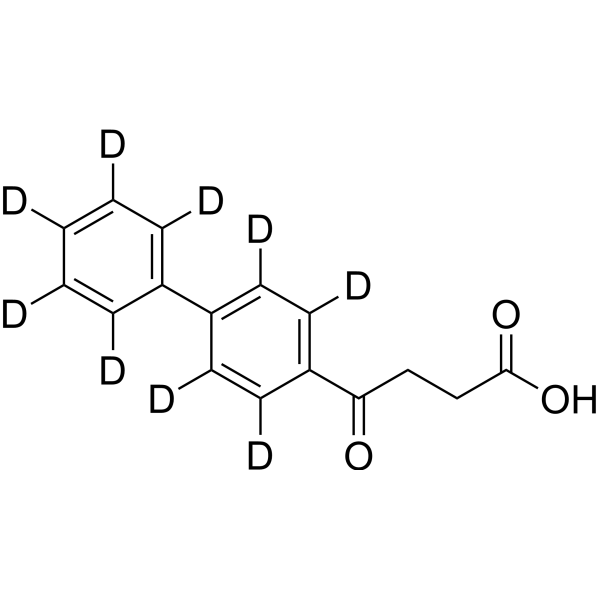 0 ImagesCat. No.: HY-B1138SCAS No.: 1189940-96-2Fenbufen-d9 (CL-82204-d9) is the deuterium labeled Fenbufen. Fenbufen (CL-82204) is an orally active non-steroidal anti-inflammatory drug (NSAID), with antipyretic effects. Fenbufen has potent activity in a variety of animal model, including carageenin edema, UV erythema and adjuvant arthritis. Fenbufen has inhibitory activities against COX-1 and COX-2 with IC50s of 3.9 μM and 8.1 μM, respectively. Fenbufen is a caspases (caspase-1, 3, 4, 5, 9) inhibitor.

-
Z-VAD-FMK (Standard)
 0 ImagesCat. No.: HY-16658BRCAS No.: 161401-82-7Synonyms: Z-VAD(OH)-FMK (Standard)Z-VAD-FMK (Standard) is the analytical standard of Z-VAD-FMK (HY-16658B). This product is intended for research and analytical applications. Z-VAD-FMK is a pan-caspase inhibitor and also an ICE-like protease inhibitor, which inhibits apoptosis by preventing the processing of CPP32 to its active form. Z-VAD-FMK sensitivity varies primarily due to differential expression of receptor-interacting protein 1 (RIP1). Z-VAD-FMK limits the cryopreservation-induced apoptosis by reducing caspase-3 activity of in vitro produced bovine embryos. Z-VAD-FMK is immunosuppressive in vitro and inhibits T cell proliferation without blocKing the processing of caspase-8 and caspase-3. Z-VAD-FMK leads to a decrease in intracellular glutathione (GSH) with a concomitant increase in reactive oxygen species (ROS) levels in activated T cells. Z-VAD-FMK is due to oxidative stress via the depletion of GSH. Z-VAD-FMK can be used for the study of acute pancreatitis.
-
Simazine (Standard)
 0 ImagesSimazine (Standard) is the analytical standard of Simazine (HY-B2046). This product is intended for research and analytical applications. Simazine is a triazine herbicide. Simazine is widely used in agriculture, potted plant and tree production. In addition, Simazine can induce the apoptosis of immune cells in the spleen of mice and inhibit the proliferation of B cells and T cells in mice.
-
Barlerin (Standard)
 0 ImagesCat. No.: HY-N0758RCAS No.: 57420-46-9Synonyms: 8-O-Acetyl shanzhiside methyl ester (Standard)Barlerin (Standard) is the analytical standard of Barlerin. This product is intended for research and analytical applications. Barlerin (8-O-Acetyl shanzhiside methyl ester) is an iridoid glucoside isolated from the leaves of Lamiophlomis rotata Kudo, a Chinese folk medicinal plant in Xi-zang. Barlerin (8-O-Acetyl shanzhiside methyl ester) could inhibt NF-κB.
-
BV02 (Standard)
 0 ImagesCat. No.: HY-101985RCAS No.: 292870-53-2BV02 (Standard) is the analytical standard of BV02 (HY-101985). This product is intended for research and analytical applications. BV02 is a 14-3-3 inhibitor and an antibacterial agent. BV02 enhances the cleavage of PARP and caspase-3. BV02 induces Apoptosis, Autophagy, and enhances Akt activation. BV02 has anti-B. melitensis infection and epilepsy-promoting effects. BV02 can also be used in colitis research.
-
Isomahanine
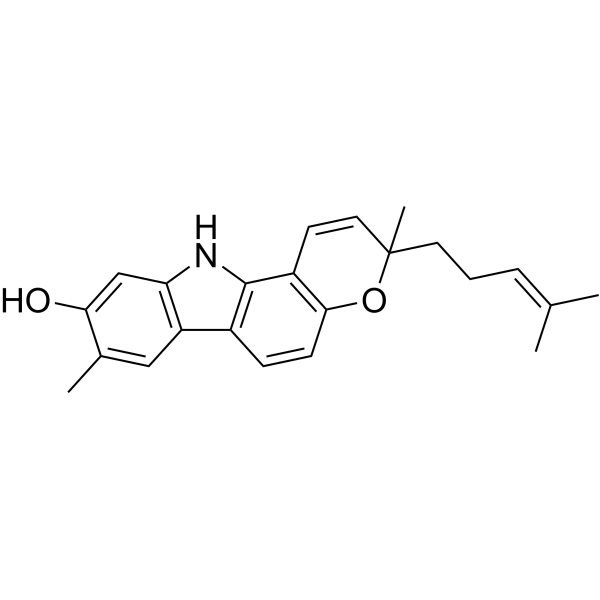 0 ImagesCat. No.: HY-111523CAS No.: 144606-95-1Isomahanine, carbazole alkaloid, is an antioxidative agent. Isomahanine has DPPH radical scavenging activity with an IC50 value of 24 μM.
-
ASP3026 (Standard)
 0 ImagesASP3026 (Standard) is the analytical standard of ASP3026. This product is intended for research and analytical applications. ASP3026 is a selective and orally active inhibitor of anaplastic lymphoma kinase (ALK). ASP3026 is a selective and oral active anaplastic lymphoma kinase (ALK) inhibitor with a IC50 value of 3.5 nM. ASP3026 can inhibit the phosphorylation of IGF-1R, STAT3, AKT and JNK proteins, and induce the cleavage of caspase 3 and PARP. It also inhibited ROS and ACK. ASP3026 can be used in anti-tumor research.
-
USP7-IN-20
 0 ImagesCat. No.: HY-183942CAS No.: 2196246-28-1USP7-IN-20 is a highly selective USP7 inhibitor that binds allosterically to the allosteric pocket of USP7 in a non-competitive and reversible manner. USP7-IN-20 downregulates MDM2 protein levels and stabilizes p53, thereby inducing p21 expression and enhancing the ubiquitin-dependent degradation of MDM2. USP7-IN-20 effectively binds endogenous USP7 to inhibit cancer cell proliferation, and also induces apoptosis by promoting the cleavage of PARP and caspase 3. USP7-IN-20 can be widely used in cancer-related basic and translational research.
-
Vitexin-2"-O-rhamnoside (Standard)
 0 ImagesCat. No.: HY-N0534RCAS No.: 64820-99-1Vitexin-2"-O-rhamnoside (Standard) is the analytical standard of Vitexin-2"-O-rhamnoside (HY-N0534). This product is intended for research and analytical applications. Vitexin-2"-O-rhamnoside is an orally active flavonoid glycoside. Vitexin-2"-O-rhamnoside inhibits Apoptosis, increases the phosphorylation levels of PI3K/Akt, inhibits caspase-3, SOD activity, and promotes cytokine (IL-2, IL-6, and IL-12) secretion. Vitexin-2"-O-rhamnoside strongly inhibits DNA synthesis in MCF-7 cells with an IC50 of 17.5 μM. Vitexin-2"-O-rhamnoside enhances immune function and improves the absorption of active compounds. Vitexin-2"-O-rhamnoside has antioxidant activity. Vitexin-2"-O-rhamnoside is used in the study of cardiovascular disease and immune-related diseases.
-
Methazolamide (Standard)
 0 ImagesMethazolamide (Standard) is the analytical standard of Methazolamide. This product is intended for research and analytical applications. Methazolamide (L584601) is a BBB-penetrable and orally active carbonic anhydrase inhibitor, with a Ki of 14 nM for human carbonic anhydrase II. Methazolamide can reduce intraocular pressure and has a neuroprotective effect, being able to inhibit neuronal apoptosis. Methazolamide can be used in the research of ophthalmic diseases such as glaucoma and cerebrovascular diseases such as subarachnoid hemorrhage.
-
Emricasan (Standard)
 0 ImagesSynonyms: PF 03491390 (Standard); IDN-6556 (Standard)Emricasan (Standard) is the analytical standard of Emricasan. This product is intended for research and analytical applications. Emricasan (PF 03491390) is an orally active and irreversible pan-caspase inhibitor. Emricasan inhibits Zika virus (ZIKV)-induced increases in caspase-3 activity and protected human cortical neural progenitors.
-
Ibulocydine
 0 ImagesCat. No.: HY-116054CAS No.: 1314096-68-8Ibulocydine is an isobutyrate prodrug of the Cdk inhibitor BMK-Y101 (HY-188159), with oral activity, and exhibits IC50 values of approximately 50 nM against CDK1/CDK2, 530 nM against CDK7/cyclin H/Mat1, and 85 nM against CDK9/cyclin T. Ibulocydine reduces the phosphorylation levels of Rb, nucleolin, and RNA polymerase II CTD Ser-5 and Ser-2, downregulates the expression of Mcl-1, survivin, and XIAP, decreases MMP-9 expression, and lowers the Bcl-2/Bax ratio, activates calpain-mediated Bax cleavage, cytochrome c release, and caspase activation. Ibulocydine induces apoptosis, inhibits the growth of cancer cells and xenografts, enhances the sensitivity of cancer cells to TRAIL and radiotherapy, and blocks cancer cell metastasis. Ibulocydine can be used in research related to various cancers, including hepatocellular carcinoma, triple-negative breast cancer, lung cancer, and colon cancer.
-
CDKi free base
 0 ImagesCat. No.: HY-W259575CAS No.: 70035-83-5CDKi free base is a CDK inhibitor. CDKi free base induces morphological changes, DNA fragmentation, and cell death in vestibular schwannoma cells. CDKi free base downregulates pRb, EGF-R, PI3K, NF-κB, and Shh levels, while upregulating JNK, ASK1, Caspase 3, and p21, and induces PARP-1 cleavage. CDKi free base can be used in research related to vestibular schwannoma.




