



GSK-3
Glycogen synthase kinase-3; Glycogen synthase kinase 3
Glycogen synthase kinase 3 (GSK-3) is a multifunctional serine/threonine kinase consisting of two isoforms, alpha and beta. It is a highly conserved negative regulator of receptor tyrosine kinase, cytokine, and Wnt signaling pathways. Stimulation of these pathways inhibits GSK-3 to modulate diverse downstream effectors that include transcription factors, nutrient sensors, glycogen synthesis, mitochondrial function, circadian rhythm, and cell fate. GSK-3 also regulates alternative splicing in response to T-cell receptor activation, and recent phosphoproteomic studies have revealed that multiple splicing factors and regulators of RNA biosynthesis are phosphorylated in a GSK-3-dependent manner.
The malfunction or aberrant activity of GSK-3 leads to several of disorders, such as Alzheimer's disease (AD) and other neurodegenerative pathologies, and other type of diseases as diabetes, cardiovascular disorders and cancer. GSK-3 is also related to innate immune response against pathogens, which makes GSK-3 an excellent target for therapeutic intervention.
GSK-3 Isoform Specific Products
All Product Categories
-
GSK-3 Inhibitors
(290)
View all products
-
GSK-3 Agonist
(1)
View all products
-
GSK-3 Activators
(47)
View all products
-
GSK-3 Modulators
(5)
View all products
-
GSK-3 Chemicals
(2)
View all products
-
GSK-3 Degraders
(3)
View all products
-
GSK-3 Ligand
(1)
View all products
-
Glycogen Synthase Kinase-3 (GSK-3) Proteins
(6)
View all products
-
GSK-3 alpha Proteins
(1)
View all products
-
GSK-3 beta Proteins
(5)
View all products
-
GSK-3 Related Products (372)
Related Products (372)

-
Recombinant Proteins (6)
-
Antibodies (9)
-
GSK-3 Signaling Pathway
-
GSK-3 Isoform Comparison
-
SB 216763 (Standard)
 0 ImagesSB 216763 (Standard) is the analytical standard of SB 216763. This product is intended for research and analytical applications. SB 216763 is potent, selective and ATP-competitive GSK-3 inhibitor with IC50s of 34.3 nM for both GSK-3α and GSK-3β.
-
Amsacrine lactate
 0 ImagesCat. No.: HY-13551DCAS No.: 80277-11-8Synonyms: m-AMSA lactate; Acridinyl anisidide lactateAmsacrine lactate (m-AMSA lactate) is a Topoisomerase II inhibitor. Amsacrine lactate intercalates into DNA. Amsacrine lactate induces Ca2+-mediated inactivation of ERK, and also downregulates AKT, promoting MCL1 downregulation mediated by GSK3β via reducing the phosphorylation level of GSK3β. Amsacrine lactate induces Apoptosis by activating Caspase-9 and Caspase-3. Amsacrine lactate blocks HERG potassium channels in the open/inactivated state. Amsacrine lactate induces chromosomal aberrations and sister chromatid exchanges, and inhibits the synthesis of RNA and DNA. Amsacrine lactate exhibits anti-leukemic activity. Amsacrine lactate causes cardiac repolarization disorders, QT interval prolongation, ventricular arrhythmias, and increases the risk of sudden cardiac death. Amsacrine lactate can be used in research related to acute myeloid leukemia, lymphoma and progressive malignancies.
-
TDZD-8 (Standard)
 0 ImagesSynonyms: GSK-3β Inhibitor I (Standard); NP 01139 (Standard)
-
MeBIO (Standard)
 0 ImagesCat. No.: HY-103221RCAS No.: 667463-95-8
-
MRT68921 dihydrochloride (Standard)
 0 ImagesMRT68921 (dihydrochloride) (Standard) is the analytical standard of MRT68921 (dihydrochloride) (HY-100006A). This product is intended for research and analytical applications. MRT68921 dihydrochloride is a potent NUAK1/ULK1 dual inhibitor. MRT68921 dihydrochloride inhibits ULK1 and ULK2 with IC50 values of 2.9 nM and 1.1 nM, respectively. MRT68921 dihydrochloride can block cells autophagy and kill tumor cells by breaking the balance of oxidative stress signals. MRT68921 dihydrochloride can inhibit cell proliferation and induce ROS production and apoptosis. MRT68921 dihydrochloride can be used for the research of cancer, such as breast cancer.
-
Antitrypanosomal agent 31
 0 ImagesCat. No.: HY-183529CAS No.: 551919-54-1Antitrypanosomal agent 31 is an antitrypanosoma agent with a pEC50 of 6.4. Antitrypanosomal agent 31 inhibits GSK-3β, CDK-2, and CDK-4 with pIC50s of 5.8, 6.9, and 7.1, respectively. Antitrypanosomal agent 31 can be used for the research of human african trypanosomiasis.
-
(E)-Methyl 4-coumarate (Standard)
 0 ImagesSynonyms: Methyl trans-p-coumarate (Standard)(E)-Methyl 4-coumarate (Standard) is the analytical standard of (E)-Methyl 4-coumarate (HY-N2492). This product is intended for research and analytical applications. (E)-Methyl 4-coumarate (Methyl 4-hydroxycinnamate) is a phenolic compound and derivative of Cinnamic acid (HY-N0610A). (E)-Methyl 4-coumarate can be found in several plants, such as the leaves of Allium cepa and Morinda citrifolia L. (E)-Methyl 4-coumarate, when combined with Carnosic acid (HY-N0644), induces Apoptosis. (E)-Methyl 4-coumarate inhibits GSK3β activity and modulates inflammatory cytokine levels (increasing IL-10 and decreasing IL-4). (E)-Methyl 4-coumarate combined with Carnosic acid exhibits anticancer effects against acute myeloid leukemia. (E)-Methyl 4-coumarate ameliorates Plasmodium berghei NK65 infection.
-
5-Iodo-indirubin-3'-monoxime (Standard)
 0 ImagesCat. No.: HY-111930RCAS No.: 331467-03-95-Iodo-indirubin-3'-monoxime (Standard) is the analytical standard of 5-Iodo-indirubin-3'-monoxime (HY-111930). This product is intended for research and analytical applications. 5-Iodo-indirubin-3'-monoxime is a potent GSK-3β, CDK5/P25 and CDK1/cyclin B inhibitor, competing with ATP for binding to the catalytic site of the Kinase, with IC50s of 9, 20 and 25 nM, respectively.
-
Cefetecol hydrate
 0 ImagesCat. No.: HY-159796CAS No.: 127182-67-6Synonyms: GR69153 hydrateCefetecol hydrate (GR69153 hydrate) is a semisynthetic β-lactam antibacterial agent and α-glucosidase inhibitor (yeast IC50 = 2.1 μM; Ki = 5.78 μM) that crosses the blood-brain barrier. Cefetecol hydrate reduces blood glucose levels in Streptozotocin-induced diabetic mice. Cefetecol hydrate decreases the mRNA expression of GSK-3, PPAR-γ, and UCP-3. Cefetecol hydrate induces bacterial cell filamentation and exhibits bactericidal activity against Gram-positive and Gram-negative bacteria. Cefetecol hydrate is used in the study of diabetes and bacterial infections.
-
Laduviglusib trihydrochloride (Standard)
 0 ImagesSynonyms: CHIR-99021 trihydrochloride (Standard); CT99021 trihydrochloride (Standard)Laduviglusib (trihydrochloride) (Standard) is the analytical standard of Laduviglusib (trihydrochloride). This product is intended for research and analytical applications. Laduviglusib (CHIR-99021) trihydrochloride is a potent and selective GSK-3α/β inhibitor with IC50s of 10 nM and 6.7 nM. Laduviglusib trihydrochloride shows >500-fold selectivity for GSK-3 over CDC2, ERK2 and other protein kinases. Laduviglusib trihydrochloride is also a potent Wnt/β-catenin signaling pathway activator. Laduviglusib trihydrochloride enhances mouse and human embryonic stem cells self-renewal. Laduviglusib trihydrochloride induces autophagy.
-
Cazpaullone
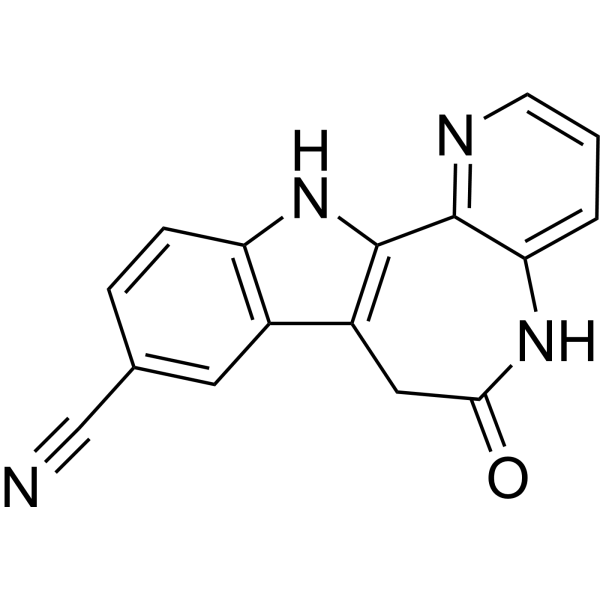 0 ImagesCat. No.: HY-12074CAS No.: 914088-64-5Cazpaullone is a glycogen synthase kinase-3 (GSK-3) inhibitor. Cazpaullone can activate pancreatic beta cell protection and replication. Cazpaullone can be used for the research of diabetes.
-
DC-120
 0 ImagesCat. No.: HY-119884CAS No.: 1261080-40-3DC-120 is an ATP-competitive AKT inhibitor, with particular activity against AKT1 (an IC50 of 0.153 μM). DC-120 functionally blocks AKT kinase activity and reduces the phosphorylation levels of FOXO3a and GSK-3β. DC-120 induces cancer cell apoptosis (apoptosis) and inhibits cancer cell proliferation. DC-120 activates the mTORC1 pathway via the Ca2+/calmodulin (calmodulin)/hVps34 signaling pathway. DC-120 abrogates AKT-mediated inhibition of CRAF, thereby activating the MEK/ERK MAPK pathway. DC-120 exerts anti-tumor activity in a nude mouse hepatocellular carcinoma xenograft model. DC-120 can be used for hepatocellular carcinoma-related research.

-
LY2090314 (Standard)
 0 ImagesCat. No.: HY-16294RCAS No.: 603288-22-8
-
K00546 (Standard)
 0 ImagesCat. No.: HY-103647RCAS No.: 443798-47-8K00546 (Standard) is the analytical standard of K00546 (HY-103647). This product is intended for research and analytical applications. K00546 is a potent CDK1 and CDK2 inhibitor with IC50s of 0.6 nM and 0.5 nM for CDK1/cyclin B and CDK2/cyclin A, respectively. K00546 is also a potent CDC2-like kinase 1 (CLK1) and CLK3 inhibitor with IC50s of 8.9 nM and 29.2 nM, respectively.

-
Flurochloridone (Standard)
 0 ImagesCat. No.: HY-121337RCAS No.: 61213-25-0Synonyms: R-40244 (Standard)Flurochloridone (Standard) (R-40244 (Standard)) is the analytical standard of Flurochloridone (HY-121337). This product is intended for research and analytical applications. Flurochloridone (R-40244) is an orally active herbicide and an inducer of ER stress, apoptosis, and cytotoxicity. Flurochloridone upregulates GRP78 and activates the PERK-eIF2α-ATF4 UPR axis, ATF6, CHOP, Bax, and Bim. Flurochloridone decreases Akt, p-Akt, GSK3β, and p-GSK3β levels, and induces ROS, oxidative stress, γ-glutamyl cycle activation, and GSH accumulation. Flurochloridone inhibits mitochondrial respiration and ATP production while enhancing glycolysis and cell viability inhibition. Flurochloridone inhibits spermatogonial proliferation, spermatocyte meiosis, and sperm mitochondrial membrane potential, and induces Sertoli cell apoptosis and mitochondrial damage. Flurochloridone non-competitively binds phytoene desaturase, blocking phytoene desaturation and carotenoid synthesis, leading to leaf bleaching and phytotoxicity. Flurochloridone can be used for research on male reproductive toxicity, hepatotoxicity, and as a herbicide.
-
GCN2/GSK3α-IN-1
 0 ImagesCat. No.: HY-208758CAS No.: 1627180-54-4GCN2/GSK3α-IN-1 is a GCN2 and GSK3α inhibitor with an IC50 of less than 1 μM for both targets. GCN2/GSK3α-IN-1 can be used in cancer research.
-
Kuwanon G (Standard)
 0 ImagesCat. No.: HY-N4247RCAS No.: 75629-19-5Kuwanon G (Standard) is the analytical standard of Kuwanon G (HY-N4247). This product is intended for research and analytical applications. Kuwanon G is a flavonoid compound and an antagonist of the bombesin receptor. Kuwanon G has multiple activities such as bactericidal, anti-tumor, anti-inflammatory, antioxidant, anti-atherosclerotic, and neuroprotective effects. Kuwanon G exhibits strong antibacterial activity against oral pathogens, especially cariogenic bacteria and periodontal pathogens. Kuwanon G can induce apoptosis and inhibit proliferation, migration, and invasion of tumor cells. Kuwanon G can be used in the research of diseases such as gastric cancer and atherosclerosis.
-
GSK-3β inhibitor 25
 0 ImagesCat. No.: HY-169606CAS No.: 75620-25-6GSK-3β inhibitor 25 (Compound 6h) exhibits a weak inhibitory activity against GSK-3β wih an IC50>100 μM.




