



Dapsone-d8

Based on 1 Customer Validation
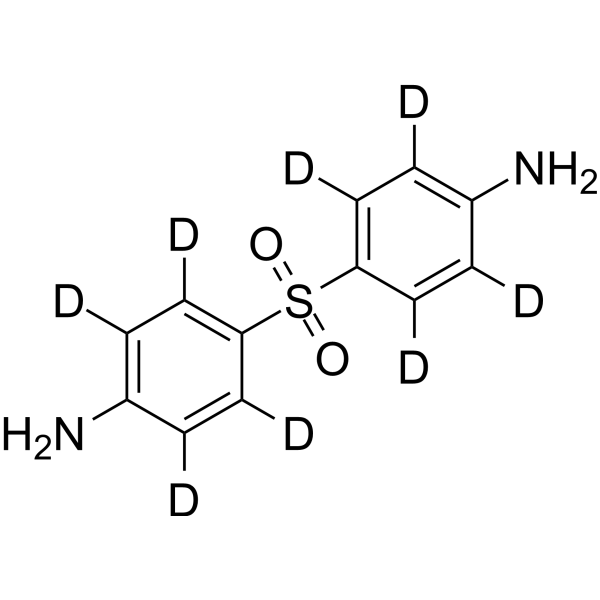
Dapsone-d8 is a deuterium labeled Dapsone. Dapsone is an orally active and blood-brain penetrant sulfonamide antibiotic with antibacterial, antigenic and anti-inflammatory activities. Dapsone?exerts effective antileprosy activity?and inhibits folate synthesis in cell extracts of?M. leprae. Dapsone can be used as an anticonvulsant and also in the research of skin and glioblastoma diseases.
For research use only. We do not sell to patients.
- Purity : 99.82%
- CAS No.: 557794-38-4
- Formula: C12H4D8N2O2S
- Molecular Weight:256.35
-
Storage:Powder -20°C, 3 years , 4°C, 2 years ; In solvent -80°C, 6 months , -20°C, 1 month

To place orders, for customer services and technical support, please contact: MedChemExpress USA
Tel: 609-228-6898 E-mail: [email protected] [email protected]


-
 Biological Activity
-
Chemical Information
-
Solvent & Solubility
- Protocols
- Purity & Documentation
- References
-
 Help & FAQs




Biological Activity
Description
In Vitro
Dapsone (0.06 mM; 30 min) suppresses intra- and extracellular production of superoxide (O2-) and elastase release triggered by N-Formyl-Met-Leu-Phe (HY-P0224) (1 μM) and physiological agonist C5a (100 nM), but not by Phorbol 12-myristate 13-acetate (HY-18739) (100 nM)[5].
MedChemExpress (MCE) has not independently confirmed the accuracy of these methods. They are for reference only. Further protocols information, click here.
In Vivo
MedChemExpress (MCE) has not independently confirmed the accuracy of these methods. They are for reference only.
-
Animal Model:Scopolamine-induced memory impairment model in mice[6]
-
Dosage:0.1, 0.3, 1, 5, and 10 mg/kg; 1 mg/kg for Scopolamine
-
Administration:Intraperitoneal injection; single dose
-
Result:Improved memory acquisition.
Application
1. This compound can be used as a tracer
2. This compound can be used as an internal standard for quantitative analysis by NMR, GC-MS, or LC-MS.


Chemical Information
-
CAS No. 557794-38-4
-
Unlabeled CAS 80-08-0
-
Appearance Solid
-
Molecular Weight 256.35
-
Formula C12H4D8N2O2S
-
Color White to off-white
-
SMILES
NC1=C(C([2H])=C(C([2H])=C1[2H])S(C2=C(C([2H])=C(C([2H])=C2[2H])N)[2H])(=O)=O)[2H]
-
Synonyms
4,4′-Diaminodiphenyl sulfone-d8; DDS-d8
-
Shipping
Room temperature in continental US; may vary elsewhere.
-
Storage
Powder -20°C 3 years 4°C 2 years In solvent -80°C 6 months -20°C 1 month


Solvent & Solubility
In Vitro:
DMSO : 250 mg/mL (975.23 mM; Need ultrasonic; Hygroscopic DMSO has a significant impact on the solubility of product, please use newly opened DMSO)
Please refer to the solubility information to select the appropriate solvent. Once prepared, please aliquot and store the solution to prevent product inactivation from repeated freeze-thaw cycles.
Storage method and period of stock solution: -80°C, 6 months; -20°C, 1 month. When stored at -80°C, please use it within 6 months. When stored at -20°C, please use it within 1 month.
Please refer to the solubility information to select the appropriate solvent. Once prepared, please aliquot and store the solution to prevent product inactivation from repeated freeze-thaw cycles.
Storage method and period of stock solution: -80°C, 6 months; -20°C, 1 month. When stored at -80°C, please use it within 6 months. When stored at -20°C, please use it within 1 month.
Concentration (start) × Volume (start) = Concentration (final) × Volume (final)

Protocols
-
Research Protocol for Infectious Diseases
Infectious-disease experiments test how pathogens interact with host barriers, innate immune receptors, inflammatory signaling, pathogen replication, and tissue injury; pattern-recognition receptors such as TLRs, RIG-I-like receptors, NOD-like receptors, and inflammasomes detect microbial molecules and activate NF-κB, interferon, and cytokine responses. The central hypothesis is that infection severity reflects the balance between pathogen burden and host response: protective inflammation restricts pathogen growth, whereas excessive or mislocalized inflammation contributes to tissue damage and disease phenotype. Unresolved questions include which host pathways are protective versus pathogenic, why some infection models fail to translate to human disease, and which combined readouts best predict clinically relevant infection outcomes.
-
Research Protocol for Inflammation-related Diseases
The NLRP3 inflammasome is a cytosolic innate immune signaling platform that integrates priming signals and danger-signal activation to promote caspase-1 activation, maturation of IL-1β and IL-18, and gasdermin D-mediated pyroptotic cell death. The core experimental logic is to determine whether inflammatory disease phenotypes are driven by increased NLRP3 expression, ASC-containing inflammasome assembly, caspase-1 cleavage, GSDMD cleavage, and extracellular release of IL-1β/IL-18 rather than by nonspecific cell injury alone. The pathway is strongly linked to inflammation-related disease phenotypes because monosodium urate crystals activate NALP3/NLRP3 inflammasome signaling in gout-like crystal inflammation, cholesterol crystals activate NLRP3 inflammasomes in atherogenesis models, and DSS-induced intestinal inflammation has been reported to involve NLRP3 inflammasome activity. However, experimental colitis studies also show context-dependent protective effects of NLRP3 inflammasome co
-
Directly Induced Neuron Culture
Directly induced neuron culture converts somatic cells, most commonly fibroblasts, into induced neurons without passing through a pluripotent or neural progenitor stage; classic evidence shows that mouse fibroblasts can be converted by Ascl1, Brn2/Pou3f2, and Myt1l, human fibroblasts can be converted by defined neuronal transcription factors, and human fibroblasts can also be converted by miR-9/9-124 with neurogenic or subtype-specifying transcription factors. The readout is acquisition of neuronal identity and function, assessed by neuronal morphology, neuronal markers such as Tuj1/βIII-tubulin, MAP2, synapsin, and subtype markers when relevant, together with functional assays such as action-potential firing, synaptic activity, and electrophysiology.


Purity & Documentation
-
Data Sheet (278 KB)
-
SDS (393 KB)
- English - EN (393 KB)
- Français - FR (393 KB)
- Deutsch - DE (393 KB)
- Norwegian - NO (393 KB)
- Español - ES (393 KB)
- Swedish - SV (393 KB)
- Italian - IT (393 KB)
- Korean - KR (393 KB)
- Portuguese - PT (393 KB)
-
Handling Instructions (2659 KB)
References
[1]. Y I Zhu, et al. Dapsone and sulfones in dermatology: overview and update. J Am Acad Dermatol [Content Brief]
[2]. Dapsone. Drug.com
[3]. D Voeller, et al. Interaction of Pneumocystis carinii dihydropteroate synthase with sulfonamides and diaminodiphenyl sulfone (dapsone).J Infect Dis. 1994 Feb;169(2):456-9. [Content Brief]
[4]. Esther Moreno, et al. Evaluation of Skin Permeation and Retention of Topical Dapsone in Murine Cutaneous Leishmaniasis Lesions.Pharmaceutics. 2019 Nov 13;11(11):607. [Content Brief]
[5]. Wozel G, et al. Dapsone in dermatology and beyond. Arch Dermatol Res. 2014 Mar;306(2):103-24. [Content Brief]
[6]. Noroozi N, et al. Protective Effects of Dapsone on Scopolamine-Induced Memory Impairment in Mice: Involvement of Nitric Oxide Pathway. Dement Geriatr Cogn Dis Extra. 2022 Mar 24;12(1):43-50. [Content Brief]


Complete Stock Solution Preparation Table
Please refer to the solubility information to select the appropriate solvent. Once prepared, please aliquot and store the solution to prevent product inactivation from repeated freeze-thaw cycles.
Storage method and period of stock solution: -80°C, 6 months; -20°C, 1 month. When stored at -80°C, please use it within 6 months. When stored at -20°C, please use it within 1 month.
| Optional Solvent | Concentration Solvent Mass | 1 mg | 5 mg | 10 mg | 25 mg |
|---|---|---|---|---|---|
| DMSO | 1 mM | 3.9009 mL | 19.5046 mL | 39.0092 mL | 97.5229 mL |
| 5 mM | 0.7802 mL | 3.9009 mL | 7.8018 mL | 19.5046 mL | |
| 10 mM | 0.3901 mL | 1.9505 mL | 3.9009 mL | 9.7523 mL | |
| 15 mM | 0.2601 mL | 1.3003 mL | 2.6006 mL | 6.5015 mL | |
| 20 mM | 0.1950 mL | 0.9752 mL | 1.9505 mL | 4.8761 mL | |
| 25 mM | 0.1560 mL | 0.7802 mL | 1.5604 mL | 3.9009 mL | |
| 30 mM | 0.1300 mL | 0.6502 mL | 1.3003 mL | 3.2508 mL | |
| 40 mM | 0.0975 mL | 0.4876 mL | 0.9752 mL | 2.4381 mL | |
| 50 mM | 0.0780 mL | 0.3901 mL | 0.7802 mL | 1.9505 mL | |
| 60 mM | 0.0650 mL | 0.3251 mL | 0.6502 mL | 1.6254 mL | |
| 80 mM | 0.0488 mL | 0.2438 mL | 0.4876 mL | 1.2190 mL | |
| 100 mM | 0.0390 mL | 0.1950 mL | 0.3901 mL | 0.9752 mL |


Dapsone-d8 Related Classifications
HY-B0688S Related Classifications
 Powered by Bioz