



BAL-30072

Based on 1 Customer Validation
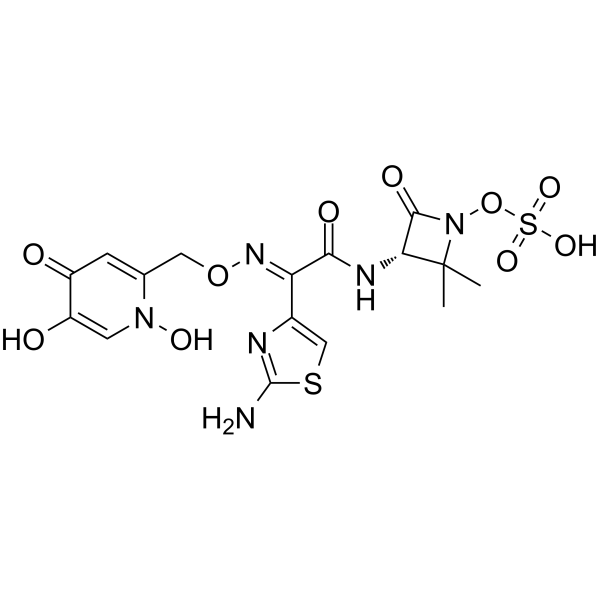
BAL-30072 is a siderophore-bearing monocyclic β-lactam antibiotic with antibacterial activity. BAL-30072 inhibits penicillin-binding proteins 1a, 1b, and 3, thereby disrupting bacterial cell wall synthesis. BAL-30072 inhibits mitochondrial electron transport chain complex II and complex III, while also inhibiting glycolysis and mitochondrial fatty acid β-oxidation. BAL-30072 induces mitochondrial ROS production, cellular ATP depletion, reduces mitochondrial membrane potential, and triggers hepatocyte apoptosis via caspase-3/7 activation. BAL-30072 is a substrate of the hepatic uptake transporters OAT1 and OAT3. BAL-30072 can be used in research related to bacterial infections.
For research use only. We do not sell to patients.
- Purity : 98.03%
- CAS No.: 941285-15-0
- Formula: C16H18N6O10S2
- Molecular Weight:518.48
-
Storage:Powder -20°C, 3 years , 4°C, 2 years ; In solvent -80°C, 6 months , -20°C, 1 month

To place orders, for customer services and technical support, please contact: MedChemExpress USA
Tel: 609-228-6898 E-mail: [email protected] [email protected]


-
 Biological Activity
-
Chemical Information
-
Solvent & Solubility
- Protocols
- Purity & Documentation
- References
-
 Help & FAQs




Biological Activity
Description
IC50 & Target
[2]|
Caspase-3 |
Caspase-7 |
Cellular Effect
|
Cell Line

|
Type | Value | Description | References |
|---|---|---|---|---|
| HepG2 | IC50 |
2420 μM
|
Reduction of intracellular ATP content in human HepG2 cells after 120 hrs of exposure to BAL30072 with re-dosing every 12 hrs, measured by CellTiter-Glo luminescence assay.
Reduction of intracellular ATP content in human HepG2 cells after 120 hrs of exposure to BAL30072 with re-dosing every 12 hrs, measured by CellTiter-Glo luminescence assay.
|
28536862 |
In Vitro
BAL30072 exhibits toxicity to liver mitochondria and inhibits glycolysis in HepG2 cells and human liver microtissues[1].
BAL30072 (120 h) decreases cellular ATP content in HepG2 cells and human 3D liver microtissues, with IC50 values of 2420 and 6520 µM[2].
BAL30072 decreases ATP content in human 3D liver microtissues in a time- and dose-dependent manner, with cytotoxicity occurring at 289 µM from day 7 onward; and it impairs albumin synthesis in human 3D liver microtissues in a time- and dose-dependent manner[2].
BAL30072 (289-2893 µM; up to 28 days) induces concentration- and time-dependent morphological changes in human 3D liver microtissues[2].
BAL30072 (5 days) decreases intracellular GSH levels in human 3D liver microtissues, whereas BSO pretreatment does not increase ATP depletion[2].
BAL30072 (100-20000 µM; 12-120 h) begins to inhibit complexes II and III of the mitochondrial electron transport chain in HepG2 cells after 72 h exposure at 500 µM; it begins to induce mitochondrial ROS accumulation in HepG2 cells after 72 h exposure at 1000 µM[2].
After 72 h of exposure to BAL30072 in HepG2 cells, the extracellular acidification rate decreases starting at 200 µM, causing a concentration-dependent decline in mitochondrial membrane potential[2].
BAL30072 (1000-5000 µM; 72 h) induces triglyceride accumulation in HepG2 cells[2].
BAL30072 (200-10000 µM; 72 h) inhibits mitochondrial β-oxidation[2].
BAL30072 activates caspase-3/7 in human 3D liver microtissues in a concentration- and time-dependent manner, suggesting that apoptosis is involved in hepatotoxicity[2].
BAL 30072 exhibits in vitro activity against multidrug-resistant P. aeruginosa and carbapenem-resistant Acinetobacter sp. through a dual mechanism of inhibiting PBPs 1a and 1b as well as PBP 3[4].
MedChemExpress (MCE) has not independently confirmed the accuracy of these methods. They are for reference only.
In Vivo
BAL 30072 shows efficacy against Acinetobacter baumannii in a rat soft tissue infection model[4].
MedChemExpress (MCE) has not independently confirmed the accuracy of these methods. They are for reference only.
- Research Protocol for Infectious Diseases
- Mitochondrial membrane-potential fluorescent assay
- Detection of Apoptosis
- TUNEL staining for apoptotic DNA fragmentation
- Annexin V plus membrane-impermeant dye apoptosis staining
- ROS/oxidative-stress fluorescent staining
- Fluorescent plasma-membrane potential dye assay
- Mitochondrial membrane-potential and mitochondrial mass staining
- Apoptosis Solutions
- Bacterial live/dead nucleic-acid viability staining


Chemical Information
-
CAS No. 941285-15-0
-
Appearance Solid
-
Molecular Weight 518.48
-
Formula C16H18N6O10S2
-
Color White to off-white
-
SMILES
O=C(N[C@H]1C(C)(C)N(OS(=O)(O)=O)C1=O)/C(C2=CSC(N)=N2)=N/OCC3=CC(C(O)=CN3O)=O
-
Shipping
Room temperature in continental US; may vary elsewhere.
-
Storage
Powder -20°C 3 years 4°C 2 years In solvent -80°C 6 months -20°C 1 month


Solvent & Solubility
In Vitro:
DMSO : 100 mg/mL (192.87 mM; Need ultrasonic; Hygroscopic DMSO has a significant impact on the solubility of product, please use newly opened DMSO)
Please refer to the solubility information to select the appropriate solvent. Once prepared, please aliquot and store the solution to prevent product inactivation from repeated freeze-thaw cycles.
Storage method and period of stock solution: -80°C, 6 months; -20°C, 1 month. When stored at -80°C, please use it within 6 months. When stored at -20°C, please use it within 1 month.
Please refer to the solubility information to select the appropriate solvent. Once prepared, please aliquot and store the solution to prevent product inactivation from repeated freeze-thaw cycles.
Storage method and period of stock solution: -80°C, 6 months; -20°C, 1 month. When stored at -80°C, please use it within 6 months. When stored at -20°C, please use it within 1 month.
Concentration (start) × Volume (start) = Concentration (final) × Volume (final)


Purity & Documentation
-
Data Sheet (276 KB)
-
SDS (251 KB)
- English - EN (251 KB)
- Français - FR (251 KB)
- Deutsch - DE (251 KB)
- Norwegian - NO (251 KB)
- Español - ES (251 KB)
- Swedish - SV (251 KB)
- Italian - IT (251 KB)
- Korean - KR (251 KB)
- Portuguese - PT (251 KB)
-
Handling Instructions (2659 KB)
References


Complete Stock Solution Preparation Table
Please refer to the solubility information to select the appropriate solvent. Once prepared, please aliquot and store the solution to prevent product inactivation from repeated freeze-thaw cycles.
Storage method and period of stock solution: -80°C, 6 months; -20°C, 1 month. When stored at -80°C, please use it within 6 months. When stored at -20°C, please use it within 1 month.
| Optional Solvent | Concentration Solvent Mass | 1 mg | 5 mg | 10 mg | 25 mg |
|---|---|---|---|---|---|
| DMSO | 1 mM | 1.9287 mL | 9.6436 mL | 19.2871 mL | 48.2179 mL |
| 5 mM | 0.3857 mL | 1.9287 mL | 3.8574 mL | 9.6436 mL | |
| 10 mM | 0.1929 mL | 0.9644 mL | 1.9287 mL | 4.8218 mL | |
| 15 mM | 0.1286 mL | 0.6429 mL | 1.2858 mL | 3.2145 mL | |
| 20 mM | 0.0964 mL | 0.4822 mL | 0.9644 mL | 2.4109 mL | |
| 25 mM | 0.0771 mL | 0.3857 mL | 0.7715 mL | 1.9287 mL | |
| 30 mM | 0.0643 mL | 0.3215 mL | 0.6429 mL | 1.6073 mL | |
| 40 mM | 0.0482 mL | 0.2411 mL | 0.4822 mL | 1.2054 mL | |
| 50 mM | 0.0386 mL | 0.1929 mL | 0.3857 mL | 0.9644 mL | |
| 60 mM | 0.0321 mL | 0.1607 mL | 0.3215 mL | 0.8036 mL | |
| 80 mM | 0.0241 mL | 0.1205 mL | 0.2411 mL | 0.6027 mL | |
| 100 mM | 0.0193 mL | 0.0964 mL | 0.1929 mL | 0.4822 mL |


BAL-30072 Related Classifications
HY-19882 Related Classifications
 Powered by Bioz
Keywords
- BAL-30072
- 941285-15-0
- BAL30072
- BAL 30072
- Antibiotic
- Bacterial
- OAT
- Caspase
- Apoptosis
- mitochondrial electron transport chain complex II and complex III
- human 3D liver microtissues
- penicillin-binding proteins 1a
- 1b
- and 3
- glycolysis
- mitochondrial fatty acid β-oxidation
- hepatocyte apoptosis
- HepaRG cells
- carbapenemase-producing strains
- HepG2 cells
- multidrug-resistant Gram-negative bacteria
- Inhibitor
- inhibitor
- inhibit