



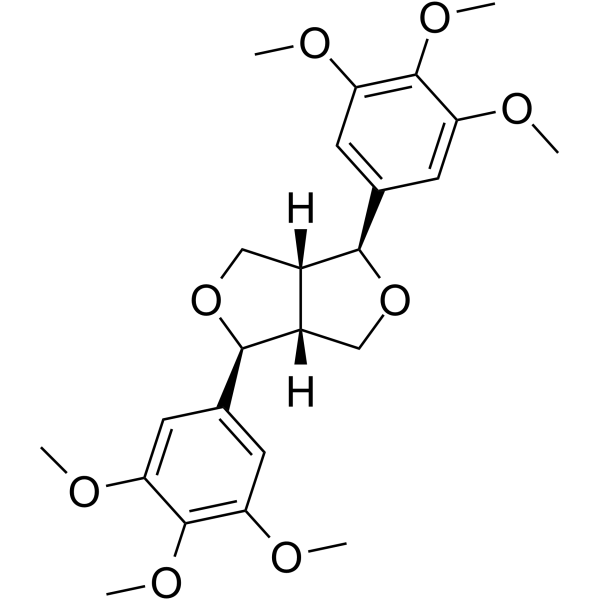
Yangambin

Based on 1 Customer Validation
Yangambin is a PAF receptor antagonist and UGT1A1/UGT1A3 inhibitor, with an IC50 of 29.7 μM and a Ki of 17.1 μM against human UGT1A1, and an IC50 of 56.5 μM and a Ki of 66.8 μM against human UGT1A3. Yangambin blocks PAF-mediated responses, inhibits LTB4-mediated neutrophil infiltration, and suppresses inflammatory events and anaphylactic contraction. Yangambin acts as a central nervous system inhibitor to reduce spontaneous activity, and also exhibits analgesic, anticonvulsant, antileishmanial, vasodilatory and hypotensive effects. Yangambin blocks voltage-gated Ca2+ channels, reduces the production of NO, TNF-α, IL-6 and PGE2 in cells, increases the production of IL-10, and exerts a protective effect against cardiovascular injury. Yangambin can be used in research related to allergies, cutaneous leishmaniasis, central nervous system diseases and cardiovascular diseases.
연구목적의 판매만을 진행합니다. 환자를 대상으로 한 판매는 하지 않습니다.
- Purity : 98.27%
- CAS No.: 13060-14-5
- 화학식: C24H30O8
- 분자량:446.49
-
보관:
4°C, protect from light
* In solvent : -80°C, 6 months; -20°C, 1 month (protect from light)

To place orders, for customer services and technical support, please contact: MedChemExpress USA
Tel: 609-228-6898 E-mail: [email protected] [email protected]


-
 Biological Activity
-
Chemical Information
-
용액&용해도
- Protocol
- 순도&문서
- References
-
 Help & FAQs




Biological Activity
제품 설명
|
UGT1A1 29.7 μM (IC50) |
UGT1A3 56.5 μM (IC50) |
UGT1A1 17.1 μM (Ki) |
UGT1A3 66.8 μM (Ki) |
IL-6 |
IL-10 |
LTB4 |
Cellular Effect
|
Cell Line

|
Type | Value | Description | References |
|---|---|---|---|---|
| BV-2 | IC50 |
28.6 μM
Compound: 3
|
Inhibition of NO production in LPS-stimulated mouse BV2 cells assessed as nitrite accumulation after 20 hrs by Griess reagent method
Inhibition of NO production in LPS-stimulated mouse BV2 cells assessed as nitrite accumulation after 20 hrs by Griess reagent method
|
[PMID: 19110419] |
In Vitro
Yangambin (50-200 μM; 48 h) potently reduces the viability and survival rate of Leishmania amazonensis in bone marrow-derived macrophages from BALB/c mice, with IC50 values of 43.9 μM and 76 μM, respectively[3].
Yangambin (100 μM; 48 h) reduces the production of NO, TNF-α, IL-6 and PGE2, and increases the production of IL-10, in bone marrow-derived macrophages from BALB/c mice infected with Leishmania amazonensis and stimulated with IFN-γ[3].
Yangambin (0.1 μM-1 mM; pre-incubated prior to 60 mM K+Cl− stimulation) inhibits K+Cl−-induced intracellular calcium signals in Fura-2/AM (HY-101897)-loaded rat mesenteric artery smooth muscle cells in a concentration-dependent manner, with significant inhibitory effects observed at concentrations of 30 μM and 1 mM[5].
Yangambin (0.1-200 µM; 60 min) inhibits the activities of UGT1A1 and UGT1A3 in pooled human liver microsomes, with IC50 values of 29.7 µM and 56.5 µM, respectively[6].
Yangambin (2-40 µM; 30 min) non-competitively inhibits UGT1A1-catalyzed glucuronidation of SN-38 in pooled human liver microsomes, with a Ki value of 17.1 µM[6].
Yangambin (5-80 µM; 30 min) competitively inhibits UGT1A3-catalyzed 24-acyl glucuronidation of chenodeoxycholic acid in pooled human liver microsomes, with a Ki value of 66.8 µM[6].
MedChemExpress (MCE) has not independently confirmed the accuracy of these methods. They are for reference only.
-
Cell Line:BALB/c mouse BMDM infected with Leishmania amazonensis (MHOM/Br88/Ba-125)
-
Concentration:50, 100, 200 μM
-
Incubation Time:48 h
-
Result:Reduced intracellular Leishmania amazonensis viability in a concentration-dependent manner.
Caused a significant reduction in parasite burden at 200 μM, with an IC50 value of 43.9 μM.
Caused a significant reduction in parasite burden at 200 μM, with an IC50 value of 76 μM.
In Vivo
Yangambin (10-20 mg/kg; i.p.; single administration 1 hour prior to challenge) significantly inhibits platelet-activating factor (PAF)-induced pleural eosinophil accumulation in normal rats. At the dose of 20 mg/kg, it inhibits PAF-induced neutrophil infiltration, but has no effect on exudation, partially inhibits hemoconcentration and leukocytosis, and almost completely blocks thrombocytopenia[1].
Yangambin (20 mg/kg; i.p.; single administration 1 hour prior to challenge) significantly inhibits LTB4 (HY-107608)-induced pleural neutrophil infiltration in normal rats[1].
Yangambin (12.5-50 mg/kg; i.p.; single administration) exerts central nervous system depressant activity in healthy male Swiss mice, reduces spontaneous and upright locomotor activities, prolongs immobility time in the forced swimming test, and alters parameters of the elevated plus maze; it also shortens pentobarbital sleep latency and prolongs pentobarbital-induced sleep duration[2].
Yangambin (10-20 mg/kg; i.v.; single bolus) dose-dependently and selectively inhibits PAF-induced cardiovascular changes and thrombocytopenia in anesthetized rabbits[4].
Yangambin (1-30 mg/kg; i.v.) induces dose-dependent hypotension and tachycardia in normotensive, unanesthetized male Wistar rats[5].
MedChemExpress (MCE) has not independently confirmed the accuracy of these methods. They are for reference only.
-
Animal Model:Wistar (both sexes, 150-200 g, sensitized subcutaneously with Ovalbumin (HY-W250978) + aluminium hydroxide)[1]
-
Dosage:10 mg/kg; 20 mg/kg/5 mg/kg; 10 mg/kg; 20 mg/kg
-
Administration:i.p.; single dose 1 h pre-challenge
-
Result:Failed to modify antigen-induced pleural exudation.
Significantly inhibited antigen-induced neutrophil infiltration at 4 hours at both 10 and 20 mg/kg.
Significantly inhibited antigen-induced eosinophil accumulation at 24 hours at both 10 and 20 mg/kg.
Failed to modify antigen-induced increases in hematocrit and circulating leucocyte numbers at any dose.
Dose-dependently inhibited antigen-induced thrombocytopenia at 5, 10, and 20 mg/kg.
-
Animal Model:Wistar (both sexes, 150-200 g)[1]
-
Dosage:10 mg/kg; 20 mg/kg
-
Administration:i.p.; single dose 1 hour pre-challenge
-
Result:Failed to modify PAF-induced pleural exudation at either dose.
Significantly inhibited PAF-induced eosinophil accumulation at 24 hours at both 10 and 20 mg/kg.
Significantly inhibited PAF-induced neutrophil infiltration at 6 hours only at the 20 mg/kg dose.
Partially inhibited PAF-induced increases in hematocrit and circulating leucocyte numbers at both 10 and 20 mg/kg.
Almost entirely prevented PAF-induced thrombocytopenia at both 10 and 20 mg/kg.
-
Animal Model:Wistar (both sexes, 150-200 g)[1]
-
Dosage:20 mg/kg
-
Administration:i.p.; single dose 1 hour pre-challenge
-
Result:Reduced LTB4-induced neutrophil accumulation from 1.42 × 10⁶ cells/cavity to 0.61 × 10⁶ cells/cavity.
-
Animal Model:Swiss mice (adult male, 25-30 g)[2]
-
Dosage:12.5 mg/kg; 25 mg/kg; 50 mg/kg
-
Administration:i.p.; single dose
-
Result:Reduced time of permanence in open arms to 63.5 s and 53.2 s, and percentage of time in open arms to 26.7% and 22.6% at 25 mg/kg and 50 mg/kg, respectively.
Reduced rearing to 7.6 and grooming to 1.5 at 12.5 mg/kg; reduced crossed squares to 35.0 and rearing to 6.5 at 25 mg/kg; reduced crossed squares to 29.8, rearing to 5.6, and grooming to 1.4 at 50 mg/kg.
Showed no significant changes in number of falls or time of permanence on the bar at any dose.
Reduced sleep latency to 177.0 s and prolonged sleeping time to 59.7 min at 50 mg/kg; no significant effects at 25 mg/kg.
Increased immobility time to 166.4 s and 187.6 s at 25 mg/kg and 50 mg/kg, respectively.
-
Animal Model:New Zealand white (either sex, 2-3 kg, pentobarbitone-anaesthetized)[4]
-
Dosage:10 mg/kg; 20 mg/kg
-
Administration:i.v.; single bolus
-
Result:Attenuated PAF (3.0 μg/kg)-induced mean arterial pressure (MAP) decrease from 49% to 30%, fully prevented PAF-induced bradycardia, and reduced PAF-induced platelet level reduction from 50% to 20% at 10 mg/kg.
Attenuated PAF (3.0 μg/kg)-induced MAP decrease from 49% to 13%, fully prevented PAF-induced bradycardia, and reduced PAF-induced platelet level reduction from 50% to 0.4% at 20 mg/kg.
Caused a short-lasting intrinsic hypotensive effect: 9.5% MAP reduction at 10 mg/kg, 23% MAP reduction at 20 mg/kg.
Failed to inhibit PAF-induced leukopaenia; PAF still caused a 62% reduction in circulating leukocytes at 10 mg/kg and 42% reduction at 20 mg/kg.
Did not alter hypotensive responses to acetylcholine, histamine, 5-hydroxytryptamine, or the hypertensive response to noradrenaline at 10 mg/kg.
-
Animal Model:Wistar (male, 300-350 g)[5]
-
Dosage:1 mg/kg; 5 mg/kg; 10 mg/kg; 20 mg/kg; 30 mg/kg
-
Administration:i.v.
-
Result:Induced short-lasting hypotension relative to baseline at each dose: -3.5%, -7.1%, -8.9%, -14%, and -25.5%, respectively.
Induced tachycardia relative to baseline at each dose: 5.9%, 5.9%, 8.8%, 11.6%, and 18.8%, respectively.


Chemical Information
-
CAS No. 13060-14-5
-
Appearance Solid
-
분자량 446.49
-
화학식 C24H30O8
-
Color White to off-white
-
SMILES
COC1=C(OC)C(OC)=CC([C@H]2OC[C@]3([H])[C@@H](C4=CC(OC)=C(OC)C(OC)=C4)OC[C@@]32[H])=C1
-
Structure Classification
-
Initial Source
-
선적
Room temperature in continental US; may vary elsewhere.
-
보관
4°C, protect from light
* In solvent : -80°C, 6 months; -20°C, 1 month (protect from light)


용액&용해도
In Vitro:
DMSO : 50 mg/mL (111.98 mM; Need ultrasonic; Hygroscopic DMSO has a significant impact on the solubility of product, please use newly opened DMSO)
Please refer to the solubility information to select the appropriate solvent. Once prepared, please aliquot and store the solution to prevent product inactivation from repeated freeze-thaw cycles.
Storage method and period of stock solution: -80°C, 6 months; -20°C, 1 month (protect from light). When stored at -80°C, please use it within 6 months. When stored at -20°C, please use it within 1 month.
Please refer to the solubility information to select the appropriate solvent. Once prepared, please aliquot and store the solution to prevent product inactivation from repeated freeze-thaw cycles.
Storage method and period of stock solution: -80°C, 6 months; -20°C, 1 month (protect from light). When stored at -80°C, please use it within 6 months. When stored at -20°C, please use it within 1 month.
Concentration (start) × Volume (start) = Concentration (final) × Volume (final)
In Vivo:
Select the appropriate dissolution method based on your experimental animal and administration route.
- For the following dissolution methods, please ensure to first prepare a clear stock solution using an In Vitro approach and then sequentially add co-solvents:
- To ensure reliable experimental results, the clarified stock solution can be appropriately stored based on storage conditions. As for the working solution for In Vivo experiments, it is recommended to prepare freshly and use it on the same day.
- The percentages shown for the solvents indicate their volumetric ratio in the final prepared solution. If precipitation or phase separation occurs during preparation, heat and/or sonication can be used to aid dissolution.
Add each solvent one by one: 10% DMSO 40% PEG300 5% Tween-80 45% Saline
Solubility: ≥ 1.25 mg/mL (2.80 mM); Clear solution
This protocol yields a clear solution of ≥ 1.25 mg/mL (saturation unknown).
Taking 1 mL working solution as an example, add 100 μL DMSO stock solution (12.5 mg/mL) to 400 μL PEG300, and mix evenly; then add 50 μL Tween-80 and mix evenly; then add 450 μL Saline to adjust the volume to 1 mL.
Preparation of Saline: Dissolve 0.9 g sodium chloride in ddH₂O and dilute to 100 mL to obtain a clear Saline solution.
Add each solvent one by one: 10% DMSO 90% (20% SBE-β-CD in Saline)
Solubility: ≥ 1.25 mg/mL (2.80 mM); Clear solution
This protocol yields a clear solution of ≥ 1.25 mg/mL (saturation unknown).
Taking 1 mL working solution as an example, add 100 μL DMSO stock solution (12.5 mg/mL) to 900 μL 20% SBE-β-CD in Saline, and mix evenly.
Preparation of 20% SBE-β-CD in Saline (4°C, storage for one week): 2 g SBE-β-CD powder is dissolved in 10 mL Saline, completely dissolve until clear.
In Vivo Dissolution Calculator
Please enter the basic information of animal experiments:
-
-
-
-
Recommended: Prepare an additional quantity of animals to account for potential losses during experiments.
Please enter your animal formula composition:
-
%DMSO +
Recommended: Keep the proportion of DMSO in working solution below 2% if your animal is weak.
-
%+
-
+%Tween-80 + +
-
%Saline +
The co-solvents required include: DMSO, . All of co-solvents are available by MedChemExpress (MCE). , Tween 80. All of co-solvents are available by MedChemExpress (MCE).
Working solution concentration: 0.22 mg/mL
Method for preparing stock solution: mg drug dissolved in μL DMSO. Stock solution concentration: mg/mL. * In solvent : -80°C, 6 months; -20°C, 1 month (protect from light)
1. Take μL DMSO stock solution;
2. Add μL .
μL , mix evenly;
3. Then add μL Tween 80, mix evenly;
4. Then add μL
Please ensure that the stock solution in the first step is dissolved to a clear state, and add co-solvents in sequence. You can use ultrasonic heating (ultrasonic cleaner, recommended frequency 20-40 kHz), vortexing, etc. to assist dissolution.


순도&문서
-
Data Sheet (295 KB)
-
SDS (251 KB)
- English - EN (251 KB)
- Français - FR (251 KB)
- Deutsch - DE (251 KB)
- Norwegian - NO (251 KB)
- Español - ES (251 KB)
- Swedish - SV (251 KB)
- Italian - IT (251 KB)
- Korean - KR (251 KB)
- Portuguese - PT (251 KB)
-
Handling Instructions (2659 KB)
References
[1]. Serra MF, et al. Anti-allergic properties of the natural PAF antagonist yangambin. Planta Med. 1997;63(3):207-212. [Content Brief]
[2]. de Sousa FC, et al. Central nervous system activity of yangambin from Ocotea duckei Vattimo (Lauraceae) in mice. Phytother Res. 2005;19(4):282-286. [Content Brief]
[3]. Rebouças-Silva J, et al. In vitro leishmanicidal effect of Yangambin and Epi-yangambin lignans isolated from Ocotea fasciculata (Nees) Mez. Front Cell Infect Microbiol. 2023 Jan 10;12:1045732. [Content Brief]
[4]. Castro-Faria-Neto HC, et al. Yangambin: a new naturally-occurring platelet-activating factor receptor antagonist: in vivo pharmacological studies. Planta Med. 1995;61(2):106-112. [Content Brief]
[5]. Araújo IG, et al. Calcium influx inhibition is involved in the hypotensive and vasorelaxant effects induced by yangambin. Molecules. 2014;19(5):6863-6876. Published 2014 May 23. [Content Brief]
[6]. Park R, et al. Tetrahydrofurofuranoid Lignans, Eudesmin, Fargesin, Epimagnolin A, Magnolin, and Yangambin Inhibit UDP-Glucuronosyltransferase 1A1 and 1A3 Activities in Human Liver Microsomes. Pharmaceutics. 2021 Feb 1;13(2):187. [Content Brief]


Complete Stock Solution Preparation Table
Please refer to the solubility information to select the appropriate solvent. Once prepared, please aliquot and store the solution to prevent product inactivation from repeated freeze-thaw cycles.
Storage method and period of stock solution: -80°C, 6 months; -20°C, 1 month (protect from light). When stored at -80°C, please use it within 6 months. When stored at -20°C, please use it within 1 month.
| Optional Solvent | Concentration Solvent Mass | 1 mg | 5 mg | 10 mg | 25 mg |
|---|---|---|---|---|---|
| DMSO | 1 mM | 2.2397 mL | 11.1985 mL | 22.3969 mL | 55.9923 mL |
| 5 mM | 0.4479 mL | 2.2397 mL | 4.4794 mL | 11.1985 mL | |
| 10 mM | 0.2240 mL | 1.1198 mL | 2.2397 mL | 5.5992 mL | |
| 15 mM | 0.1493 mL | 0.7466 mL | 1.4931 mL | 3.7328 mL | |
| 20 mM | 0.1120 mL | 0.5599 mL | 1.1198 mL | 2.7996 mL | |
| 25 mM | 0.0896 mL | 0.4479 mL | 0.8959 mL | 2.2397 mL | |
| 30 mM | 0.0747 mL | 0.3733 mL | 0.7466 mL | 1.8664 mL | |
| 40 mM | 0.0560 mL | 0.2800 mL | 0.5599 mL | 1.3998 mL | |
| 50 mM | 0.0448 mL | 0.2240 mL | 0.4479 mL | 1.1198 mL | |
| 60 mM | 0.0373 mL | 0.1866 mL | 0.3733 mL | 0.9332 mL | |
| 80 mM | 0.0280 mL | 0.1400 mL | 0.2800 mL | 0.6999 mL | |
| 100 mM | 0.0224 mL | 0.1120 mL | 0.2240 mL | 0.5599 mL |


Yangambin Related Classifications
HY-N4267 Related Classifications
 Powered by Bioz
Keywords
- Yangambin
- 13060-14-5
- Calcium Channel
- Platelet-activating Factor Receptor (PAFR)
- UGT
- Leukotriene Receptor
- TNF Receptor
- PGE synthase
- Interleukin Related
- human liver microsomes
- Leishmania amazonensis
- LTB4 receptor
- UGT1A1
- PAF receptor
- rabbit platelets
- UGT1A3
- Leishmania braziliensis
- BALB/c mouse bone-marrow derived macrophages
- rat mesenteric artery smooth muscle cells
- Inhibitor
- inhibitor
- inhibit