



Bcl-2 Family
Bcl-2 is a family of evolutionarily related proteins. These proteins govern mitochondrial outer membrane permeabilization (MOMP) and can be either pro-apoptotic (Bax, Bad, Bak and Bok among others) or anti-apoptotic (including Bcl-2 proper, Bcl-xL, and Bcl-w, among an assortment of others). There are a total of 25 genes in the Bcl-2 family known to date. Human genes encoding proteins that belong to this family include: Bak1, Bax, Bal-2, Bok, Mcl-1.
Bcl-2 Family Isoform Specific Products
-
Bcl-2 Family
(450)
View all products
-
Bcl-2
(328)
View all products
-
Bcl-xL
(123)
View all products
-
Bcl-W
(17)
View all products
-
Mcl-1
(99)
View all products
-
Bfl-1
(11)
View all products
-
Bcl-B
(6)
View all products
-
Bax
(220)
View all products
-
Bak
(14)
View all products
-
Bim
(14)
View all products
-
BNIP3
(1)
View all products
-
Bad
(10)
View all products
All Product Categories
-
Bcl-2 Family Inhibitors
(567)
View all products
-
Bcl-2 Family Agonists
(5)
View all products
-
Bcl-2 Family Antagonists
(9)
View all products
-
Bcl-2 Family Activators
(90)
View all products
-
Bcl-2 Family Modulators
(153)
View all products
-
Bcl-2 Family Inducers
(13)
View all products
-
Bcl-2 Family Degraders
(21)
View all products
-
Bcl-2 Family Controls
(2)
View all products
-
Bcl-2 Family Ligands
(9)
View all products
-
Bcl-2 Family Related Products (1047)
Related Products (1047)

-
Antibodies (31)
-
Bcl-2 Family Signaling Pathway
-
Bcl-2 Family Isoform Comparison
-
Bcl2l2 Rat Pre-designed siRNA Set A
 0 ImagesCat. No.: HY-RS01436
Bcl2l2 Rat Pre-designed siRNA Set A contains three designed siRNAs for Bcl2l2 gene (Rat), as well as a negative control, a positive control, and a FAM-labeled negative control.
-
p38α inhibitor 6
 0 ImagesCat. No.: HY-159938p38α inhibitor 6 (compound 19) is a p38α inhibitor with the IC50 of 0.68 μM. p38α inhibitor 6 induces cell apoptosis and arrests cell cycle at G0 and G2/M phase. p38α inhibitor 6 decreases the TNF-α concentration as well as increased the expression of tumor suppressor gene p53, Bax/BCL-2 ratio and caspase 3/7.
-
EGFR-IN-170
 0 ImagesCat. No.: HY-175588EGFR-IN-170 (Compound 5c) is an EGFR inhibitor with an IC50 of 5.17 μM. EGFR-IN-170 induces apoptosis by inhibiting Bcl2 expression and activating Bax expression with a significantly increased ratio of Bax/Bcl2. EGFR-IN-170 has potent anticancer activity and inhibits the cell growth of resistant lung cancer cells.
-
MAPK-IN-5
 0 ImagesCat. No.: HY-175175CAS No.: 2579683-39-7MAPK-IN-5 is a potent MAPK inhibitor with an IC50 of 1.35 μM against HeLa cells. MAPK-IN-5 inhibits HeLa cell proliferation by inducing ROS-mediated DNA damage and mitochondrial apoptosis via the MAPK pathway. MAPK-IN-5 significantly inhibits colony formation, reduces the number of live cells, suppresses cell migration, and causes cell cycle arrest in the G2/M phase in HeLa cells. MAPK-IN-5 can be used for the study of cervical cancer.
-
IKKβ-IN-6
 0 ImagesCat. No.: HY-181836CAS No.: 3117527-91-7IKKβ-IN-6 is an antitumor agent. IKKβ-IN-6 inhibits IKKβ (IC50: 18.24 μM), thereby suppressing the phosphorylation of p65 and IκBα, blocking the nuclear translocation of p65, and subsequently regulating genes controlled by NF-κB. IKKβ-IN-6 also targets topoisomerase I (Topo I), induces DNA damage, ROS accumulation, loss of mitochondrial membrane potential, and S-phase arrest. IKKβ-IN-6 is applicable to related research on colorectal cancer.
-
Anticancer agent 306
 0 ImagesCat. No.: HY-181769CAS No.: 3043892-01-6Anticancer agent 306 is a spiro tetramic acid derivative and a inhibitor of MMP1, MMP7 and PLK1. Anticancer agent 306 exerts antiproliferative activity against H1299, RKO and MCF-7 cells with IC50 values of 19.25 μM, 3.29 μM and 102.36 μM, respectively. Anticancer agent 306 can up-regulate p21 protein and down-regulate CCND1 and CCNB1 proteins to induce cell cycle arrest, regulate the expression of Bcl-2 and Bax to induce cell apoptosis. Anticancer agent 306 can down-regulate MMP1 and MMP7 proteins to inhibit tumor invasion and metastasis. Anticancer agent 306 can be used for the research of lung cancer, colorectal cancer, breast cancer.
-
Entadamide A-CO-C12
 0 ImagesCat. No.: HY-179615Entadamide A-CO-C12 is an Entadamide A (HY-N12125) derivative with potent anti-cancer activity, particularly against breast cancer cell lines. Entadamide A-CO-C12 promotes apoptosis, suppresses migratory ability, sphere formation, and stem-like cell populations. Entadamide A-CO-C12 inhibits tumor growth in a 4T1 mouse model. Entadamide A-CO-C12 can be used for the research of breast cancer.
-
PZ703b hydrochloride
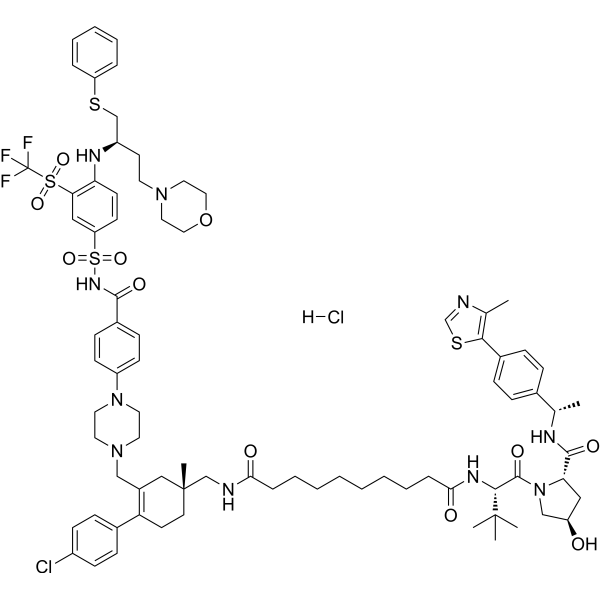 0 ImagesCat. No.: HY-115718BPurity: 99.18%PZ703b hydrochloride is a Bcl-xl PROTAC degrader that induces apoptosis and inhibits cancer cell proliferation. PZ703b hydrochloride can be used for the research of bladder cancer research.
-
Bax activator-2
 0 ImagesCat. No.: HY-182349CAS No.: 3034297-25-8Bax activator-2 is a pro-apoptotic agent targeting BAX, with an IC50 of 0.30 μM against human BAX. Bax activator-2 binds to the trigger site of BAX and induces its conformational change. Bax activator-2 induces mitochondrial depolarization, cytochrome c release, cleavage of caspase-3/9 and PARP, thereby initiating apoptosis. Bax activator-2 exhibits cytotoxicity against a variety of cancer cell lines. Bax activator-2 can be used in research related to acute myeloid leukemia and solid tumors.
-
Dth
 0 ImagesCat. No.: HY-175397Synonyms: DFHBI-thalidomideDth (DFHBI-thalidomide) is an RNA aptamer-based PROTAC degrader. Dth can degrade a variety of endogenous proteins (such as mCherry, p50, p65 and E2F1) by replacing the 3′ module on the RNA scaffold with the RNA aptamer corresponding to the target protein. Dth upregulates IκB-α and Bax, and downregulates Bcl-2 and VEGF. Dth generates green fluorescence upon binding to the Broccoli RNA aptamer, enabling the tracing of RNA scaffolds. Dth can be used in cancer-related research.
-
CSN5-IN-3
 0 ImagesCat. No.: HY-181795CSN5-IN-3 (Compound 30) is a CSN5 inhibitor with an IC50 of 0.58 μM. CSN5-IN-3 inhibits the enzymatic activity of CSN5, leading to increased accumulation of NEDD8-Cul1 and promoting the degradation of PD-L1. CSN5-IN-3 downregulates Bcl-2, and upregulates P53 and Cleaved caspase-3. CSN5-IN-3 exhibits anticancer activity against triple-negative breast cancer.
-
ZM484
 0 ImagesCat. No.: HY-178036ZM484 is a potent dual p53-MDM2/TOP1 inhibitor that exhibits antiproliferative and antitumor activity both in vitro and in vivo. ZM484 effectively upregulates p53 and MDM2 proteins and maintains TOP1 inhibitory activity by the release of camptothecin (CPT) and a potent p53-MDM2 inhibitor. ZM484 induces cell cycle arrest and apoptosis by regulating the expression of key apoptosis- and cycle-related proteins, including caspase-3, Bcl-2, and Cyclin B1. ZM484 can be used for colorectal cancer research.
-
Garlic oil (synthetic)
 0 ImagesCat. No.: HY-N14116ACAS No.: 8000-78-0Garlic oil (synthetic) is an orally effective anti-inflammatory, antioxidant, and anticancer agent. Garlic oil (synthetic) inhibits the activation of NF-κB, NFκB2 and NLRP3 inflammasome, and induces the expression of GSTA1, HO-1 and NQO-1. Garlic oil (synthetic) reduces the Bcl-2/Bax protein ratio and activates NNK-induced apoptosis (apoptosis) in lung tissues. Garlic oil (synthetic) attenuates NNK-induced apoptosis in MRC-5 cells and reduces excessive ROS production. Garlic oil (synthetic) alleviates pyroptosis (pyroptosis) and exerts a protective effect against acute lung injury in mice. Garlic oil (synthetic) inhibits lung tumorigenesis in mice and improves small intestinal motility in rats with type 2 diabetes. Garlic oil (synthetic) can be used in research related to acute lung injury, lung cancer, peptic ulcer, type 2 diabetes and hypertension.
-
Topo I/II-IN-2
 0 ImagesCat. No.: HY-170912Topo I/II-IN-2 (Compound 3g) is an inhibitor of Topo I and Topo II. Topo I/II-IN-2 inhibits NCI-H446 cells and NCI-H1048 cells with IC50s of 1.30 μM and 1.42 μM, respectively. Topo I/II-IN-2 induces mitochondrial Apoptosis, mitochondrial dysfunction and activity generation. Topo I/II-IN-2 inhibits the PI3K/Akt/mTOR pathway. Topo I/II-IN-2 prevents SCLC (small cell lung cancer) cell proliferation, invasion, and migration in vitro. .
-
Apoptosis inducer 28
 0 ImagesCat. No.: HY-169124Apoptosis Inducer 28 (Compound X1) is an apoptosis-inducing agent with anticancer activity in vitro. Apoptosis Inducer 28 can arrest the cell cycle at the G1 phase, promote cell death, and induce apoptosis by disrupting mitochondrial membrane potential. Apoptosis inducer 28 can also decrease the production of reactive oxygen species, downregulate the gene expression of BAX, Bcl-xL, and Bcl-2, while upregulating the gene expression of PAR-4.
-
SP-6-27
 0 ImagesCat. No.: HY-136893CAS No.: 1384170-58-4SP-6-27 is a tubulin depolymerizing agent that binds to the colchicine site of β-tubulin. SP-6-27 induces G2/M cell cycle arrest in ovarian cancer cells. SP-6-27 enhances intrinsic apoptosis in ovarian cancer cells through upregulation of Bax, Apaf-1, caspase-6, caspase-9, and caspase-3. SP-6-27 reduces ovarian cancer cell migration. SP-6-27 inhibits capillary tube formation by human umbilical vein endothelial cells. SP-6-27 shows minimum cytotoxicity to normal ovarian epithelia. SP-6-27 shows enhanced cytotoxicity in chemo-sensitive/resistant ovarian cancer cells when combined with Cisplatin (HY-17394). SP-6-27 can be used for the research of ovarian cancer.
-
(-)-Norgestrel-d6
 0 ImagesCat. No.: HY-W743417(-)-Norgestrel-d6 is the deuterium labeled Levonorgestrel (HY-B0257). Levonorgestrel is an orally active inhibitor of progesterone (HY-N0437). Levonorgestrel has anticancer activity and can induce Apoptosis. Levonorgestrel can be used as a contraceptive and in combination with other medications. Levonorgestrel can be used in the study of osteoporosis and uterine leiomyoma.
-
Semaglutide, Cy5 labeled
 0 ImagesCat. No.: HY-114118F5Synonyms: Semaglutide-Cys(Cy5)Semaglutide, Cy5-labeled (Semaglutide-Cys(Cy5)) is a CY5 (HY-D0821) -labeled version of Semaglutide (HY-114118) (Ex/Em = 633/670 nm). Semaglutide, Cy5-labeled can be used for studies on Semaglutide receptor binding (GLP-1R), cellular uptake and endocytosis, in vivo tissue distribution, and the targeting efficiency of delivery systems.
-
BRD-K44839765
 0 ImagesCat. No.: HY-169267CAS No.: 303066-86-6BRD-K44839765 is selective against Bcl-2 with an IC50 value of 5.6 μM in IMR-90 cell. BRD-K44839765 has oral activity.
-
Tubulin polymerization-IN-85
 0 ImagesCat. No.: HY-180190Tubulin polymerization-IN-85 (Compound C21) is a tubulin polymerization inhibitor (IC50 = 1.59 μM) targeting the colchicine binding site. Tubulin polymerization-IN-85 can cause cancer cells G2/M phase arrest and induce apoptosis. Tubulin polymerization-IN-85 downregulates the expression of Bcl-2, Bcl-xl, Mcl-1, Cyclin B1, cdc25, cdc2 protein and upregulates P53, P21, Bad and Bax levels. Tubulin polymerization-IN-85 can be used for the research of cancer, such as cervical cancer.




