



GSK-3
Glycogen synthase kinase-3; Glycogen synthase kinase 3
Glycogen synthase kinase 3 (GSK-3) is a multifunctional serine/threonine kinase consisting of two isoforms, alpha and beta. It is a highly conserved negative regulator of receptor tyrosine kinase, cytokine, and Wnt signaling pathways. Stimulation of these pathways inhibits GSK-3 to modulate diverse downstream effectors that include transcription factors, nutrient sensors, glycogen synthesis, mitochondrial function, circadian rhythm, and cell fate. GSK-3 also regulates alternative splicing in response to T-cell receptor activation, and recent phosphoproteomic studies have revealed that multiple splicing factors and regulators of RNA biosynthesis are phosphorylated in a GSK-3-dependent manner.
The malfunction or aberrant activity of GSK-3 leads to several of disorders, such as Alzheimer's disease (AD) and other neurodegenerative pathologies, and other type of diseases as diabetes, cardiovascular disorders and cancer. GSK-3 is also related to innate immune response against pathogens, which makes GSK-3 an excellent target for therapeutic intervention.
GSK-3 Isoform Specific Products
All Product Categories
-
GSK-3 Inhibitors
(290)
View all products
-
GSK-3 Agonist
(1)
View all products
-
GSK-3 Activators
(47)
View all products
-
GSK-3 Modulators
(5)
View all products
-
GSK-3 Chemicals
(2)
View all products
-
GSK-3 Degraders
(3)
View all products
-
GSK-3 Ligand
(1)
View all products
-
Glycogen Synthase Kinase-3 (GSK-3) Proteins
(6)
View all products
-
GSK-3 alpha Proteins
(1)
View all products
-
GSK-3 beta Proteins
(5)
View all products
-
GSK-3 Related Products (372)
Related Products (372)

-
Recombinant Proteins (6)
-
Antibodies (9)
-
GSK-3 Signaling Pathway
-
GSK-3 Isoform Comparison
-
GSK-3β inhibitor 14
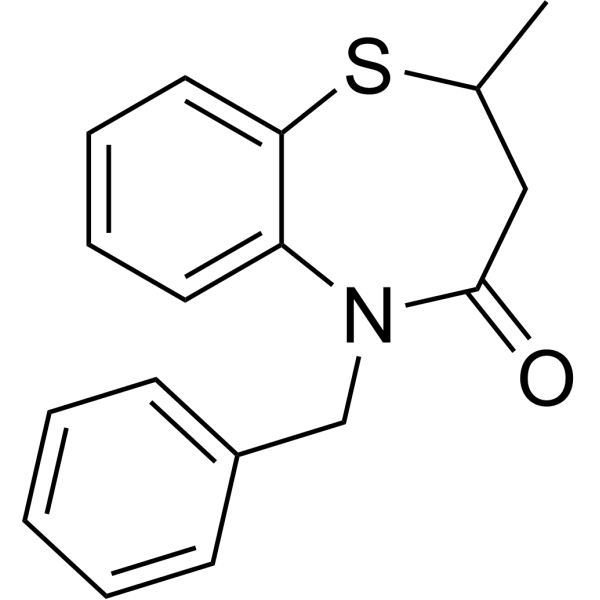 0 ImagesGSK-3β inhibitor 14 (Compound 6i), benzothiazepinone derivative, is a weak GSK-3β inhibitor (IC50 >100 μM).
-
ZDWX-25
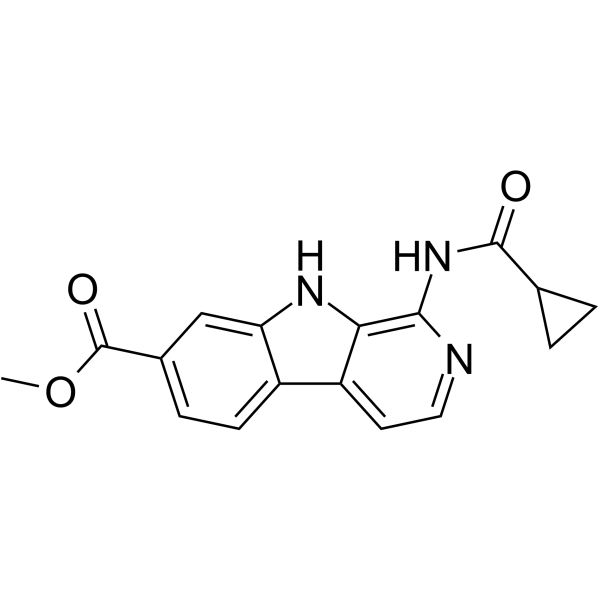 0 ImagesCat. No.: HY-144826CAS No.: 2668297-70-7ZDWX-25 is a highly potent GSK-3β and DYRK1A dual inhibitor with an IC50 value of 71 nM for GSK-3β. ZDWX-25 possesses significant cytotoxic activities against SH-SY5Y and HL-7702 cells. ZDWX-25 can be used for researching alzheimer's disease.
-
GSK-3β/VEGFR2-IN-1
 0 ImagesCat. No.: HY-184741GSK-3β/VEGFR2-IN-1 is an orally active dual inhibitor of GSK-3β (IC50 = 325 nM) and VEGFR2 (IC50 = 78 nM). GSK-3β/VEGFR2-IN-1 suppresses the phosphorylation of VEGFR2, AKT, MEK and ERK, inhibits human tongue squamous cell carcinoma cells migration and suppresses formation of HUVECs, exhibits low toxicity towards other cancer cells and normal cells, demonstrates significant antitumor efficacy in a CAL27 xenograft mouse model. GSK-3β/VEGFR2-IN-1 can be used for the study of tongue squamous cell carcinoma.
-
GSK-3β inhibitor 18
 0 ImagesCat. No.: HY-162638GSK-3β inhibitor 18 (compound 2) is a potent inhibitor of GSK-3β, with the IC50 of 0.0021 μM.
-
Presenilin 1 (349-361)
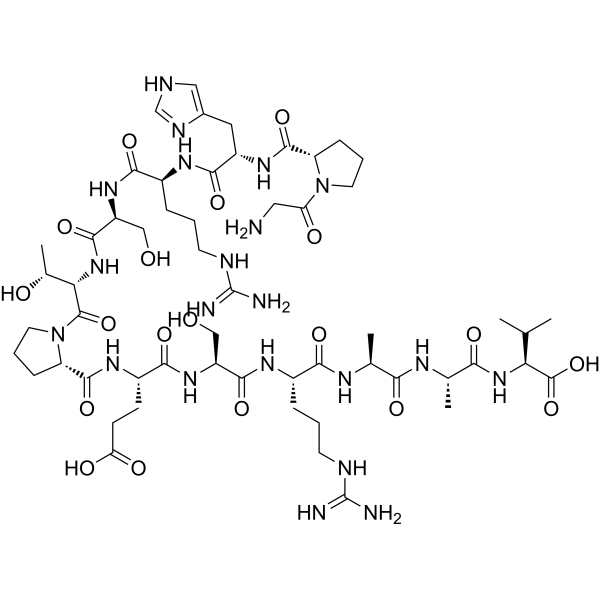 0 ImagesCat. No.: HY-P3713CAS No.: 956004-39-0Presenilin 1 (349-361) is an active petide, and synthetic peptides representing amino acids 349–361 can be phosphorylated by glycogen synthase kinase-3β(GSK3β) in vitro. Presenilin 1 (349-361) can be used for the research of various diseases.
-
JNK3 inhibitor-9
 0 ImagesCat. No.: HY-168859JNK3 inhibitor-9 (Compound 24a) is a potent, selective and BBB-permeable JNK3 inhibitor with an IC50 value of 12 nM. JNK3 inhibitor-9 also potently inhibits GSK3α/β (IC50s: 14 and 35 nM, respectively) involved in Tau phosphorylation. JNK3 inhibitor-9 reduces c-Jun and APP phosphorylation. JNK3 inhibitor-9 protects neurons from Aβ1-42 toxicity.
-
MLS-2064
 0 ImagesCat. No.: HY-111168CAS No.: 906660-74-0MLS-2064 is a 3'-substituted 7-haloindirubin with antitumor activity. MLS-2064 induces caspase-independent cell death. MLS-2064 induces dose-dependent cell death in various human cancer cell lines. MLS-2064 shows no significant inhibitory activity against CDK1 and CDK5 kinases, and only weak inhibitory activity against GSK-3 kinase (IC50: 5 μM). MLS-2064 can be used in research related to colon cancer, breast cancer, lung cancer, prostate cancer, liver cancer, and neuroblastoma.

-
Erlotinib-13C6
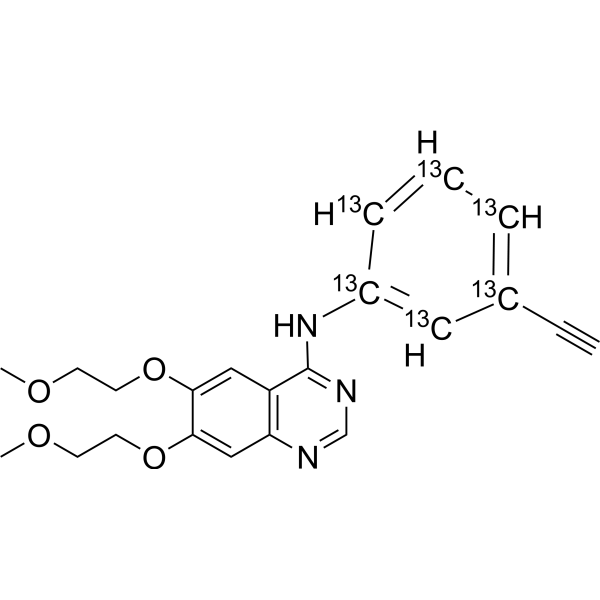 0 ImagesCat. No.: HY-50896S1CAS No.: 1211107-68-4Synonyms: CP-358774-13C6; NSC 718781-13C6; OSI-774-13C6Erlotinib-13C6 (CP-358774-13C6) is the 13C-labeled Erlotinib (HY-50896). Erlotinib (CP-358774) is a selective, orally active EGFR tyrosine kinase inhibitor. Erlotinib also acts as a substrate and inhibitor of OATP2B1, with an IC50 of approximately 0.079 μM for inhibiting OATP2B1-mediated uptake of estrone 3-sulfate. Erlotinib blocks EGFR phosphorylation, downstream signal transduction, as well as the growth and proliferation of cancer cells. Erlotinib inhibits MMP-10-mediated renal injury, fibrotic lesions, the ERK1/2, GSK-3β and β-catenin signaling pathways, fibronectin, α-SMA, collagen deposition, and renal injury markers. Erlotinib is metabolized via CYP3A to produce the active metabolite OSI-420. Erlotinib can be used in research related to non-small cell lung cancer, gastric cancer, papillary renal cell carcinoma, pancreatic cancer, renal fibrosis, and other conditions.
-
UNC10112785
 0 ImagesCat. No.: HY-128491CAS No.: 748142-06-5UNC10112785 is a serine/threonine kinase inhibitor with a human GSK-3β IC50 of 0.031 μM, human CDK-2 IC50 of 0.016 μM, and human CDK-4 IC50 of 1.99 μM. UNC10112785 can be used for the research of type 2 diabetes.
-
AZ12943203
 0 ImagesCat. No.: HY-174923AZ12943203 (Compound 13e) is a GSK-3 PET radioligand with a Kd of 2.94 nM. AZ12943203 has a significant inhibitory potency toward GSK-3β (IC50 : 4.44 nM), and can specifically bind to GSK-3-rich regions of the rodent brain. AZ12943203 can be used for neurodegenerative diseases imaging, particularly Alzheimer’s disease.
-
BRD1652
 0 ImagesCat. No.: HY-117739CAS No.: 1597438-92-0BRD1652 is a highly selective GSK3 inhibitor. BRD1652 can be used in the study of emotion-related diseases.
-
6-Methoxy-4-methylcoumarin
 0 Images6-Methoxy-4-methylcoumarin is a 4-methylcoumarin derivative with an antitumor activity. 6-Methoxy-4-methylcoumarin activates melanin synthesis in B16F10 melanoma cells. 6-Methoxy-4-methylcoumarin is a pigmentation stimulator, and can be used for the study of skin conditions such as vitiligo.
-
Indazole (Standard)
 0 ImagesIndazole (Standard) is the analytical standard of Indazole. This product is intended for research and analytical applications. Indazole, also called isoindazole, a heterocyclic aromatic organic compound. Its derivatives display a broad variety of biological activities including anti-inflammatory, antibacterial, anti-HIV, antiarrhythmic, antifungal and antitumour properties. Indazole and its derivatives can be used for research of cancer, neurological disorders, cardiovascular diseases, gastrointestinal diseases.
-
Dihydronarwedine
 0 ImagesCat. No.: HY-133102CAS No.: 21041-10-1Synonyms: LycoraminoneDihydronarwedine (Lycoraminone) is the alkaloid. Dihydronarwedine inhibits 39% activity of glycogen synthase kinase-3β (GSK-3β) at a concentration of 10 μM.
-
GNF7156
 0 ImagesCat. No.: HY-183955CAS No.: 2041071-54-7GNF7156 is a DYRK1A/GSK3B inhibitor, IC50 values of 100 nM for DYRK1A and 40 nM for GSK3B. GNF7156 inhibits DYRK1A and GSK3B kinase activity and induces NFAT nuclear retention. GNF7156 stimulates beta-cell cycle entry and division and maintains insulin secretory capacity. GNF7156 can be used for the research of type 1 diabetes, and type 2 diabetes.
-
Multi-kinase-IN-14
 0 ImagesCat. No.: HY-181046CAS No.: 2201083-51-2Multi-kinase-IN-14 is an orally active and blood-brain barrier-permeable multi-kinase inhibitor. Multi-kinase-IN-14 reduces the excessive phosphorylation of α-synuclein by inhibiting four kinases (ABL1, DYRK1A, GSK3β, and LRRK2) and stabilizing microtubules. Multi-kinase-IN-14 is applicable for research on neurodegenerative diseases such as Parkinson’s disease and Alzheimer’s disease.
-
TFGF-18
 0 ImagesCat. No.: HY-171031CAS No.: 2222662-20-4TFGF-18 is a GSK-3β inhibitor (IC50: 0.59 μM). TFGF-18 inhibits LPS-induced microglia activation and proinflammatory mediators release via inhibiting GSK-3β and downstream p65/NF-κB signaling. TFGF-18 inhibits neuronal apoptosis and oxidative stress, inhibits expressions of Bax, caspase3 and cleaved-caspase3 and increases the expression of Bcl-2. TFGF-18 has neuroprotection effect, inhibit neuroinflammation and attenuates cognitive impairment.
-
R547 (Standard)
 0 ImagesCat. No.: HY-10014RCAS No.: 741713-40-6R547 (Standard) is the analytical standard of R547 (HY-10014). This product is intended for research and analytical applications. R547 is a potent, selective and orally active ATP-competitive CDK inhibitor, with Kis of 2 nM, 3 nM and 1 nM for CDK1/cyclin B, CDK2/cyclin E and CDK4/cyclin D1, respectively.
-
PHA-793887 hydrochloride
 0 ImagesCat. No.: HY-11001ACAS No.: 718630-60-5PHA-793887 hydrochloride is a CDK inhibitor (with IC50 values of 8 nM for Cdk2, 60 nM for Cdk1, 62 nM for Cdk4, 138 nM for Cdk9). PHA-793887 hydrochloride inhibits purified GSK3β (IC50 79 nM). PHA-793887 hydrochloride reduces the phosphorylation level of nucleophosmin/cdc6, induces G1/G2/M phase arrest, and triggers Apoptosis by activating Caspase-3. PHA-793887 hydrochloride exhibits anticancer activity against leukemia. PHA-793887 hydrochloride can be used in research related to acute leukemia, chronic myeloid leukemia, and advanced/metastatic solid tumors.




